A polished pitch can’t show you how a franchisor’s leaders make decisions when growth gets difficult. Knowing how to vet a franchisor’s leadership team means looking beyond titles and presentations: assess executives’ track records, how they respond to direct questions, and whether franchisees describe consistent, practical support.
You’re right to treat this as a serious business decision. The leadership team shapes the systems, communication, and direction you’ll rely on, so confidence should come from evidence, not promises. A thorough review should clarify how leaders think, handle challenges, and whether their priorities align with yours.
This guide explains what to review in executives’ backgrounds, what to watch for at Discovery Day, and how franchisee perspectives can reveal the reality behind a brand’s pitch. Use these insights to ask sharper questions and decide whether the people leading the franchise have earned your confidence.
Key Takeaways
- Use Item 2 of the Franchise Disclosure Document to review leadership backgrounds, then look for relevant experience and a clear strategic vision.
- At Discovery Day, pay attention to how executives explain decisions, address difficult periods, and respond to challenging questions.
- Speak with franchisees who have been in the system for years to understand how leadership’s promises compare with their experience.
- If you’re drawn to leading relationship-driven business communities, explore whether Network In Action’s franchise opportunity aligns with your goals.
1. What should I look for when evaluating a franchise leadership team?
Knowing how to vet a franchisor's leadership team starts with assessing experience relevant to the franchise’s operating demands. A restaurant executive may understand service consistency, staffing pressures, and repeat customer behavior, while another sector calls for different expertise. Look for evidence that senior leaders have turned industry knowledge into practical operating systems, not simply held impressive titles. Ask how their past decisions shaped the model you would invest in and what they learned when a plan failed.
Then test the vision. An effective strategy connects a clear understanding of the market, customers, and competition to practical priorities for franchisees. Ask leaders to explain the brand’s direction, the customer need it serves, and how franchisees contribute. Listen for specific examples, such as a process change prompted by customer feedback or an initiative tested with franchisees before wider adoption. A vision matters when it guides decisions, not just when it sounds ambitious.
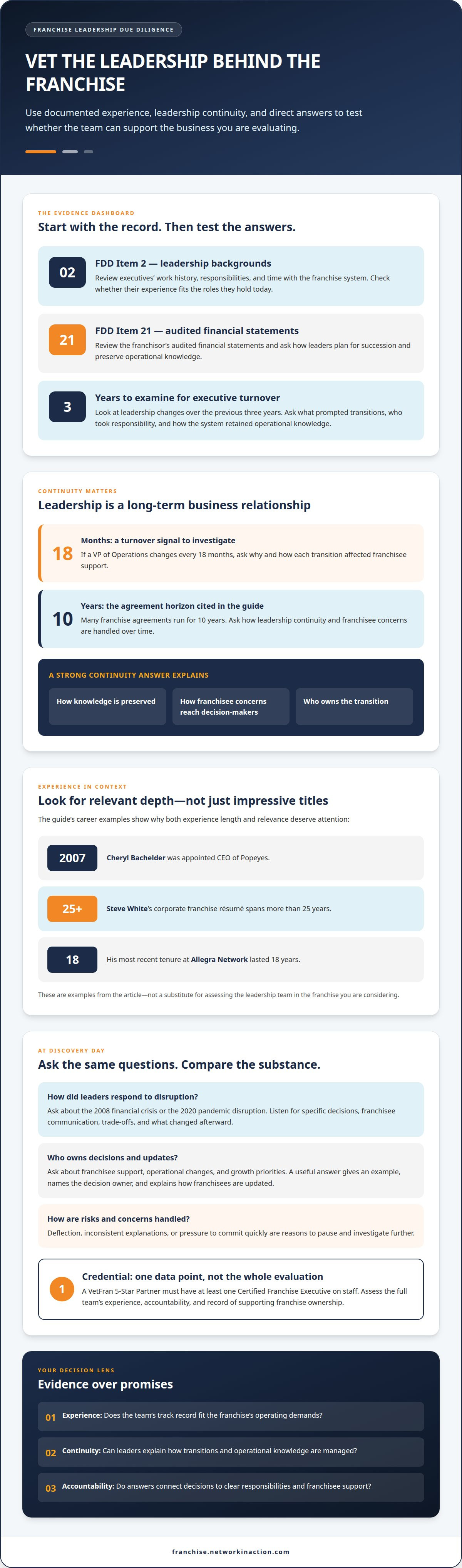
A second test for how to vet a franchisor's leadership team is continuity. If a VP of Operations changes every 18 months, ask why and how the transition affected franchisee support. Many franchise agreements run for 10 years, so the leadership approach shapes a long-term business relationship. Look for a team that can explain how operational knowledge is preserved and how franchisee concerns reach decision-makers. Clear answers show whether continuity is a system or depends on one person.
Finally, assess whether leaders build a shared business vision through dialogue. A restaurant-literature study found leaders’ emotional-intelligence factors were significantly related to team satisfaction, customer satisfaction, and unit profit. Notice whether executives listen, acknowledge trade-offs, and explain their reasoning. Ask how franchisee feedback influences decisions and how the team handles disagreement. Strong leadership pairs direction with accountability: executives set priorities, explain success measures, and make room for franchisees to contribute practical insight.
2. Reviewing executives’ backgrounds and achievements
Start with the Franchise Disclosure Document. According to the Federal Trade Commission, Item 2 provides information about the brand’s leadership team. Review each executive’s work history, responsibilities, and time with the franchise system. Then compare those details with the role they hold today. A strong résumé should show relevant experience, not just recognizable brands or impressive titles.
Trace each career step. Look for direct franchise experience, operational responsibility, and evidence of managing change. Cheryl Bachelder was appointed CEO of Popeyes in 2007. Steve White’s corporate franchise résumé spans more than 25 years, and his most recent tenure at Allegra Network lasted 18 years. These examples show why both the depth and relevance of an executive’s experience matter. Ask how prior roles prepared leaders for the demands of this specific franchise relationship.
Look for patterns, not isolated achievements. Ask about executive turnover over the previous three years, especially departures from key leadership roles. Compare changes with the brand’s direction and approach to support. For example, frequent changes in operations leadership may disrupt continuity for franchisees. Ask what prompted transitions, who took responsibility, and how the system preserved operational knowledge. The explanation should connect leadership changes to clear responsibilities and decisions.
Use Item 2 to identify executives, then assess whether their backgrounds fit their current roles. A finance leader’s experience may differ from the operational judgment needed to guide franchisees. Ask how achievements were measured, what each leader learned from setbacks, and how those lessons shaped the current model. A VetFran 5-Star Partner must have at least one Certified Franchise Executive on staff. Treat that credential as one point of context, not a substitute for examining the full leadership team’s experience, accountability, and record of supporting franchise ownership.
3. Evaluating leadership responses at Discovery Day
Discovery Day gives you a chance to hear executives explain the franchise beyond polished materials. Compare leadership teams across franchise opportunities by asking the same questions about franchisee support, operational changes, and growth priorities. Note whether answers include a clear example, identify who owns the decision, and explain how franchisees receive updates. Using consistent criteria makes it easier to assess each team’s judgment, communication, and commitment without relying on presentation style alone.
Test how leaders handle challenges. Ask whether senior executives guided a brand through the 2008 financial crisis or the 2020 pandemic disruption. Listen for specific decisions, how they communicated with franchisees, and what changed afterward. Strong answers explain trade-offs and acknowledge what leaders learned. A vague claim of resilience tells you less than a clear account of decisions and follow-through.
Assess financial strength by reviewing the franchisor’s audited financial statements. According to the Federal Trade Commission, Franchise Disclosure Document Item 21 contains audited financial statements. Ask how leaders plan for succession, which roles have transition plans, and how operational knowledge would be maintained if a key executive left. Direct answers can clarify whether continuity depends on one person or an established process.
Watch how executives respond when you ask about risks, system performance, or franchisee concerns. Deflection, inconsistent explanations, and pressure to commit quickly are reasons to pause. Investigate further if a franchisor promises exceptionally high achievements. Ask what evidence supports the claim, what assumptions it depends on, and how results are tracked across the network. A credible leader distinguishes targets from outcomes and explains the reasoning behind both.
Use the same notes after each Discovery Day: record the question, answer, supporting examples, and any promised follow-up. Compare your notes with written materials and later conversations. If executives give different answers, ask for a clear explanation before dismissing the difference as a communication gap. A leadership team’s quality shows in its decisions, transparency, and response to scrutiny.
4. Listening to franchisee perspectives
Franchisees can show how leadership decisions affect daily operations, not just how executives describe them. Speak directly with current owners and recently exited franchisees listed in the Franchise Disclosure Document. Include owners who joined five or more years ago; their experience can reveal how the brand’s culture and leadership have evolved. Ask how leaders handle concerns, communicate changes, and follow through on commitments.
Use consistent questions to compare answers. Ask what support franchisees received during difficult periods, how quickly leadership addressed operational issues, and whether employees understand the brand’s stated values. Tamra Kennedy had 33 years of experience as a Taco John’s multi-unit franchisee. Her long perspective illustrates why tenure matters: experienced owners can describe how policies and leadership practices changed over time. Look for patterns across conversations, not one person’s isolated experience.
Find out how franchisee feedback reaches decision-makers. Ask whether owners have a formal way to share input and request an example of a concern that led to a change. Julie Carter had owned Children’s Lighthouse of Oak Point for seven years when describing her experience with the franchisor’s processes. Questions about specific processes can reveal whether leadership explains decisions, considers franchisee input, and communicates next steps.
Make these conversations useful to your business plan. Ask franchisees where they obtained capital to start and grow their businesses, what operational demands surprised them, and which leadership practices helped them respond. Compare their answers with the franchisor’s explanations and your own priorities. Follow up on differences, especially when owners describe recurring communication gaps or unclear expectations. A balanced picture includes positive and difficult experiences, along with the reasons behind them. That evidence helps you judge whether the franchise relationship fits your working style, values, and long-term goals.
Network In Action
Network In Action offers a franchise opportunity for professionals who want to lead local business referral groups. As you assess the leadership, consider whether the opportunity suits your strengths in relationship-building, community leadership, and business growth. The model updates traditional networking with monthly meetings and a technology platform that helps members stay connected.
Apply the same disciplined approach you would use for any franchise decision: examine the leadership, understand the support structure, and consider whether the model fits your goals for flexibility and meaningful work. Network In Action provides training and support to help franchisees build and manage groups of small to mid-sized business owners seeking high-quality referrals and a strong return on investment. If that direction fits your ambitions, contact Network In Action to explore the franchise opportunity.
Make Your Next Move With Confidence
Your next step is to turn careful evaluation into a decision that fits your priorities. Use what you’ve learned about how to vet a franchisor’s leadership team to define the leadership qualities, communication style, and business direction you need from a long-term partner. Then weigh those criteria against the work and lifestyle you want to build.
Network In Action offers a franchise business opportunity for professionals interested in leading local business communities. If that path aligns with your goals, explore whether the opportunity fits your ambitions.
Contact Network In Action to discuss your next step. A deliberate decision can open the door to work that draws on your strengths and creates meaningful professional connections.
Frequently Asked Questions
What should I look for when evaluating a franchise leadership team?
Look for leaders whose decisions align with the franchise’s stated priorities and whose responsibilities are clear. Trace a proposed initiative from idea to execution: who approves it, who supports franchisees, and how results shape the next decision? This practical test reveals whether leadership works as a coordinated team or leaves important responsibilities unclear.
How do you evaluate a franchisor's executive team's experience and track record?
Evaluate experience by connecting each executive’s past responsibilities to the decisions they make now. For example, consider whether an operations leader has managed the systems or teams central to the franchise model. Then ask what outcomes the executive considers meaningful and how they measured them. Specific examples and consistent explanations offer stronger evidence than broad claims of success.
How can you verify a franchisor's leadership backgrounds and employment history?
Start with the leadership details in the Franchise Disclosure Document, then compare names, titles, and career timelines with executives’ professional biographies and company announcements. Note gaps or overlapping roles and ask for clarification directly. Focus on whether the experience described matches the responsibilities claimed. A discrepancy is a reason to ask a precise follow-up, not proof of misconduct.
How do you check a franchisor's leadership team for bankruptcies, litigation, or regulatory actions?
Search public court and regulatory records using executives’ full names and the franchisor’s legal business names. Carefully match identities, since similar names can refer to different people or companies. For any relevant result, distinguish allegations from final outcomes and ask leadership for context. Keep written notes of the explanations and compare them with the disclosure materials before deciding what the information means for you.
What questions should you ask franchisor executives during franchise discovery?
Ask who makes decisions that affect franchisees, how leaders communicate changes, and how unresolved concerns move through the organization. Request a recent example of a decision that required coordination across departments. Then ask what the team changed after receiving feedback. These questions reveal who owns decisions, how communication works, and whether executives can explain the practical impact of their choices.
How can you interview current and former franchisees about franchisor leadership?
Ask current and former franchisees the same core questions, then explore differences with specific follow-ups. For example, ask how a recent policy change was explained, whether support matched leadership’s description, and what happened after an issue was raised. Include owners at different stages of their franchise relationship. Their contrasting experiences can help distinguish isolated concerns from recurring patterns.