A business networking franchise is built on more than a room full of introductions. To understand how to start a business networking franchise, define the model you want to lead, assess the financial commitment, and evaluate the systems that help you build a strong local community.
You know relationships can drive business growth, but a franchise investment takes more than enthusiasm. Consider the operating model, marketing and technology support, financial commitments, and the work involved in leading a professional network.
This guide breaks down the practical steps: how to assess financing options, evaluate a franchisor’s marketing and technology support, avoid common investment mistakes, and learn from current and former franchise owners. You’ll also see how a structured, relationship-driven model can support community leadership, recurring revenue potential, and greater flexibility, without confusing networking activity with measurable business value.
Key Takeaways
- Map your funding options to the franchise’s startup needs, then assess eligibility and repayment capacity before choosing a financing route.
- Look beyond headline projections: review the full investment terms, operating requirements, and support systems to avoid costly assumptions.
- Speak with current and former owners about daily operations, franchisor support, and the realities of building a local network.
- Compare networking franchise models by their structure, technology, membership approach, and fit with the way you want to lead.
Financing through SBA loans, banks, personal capital, or investors
Match your financing plan to startup costs, working capital, and the work of leading a local business network.
Available Funding Sources
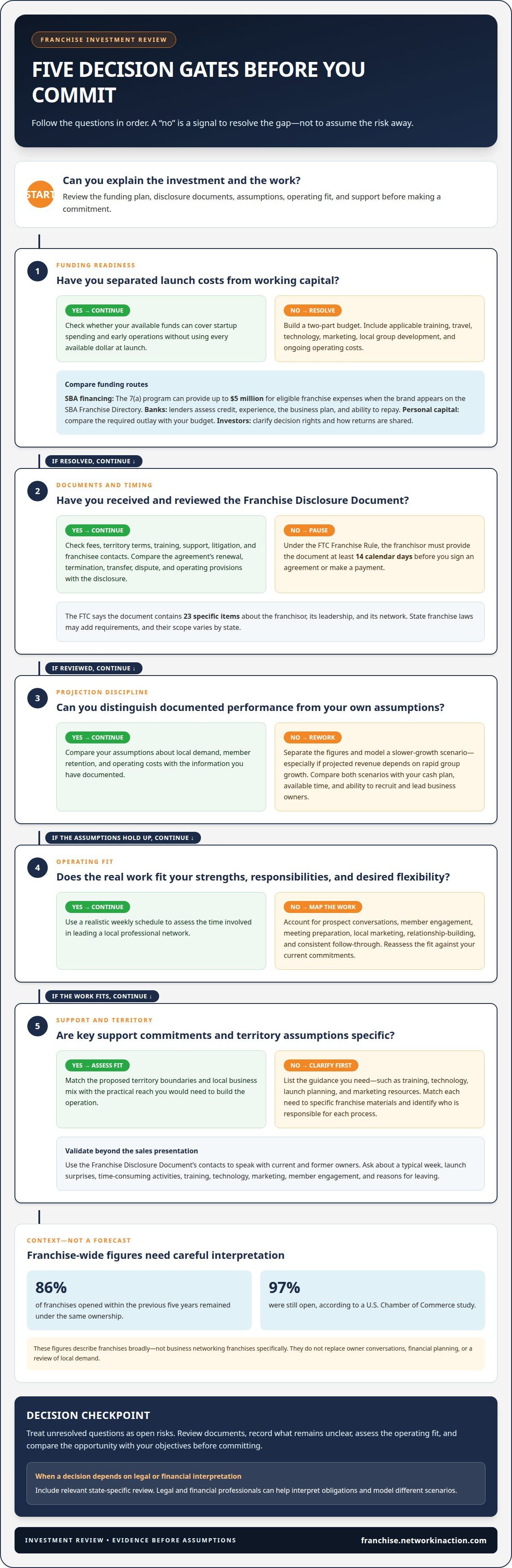
Compare SBA financing, bank loans, personal capital, and investor funding by repayment terms, eligibility, and control. According to the U.S. Small Business Administration, its 7(a) loan program can provide up to $5 million for eligible franchise expenses when the brand appears on the SBA Franchise Directory. A lender will assess your credit, experience, business plan, and ability to repay. Investors may bring capital, but clarify decision rights and how returns are shared.
Startup Capital and Working Capital
Separate one-time launch expenses from ongoing operating costs. Budget for training program participation, travel, technology, marketing, and local group development where applicable. Working capital helps cover expenses while you establish relationships and build a sustainable operation. Liquid capital means funds readily available for required startup spending and early operations. Review the franchise’s stated capital requirements alongside your personal budget, and avoid committing every available dollar to launch costs.
Federal and state laws regulate franchise sales and operations. Under the U.S. Federal Trade Commission’s Franchise Rule, a franchisor must provide a prospective buyer with the Franchise Disclosure Document at least 14 calendar days before signing an agreement or making a payment. State franchise laws may add requirements, and their scope varies by state.
Review the Franchise Disclosure Document for fees, territory terms, training, support, litigation, and franchisee contacts. The U.S. Federal Trade Commission says the document contains 23 specific items about the franchisor, its leadership, and its network. Read the franchise agreement for renewal, termination, transfer, dispute, and operating provisions. Compare each commitment with the disclosure document before signing.
Franchising carries risks, including insufficient working capital, weak local demand, and a mismatch with the operating model. A U.S. Chamber of Commerce study found 86% of franchises opened within the previous five years remained under the same ownership, and 97% were still open. Those figures describe franchises broadly, not business networking franchises specifically, so use owner conversations and financial planning to assess this opportunity.
Common franchise-investment mistakes
A franchise decision can go wrong before launch if enthusiasm replaces a defined review process. Use a written scorecard to assess the investment, operating model, support, and fit with your strengths. Rate each area as strong, unclear, or weak, then resolve open questions before committing.
A common mistake is treating projected revenue as a personal forecast. Separate documented historical performance from your assumptions about local demand, member retention, and operating costs. If a projection depends on rapid group growth, model a slower-growth scenario too. Compare both with your cash plan, available time, and ability to recruit and lead business owners.
Another mistake is overlooking the work behind the opportunity. A networking franchise calls for community leadership, relationship-building, and consistent follow-through, not just a recognizable brand. Map a typical workweek, including prospect conversations, member engagement, meeting preparation, and local marketing. Compare that schedule with your current responsibilities and desired flexibility.
Assess support by looking for specific commitments, not broad promises. List the guidance you need, such as training, technology, launch planning, and marketing resources. Match each need to the franchise materials. For any process central to success, understand how it works and who is responsible for each step.
Territory assumptions can distort an investment decision. Review the proposed boundaries, local business mix, and practical reach before estimating potential. State rules and disclosure requirements can differ, so include relevant state-specific review in your decision process. Legal and financial professionals can help interpret obligations and model different scenarios.
Finally, avoid rushing because a launch seems urgent. Set a decision sequence: review documents, record open questions, assess the operating fit, and compare the opportunity with your objectives. A franchise information kit can be one useful input as you organize that evaluation.
Contacting current and former franchise owners
Conversations with franchise owners show how the model works beyond its sales presentation. Use the Franchise Disclosure Document’s contact information to identify owners with different experience levels and locations. Ask current owners about launching and running their groups. Former owners can explain why they left and how ownership aligned with their goals.
Prepare consistent questions, then compare answers across conversations. Ask current owners to describe a typical week, from member outreach to meeting preparation. Find out how training, technology, and marketing guidance apply to everyday work. For example, ask how they attract qualified local professionals and maintain engagement without relying on cold prospecting.
- Ask what surprised them most after launch, and what they would plan differently now.
- Explore which activities consume the most time and how the schedule changes as a group develops.
- Discuss how members experience referrals, relationship-building, and the value of participation.
- Ask former owners what influenced their exit, including business fit, personal priorities, or operational demands.
Listen for specifics, not broad praise or criticism. A useful answer describes a process, such as how a prospect becomes a member, or explains a challenge and its resolution. If owners report different experiences, note their territory conditions, leadership approach, and time commitment. These details help distinguish a system-wide issue from an individual operating choice.
Keep written notes after each conversation. Record the owner’s tenure, current or former status, key benefits, pressure points, and unanswered questions. Compare your notes with the franchise documents and your priorities. Patterns around support, workload, and member quality can help you decide whether the opportunity fits your strengths and preferred pace.
What types of business networking franchises are available in the United States?
If you’re considering how to start a business networking franchise, first identify the model you want to lead. Options differ in how they organize relationships, meetings, and member value. A referral-focused group, for example, centers on trust-building and introductions among local professionals. Other models emphasize shared industries, digital connections, or broader business education.
Referral-based groups bring professionals together to build relationships and exchange business opportunities. They may include regular meetings, member introductions, and follow-up systems. Assess whether the model encourages genuine relationship-building or makes referrals feel like quotas. That distinction shapes the experience for the leader and participating business owners.
Industry-focused networks bring professionals together around a particular field, such as real estate, finance, or healthcare. A focused audience can make conversations more relevant, but it may also narrow the local pool of prospective members. Review how the franchise defines its audience and whether your area can support a lasting community around that focus.
General business communities serve owners across different sectors. Their value depends on member quality, useful connections, and consistent engagement, not simply the number of names on a roster. Ask how the model supports credibility and helps members build relationships beyond a single meeting.
Technology-enabled or hybrid models combine in-person interaction with digital tools for communication and ongoing connection. Compare how the platform supports follow-up, member engagement, and access between meetings. Technology should reinforce relationships, not replace the leadership and personal trust that make a professional community work.
The model you choose shapes how to start a business networking franchise, from the professionals you bring together to the structure you lead. Compare each model’s meeting rhythm, audience, technology, and operating expectations against your strengths and preferred lifestyle. If you’re evaluating a local opportunity, explore available territories as part of your next step.
Network In Action: Franchise a business opportunity
Network In Action offers a franchise opportunity for professionals ready to lead a local business network. Its model uses monthly meetings rather than weekly ones, alongside a technology platform that keeps members connected. Franchisees receive comprehensive training and ongoing support to build and manage groups focused on professional relationships and quality referrals.
This path may suit you if you value community leadership, structured networking, and a business model designed for flexibility. The approach emphasizes curated membership and relationship-driven growth, without forced referrals. Consider how its meeting cadence, digital tools, and leadership responsibilities align with your goals and preferred lifestyle.
To explore whether a Network In Action franchise fits your ambitions, contact the team and discuss the opportunity.
Turn Your Next Move Into a Leadership Opportunity
Deciding how to start a business networking franchise also means choosing the kind of work and influence you want to build. Choose a path that fits your strengths, priorities, and vision for leading a professional community. Strong relationships grow through consistent leadership and meaningful connection, not activity for its own sake.
Network In Action offers a franchise business opportunity for professionals ready to explore this path. In your next conversation, consider how the model aligns with your goals and the value you want to create in your business community. Take time to make a deliberate choice, then move forward with clarity.
Explore the franchise opportunity with Network In Action and decide whether it’s the right next step for you.
Frequently Asked Questions
How to Start a Franchise in the U.S.?
Start by choosing a franchise model that fits your skills, goals, and preferred role. Review the disclosure materials and agreement, assess the territory, plan your funding, and speak with current and former owners. Before signing, map your first-year operating plan, including how you’ll find prospects, establish local credibility, and manage day-to-day responsibilities.
How much does it cost to start a business networking franchise, including initial fees and working capital?
Your startup investment combines the initial franchise license fee, any technology or platform charges, launch expenses, and working capital. The amount depends on the franchise terms and your launch plan. Build a cash-flow forecast that separates one-time setup costs from ongoing expenses, then assess whether you can cover operations while developing your local business community.
What are the typical revenue, profit margins, and ongoing fees for a business networking franchise?
Revenue and profit depend on factors such as group growth, member retention, operating expenses, and how efficiently you manage the business. Network In Action’s ongoing monthly royalty fees are based on a percentage of gross revenue or a flat fee. Model conservative and stronger revenue scenarios, then calculate margins after royalties and local operating costs.
How can you evaluate and compare business networking franchise opportunities?
Compare each opportunity using the same criteria: territory, target professionals, meeting structure, technology, training, and ongoing support. Assess whether the model prioritizes meaningful connections or simply meeting volume. For example, consider how the one-professional-per-industry rule affects a group’s mix and local recruitment. Use owner feedback to evaluate whether the model delivers its stated value.
What qualifications and experience do business networking franchise owners need?
Strong relationship-building, business development, and community leadership skills are valuable because the role centers on attracting professionals and keeping them engaged. Experience in sales, management, or running a local business can help you organize outreach and follow-up. Network In Action provides a 40-hour training program, while your professional credibility and consistency shape how you lead locally.
What steps are required to buy and launch a business networking franchise?
Begin by reviewing the franchise model and territory, then assess the financial commitment and speak with owners. Complete your document review before signing, and prepare a launch plan covering local outreach, prospect conversations, and group development. After joining, use the franchisor’s training and operating guidance to organize your first activities and build momentum in the community.