Franchise viability is proven by repeatable operations, sustainable unit economics, real customer demand, and support that holds up over time. To assess the long-term viability of a franchise system, look beyond brand appeal and compare those measures with similar systems in the same category. The FTC says Item 20 of the Franchise Disclosure Document contains standardized tables covering franchise openings, closures, transfers, terminations, and non-renewals for the past three years.
A polished pitch can make a franchise opportunity look compelling, but its long-term viability depends on whether the model works for franchisees as well as customers. Evaluate the documentation, fees and ongoing costs, market demand, franchisee capital needs, training and support, and the franchisor’s transparency. The goal is a grounded comparison, not a guess based on reputation.
Use the same criteria across systems: examine the underlying numbers, consistency of the customer experience, franchisee turnover, and how clearly the business explains its obligations. This gives you a stronger basis for judging whether the opportunity can support durable growth and fit your goals.
Key Takeaways
- Assess whether the operating model is documented and repeatable, not dependent on the founder’s daily involvement.
- Map initial and ongoing costs against customer demand and the capital needed to sustain the business.
- Use the FDD to understand the franchisor’s obligations, then evaluate how clearly its support and business plan are explained.
- Compare systems in the same category on customer experience, unit economics, franchisee turnover, and territory overlap.
Operational documentation and transferable systems
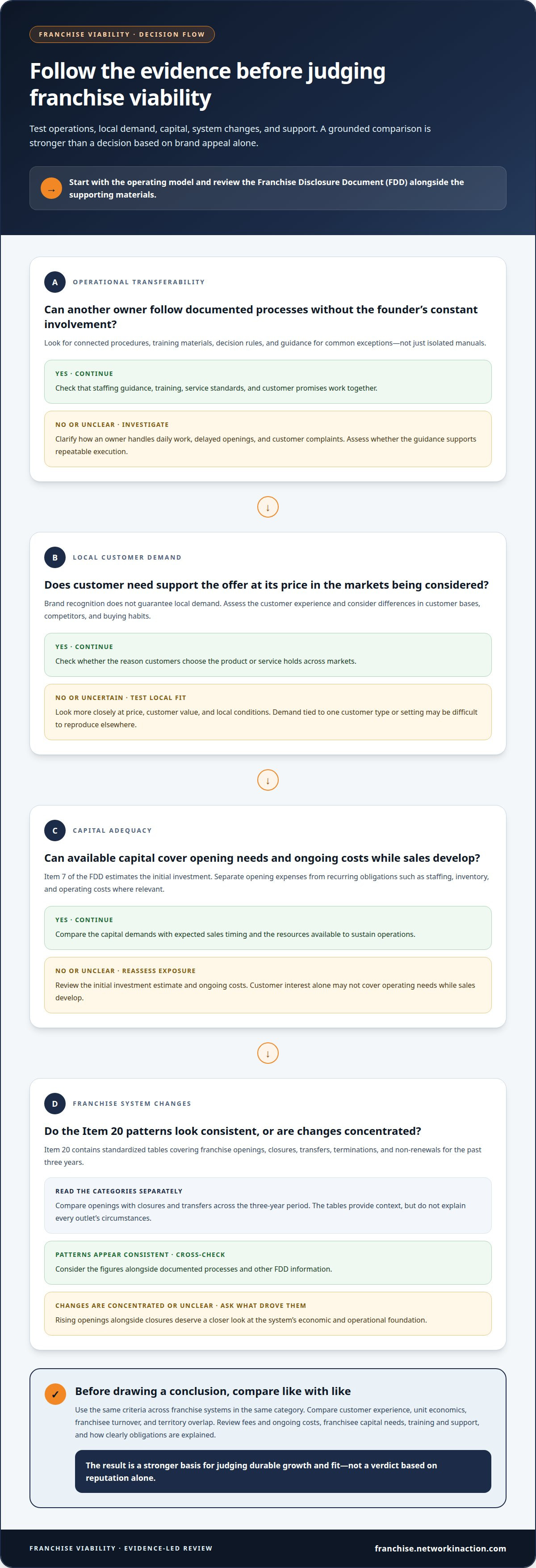
Transferable systems turn an operating model into clear processes another owner can follow. Review the Franchise Disclosure Document (FDD) alongside operational materials to judge whether the model is documented, consistent, and designed for repeatable execution.
Documented and Repeatable Operating Systems
Documented operating systems translate daily work into procedures, training materials, and decision rules. They matter because franchisees need to deliver the model without relying on the founder’s constant involvement. For example, a written opening checklist can clarify how staff prepare a location, serve customers, and close operations. Compare those procedures with the customer experience and the support described in the FDD.
Look for connected processes, not isolated manuals. A staffing guide should align with training, and service standards should match customer promises. Ask how the system handles common exceptions, such as a delayed opening or a customer complaint. These examples show whether documentation supports real operational decisions or simply describes an ideal day. Transferability improves when another operator can apply the guidance consistently.
Reviewing Item 20 in the Franchise Disclosure Document
Item 20 presents standardized tables about franchise system changes. According to the Federal Trade Commission, those tables show franchise openings, closures, transfers, terminations, and non-renewals for the past three years. Review each category separately, then consider how the pattern relates to the system’s ability to attract and retain franchisees. The figures offer context, not a complete explanation of each outlet’s circumstances.
Use the Item 20 tables as a starting point for focused FDD review. Compare openings with closures and transfers across the three-year period, then note whether changes appear consistent or concentrated. For example, rising openings alongside closures deserve a closer look at the system’s economic and operational foundation. The tables help frame questions about transferability, but they don’t explain every outcome. Consider them alongside the documented processes and other FDD information.
Capital intensity, demand, and franchisee capital adequacy
Strong customer interest matters only if the business can cover its costs. Evaluate local demand alongside the capital required to open and sustain operations. A useful way to assess the long-term viability of a franchise system is to test whether customer need and available resources align.
Product and Service Demand Across Markets
Demand is the local willingness to buy a franchise’s product or service at its offered price. Brand recognition does not guarantee customers in every market. Assess the experience directly: purchase from multiple locations when possible, and consider whether the offer meets a real need at a price customers find appropriate.
Compare locations with different customer bases, competitors, and buying habits. For example, a service popular in a dense business district may attract fewer customers in a residential area. A trusted person who matches the target demographic can offer another perspective on product value and service quality. These checks help distinguish broad awareness from demand that can support local profitability.
Identify why customers choose the offer, then assess whether that reason holds across markets. A product may solve a specific need, while a service may depend on convenience or repeat use. If demand relies on one customer type or local conditions, expansion may struggle to reproduce results. For anyone assessing the long-term viability of a franchise system, local fit is a critical part of the analysis.
Capital Intensity and Franchisee Capital Adequacy
Capital intensity describes the resources required to launch and operate a franchise; adequacy means having enough capital for those demands. According to the Federal Trade Commission, Item 7 of the Franchise Disclosure Document gives an estimate of the initial investment. Use it to understand opening requirements, then account for ongoing costs in your financial plan.
Separate opening expenses from recurring obligations, such as staffing, inventory, and operating costs where relevant. A capital-intensive model may require more resources before revenue stabilizes. Compare those demands with expected sales timing and available capital. A business can attract customers yet still face pressure if franchisee resources cannot cover operating needs while sales develop.
Evaluating franchisor support and transparency
Support matters when franchise owners face operational decisions, not just during launch. Evaluate leadership, training, and disclosure together to see how the system addresses those needs.
Leadership Capacity and Franchisee Support
Leadership capacity is the franchisor’s ability to guide franchise owners as the system grows. Entrepreneurs need useful direction, not just a polished launch plan. Consider how leadership communicates operational changes, responds to recurring issues, and uses franchisee feedback. For example, repeated questions about staffing may point to a need for clearer guidance. Strong support connects leadership decisions with practical franchisee needs.
Franchisor Support and Training
Training prepares franchise owners to operate the model, while ongoing support helps them apply it as conditions change. Assess both before judging the system’s strength. Look for clear explanations of training topics, support responsibilities, and how guidance is delivered. A new owner may need help understanding customer service standards, while an established location may need updated operational direction. Consider whether that support helps owners protect service quality and margins.
Support should connect to the operating model, not sit apart from it. Compare training materials with the documented procedures and obligations described in the Franchise Disclosure Document. If the manual sets a customer service standard, the training should explain how to apply it. This alignment helps you assess whether support reinforces the system’s daily execution.
Transparency in Franchisor Support
Transparency means explaining obligations, support, and business expectations clearly. According to the Federal Trade Commission, Item 11 of the Franchise Disclosure Document covers the franchisor’s obligations. Review those disclosures alongside the business plan, looking for understandable descriptions of responsibilities and any important gaps. Clear information gives you a stronger basis for evaluating what support means in practice.
For each stated obligation, identify the support provided and the operational need it addresses. For example, distinguish initial training from continuing guidance, then consider how each relates to franchisee responsibilities. Clear explanations make it easier to assess whether the support structure fits the model. If key details are difficult to interpret, that uncertainty can complicate your assessment.
Comparing franchise systems within the same category
Compare like with like. Systems in the same category face similar customer expectations and operating pressures, making differences in execution easier to identify.
Start with the customer experience, not brand recognition. Assess whether each system’s product or service matches its marketing claims and offers value for money. Compare employee courtesy and competence, business organization, and consistency between locations. A polished location alongside inconsistent service elsewhere, for example, may point to an execution gap. Separate what customers experience from what franchise materials promise.
Then compare the financial structure. Review unit financials, fees, startup and ongoing costs, and margins together. Revenue alone can mislead if operating costs leave too little room for sustainable performance. Look for a business model where the relationship between sales, expenses, and franchise obligations is clear. Compare equivalent information across systems rather than treating different cost categories as interchangeable.
- Customer delivery: Compare service consistency, staff competence, organization, and value for money.
- Unit economics: Assess how fees and ongoing costs relate to revenue, expenses, and margins.
- Franchisee stability: Review turnover and consider what exits may indicate about franchisee experience.
- Territory structure: Assess whether territories compete heavily with one another and how leadership manages overlap.
Context matters. Compare a system’s franchisee turnover and failure rates with category averages, not unrelated business models. A rate that looks concerning in isolation may reflect category conditions; a stronger comparison considers the system’s pattern alongside relevant peers. Consider closures, transfers, and non-renewals separately, as each can reflect different circumstances. The practical takeaway is to assess operating performance, customer experience, economics, and franchisee outcomes together. No single metric establishes viability, but consistent strengths across these areas provide a more useful basis for judging resilience.
Use the same questions for each system: does the product or service match its marketing claims, and do customers feel they received value for money? Check employee courtesy and competence, business organization, and consistency between locations as distinct parts of the customer experience. A favourable impression in one area does not answer the others.
For the financial comparison, consider unit financials alongside fees, startup and ongoing costs, and margins to judge whether the structure is reasonable and sustainable. Also examine franchisee turnover and whether territories compete heavily with one another, rather than treating either factor as a standalone verdict.
Network In Action: Franchise a business opportunity
Network In Action offers a franchise opportunity for entrepreneurs who want to lead local business referral groups. It may fit you if you value relationship-driven growth, community leadership, and a structured alternative to cold prospecting. The model features monthly networking meetings, a technology platform that keeps members connected, and training and support for franchisees building and managing groups.
That creates a distinct operating proposition: develop professional communities where strong relationships can generate referrals, credibility, and recurring revenue potential. Consider whether the role aligns with your preferred leadership style, financial goals, and desire for flexibility. A franchise opportunity is worth exploring when its day-to-day responsibilities and growth model match your priorities.
Explore the franchise opportunity with Network In Action to decide whether it fits your next business move.
Choose Your Next Move With Intention
Your next move should reflect more than a promising category. It should fit the leadership you want to practise, the community you hope to build, and the role you want work to play in your life. A deliberate franchise decision starts with that alignment, not pressure to move quickly.
Define success in practical terms: the responsibilities you welcome, the flexibility you value, and the impact you want to create. This personal filter helps you make a decision you can own, with ambition grounded in the day-to-day work of leading a business and building professional relationships.
Knowing how to assess the long-term viability of a franchise system gives you a sound basis for judging whether it fits your priorities. Choose with intention, then take the next step with clarity and confidence.
If you’re ready to explore whether franchise ownership aligns with your goals, Contact Network In Action to start a conversation.
Frequently Asked Questions
What Metrics Matter Most When Growing a Franchise System?
Key metrics include franchisee unit economics, customer retention, time from signing to opening, and how effectively new locations establish stable operations. Track them together, not as isolated wins. Rapid openings mean little if locations struggle to retain customers or require constant leadership intervention. Sustainable growth combines customer value, franchisee confidence, and consistent execution as the system expands.