
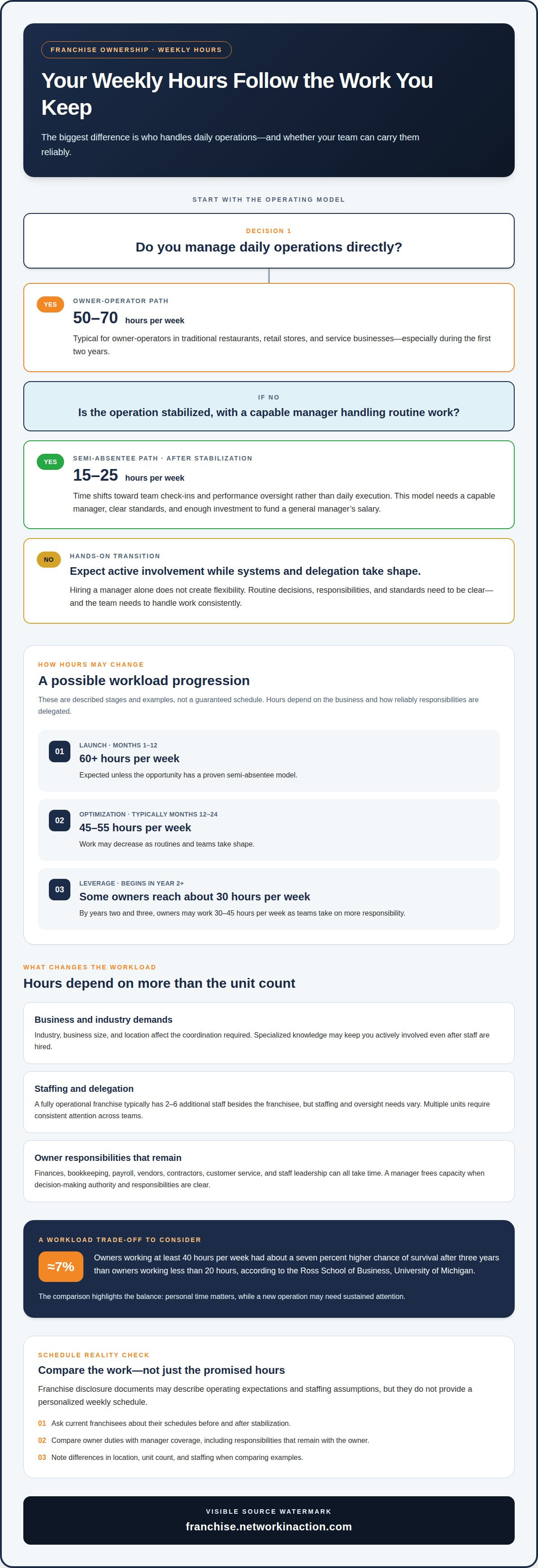
Franchise ownership can demand a full-time commitment at the start, but it doesn’t have to stay that way. If you’re asking what the real weekly hours of a franchise owner look like, owner-operators in traditional restaurants, retail stores, and service businesses typically work 50-70 hours per week, especially in the first two years. Once a business is stabilized, semi-absentee owners may spend 15 to 25 hours per week.
That range is wide for a reason. Your ownership style, industry demands, and ability to build a capable team all shape your weekly hours and work-life balance. Even a lower-hour model needs oversight. Flexibility comes from building systems and assigning responsibility, not simply stepping away.
This guide explains how weekly hours can change during the first year and beyond, which responsibilities tend to take up an owner-operator’s time, and why some industries call for more hands-on leadership. You’ll get a clearer view of the trade-offs and be better equipped to assess franchise ownership as a path to flexibility, growth, and community impact.
Key Takeaways
- Choose an ownership style that fits the time you can commit, and plan for ongoing oversight even when a manager handles daily operations.
- Expect the launch phase to involve hands-on work across finances, staffing, payroll, and vendor coordination.
- Assess how an industry’s operating demands shape your schedule before deciding whether its lifestyle fits your goals.
- Explore a Network In Action franchise opportunity if you want to lead a local business community through relationship-driven networking.
Passive, absentee, and semi-absentee ownership
Your ownership style determines whether you run daily operations or manage through a team. Your actual weekly workload depends on who handles routine decisions and how reliably they meet your standards.
Owner-Operator and Semi-Absentee Models
An owner-operator manages daily work directly; a semi-absentee owner delegates operations and oversees performance. That difference matters if you’re balancing a franchise with other professional commitments. A semi-absentee owner needs a capable manager, clear standards, and regular check-ins. Once stabilized, this model may involve 15 to 25 hours per week, with enough investment to fund a general manager’s salary.
For a stabilized semi-absentee operation, what are the real weekly hours of a franchise owner? They may be 15 to 25 hours per week, with time devoted to team check-ins and oversight rather than daily execution.
Passive ownership still requires management. A site manager and administrative staff may handle daily operations and payroll, while the owner conducts periodic inspections. Some owners also put in longer hours at first, before the business can operate without their direct oversight.
Factors That Shape Owner Hours
Business size, location, and unit count shape the amount of coordination required. A fully operational franchise typically has 2-6 additional staff besides the franchisee, but staffing and oversight needs vary. One location with a manager differs from multiple units requiring consistent attention across teams. To understand what the real weekly hours of a franchise owner are, consider the operating demands and delegation structure, not just the unit count.
Franchise disclosure documents may describe operating expectations and staffing assumptions, but they do not provide a personalized weekly schedule. Your actual responsibilities depend on the business model and how you assign duties.
To assess claims about weekly hours, ask current franchisees to describe their schedules before and after the business stabilizes. Compare the owner’s duties with manager coverage, and ask which responsibilities stay with the owner. Use the same questions with each franchisee, noting differences in location, unit count, and staffing. These firsthand examples can help you judge whether the proposed schedule reflects day-to-day operations.
Is Work-Life Balance as a Franchise Owner Possible?
Yes, but flexibility usually follows setup, not launch. During the launch phase, typically months 1-12, expect 60+ hour weeks unless the opportunity has a proven semi-absentee model. You may be the sole staff member or work with one other person. That makes early boundaries and a realistic schedule essential, especially when customer needs compete with planning and business development.
Owners working at least 40 hours per week have about seven percent higher chance of survival after three years than owners working less than 20 hours, according to Ross School of Business, University of Michigan. The comparison highlights a practical tension: protecting personal time matters, but cutting involvement too early can limit the attention a new operation needs.
Hours can change as systems and teams take shape. During optimization, typically months 12-24, weekly work might decrease to 45-55 hours. In the leverage phase, which begins in year 2+, some owners reach about 30 hours a week. By years two and three, owners may work 30 to 45 hours per week as teams take on more responsibility. These stages depend on delegation becoming reliable, not simply on time passing.
Administrative work also fills the calendar. Owner-operators often review revenue, make bank deposits and withdrawals, and manage bookkeeping. They oversee payroll and select, manage, and pay vendors or contractors. These tasks compete with customer service and staff leadership, so a manager frees up time only when responsibilities and decision-making authority are clear.
Set work-life boundaries from day one. Schedule regular times to review finances, follow up with vendors, and meet with staff. Keep operational issues from turning every evening into an open work window. A business that requires specialized knowledge may still need your active involvement after you hire staff. Track whether the team handles routine work consistently, leaving you to focus on oversight and growth.
First-year owner-operator responsibilities
The launch phase covers months 1-12, when owner-operators build routines while managing daily operations. Most franchisors expect significant owner involvement during the first six to twelve months. That commitment includes learning the business, handling immediate issues, and establishing consistent ways to track work. The schedule reflects both operating demands and the owner’s responsibility for keeping essential tasks moving.
Finances need regular attention. Owner-operators typically review revenue, make bank deposits and withdrawals, and manage bookkeeping themselves. These tasks make cash activity visible, but take time away from customer service and team leadership. Set a recurring routine to review transactions and organize records instead of letting financial work pile up between busy operating days.
People and suppliers add another layer. Owners oversee payroll and select, manage, and pay vendors and contractors. Each relationship calls for follow-up, clear expectations, and decisions when work or payments need attention. New owners may also need to recruit staff and coordinate schedules. Extended operating hours may require a second or third shift, adding coverage and communication needs.
Delegation can create capacity, but it depends on the business’s finances. Owner-operators are generally advised to hire at least one manager when finances allow. A manager can handle routine decisions while the owner retains oversight. Define responsibilities clearly so staff know what they can resolve and which issues need the owner’s decision. That clarity makes daily operations more reliable.
Underestimating a franchise’s time commitment can create bottlenecks. Financial reviews, payroll, vendor follow-up, and staffing compete with daily operations when the owner has limited time. If you plan to delegate before the business can support a manager, routine decisions may still fall to you. Plan your first-year schedule to cover both operations and administrative work.
How franchise owner hours vary by industry
Traditional restaurants, retail stores, and service businesses typically demand 50-70 hours per week. This is especially true in the first two years. The range reflects operating demands, not a universal franchise schedule. Compare the work behind each model: customer coverage, staff coordination, inventory, service delivery, and follow-up. If core tasks depend on your presence, your schedule will reflect that dependence.
A restaurant’s operating rhythm may involve coordinating staff, maintaining service, and resolving issues during customer-facing hours. A retail owner may oversee the sales floor, product availability, and employee coverage. In a service business, scheduling jobs and coordinating delivery can dominate the week. These examples show why the required tasks matter more than the industry label.
Specialized training or knowledge can also increase an owner’s active role. If service quality depends on expertise only you currently have, delegation may take time. Identify which decisions require your skills and which staff can handle under clear standards. Then consider how the workload may change as employees gain experience and responsibility. The transfer of routine work, not the franchise category alone, affects your available time.
Operating hours make a difference, too. A business open for extended hours may need a second or third shift, increasing the coordination required across employees. A manager can help cover daily operations, but staffing still needs oversight. Ask how schedules, handoffs, customer needs, and administrative follow-up fit into a typical week. These details reveal whether the model suits your preferred level of involvement.
Compare duties before choosing an industry. List recurring tasks, note which require your presence, and separate routine work from decisions that need owner judgment. Compare a restaurant shift, a retail sales day, and a service schedule using the same categories. The clearest estimate comes from understanding the operating rhythm and delegation structure, not relying on a broad average for franchise hours.
Network In Action: Franchise a business opportunity
Network In Action offers franchise opportunities for professionals who want to lead local business referral groups. If you’re weighing weekly hours against the kind of work you want to own, this model centers on community leadership and relationship-driven growth rather than running a restaurant, retail floor, or service crew.
Franchisees build and manage groups of small to mid-sized business owners seeking quality referrals and a strong return on investment. Monthly meetings and a proprietary technology platform help members stay connected between meetings. Training and support help franchisees develop and manage their groups. The work still calls for leadership, consistent follow-up, and attention to member relationships, so factor those responsibilities into your preferred schedule.
If you want to explore a franchise built around professional relationships and structured networking, review the franchise opportunity with Network In Action. Contact Network In Action to discuss whether this business model aligns with your goals.
Choose a franchise that fits the life you want to lead
Treat your preferred schedule as a design constraint, not an afterthought. Before choosing a business, define what you want to handle personally, what you’re prepared to delegate, and how much time you want to protect outside work. Then assess whether the franchise’s operating model supports those priorities. Your calendar is part of the investment decision.
Understanding what the real weekly hours of a franchise owner look like is only the starting point. The more important question is whether the work suits your leadership strengths and long-term goals. A franchise opportunity should make sense as a business and as a way to build professional relationships, lead a community, and grow with purpose.
Network In Action offers a franchise opportunity for professionals drawn to relationship-driven business leadership. If that direction aligns with your goals, explore the franchise opportunity with Network In Action. Make your next move with a clear view of the business and the life you want to build.
Frequently Asked Questions
Can I own a franchise while working a full-time job?
Some franchise models can be managed alongside employment, particularly after operations are established. The key is whether scheduled work, urgent decisions, and team oversight fit around your job. A semi-absentee model may still require regular check-ins and a manager. Before committing, compare your work calendar with the franchise’s operating needs and decide who will handle issues during your work hours.
Is It Flexible?
Franchise ownership can offer flexibility, but the degree depends on how the business operates and responsibilities are assigned. Dependable management may give you more control over when you focus on oversight. A business that requires your direct expertise or presence may leave less room to shift your schedule. Define your non-negotiable personal commitments, then assess how the ownership role fits around them.
How many hours per week does a franchise owner typically work?
There isn’t one schedule that fits every franchise owner. Traditional restaurants, retail stores, and service businesses typically demand 50-70 hours per week, especially in the first two years. A stabilized semi-absentee franchise may involve 15 to 25 hours per week. Treat these as different operating situations, not interchangeable estimates, and consider what duties the owner retains after delegation.
How do franchise owner hours vary by industry and business type?
Weekly hours reflect the work a business needs to cover. A restaurant or retail location may require ongoing customer-facing operations, while a service business may need coordination among jobs, staff, and vendors. Specialized services may also depend on the owner’s expertise. Compare operating schedules, coverage needs, and tasks that require your judgment. Those details offer a clearer picture than the industry label alone.
How many hours do franchise owners work during the first year?
During the launch phase, typically months 1-12, franchise owners should expect 60+ hour weeks, except with a proven semi-absentee opportunity. The workload can include establishing operations while addressing daily business needs. Your schedule may also shift as staffing and routines develop. Build your personal commitments around the launch demands, then reassess as the team takes on more responsibility.
How do owner-operator hours compare with semi-absentee franchise ownership?
An owner-operator works directly in daily operations, while a semi-absentee owner delegates more execution and focuses on oversight. Owner-operators often put in more than 40 hours a week during the launch phase. Once stabilized, semi-absentee owners may spend 15 to 25 hours per week. The distinction is the level of delegation, not whether the owner has ongoing responsibilities.