
A missed target doesn’t automatically mean you lose your franchise. What happens if your chosen franchise territory is underperforming depends on the agreement: it may call for a performance review, a remedial plan, more time or training, a smaller territory, or, in some cases, termination. The terms matter, as do the reasons behind the shortfall, including local demand, competition and customer access.
It’s worth looking beyond the sales figure. Territory conditions or boundaries can limit a business’s potential, and projections don’t guarantee results. This guide explains how territory clauses shape your options, what a review and remedial plan can involve, and how territory reductions or competition from the franchisor may affect your business. You’ll get a clearer view of the contract terms and performance factors to consider before deciding what to do next.
Key Takeaways
- Read the performance and territory clauses together to understand what can trigger action and which remedies the agreement allows.
- Assess whether local demand, customer access, competition, or changing demographics may be affecting results before interpreting a missed target.
- Use a performance review to clarify the shortfall and discuss a practical remedial plan, such as training or more time.
- Understand how territory boundaries, reduction rights, and the franchisor’s ability to compete could affect your growth options.
Can I negotiate the terms related to franchise territory performance minimum in my franchise agreement?
Yes. Before signing, negotiate how sales targets account for territory potential, competition, and the time needed to build demand. Ask how the agreement defines minimum performance, what data measures it, and what follows when results fall short. Virginia’s franchise definition requires a franchisee to pay, directly or indirectly, a franchise fee of $500 or more, according to Virginia General Assembly. That definition is separate from the performance terms you negotiate.
Territory quality affects what a business can realistically sell. Low foot traffic can restrict customer access, while low local incomes may limit demand for premium products. A territory with few existing customers also needs a different growth strategy from an established market. Assess population trends, household income, accessibility, local demand, and competitors’ prices and offerings. These factors can help show whether a target reflects realistic potential or an uneven territory.
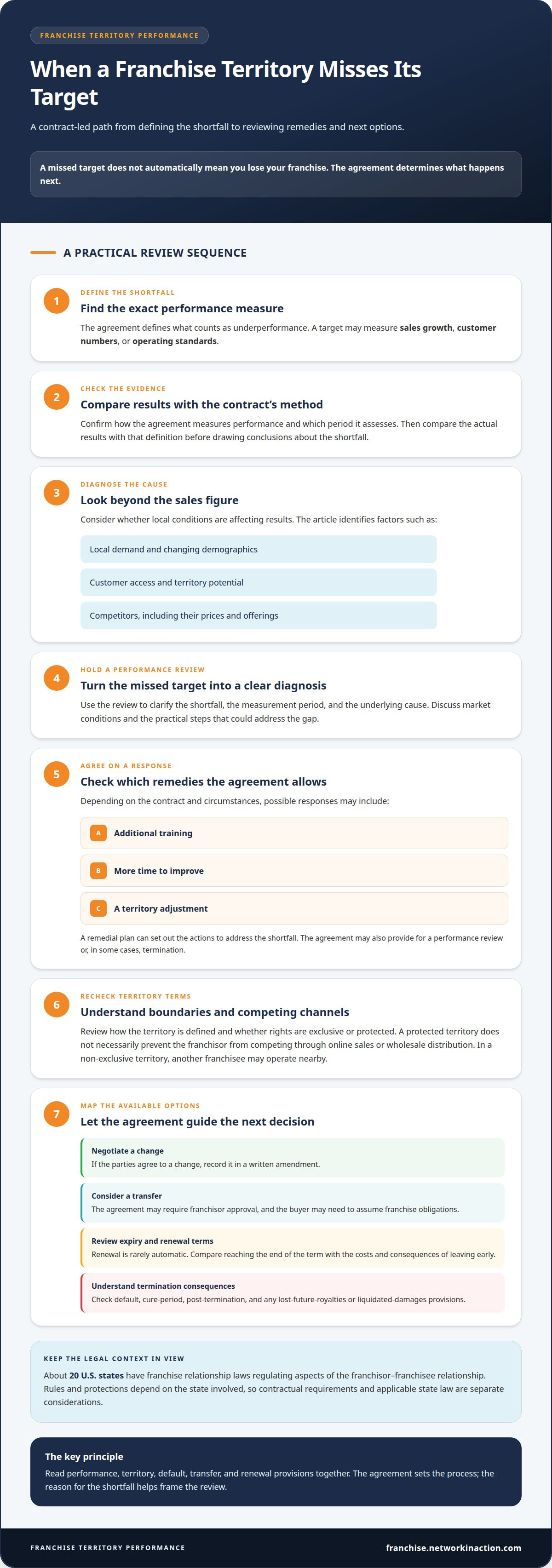
Define the territory precisely. Agreements may use ZIP codes, municipal boundaries, radius measurements, or other geographic lines. Clarify whether your rights are exclusive or protected, and whether the franchisor can open another location or compete through online sales or wholesale distribution. A protected territory doesn’t necessarily block those sales channels. In a non-exclusive territory, another franchisee may operate nearby, so targets should account for additional brand competition.
Negotiate the obligations as well as the boundaries. Discuss whether targets measure sales, customer numbers, growth, or operating standards, and how often performance is reviewed. Ask what adjustment process applies if demographics change or another franchise opens nearby. The agreement may also allow the franchisor to review sales and management information, including records used to calculate turnover-based fees. Clear definitions of required records and review procedures can help prevent operational disputes.
Establish what remedies apply before a missed target becomes a default. Negotiations can cover review meetings, an opportunity to explain market conditions, and a remedial period with defined actions. Possible responses include additional training, more time, or a territory adjustment. Put the agreed process in the contract rather than relying on informal assurances. This gives both sides a practical framework for evaluating results and responding to changing market conditions.
Reviewing franchise agreement territory clauses
Read the territory provisions alongside the agreement’s term, renewal, default, and transfer clauses. Franchise agreements often have initial terms of at least five to ten years, so boundaries and performance obligations can shape a substantial period of business. Look for rights to expand into adjacent areas, including options or rights of first refusal. These clauses can affect whether you have a path to growth when nearby territory becomes available.
Then trace the consequences of missing a target. The agreement may define performance requirements, grounds for termination, default consequences, and obligations that continue after termination. Check whether it allows a cure period, sets a process for addressing shortfalls, or permits territory changes. A lost-future-royalties or liquidated-damages clause may require fees for the remaining agreement period. Independent legal advice can help explain how these provisions work together.
Waiting for the term to expire may be an alternative to leaving early. Franchise agreements run for a set period, and renewal is rarely automatic. If you reach the end of the term, you may choose not to renew. Compare that option with the costs and consequences of termination, including any post-termination obligations. Renewal may also require updated equipment, a remodel, or acceptance of the franchisor’s current contract.
Negotiation is most useful before signing, while the franchise agreement’s terms are still open for discussion. Focus on how performance obligations respond to changed circumstances, what notice and remedy process applies, and whether territory boundaries can be adjusted. If results remain weak, the parties may agree to a change, but the existing contract determines your rights. Record any change in a written amendment rather than relying on informal discussions.
A transfer can offer another route if continuing operations no longer makes sense. The agreement may require franchisor approval before you sell the business, and the buyer may need to assume franchise obligations. Review the transfer conditions, termination provisions, and rules that continue after a sale. Together, these terms show whether waiting, negotiating a resolution, transferring the business, or leaving at expiry best suits your financial and operating priorities.
Reviews and remedial plans for missed targets
An underperforming franchise territory is one where results fall below a minimum set in the franchise agreement. The target may measure sales growth, customer numbers, or operating standards, so the contract’s wording defines the shortfall. Understanding what happens if your chosen franchise territory is underperforming starts with identifying the measure missed and the period assessed.
Rules vary by state because franchise agreements operate alongside state-specific laws. About 20 U.S. states have franchise relationship laws regulating aspects of the franchisor-franchisee relationship; the rules and protections depend on the state involved. That makes it important to distinguish a contractual performance requirement from protections created by applicable state law.
A performance review should turn a missed target into a clear diagnosis. Compare actual results with the contract’s measurement method, then identify the period assessed and the underlying cause. For example, declining customer numbers could reflect weak local demand, limited access, or a new competitor. Sales figures reveal trends, while management information can show whether operations followed required standards.
Use the meeting to establish a practical remedial plan. Set out the specific gap, the actions each party will take, and how progress will be assessed. Remedies may include additional training, operational improvements, more time to meet the minimum, or a smaller territory. In the UK, struggling franchisees should have a review meeting to agree on a remedial plan. A reasonable plan links its actions to the cause instead of treating every shortfall the same way.
Keep the investment and the agreement’s consequences in view. A missed target doesn’t by itself establish whether a default has occurred; the contract defines the trigger, notice, and available remedies. An exclusive territory also doesn’t guarantee sales, so the review should distinguish territory rights from performance results. If market conditions explain the shortfall, document how they affect customer access or demand. This evidence clarifies what happens if your chosen franchise territory is underperforming and gives both sides a concrete basis for assessing progress and deciding whether to adjust the plan.
Territory reduction and franchisor competition
A territory reduction can change your access to customers, revenue potential, and growth options. Start with the agreement’s boundary language: identify whether it allows the franchisor to reduce your area, under what conditions, and whether targets change afterward. A smaller territory may focus operations on a more workable market, but it can also remove valuable customers or future opportunities. The impact depends on which accounts, locations, and growth prospects fall outside your boundaries.
Competition also depends on the rights the agreement actually grants. An exclusive territory can restrict other franchisees of the same brand from operating there, but it doesn’t prevent competition from other brands. A non-exclusive territory may allow another franchise nearby. The franchisor may also reserve the right to sell online or through wholesale distribution in your area. Those channels can affect customer access even when no new storefront opens.
Separate each source of competition before assessing a shortfall. Compare sales trends before and after a nearby unit opens, identify overlapping customer groups, and note whether online or wholesale sales reach your territory. Existing franchisees can offer practical insight into how territory rights work and how new competitors affect operations. That perspective can help you focus discussions on boundaries, targets, and support.
Use the franchise disclosure document and agreement as distinct parts of your review. The disclosure document provides context for evaluating the opportunity, while the signed agreement defines territory rights and obligations. An attorney can explain how reduction, competition, transfer, and termination provisions interact. Bring specific examples, such as lost accounts or changed access, rather than relying only on general revenue concerns.
If the franchisor proposes reducing your territory, ask how the change affects performance targets and existing obligations. Discuss adjustments that reflect lost customers, boundary changes, or new competition, and put any agreed terms in writing. A review of franchise territory opportunities can help you assess how territory design fits your growth priorities.
Network In Action: Franchise a business opportunity
Network In Action offers a franchise opportunity for people who want to lead local business referral groups. If you’re weighing franchise options after reviewing territory risks, this model centers on relationship-driven growth, community leadership, and recurring revenue potential.
Rather than relying solely on weekly, in-person meetings, franchisees use monthly meetings and a technology platform to keep members connected. Training and ongoing support help franchisees build and manage groups of small to mid-sized business owners seeking high-quality referrals. The model may suit you if you value structured operations, flexibility, and professional credibility over cold prospecting.
Explore whether the opportunity aligns with your goals, preferred working style, and plans for local leadership. Contact Network In Action to continue the conversation.
Make Your Next Franchise Decision With Clarity
Knowing what happens if your chosen franchise territory is underperforming is useful, but a stronger move is to assess territory fit before committing. Consider local opportunity, the operating model, and your appetite for community leadership as parts of one decision. The right franchise path should align with how you want to build relationships, develop credibility, and shape your working life.
Use that perspective to decide what deserves closer exploration: the franchise model, your goals, and the role you want to play in a local business community. Network In Action offers a franchise business opportunity for entrepreneurs interested in leading professional referral groups. A thoughtful conversation can help you explore whether that direction matches your priorities without rushing your decision.
Contact Network In Action to explore the opportunity and consider your next move with confidence. Build a path that reflects your ambition, your strengths, and the professional impact you want to make.
Frequently Asked Questions
What happens if you don’t meet minimum performance targets?
The agreement determines whether a shortfall triggers notice, an opportunity to correct performance, or default consequences. For example, a notice may specify the missed measure and response period, while dispute terms may require arbitration or allocate legal costs. Respond promptly and preserve sales reports, customer records, and communications that help explain the results. Ignoring a notice can narrow your options, especially when deadlines apply.
Can You Negotiate an Amicable Resolution?
Yes, you can propose a written resolution that addresses the cause of the shortfall and sets clear next steps. For example, the parties might agree on revised reporting milestones, operational support, or a transfer discussion. Record responsibilities, review dates, and what happens if the plan isn’t completed. A practical agreement can help preserve business value while both sides decide whether continued operations remain viable.
Do you have to achieve minimum turnover levels?
Assess your contract’s turnover obligations and the rules that apply where you operate. In the UK, minimum turnover levels should be reasonable, and territory size and maturity can matter. Targets should be based on a reasonable business plan agreed at the outset, and missing a level shouldn’t automatically end the agreement. Review how the contract defines turnover and measures performance.
How Do Bad Territories Happen?
Territories can underperform when their customer potential is misjudged or changes after assignment. For example, a major employer may leave, a planned infrastructure project may stall, or new development may shift local demand. Overlapping products, competitor pricing, and customer access can also reshape the market. Compare the territory’s original assumptions with current local conditions to identify whether the opportunity has materially changed.
How Does franchise territory performance minimum Affect Your Exit Strategy?
A performance clause can influence when you act and which exit options remain practical. A sale may require franchisor approval, while termination can leave post-termination duties in force. Personal guarantees may also expose an owner beyond the business entity. Develop an exit plan before default concerns escalate, and map transfer requirements, continuing obligations, and dispute terms against the timing of a potential sale.
How Much Could franchise territory performance minimum Cost You Over a 10-Year Franchise Term?
There’s no single total that applies across franchise agreements. Your exposure depends on the contract’s performance remedies, operating costs, lease commitments, renewal conditions, and any damages clause tied to early termination. A long-term assessment should also consider how weak revenue affects your ability to meet continuing obligations. Separate routine operating expenses from costs triggered specifically by a shortfall or exit.