Expansion alone doesn’t prove a franchise is ready to scale. Repeatable performance does. Scaling a franchise from one location to multiple means moving beyond an owner-led operation and building a business that can perform consistently across sites.
That distinction matters. A strong first location can make the next one seem obvious, but growth also adds complexity in leadership, cash flow, staffing, and daily oversight. You need to know whether the business can maintain its standards when you’re no longer managing every detail yourself.
This article explains multi-unit franchising and how to assess your first location before expanding. You’ll learn how to review financial performance, build leadership capacity, and compare results across locations so your next move is based on operational strength, not momentum alone.
Key Takeaways
- Build a clear reporting structure and develop managers who can maintain standards across locations without your constant oversight.
- Use consistent profitability, cash flow, available capital, and operating reserves to judge whether expansion is financially sustainable.
- Document repeatable workflows and align training, compliance, and operating tools so each location can deliver a consistent experience.
- Compare financial, customer, and operational results by location to spot patterns, address weak performance, and guide your next growth decision.
1. Developing regional managers and promoting from within
Managing two to four locations tests your leadership: each site needs accountable managers, clear reporting, and shared performance measures. Owners can lose visibility when decisions, staffing, and inventory depend on one person’s memory. The stage between two and four units is sometimes called the “Hell Zone,” because owners must delegate before a larger management structure seems necessary.
Build that structure deliberately. Look for employees who already solve problems, coach colleagues, and uphold operating standards. Give each candidate responsibility for a defined shift, training task, or inventory review. Then assess their follow-through, communication, and judgment before promoting them. At three or more locations, consider hiring or promoting a district manager to coordinate unit managers and flag issues early.
Develop leadership through practical assignments, not titles alone. Over the following 12 months, Amanda Rainsberger hired three District Managers for her franchise business. The example highlights how regional leadership can add capacity as a franchise grows. Unit franchisees also need clear authority: specify which decisions managers can make locally and which require owner approval.
Centralize information that helps teams work consistently. A shared POS system brings sales data together, while analytics can reveal differences between locations. Centralized menu management keeps approved offerings and updates aligned. Connect these systems with inventory records, then review exceptions with managers instead of relying on scattered reports.
Clear structure supports engagement by showing people what success looks like. Set regular check-ins, share location-level goals, and recognize managers who improve service, inventory control, or team retention. Invite employees to flag recurring challenges and explain how decisions affect their work. As the team grows, consistent communication preserves accountability without making every decision wait for the owner. This leadership shift makes multi-location operations more manageable.
2. Assessing the first location's financial performance
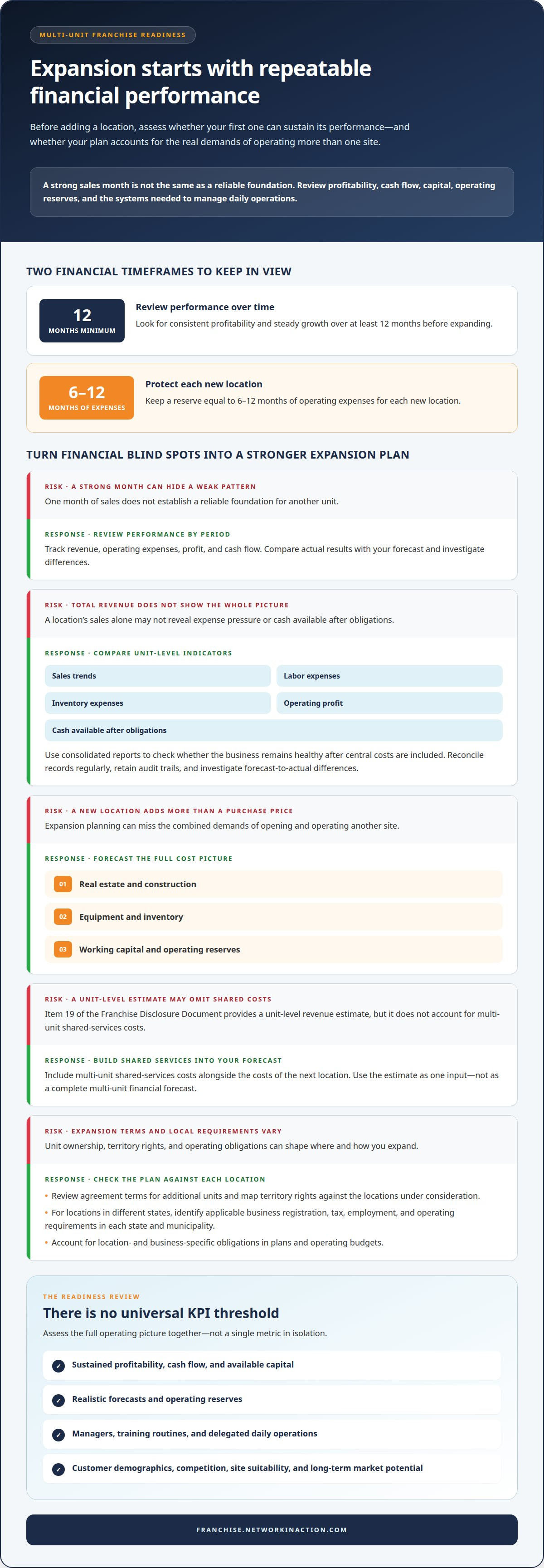
Start with the numbers that show whether your first location can fund expansion. Review revenue, operating expenses, profit, and cash flow by period, then compare actual results with your forecast. Look for consistent profitability and steady growth over at least 12 months before expanding. A strong sales month alone doesn’t establish a reliable foundation for additional unit ownership.
Track unit-level indicators that explain performance, not just total revenue. Compare sales trends, labor and inventory expenses, operating profit, and cash available after obligations. Consolidated financial reports can show whether the business remains healthy after central costs are included. Reconcile records regularly, retain audit trails, and investigate differences between forecasts and actual results.
Cash flow needs its own stress test. Estimate the costs of real estate, construction, equipment, inventory, and working capital for the next location. Keep a reserve of 6–12 months of operating expenses for each new location. Item 19 of the Franchise Disclosure Document provides a unit-level revenue estimate, but it doesn’t account for multi-unit shared-services costs. Include those costs in your forecast.
Operating multiple locations under an existing franchise relationship, or becoming a multi-unit franchisee under a new agreement, depends on the franchisor’s structure and your expansion plan. Review the agreement’s terms for additional units before committing. Territory rights can affect where you may open, so map those rights against the locations you’re considering.
For locations in different states, identify the business registration, tax, employment, and operating requirements that apply in each state and municipality. Specific obligations depend on location and business activity, so account for them in your plans and operating budgets.
There is no universal KPI threshold for financial readiness. Before expanding, assess sustained profitability, cash flow, available capital, realistic forecasts, and reserves. Staffing needs change too: assign managers, establish training routines, and delegate daily operations. To assess local demand, examine customer demographics, competition, site suitability, and long-term market potential before choosing a location.
3. What Is Multi-Unit Franchising?
Multi-unit franchising means owning and operating multiple locations under the same brand. That ownership shift changes the job: franchise owners must build systems that let managers run daily operations consistently. A location that performs smoothly without the owner’s constant presence offers a stronger base for expansion than one dependent on the owner’s daily decisions.
Start by documenting repeatable work. For example, record the inventory-ordering timeline, who places orders, and how managers handle shortages. Add procedures for hiring, onboarding, customer service, and opening and closing routines. Clear instructions help teams maintain consistent operating standards across locations while giving local managers room to handle day-to-day issues.
Technology can give multi-location operations a shared view. Integrated point-of-sale, inventory, payroll, and customer relationship management systems help franchise owners monitor activity across sites. Shared reporting can highlight sales or staffing differences, which managers can explain and address. Choose tools that support the franchise system’s operating strategies and reporting needs.
Centralized procedures also make compliance and quality easier to oversee. Set consistent brand guidelines, use standardized workflows, and schedule regular audits. Checklists help managers follow required steps, while training manuals and digital learning platforms support onboarding and continued education. For example, managers can use the same quality checklist at each location and record follow-up actions.
A clear structure reduces dependence on the owner by assigning decisions to the right level. Unit managers handle routine staffing and service issues; regional leaders coordinate patterns across locations. Regular meetings and a shared technology platform keep teams informed. As operations grow, review responsibilities to ensure they remain clear and managers stay engaged. The goal is not simply to add locations, but to build a repeatable operating model that works without routing every decision through ownership.
4. Reviewing business performance across locations
Multiple locations create opportunities to learn, but only when you compare results consistently. Review financial, customer, and operational measures for each site using the same definitions and reporting periods. A location with lower sales may still be more profitable if it controls expenses better. Look beyond the headline number before deciding what needs attention.
Start with a location-level scorecard. Track revenue, operating costs, cash flow, customer feedback, staffing, and service quality. Compare actual results with each location’s budget and forecast, then investigate the biggest differences. If one site has rising inventory expenses, review ordering patterns and waste before changing its targets. Accurate forecasts help you manage cash flow across the portfolio.
Next, look for patterns across locations. If customer feedback declines at several sites, the cause may be a shared process or training issue. If only one location struggles, examine local demand, staffing, and execution. Record each finding, the action taken, and the next review point. This process turns isolated problems into practical lessons for other managers.
Use results to strengthen consistency without treating every location as identical. Standardize brand-critical service and operating practices, then let local teams respond to community preferences. For example, a promotion at one location may suit its market, while a broader campaign supports the brand across the network. Compare results before expanding either approach.
Expansion should follow evidence of sustainable performance, not just a strong top-line result. Review whether profit, customer experience, and operational standards hold across existing locations. Use recurring reviews to spot trends early, adjust forecasts, and direct support where it can make a difference. Each additional location should add insight, not simply workload. If your next step is evaluating growth opportunities, explore available territories alongside the performance evidence.
Network In Action: Franchise a business opportunity
Network In Action offers a franchise opportunity for entrepreneurs who want to lead local business referral groups. Its model builds professional relationships through curated groups, with no forced referrals. Franchisees receive training and ongoing support to build and manage groups focused on high-quality business connections.
Monthly meetings and a technology platform help keep groups connected without the traditional weekly networking routine. As a franchisee develops groups, the model may offer room to scale and the potential for recurring revenue, though results depend on execution and local conditions. This flexibility may also support greater lifestyle autonomy over time. Consider whether your strengths, local relationships, and preferred working style align with building a professional network centered on meaningful connections rather than sheer volume.
Contact Network In Action to explore whether its franchise opportunity fits your goals.
Choose the Growth Path That Fits Your Goals
Growth changes more than the size of a business. It affects how you spend your time, where you focus your leadership, and the impact you can have in your community. Before committing to the next stage, define success beyond adding locations. You might prioritize greater autonomy, a stronger leadership role, or a business that connects professionals through meaningful relationships.
Scaling a franchise from one location to multiple locations is a strategic choice, not a test of ambition. The right opportunity should align with your strengths, values, and preferred way of working. Network In Action offers a franchise opportunity for entrepreneurs interested in leading local business referral groups. Explore whether the model fits your plans and take the next step at your own pace.
Contact Network In Action to discuss the opportunity and consider your next move with confidence.
Frequently Asked Questions
What Is Multi-Unit Franchising?
Multi-unit franchising means owning and operating more than one location under a franchise brand. The franchisee manages a portfolio, coordinating people, performance, and decisions across locations rather than focusing on a single site. For example, a shared staffing plan can help managers cover seasonal demand across nearby units while keeping each location accountable for its own results.
What does it take to scale a franchise business successfully?
Successful expansion takes more than demand for another location. You need a reliable operating model, leaders who make sound decisions, and financial plans that account for different outcomes. Set a go-or-pause checkpoint before each commitment: confirm the existing business can run without constant owner intervention, then assess whether the next site fits the brand and your long-term goals.
What are the steps to scale a franchise from one location to multiple locations?
Move through clear decision gates: assess readiness, review the franchise agreement, model the next location, select a market, and prepare its leadership team. Before signing a lease, test whether the plan still works if sales grow more slowly than forecast. Then document launch responsibilities, assign decision-makers, and compare early results with the assumptions behind your approval.
How much capital is needed to open additional franchise locations?
There is no universal capital figure because site condition, market, build-out scope, equipment needs, and franchisor requirements vary. Prepare a location-specific forecast that separates pre-opening commitments from the operating funds needed after launch. Include a downside scenario for slower revenue growth, and distinguish available cash from financing that still depends on approval or other conditions.
How can franchise owners finance additional locations, and what are the costs?
Owners may fund expansion with retained business earnings, personal capital, or external financing, depending on their financial position and lender terms. Compare repayment obligations with projected cash flow before choosing a funding structure. Separate opening expenses from ongoing obligations, including fees required by the franchise agreement. Avoid relying on projected sales alone to cover fixed commitments during the ramp-up period.
What systems and technology help manage multiple franchise locations?
Choose systems that give owners and managers a consistent view of performance, with access assigned by role. For example, a regional leader may need portfolio-level reports, while a unit manager needs location-specific tasks and results. Agree on shared data definitions and escalation rules before rollout. Consistent reporting makes comparisons more useful and helps teams act on exceptions instead of debating mismatched reports.