
A master franchise can offer a faster route to market, but it can also bring a longer legal chain. The risks of investing in a master franchise license go beyond launching a business: you may take on territory-level responsibilities, disputes with individual franchisees, and disclosure obligations if you sell franchises within your territory.
An established system can offer structure, but it doesn’t remove the need to understand what you’re agreeing to or what you’ll be responsible for. In the United States, the Federal Trade Commission says a franchisor must provide a Franchise Disclosure Document at least 14 days before an agreement is signed or money changes hands. That document must cover 23 categories of information.
This comparison covers the legal, disclosure, contract, and business risks of a master franchise and an independent business. You’ll see how the responsibilities differ, which obligations deserve close attention, and what to weigh before choosing a model that fits your goals for growth, control, and community leadership.
Key Takeaways
- Map the master franchisee’s territory-level duties before weighing the opportunity, including responsibility for supporting and managing local franchisees.
- Separate obligations created by the franchisor’s actions from those you may assume, and consider how the agreement allocates liability and indemnification.
- Compare the structure and operating constraints of a franchise with the control and setup demands of building independently.
- Assess whether leading a relationship-driven professional community through Network In Action’s franchise opportunity aligns with your growth and lifestyle goals.
What are the Legal Risks Involved with Buying a Master Franchise?
Buying a master franchise can make you both an operator and a local franchisor. The U.S. Federal Trade Commission’s Franchise Rule identifies three elements: trademark rights, significant control or assistance, and a required payment. That structure can bring responsibilities beyond running one location, including selling franchises and supporting franchisees across a territory. These responsibilities are central to the risks of investing in a master franchise license.
Required payments need careful interpretation. The U.S. Federal Trade Commission states that the total of required payments, or commitments to make a required payment, to the franchisor or an affiliate made before or within six months after commencing operation of the franchisee’s business is less than $735. That threshold is not a measure of the full investment. A franchise fee, setup expenses, and ongoing royalty or marketing fees may shape the actual financial commitment.
Review the master franchise agreement line by line. Identify the initial fee, recurring royalties, marketing contributions, payment dates, and minimum performance obligations. Then map each payment to the party receiving it: the franchisor, an affiliate, or a local franchisee. For example, you may owe royalties to the franchisor while collecting them from individual franchisees. The agreement should explain how these payments work and what happens if a local operator pays late.
| Option | Payment structure | Legal focus |
|---|---|---|
| Master franchise | Franchise fee, ongoing royalties, and possible marketing contributions | Territory duties and subfranchise obligations |
| Starting from scratch | Startup and operating costs set by the independent business | Creating contracts and operating terms without a franchisor’s system |
A national system may set brand standards while the master agreement assigns local sales, support, or reporting duties. Have franchise counsel assess whether the fees match those duties and whether the agreement clearly defines defaults, renewal, and termination. Weigh total payment obligations against the legal workload you can manage, not just the headline franchise fee, when assessing the risks of investing in a master franchise license.
State registration and disclosure requirements
U.S. disclosure rules set timing and content requirements for franchise sales. A master franchisee that sells franchises may also have disclosure responsibilities and related liability.
Disclosure Duties and Violation Liability
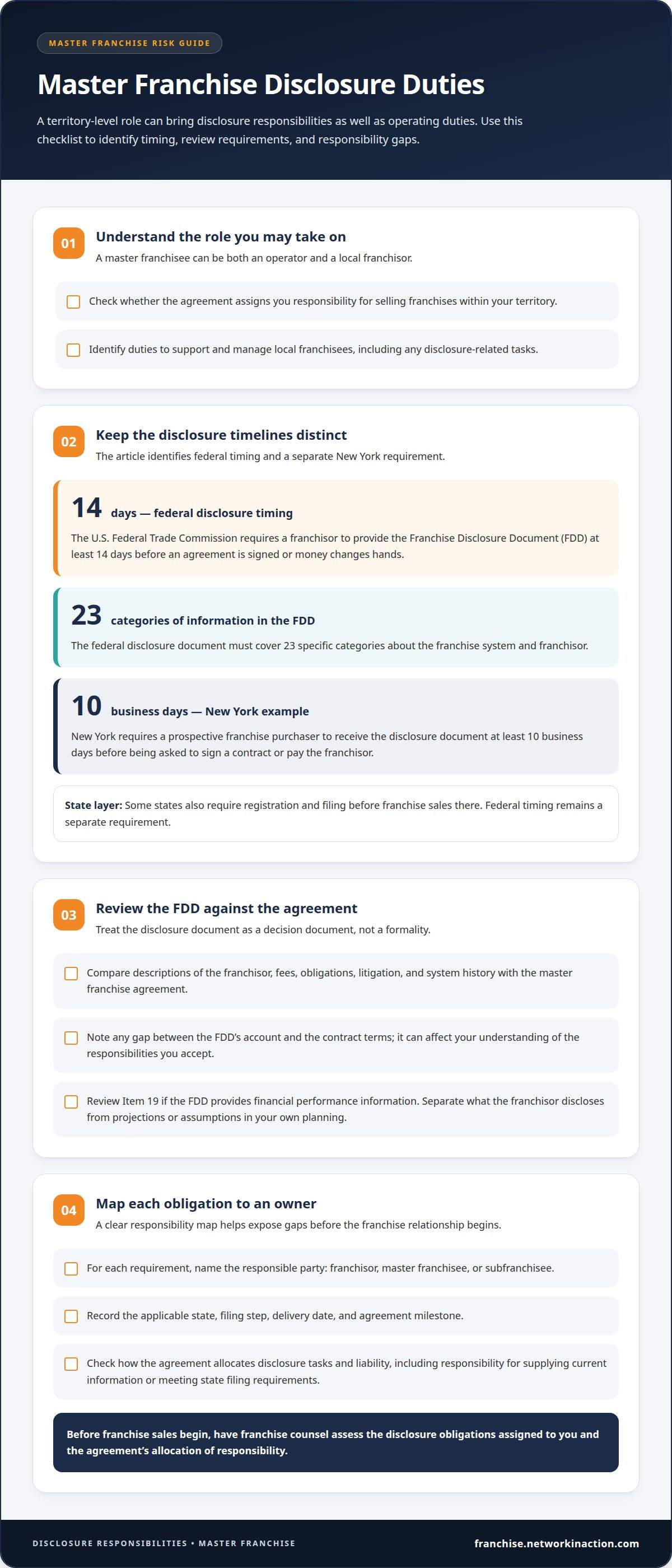
The U.S. Federal Trade Commission requires franchisors to provide prospective franchisees with a Franchise Disclosure Document at least 14 days before an agreement is signed or money changes hands. The U.S. Federal Trade Commission also requires the document to contain 23 specific categories of information about the franchise system and franchisor.
State rules can add another layer. In New York State, a prospective franchise purchaser must receive the disclosure document at least 10 business days before being asked to sign a contract or pay the franchisor, according to the New York State Legislature. Some states also require registration and filing before franchise sales there. A master franchisee selling within a territory may face liability for disclosure violations, so the agreement’s allocation of disclosure tasks matters.
Franchise Disclosure Document Review
Review the FDD as a decision document, not a formality. Compare its descriptions of the franchisor, fees, obligations, litigation, and system history with the master franchise agreement. A gap between the FDD’s account and the contract’s terms can affect your understanding of the opportunity and the responsibilities you accept.
Focus on Item 19 if the FDD provides financial performance information. Separate what the franchisor actually discloses from projections or assumptions used in your own planning. Also examine whether the master agreement assigns you responsibility for preparing disclosures to subfranchisees, supplying current information, or meeting state filing requirements. Franchise counsel can help assess those obligations before purchase.
For a practical review, map each requirement to the responsible party: franchisor, master franchisee, or subfranchisee. Then record the applicable state, filing step, delivery date, and agreement milestone. For example, a sale involving New York requires attention to its 10-business-day disclosure period, while federal timing remains a separate requirement. This process helps expose responsibility gaps before the franchise relationship begins.
Contract protections when the franchisor is responsible
A master franchise agreement should distinguish the franchisor’s duties from yours. That matters when a system-level problem affects local franchisees. For example, the franchisor may control brand standards or required suppliers, while you handle franchise sales and local support. If the agreement blurs those responsibilities, franchisees may direct complaints or demands to you first, even when the problem began with the franchisor.
Negotiate indemnification for liability arising from issues the franchisor controls, including problems with its Franchise Disclosure Document. Indemnification sets out when one party must cover specified losses or costs for another. The agreement should define covered claims, exclusions, notice deadlines, and how defense decisions are handled. For instance, if a franchisee alleges that the franchisor’s disclosure was inaccurate, the contract should say who leads the response and who bears the resulting costs.
Make responsibility operational, not abstract. Identify who prepares and updates system materials, approves required suppliers, communicates changes, and responds to franchisee complaints. If the franchisor requires a supplier but controls its selection, the agreement can clarify responsibility for related claims. It should also specify what help the franchisor must provide when a complaint concerns system rules rather than your local management.
Before signing, ask franchise counsel to compare the agreement’s protections with the duties assigned to you. Focus on these provisions:
- Indemnification: Specify which franchisor-controlled acts or omissions are covered, including disclosure-related claims.
- Claims process: Set notice, cooperation, defense-control, and settlement procedures.
- Responsibility map: Match each obligation to the party controlling the relevant decision.
- Compliance demands: Define required assistance, deadlines, and remedies if the franchisor does not provide it.
A partnership needs clear risk allocation. Compare each protection with the agreement’s demands, then negotiate any gaps before signing. The goal is not to transfer every business risk, but to avoid carrying liability for decisions controlled by the franchisor.
A master franchisee should ensure the agreement provides adequate protection when the franchisor is responsible for an issue. Consider those protections alongside the agreement’s allocation of responsibility, so you have contractual support when a problem rests with the franchisor.
Franchise business risks compared with starting from scratch
A franchise can give you an established business model, but it adds obligations that an independent startup avoids. Franchise owners operate under brand standards and may have less freedom to change pricing, suppliers, or customer processes. In a master franchise, your decisions also affect local franchisees, while the franchisor’s reputation and other operators’ actions can influence the territory’s credibility.
Starting from scratch gives you greater control, but it is not a simpler route to success. You create the brand, operating systems, customer offer, and market position yourself. For example, an independent owner can revise a service model without franchisor approval, but must build the procedures and recognition a franchise system may already provide. That work takes time and disciplined execution.
The survival challenge is real. Nearly 52% of all U.S. startups do not last past the five-year mark. That figure does not predict a particular venture’s outcome, but it underlines why owners should test demand, working capital needs, and operating costs before committing. A franchise can reduce some setup uncertainty through an existing system, yet royalties, required standards, and reputational exposure remain part of the trade-off.
Compare the paths against the work you want to lead:
- Franchise: Assess the franchisor’s support, system performance, territory, recurring fees, and limits on independent decisions.
- Master franchise: Consider whether you can both develop the territory and manage relationships with local franchisees.
- Independent startup: Plan how you will build brand credibility, operating processes, and customer acquisition without an established system.
Then test each model against a realistic operating scenario. If sales soften, can the business meet rent, payroll, debt, and supplier commitments? If another franchisee harms the brand, can your local reputation withstand the impact? Choose the structure whose control, support, and obligations fit your appetite for hands-on work and risk.
Before committing, assess whether the business can meet its obligations through normal ups and downs. Account for the demands of the operating model rather than relying only on favorable conditions.
Franchise owners manage daily operations while following the franchisor’s guidelines and standards, which may limit independent decisions. Consider how those requirements would affect the business during both stronger and weaker periods.
Network In Action: Franchise a business opportunity
Network In Action offers a franchise opportunity for professionals ready to lead local business referral groups. Its model brings small and mid-sized business owners together to build credibility and generate quality referrals without forced referrals. Monthly meetings and a technology platform help members stay connected beyond the meeting, while franchisees receive training and support to build and manage their groups.
This path may suit you if you want to develop a community-focused business with structure, flexibility, and potential for recurring revenue. It may be less aligned if you prefer operating entirely independently or don’t want to lead relationships among local business owners. Consider how the responsibilities, lifestyle, and growth model fit your goals. Contact Network In Action to explore whether its franchise opportunity is the right strategic fit for you.
Choose a Path That Fits Your Ambition
The risks of investing in a master franchise license call for a clear decision standard, not a rushed yes or no. Define the role you want to play, the decisions you need to control, and the kind of growth that would make the commitment worthwhile. That clarity can help you distinguish an attractive opportunity from one that does not match your priorities.
Before moving forward, write down what success means to you. Is it building a local business, developing leaders, creating professional relationships, or gaining more control over your schedule? Then identify which trade-offs you can accept and which would undermine your goal. A sound decision connects the business model to your capabilities and the life you want to build.
If a structured, relationship-driven franchise path aligns with that direction, take the next step at your pace. Contact Network In Action to explore the opportunity and assess your fit. Make the move that reflects your goals, and build with intention.