
A full room isn’t proof of trust. That’s why mandatory attendance in networking groups fails: it can ensure people are present, but it can’t compel trust, useful introductions, or follow-through. Members may show up to avoid consequences while remaining guarded, disengaged, or focused on their next sales opportunity.
Attendance expectations can create consistency, which matters. But when presence becomes the main measure of commitment, members and leaders can mistake compliance for connection. Trust grows through repeated, meaningful interactions and mutual value, not a roll call.
You’ll learn who mandatory attendance affects and how accountability, consequences, and group culture shape engagement. The article also explores healthier expectations, the importance of follow-up, and how to tell whether a group is building relationships or simply counting seats. The distinction matters: quality connections create a stronger foundation for relationship-driven growth than attendance alone.
Key Takeaways
- Set attendance expectations around meaningful participation, and distinguish unavoidable absences from disengagement.
- Use consistent, proportionate consequences to address repeated disengagement without treating attendance as proof of trust.
- Build a welcoming culture through repeated interaction, mutual value, and thoughtful follow-up.
- Assess group health by the quality of connections and ongoing relationships, not just who shows up.
Attendance expectations and accountability
Attendance expectations work best when they encourage participation, not just presence. A clear record can help leaders distinguish an isolated absence from a pattern that limits member engagement.
Voluntary and Required Attendance Models
A voluntary model lets members choose when to attend, while a required model sets an expectation and may attach consequences to absence. Voluntary groups offer flexibility, but inconsistent participation can make introductions and follow-up harder. Required attendance can create a predictable meeting rhythm, yet a seat filled under pressure doesn’t prove trust or active contribution. For example, a member might attend every meeting but never follow up on a referral. The useful measure is whether expectations lead to meaningful participation, not simply a perfect attendance record.
Alternatives to Mandatory Attendance
Alternatives replace attendance penalties with clear ways to contribute and reconnect. Leaders can ask absent members to share an update, arrange a follow-up conversation, or identify a colleague to represent their business. Online and hybrid groups can offer a remote way to participate, then record key introductions and agreed next steps for those who miss the live session. This preserves continuity without treating physical presence as the only sign of commitment. It also gives members facing schedule challenges a practical route back into the conversation.
Attendance Requirements and Member Retention
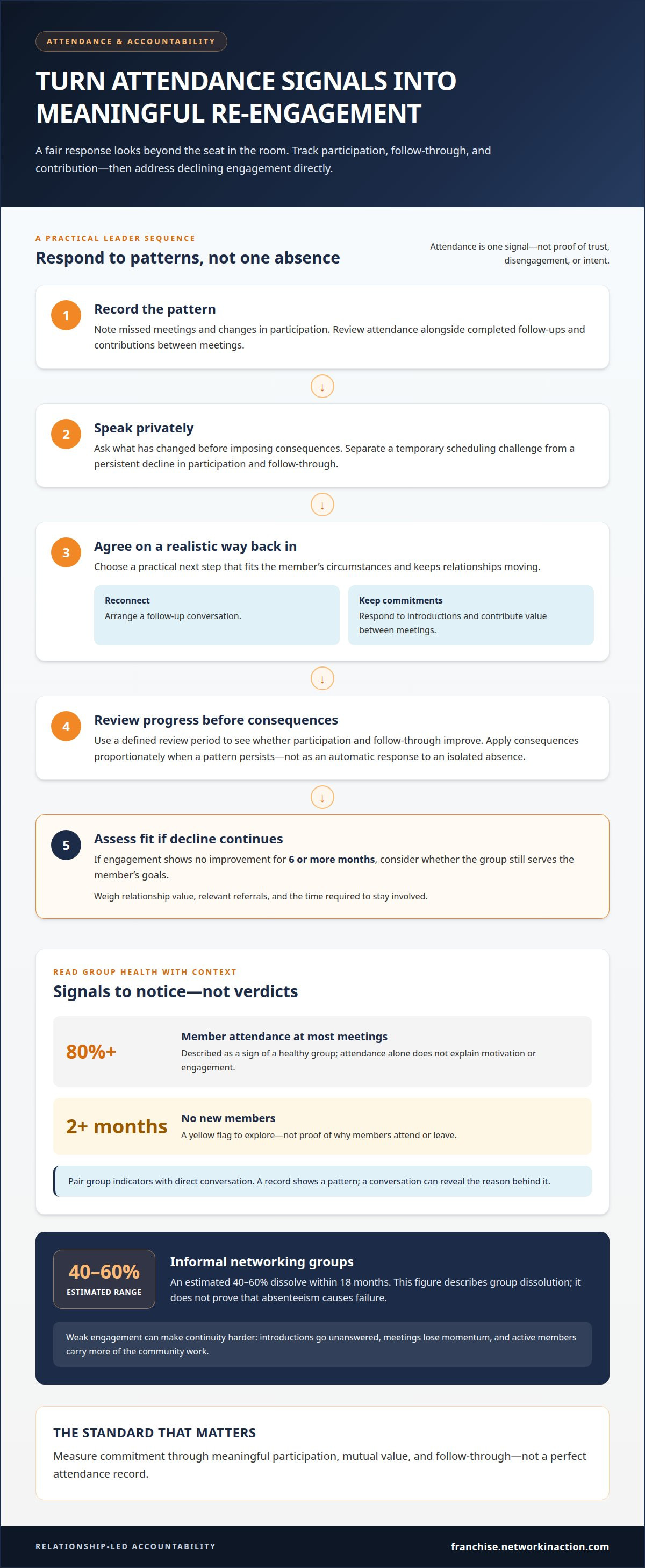
Attendance should be one signal of group health, alongside new-member activity and relationship-building. A healthy group is described as having 80% or more of members at most meetings; no new members in 2 or more months is a yellow flag. Neither measure proves why people attend or leave, so leaders should pair the record with a direct conversation. For comparison, the University of Bristol contacts students who stop attending and engaging satisfactorily to understand reasons for absence and offer support where possible. Networking leaders can apply that principle by asking about barriers before imposing consequences. This matters because a school attendance record and a business group’s attendance record serve different purposes; neither alone explains an individual’s motivation. Clear expectations, a useful participation option, and timely follow-up make accountability more informative than a penalty alone.
Consequences of unsatisfactory engagement
Repeated absence affects more than a meeting’s headcount. When members miss introductions, delay follow-up, or stop contributing, referral relationships lose momentum. For example, a member who repeatedly misses meetings may not hear that another participant needs a trusted introduction. The missed opportunity can affect both businesses, even when the absence has a valid reason. Attendance alone, however, can’t show whether someone is disengaged or facing a temporary challenge.
Group leaders need to distinguish a short-term disruption from a persistent pattern. A practical review can consider attendance, participation, completed follow-ups, and whether members still contribute value between meetings. If a member misses meetings but responds to introductions and keeps commitments, the issue may be scheduling rather than a lack of engagement. If participation and follow-through both fade, a direct conversation can help identify what has changed before consequences are imposed.
The stakes are real. An estimated 40-60% of informal networking groups dissolve within 18 months. That figure describes group dissolution, not proof that absenteeism causes failure. Still, weak engagement can make operations harder: meetings lose continuity, introductions go unanswered, and active members carry more of the community work. Leaders can respond with a clear sequence:
- Record missed meetings and note changes in participation.
- Speak privately with members whose engagement has declined.
- Agree on a realistic way to reconnect, such as a follow-up conversation.
- Review progress before applying a consequence.
Give the response a defined review period, then assess whether participation and follow-through improve. If decline continues without improvement for 6 or more months, consider whether the group still serves the member’s goals. That decision should weigh relationship value, relevant referrals, and the time required to stay involved. A fair process protects group standards without treating every absence as failure, and keeps learning focused on what helps members contribute consistently.
Creating a welcoming group environment
Trust grows through repeated interaction, shared experiences, follow-up conversations, and mutual value over time. A welcoming group makes those interactions easier to begin. For example, a facilitator can introduce a new member by linking their expertise to a specific challenge raised during the meeting. That gives the conversation a useful starting point instead of forcing a generic pitch.
Networking groups can improve participation without penalizing absences by making meetings relevant and giving members clear ways to contribute. Build connections around useful discussion, practical education, and thoughtful introductions. If someone misses a meeting, share the key discussion points and offer a direct way to reconnect, such as a follow-up conversation with the person they hoped to meet.
A three-part meeting structure can help members invest their time with purpose:
- Before: Ask members to identify a business challenge or connection they hope to explore.
- During: Make space for focused discussion, useful questions, and introductions tied to those needs.
- After: Capture agreed follow-ups so conversations continue beyond the room.
For example, a member seeking a reliable supplier can leave with an introduction and a clear next step, rather than a stack of business cards.
Group culture also depends on how leaders handle differences. A new entrepreneur may need context before contributing; an experienced executive may prefer a concise, relevant exchange. Facilitators can set expectations for respectful listening, concise introductions, and specific offers of help. These norms make participation easier without requiring members to perform confidence or disclose more than they choose.
Finally, assess the experience through evidence of ongoing connection. Are members following up? Are introductions relevant? Do people return to conversations with useful updates? These signals show whether the group creates value beyond a meeting. A welcoming environment doesn’t mean lowering standards; it means setting clear expectations, giving members meaningful ways to contribute, and treating each interaction as the start of a professional relationship.
What research shows about attendance requirements and member retention in networking groups?
Attendance alone can’t show whether a networking group retains members or creates lasting value. A stronger evaluation asks whether participants found relevant connections and continued those relationships after the event. That distinction matters: a full meeting can still produce few useful introductions, while a smaller gathering may lead to meaningful professional relationships.
Evaluate retention through outcomes members can describe and leaders can track:
- Relevant connections: Did a participant meet someone who fits a current business need?
- Continued contact: Did the introduction lead to a conversation after the event?
- Ongoing participation: Do members return to contribute, collaborate, or make useful introductions?
For example, a member who attends consistently but makes no relevant connections may be less engaged than someone who misses a meeting yet follows through on introductions. That comparison doesn’t make attendance irrelevant. It considers attendance alongside evidence of value instead of treating it as the outcome.
Potential connections also need context. A networking group of 16 people has 256 potential connections, but that figure describes possibility, not active relationships or business results. Leaders can assess whether members know whom to approach, have a clear reason to connect, and continue the conversation afterward. Counting names in a room won’t answer those questions.
Use the evidence to improve group design. If members attend but relationships stall, refine introductions around specific needs and give participants a clear way to continue conversations. If members leave before building connections, examine whether meetings create enough relevance and follow-through. This helps leaders distinguish an attendance problem from a value problem, then address the cause instead of adding stricter rules.
If building a professional community interests you, explore the network-leadership business opportunity.
Network In Action
Network In Action offers a franchise business opportunity for professionals interested in leading local business networking groups. Its approach combines monthly meetings with a technology platform that keeps members connected, without forced referrals. Curated group composition helps create relevant professional connections while giving members room to build trust naturally.
Franchisees receive training and support to build and manage groups of small and mid-sized business owners. The lifestyle-friendly model may suit professionals drawn to community leadership and relationship-driven growth, with the flexibility to shape a business around their goals.
Contact Network In Action to explore whether leading a professional community fits your ambitions.
Make Trust the Standard for What Comes Next
Understanding why mandatory attendance in networking groups fails gives you a sharper lens for designing professional communities: start with the behavior you want to encourage, then make the structure support it. Before adopting a rule, ask whether it helps people build credibility, contribute useful insight, and stay connected around shared business goals. If not, rethink the incentive rather than simply raising the attendance target.
That principle matters whether you’re shaping a group, evaluating your participation, or considering a larger role in business networking. The opportunity is to build an environment where invested time has purpose and relationships can grow through relevant engagement. Network In Action offers a way to explore community leadership and decide whether that path aligns with your ambitions. Choose a role that lets your strengths shape a professional community.
Contact Network In Action to explore your next step. Move forward with clarity, intention, and a focus on meaningful professional relationships.
Frequently Asked Questions
Why does this matter?
It matters because networking takes time, and your time should create professional value. If a group measures success only by attendance, you may invest effort without building useful business relationships. For example, a consultant choosing between two groups can look beyond meeting frequency and consider whether members share relevant expertise, follow through on introductions, and create opportunities to collaborate.
Why do mandatory attendance rules in networking groups fail?
Mandatory attendance in networking groups fails because a rule can require presence, not genuine interest or contribution. A member may arrive, deliver a brief introduction, and leave without engaging with anyone. Group leaders can improve the experience by making each meeting purposeful, inviting specific contributions, and giving members a clear reason to continue conversations after the session.
How do mandatory attendance policies affect trust and relationship-building?
Strict attendance policies can make participation feel like a test of obedience rather than a choice to invest in relationships. A member who attends mainly to avoid criticism may hesitate to share a genuine business challenge or make a thoughtful introduction. Leaders build credibility by explaining expectations openly, applying them consistently, and recognizing useful contributions rather than treating every missed session as evidence of low commitment.
What are the consequences of missing meetings in networking groups?
Missing a meeting can mean losing context, updates, or an opportunity to contribute to a conversation. For example, a member absent during a discussion about a shared client need may need a briefing before making a relevant introduction. The practical response depends on the group’s stated policy and the pattern of absence. A member can reconnect by reviewing key updates and following through on outstanding commitments.