Credibility isn’t built by being the loudest person in the room. If you’re learning how to build professional credibility from scratch, focus on dependable work, clear communication, and relationships grounded in genuine trust. There’s no universal timeline: early confidence comes from following through, while deeper trust grows as people see you deliver consistently.
It’s understandable to want your expertise recognized quickly, especially in a new role or field. A polished introduction may open the door, but what you do next determines whether people trust your judgment. Listen before proposing solutions, be clear about what you can deliver, and make your contributions visible without overstating them.
This guide shows you how to build trust through strong work, thoughtful communication, and authentic professional relationships. You’ll find practical ways to contribute in meetings, demonstrate your value, and nurture connections beyond a single conversation. The goal isn’t to collect contacts or chase quick approval. It’s to become someone others respect, remember, and feel confident working with.
Key Takeaways
- Earn trust in a new role by listening closely, learning what matters to stakeholders, and delivering a focused early contribution.
- Make your expertise easier to assess with a portfolio and credible testimonials that show the value of your work.
- Communicate your contributions clearly in meetings, and follow through on commitments to strengthen confidence in your judgment.
- Build a smaller circle of genuine professional relationships through curiosity, consistency, and thoughtful follow-up.
1. Building credibility as a new or less experienced employee
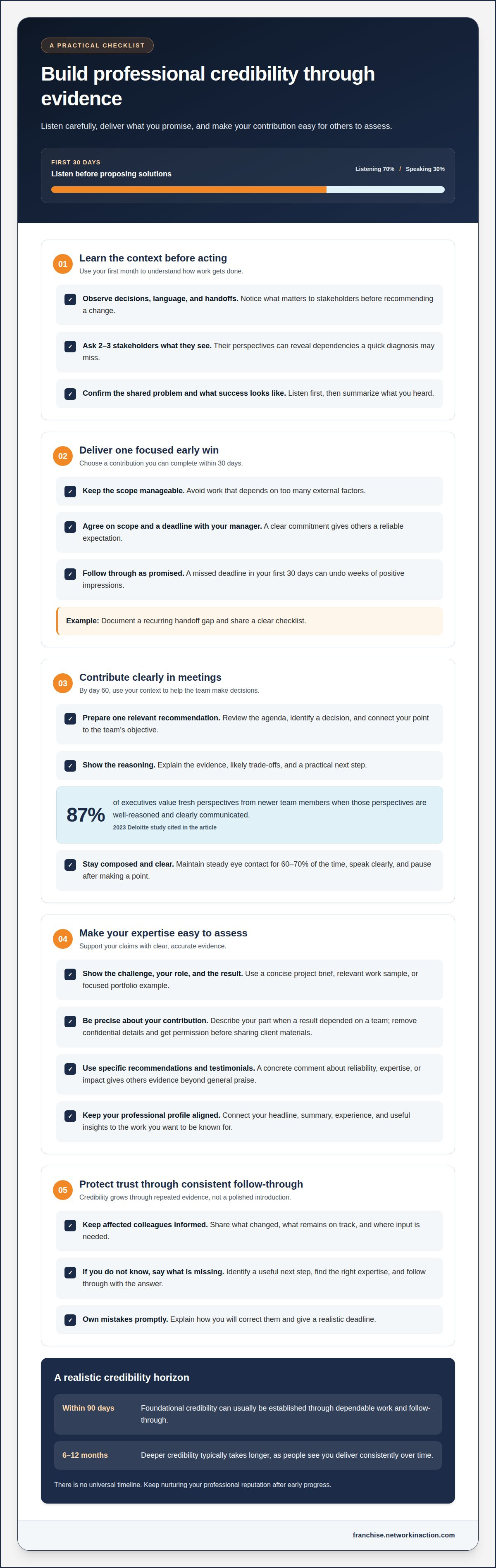
Foundational credibility can usually be established within 90 days. Deep credibility typically takes 6-12 months. Both depend on repeated evidence, not a polished introduction. Treat your first 30 days as a listening phase: observe decisions, language, and handoffs. A professional reputation needs continual nurturing, even after early progress.
During your first 30 days, listen for 70% of the time. Speak for the remaining 30%. Before proposing a solution, ask 2-3 stakeholders what they see. Their perspectives can expose dependencies that a quick diagnosis misses. Then summarize the shared problem and confirm what success should look like.
Choose an early win you can deliver within 30 days. Avoid projects that depend on too many external factors. For example, document a recurring handoff gap and share a clear checklist. Confirm scope with your manager, agree on a deadline, then deliver what you promised. A missed deadline in your first 30 days can undo weeks of positive impressions.
Certifications, education, and practical skills can demonstrate credibility by showing what you’ve studied and can apply. A project-management certification signals formal learning; a concise project brief shows applied skill. Connect each credential to a result: explain the problem, your approach, and the outcome. Describe completed training accurately, and be clear about the skills you’re still developing.
To build expertise beyond your assigned tasks, identify relevant conferences, follow interesting speakers, and read their work. Test their advice on real projects, then share a considered perspective colleagues can assess. Learning becomes credible when people see you put it into practice.
Avoid overpromising, missing commitments, or pretending to know what you don’t. When a request exceeds your expertise, suggest another approach or connect the person with a knowledgeable colleague. Own mistakes promptly, explain how you’ll correct them, and give a realistic deadline. Silence and defensiveness only add avoidable damage.
2. Client testimonials and work portfolios
Prospective clients often look up professionals online before deciding whether to work with them. A focused portfolio makes your contribution visible before the first conversation. Choose projects that show the challenge, your role, and the result. For example, a consultant could present a process redesign, explain the decisions they owned, and describe how the new workflow helped the client.
Make each example easy to assess with a short project summary, relevant work samples, and a clear explanation of your approach. Remove confidential details and get permission before sharing client materials. If a result depended on a team, describe your specific contribution rather than claiming the entire outcome. That precision strengthens trust.
References, testimonials, and professional recommendations add another person’s perspective to your own account. Ask a client or colleague for a specific comment about your reliability, expertise, or impact. A recommendation describing a concrete outcome gives prospective clients stronger evidence than general praise.
On LinkedIn, align your headline, summary, and experience with the work you want to be known for. Share a concise case study or useful professional insight, then explain its relevance to your field. A clear profile helps people connect your expertise with the opportunities they’re considering.
Keep your evidence current. After a project, record the challenge, your actions, and the outcome while the details are fresh. Choose a suitable sample for your portfolio and request a recommendation that describes your contribution. A brief, accurate project story shows how your judgment works in practice. Avoid inflated claims: readers can assess whether the evidence supports them.
3. Communicating contributions and speaking in meetings
By day 60, a new employee should have enough context to contribute meaningfully in meetings. Move from observation to useful participation. Before a meeting, review the agenda, identify one relevant decision, and prepare a concise recommendation. Tie your point to the team’s objective, then state the evidence behind it. This makes your contribution easier to evaluate and act on.
A 2023 Deloitte study found that 87% of executives value fresh perspectives from newer team members when those perspectives are well-reasoned and clearly communicated. Offer an idea with its rationale, likely trade-offs, and a practical next step. If a handoff delays a project, describe where it stalls and propose a small test. A relevant observation earns attention when it helps the group decide.
In conversations, maintain steady eye contact for 60-70% of the time. Keep your posture open, speak clearly, and pause after making a point. In a video meeting, look toward the camera when addressing the group, then check participants’ reactions. These signals help others follow your message without turning confidence into performance.
Credibility also depends on keeping colleagues informed. When a decision changes your work, tell affected teammates what changed, what remains on track, and where you need input. For example, a project lead can send a brief update when a revised deadline affects a shared deliverable. Timely communication prevents surprises and makes collaboration easier.
If you can’t answer a question, don’t bluff. State what you know, identify what’s missing, and offer a useful next step, such as finding a colleague with relevant expertise. Then follow through and share the answer. When you own a task, close the loop by reporting the result, not just the effort. Clear updates make your contribution visible and help leaders assess your judgment.
4. Networking and building genuine professional relationships
A professional network earns its value through trust, not contact volume. At an industry event, go beyond introductions: ask what challenge someone is working through, listen for context, and share a useful connection or idea when relevant. Genuine curiosity helps you understand the issue instead of rushing into a pitch.
Build relationships across teams and specialties, not only with people who share your role. A 2022 Harvard Business Review study reported that professionals who built cross-functional relationships in their first 60 days were 2.6 times more likely to be rated as high performers at their one-year review. The practical takeaway is simple: learn how another team works, understand its priorities, and look for ways to make collaboration easier.
At a networking event, prepare a concise introduction and one open question. Then give the other person room to speak. Perseverance matters; starting conversations takes effort, and a useful connection may develop over several interactions. Follow up on a commitment within 24 hours, whether you promised an introduction, an article, or a simple answer. Reliable follow-through turns a brief exchange into a basis for trust.
Map the people who can help you learn, collaborate, and grow your professional profile. Write down 2-3 names in each category, then identify a genuine reason to connect with each person. Ask experts a specific question about their work rather than requesting broad, unpaid advice. Trust colleagues first by sharing relevant context and being open about what you’re still learning. Reciprocity grows from honest exchanges, not forced favors.
Consistency keeps the network active. Michael Knouse says he spends 5 minutes a day nurturing key professional connections. Use a short daily check-in to congratulate a contact, share a useful resource, or respond thoughtfully to an update. Small, specific gestures keep relationships warm without turning every interaction into a transaction.
Network In Action
Network In Action offers a franchise opportunity for professionals ready to build credibility through community leadership. You can turn relationship-building into a structured business by leading local business referral groups and helping business owners form meaningful connections. Monthly meetings and a technology platform support connections beyond the meeting room, while the approach avoids forced referrals. The flexible model can give you more control over your schedule, with the potential to scale your business and build recurring revenue as your community grows. This can suit an experienced professional who values quality relationships and wants to create an impact in their business community. It’s a different path from simply growing your own network: you help create the setting where trust and professional relationships can develop. Explore whether leading a relationship-driven community aligns with your goals and preferred way of working. Contact Network In Action to start a conversation.
Turn credibility into your next opportunity
The question of how to build professional credibility from scratch can lead to a bigger decision: what do you want your reputation to make possible? For some professionals, the next step is applying their influence within a new venture. For others, it’s taking a leadership role in a community where strong business relationships matter.
Network In Action offers a franchise business opportunity for people interested in leading local business communities. Consider whether that direction fits your ambitions, working style, and appetite for building something of your own. The right move should align with the impact you want to create, not just the title you want to hold.
Explore the Network In Action opportunity and decide whether community leadership could be a meaningful next chapter. Keep building with intention. Your credibility can open doors to work and leadership that fit your goals.
Frequently Asked Questions
How long does it take to build credibility at a new job?
It depends on the role’s complexity, your responsibilities, and how often you can demonstrate sound judgment. Credibility develops as colleagues see you handle different situations, communicate clearly, and adapt when priorities shift. A role involving unfamiliar systems or high-stakes decisions may take longer to build trust. Focus on dependable work and visible progress rather than targeting a fixed date.
What Is Professional Credibility (and Why Does It Matter at a New Job)?
Professional credibility is the confidence others place in your judgment, ability, and reliability at work. In a new job, it affects whether teammates share information, consider your recommendations, and trust you with important responsibilities. For example, a colleague who explains a decision clearly and follows through gives others a concrete reason to rely on their work.
What's the difference between credibility and reputation?
Credibility is whether people trust your expertise and judgment in a particular situation; reputation is the broader impression they form over time. A strong reputation may help you earn an initial opportunity, but your conduct on the project determines whether colleagues trust your decisions. Each interaction can reinforce or reshape the reputation people bring to future work.
What does professional credibility mean, and what signals build it?
Professional credibility means your colleagues have good reason to trust what you say and do. Signals include accurate information, sound judgment, clear ownership, and appropriate transparency about limitations. For instance, a finance analyst who distinguishes confirmed figures from estimates gives decision-makers a clearer basis for action. These signals matter most when your words and decisions remain consistent under pressure.
How can a beginner build professional credibility with no experience?
You can build professional credibility without a long work history by making your current abilities visible. If you’re learning how to build professional credibility from scratch, choose a small, relevant project and document your process, decisions, and finished work. Coursework, volunteer assignments, and personal projects can demonstrate applied skills. Describe your contribution accurately, then use feedback to decide what to improve next.
What steps help establish credibility in a new industry or role?
Start by learning the industry’s terminology, customer priorities, and common measures of success. Review credible trade publications and study how experienced professionals explain their decisions. Then connect your existing skills to a current business need. For example, a teacher moving into corporate training can show how lesson planning supports employee learning. This translation helps others see relevant experience, not just a different job title.