Do you need the franchisor’s permission before contacting a franchisee? No. You can contact franchisees listed in the Franchise Disclosure Document (FDD) directly. Knowing what to ask former franchisees before buying helps you test whether the investment and support described on paper match the day-to-day experience.
You’re right to look beyond the sales pitch. Former franchisees can offer valuable perspective on actual startup costs compared with Item 7, the quality of training and ongoing support, and what changed when they left the system. Their answers are most useful when you compare them with the FDD and look for recurring themes, not just one person’s opinion.
This guide gives you focused questions for those conversations, from assessing an existing location to finding out whether the franchisor provided the support owners expected. You’ll have a clearer way to weigh the opportunity, spot gaps, and decide what to examine more closely before committing.
Key Takeaways
- Compare reported startup spending with the estimate in FDD Item 7, and ask which costs drove any differences.
- Speak with current and former franchisees, then look for patterns in their experiences rather than relying on one account.
- Ask for specific examples of training and ongoing support to understand how the franchisor helps owners handle day-to-day operations.
- When considering an existing location, explore its operating history, transfer terms, and any restrictions that could shape your plans.
1. Actual startup costs compared with FDD Item 7
Use Item 7 as the starting point, not a guarantee of your final opening budget. Ask former franchisees whether their actual startup costs matched the estimate, and where spending differed. Request concrete examples, such as extra site preparation, equipment, or opening inventory. Then compare those costs with the assumptions behind your own location and operating plan.
Timing matters. According to the Federal Trade Commission, federal law in the United States generally requires a franchisor to provide the Franchise Disclosure Document at least 14 calendar days before a prospective franchisee signs a binding agreement or pays the franchisor. Use that review period to study Item 7 and prepare focused questions for former owners.
Separate the initial franchise fee from the broader investment. Ask what the fee covered and whether other startup expenses came up before opening. Then discuss recurring costs. Item 6 lists ongoing royalty, marketing, and technology fees; ask former franchisees how those charges affected their operating budgets and whether other recurring expenses mattered. Compare their answers with the FDD rather than relying on memory alone.
Opening costs can vary with the location and its condition. Ask which expenses owners expected, which caught them by surprise, and what they would budget differently today. If a former owner mentions unexpected site work, for example, ask how it affected the opening schedule and total investment. Look for patterns across conversations rather than drawing conclusions from one unusual experience.
Ask when the business reached break-even and what helped or delayed that milestone. Follow up on revenue growth, operating expenses, customer acquisition, and opening delays. Ask when the owner recovered their full investment, too. These are distinct milestones, so clarify how each person defines them. The answers can help you assess whether your financial assumptions reflect the demands of opening and operating the franchise.
2. Questions to ask current and former franchisees
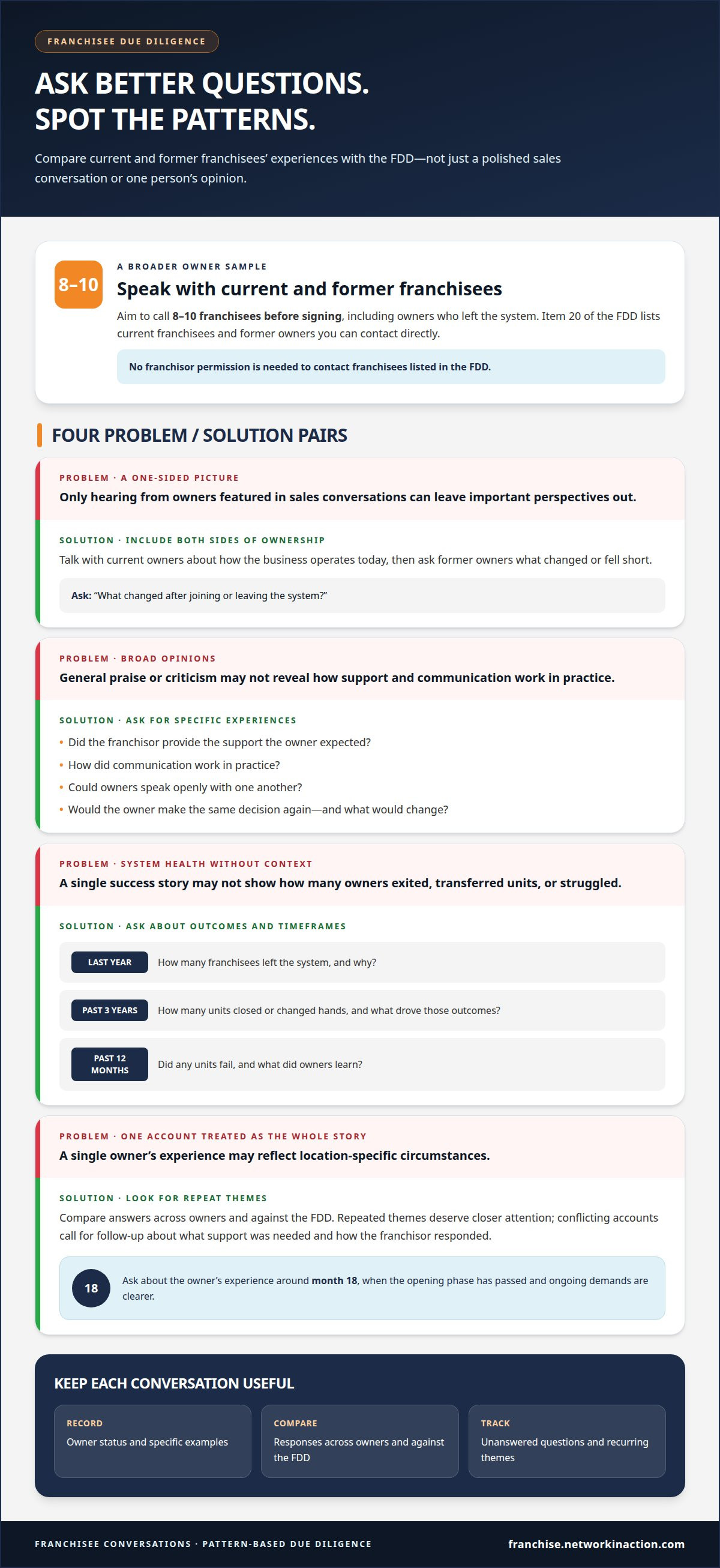
Build a balanced view by speaking with current and former owners, not only those featured in sales conversations. Aim to call 8-10 franchisees before signing, including owners who left the system. Item 20 of the Franchise Disclosure Document lists current franchisees and former owners you can contact directly. You don’t need the franchisor’s consent to call franchisees listed in the FDD.
When considering what to ask former franchisees before buying, focus on specific experiences, not broad opinions. Ask current owners how the business operates today, then ask former owners what changed or fell short. Did the franchisor provide the support they expected? How did communication work in practice? Could owners speak openly with one another? Would they make the same decision again, and what would they do differently?
- Ask how many franchisees left the system in the last year, and why.
- Ask how many units closed or changed hands during the past three years, and what drove those outcomes.
- Ask whether any units failed during the past 12 months, and what owners learned.
- Ask whether owners can share net-profit figures and explain how they calculated them.
Compare responses across owners and against the FDD. One account may reflect a location’s unique circumstances; repeated themes deserve closer attention. Ask franchisees about their experience around month 18, when the opening phase has passed and ongoing demands are clearer. If owners give conflicting accounts, ask what support they needed and how the franchisor responded.
Keep concise notes from each conversation: the owner’s status, specific examples, and unanswered questions. Knowing what to ask former franchisees before buying also means asking what they wish they had understood before joining or leaving. Their final reflections can surface practical issues that broader questions miss.
3. Training, onboarding, and ongoing support
Ask former franchisees how training prepared them to make day-to-day decisions. Which tasks did they practice, and what did they have to learn after opening? Request a specific example, such as handling a customer complaint or coaching a new employee. Find out who provided the training, how questions were answered, and whether the materials remained useful as the business changed.
Ask how support worked after initial onboarding. How did owners raise operational issues? What guidance did they receive, and was it practical? If a franchisee needed marketing help, for example, ask what the franchisor provided and what the owner still had to handle. Specific situations help distinguish access to support from guidance that resolves a real problem.
Ask about unexpected expenses for training, required tools, marketing, or suppliers. Former franchisees can describe which costs arose after launch and whether they were one-time or recurring. When discussing revenue and owner earnings, ask what records support the figures, which expenses were included, and whether owner compensation was counted separately from business profit.
Ask whether franchisees were satisfied with marketing resources, supplier arrangements, territory expectations, and ongoing guidance. Request a recent example in each area, such as a campaign that attracted customers or a support request that went unresolved. Then ask what response they expected and what happened. Concrete examples make broad opinions easier to assess.
To verify an account, compare it with the Franchise Disclosure Document and relevant public records. Match the owner’s description against written disclosures, agreements, and available business filings for the location. Check dates and entity names, and note any discrepancies for your due diligence. For earnings claims, distinguish reported revenue from expenses and owner earnings. Compare figures only when the terms mean the same thing.
4. Buying an existing franchise location
An existing location has an operating history, but past performance is not a forecast. Ask what changed in revenue, expenses, staffing, and customer demand. Compare the owner’s explanations with available records and the location’s current condition. Separate strengths that may carry over from issues you might need to address after taking over.
Item 20 identifies current franchisees and owners who left the system. Use it to find former owners with relevant experience, then ask why the location changed hands. A departure may reflect personal circumstances, financial pressure, or a mismatch with the operating model. Ask what the seller would improve if continuing, and what a new owner should understand before assuming operations.
Clarify the transfer process and obligations before treating the purchase as settled. Ask which agreements apply to you, what terms govern renewal or termination, and whether the franchisor must approve the transfer. Review Item 17 for agreement duration, renewal, transfer, and termination terms. Ask the seller which operational restrictions affect pricing, suppliers, and everyday decisions.
Ask direct, specific questions to test the location’s operating story. Which products or services drive repeat business? Which recurring expenses have the greatest effect on margins? Could staffing, equipment, or supplier arrangements change after the transition? Request examples and supporting records where available. A seller’s explanation is more useful when it reflects actual operations rather than broad assurances.
Build a transition checklist before deciding: transfer terms, ongoing obligations, operating restrictions, and unresolved issues. Then compare the seller’s account with current and former franchisee perspectives. If you’re weighing an independently led franchise opportunity, explore available franchise territories as another path to ownership. The key takeaway: assess the location and the system separately. An established site may offer operating context, while its transfer terms shape what you can do next.
Network In Action: Franchise a business opportunity
Network In Action offers a franchise opportunity for people ready to lead local business referral groups. If you want to build a relationship-driven business, its model uses monthly meetings instead of weekly gatherings and a technology platform to keep members connected. Franchisees receive training and ongoing support to build and manage groups of small to mid-sized business owners.
The opportunity may suit you if you value community leadership, quality relationships, and a more flexible approach than traditional networking. No forced referrals. A technology-enabled platform. A structured model built around professional connections. Consider how those elements fit your preferred role, operating style, and goals before choosing your next step.
If you’re exploring franchise ownership, contact Network In Action to discuss whether this opportunity fits your ambitions.
Turn your research into a confident next step
Knowing what to ask former franchisees before buying is about more than collecting answers. It can help you decide what kind of ownership suits your strengths, priorities, and interest in community leadership. Use what you learn to define the business you want to build, not just evaluate the opportunity in front of you.
For your next move, focus on fit. Consider whether a relationship-driven business matches how you want to grow professionally and contribute to your community. Network In Action offers a franchise opportunity for people interested in leading local business referral groups. Explore how that direction could support greater time autonomy and meaningful community impact, then take the next step at your pace.
Contact Network In Action to discuss the opportunity and explore whether it aligns with your plans. Your research is the foundation; your decision can shape what comes next.
Frequently Asked Questions
Do You Need to Ask the Franchisor’s Permission Before Contacting a Franchisee?
Yes. You can contact franchisees directly and ask to speak with them without having the franchisor arrange the conversation. Keep your request brief, explain that you’re evaluating the opportunity, and let the owner decide whether to respond. If they agree, ask whether they prefer a call or another format, and don’t request confidential business records. Respecting their boundaries helps keep the discussion candid and professional.
What questions should you ask current and former franchisees before buying a franchise?
Ask for specific examples that show how ownership fits your priorities. What does a typical workday involve? Which responsibilities take more time than expected? How much flexibility do owners have in organizing their schedules? Ask current owners what keeps them engaged and former owners what they would change about their decision. These questions reveal practical fit, not just general satisfaction.
How much did former franchisees invest in total, including fees and startup costs?
There is no single total that applies to every owner. Ask former franchisees to describe their actual spending by phase, from preparation through opening and early operations. Request categories and timing instead of relying on a rounded estimate. If they can share supporting documents, clarify what the records cover and whether the figures relate to one location, one owner, or a particular operating period.
How long did it take former franchisees to break even and become profitable?
There is no universal timeline, so ask how each owner defined and calculated the milestones. Find out whether their estimate included owner compensation, debt obligations, and seasonal revenue changes. Then ask which operating decisions affected the timing, such as staffing levels or customer outreach. Comparisons are useful only when owners use similar definitions and describe the same stage of business performance.
Why did former franchisees leave or sell their franchise?
Ask each former owner to separate personal reasons for leaving from business-related concerns. A sale might follow a planned career change, shifting priorities, or dissatisfaction with operating conditions. Ask whether the owner would have stayed if a specific issue had changed, and whether that issue affected other owners too. This helps distinguish an individual circumstance from a pattern worth understanding.
How much support and training did franchisees receive from the franchisor?
Ask owners what their training covered, which skills they developed, and where they needed more guidance. For ongoing support, ask how they raised questions, what responses were helpful, and whether the guidance worked in practice. A useful example could involve resolving an operational challenge or adapting a local outreach plan. These details show how support worked beyond a general promise.