
A franchisor generally cannot unilaterally change the royalty rate during the initial term if the agreement does not allow it. But hidden fees in franchise royalty structures can still raise your total costs. Advertising contributions, technology charges, required spending, and fixed monthly royalties may sit alongside the percentage royalty. A fixed monthly royalty is due regardless of revenue.
The distinction matters: a percentage-based charge changes with the revenue it applies to, while a fixed monthly charge does not. When sales dip, the fixed amount can take a larger share of your income, even if the stated royalty rate stays the same.
You’ll learn how royalties and advertising contributions affect total costs, where recurring and event-based fees appear in the Franchise Disclosure Document (FDD), and how fixed monthly royalties affect cash flow. The aim is to help you assess the full payment structure, not just the headline percentage, before making a franchise decision.
Key Takeaways
- Model the full payment structure, not just the headline royalty rate, to see how recurring charges affect operating cash flow.
- Assess advertising contributions alongside any local marketing commitments, and understand how the fund is managed and reported.
- Use the FDD’s fee and investment items to identify recurring obligations, sourcing restrictions, and potential costs beyond the initial fee.
- Test fixed monthly royalties against different revenue scenarios to understand how they may affect your margins when sales fluctuate.
Can royalty rates change during my franchise term?
A franchisor cannot unilaterally raise your royalty rate during the initial agreement term. That doesn’t freeze every ongoing payment. Separate technology, software, support, upgrade, and marketing obligations can still affect your costs, depending on the agreement’s terms.
Technology fees may be a fixed monthly charge or a percentage of sales. Some systems instead scale technology fees with sales at 1% to 2%. The payment method matters: a fixed amount stays due when revenue falls, while a percentage charge changes with sales.
Required software can create a recurring expense separate from royalties. Review the agreement for terms covering platform access, updates, support, and replacement systems. A technology fee may cover specific software, while support or upgrades may be separate obligations. Consider the system’s practical value alongside its total cost over the franchise relationship.
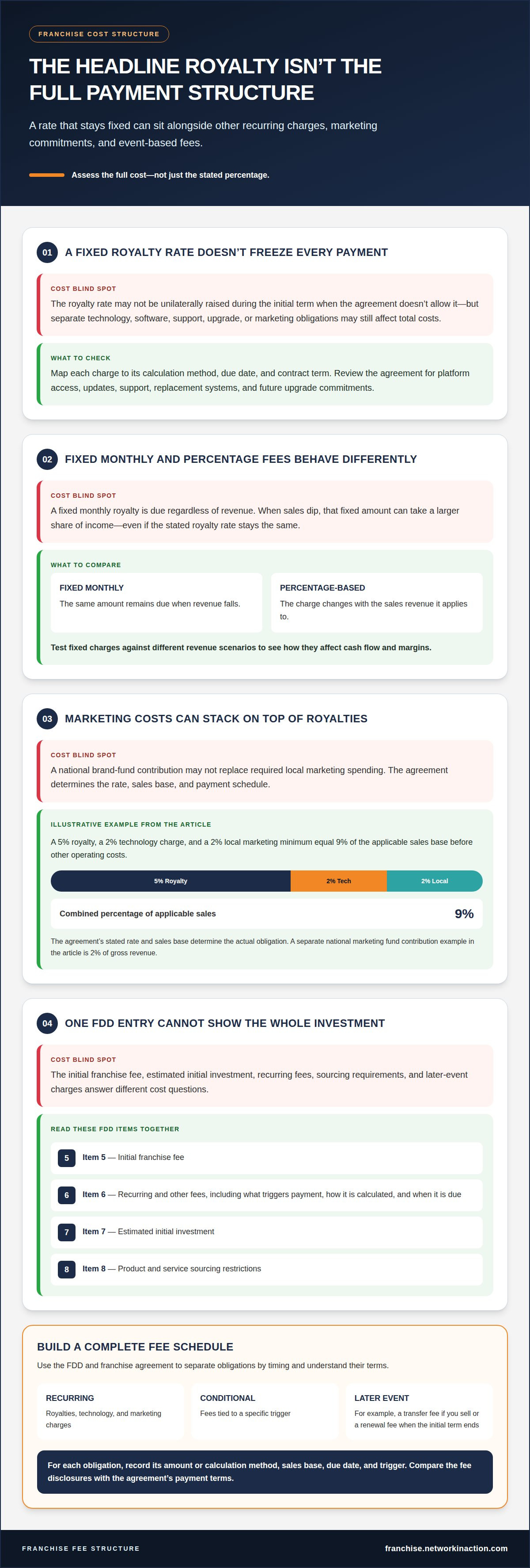
Technology isn’t the only additional percentage. Some agreements require local marketing spending of 2% to 3%, on top of a brand fund contribution. Model each percentage against the same sales base. For example, a 5% royalty, a 2% technology charge, and a 2% local marketing minimum would represent 9% of the applicable sales base before other operating costs.
Also look for future upgrade commitments. Some franchise agreements may require a re-imaging project every 5 to 7 years, which can involve substantial capital spending. Identify what triggers an upgrade, whether the franchisor sets the timing, and which costs fall to you. Renewal terms can set a different royalty rate than the initial agreement, so compare both periods.
Keep payment records alongside your sales reports. The Internal Revenue Service says businesses use Form 1099-MISC to report royalty payments of $10 or more. For planning, map every recurring charge to its calculation method, due date, and contract term. That view reveals how technology and marketing costs may change even when the stated royalty percentage stays fixed.
Advertising fund contributions and transparency
Advertising contributions can add recurring costs beyond royalties and technology fees. Their impact depends on how they are calculated, any required local spending, and the payment schedule.
Marketing Fund Contributions
Marketing fund contributions are payments toward advertising, brand promotion, national campaigns, or other marketing activities. They commonly range from 1% to 3% of gross revenue, while advertising fund contributions are also described across a 1% to 5% range. The agreement determines the applicable rate and sales base. Many franchise agreements also require minimum local marketing spending beyond the brand fund contribution, so budget both obligations.
Advertising Fund Transparency
To understand advertising contributions, check how they are calculated, managed, and reported. The FDD and agreement can clarify whether payments support national advertising, local campaigns, or other brand activities. A contribution to a national fund does not automatically replace required local marketing spending. Review the reporting period and fund-use terms to see what each payment covers.
A separate national marketing fund contribution example is 2% of gross revenue. These examples show why the rate alone doesn’t reveal the full commitment: the revenue base and any additional local minimums also shape total spending.
Map each marketing obligation separately in your operating forecast. Record its percentage, whether it applies to gross sales or another revenue base, its payment schedule, and any local minimum. Then compare those obligations with the advertising activities and fund reports described in the agreement. This makes it easier to distinguish a brand contribution from an additional marketing commitment and assess their combined effect on operations.
Franchise Disclosure Document fee and investment items
The Franchise Disclosure Document (FDD) separates initial investment estimates from recurring and event-based fees. Its numbered items can help you identify obligations beyond the initial franchise fee.
FDD Fee Disclosures
FDD Item 6 covers fees a franchisee may incur, including recurring charges and other fees beyond royalties. Use it to identify what triggers each payment, how it’s calculated, and when it’s due. Franchise royalty fees are distinct from the one-time initial franchise fee, so don’t treat the entry fee as the full cost of joining a business model.
For a broader view, Items 5, 6, 7, and 8 address different cost questions. Item 5 covers the initial franchise fee; Item 7 details estimated initial investment; Item 8 covers product and service sourcing restrictions. Reading these together can reveal how required purchases and ongoing obligations affect your projected costs.
Reviewing FDD Fees
Start with Item 6 and group each charge by timing: recurring, conditional, or tied to a later event. Then compare those obligations with the franchise agreement, where the payment terms and triggers are set out. For example, a transfer fee may apply if you sell, while a renewal fee may arise when the initial term ends.
These amounts illustrate why a single entry figure cannot represent the full investment. Item 7’s estimated initial investment and Item 6’s fee disclosures serve different purposes, so include both in your financial model.
Also note any audit fees, required purchases, and recurring technology or marketing charges listed in the FDD. Create a schedule showing each fee’s amount or calculation method, due date, and trigger. This helps separate startup costs from ongoing and event-based obligations, then assess whether the full structure fits your capital plan.
Fixed monthly royalty fees
A fixed monthly royalty is due regardless of how much revenue the franchise generates. Unlike a percentage charge, it does not fall when sales decline, so it can take a larger share of available cash during a slow period. Find out whether the system uses a flat payment, a percentage, or both.
Compare the mechanics. A 4% royalty changes with the sales base; a fixed monthly charge stays constant. That difference affects your investment planning, especially before the business reaches steady revenue. Model both structures against stronger and weaker sales scenarios. The same fixed payment may be manageable at one sales level but restrictive at another.
Some agreements combine both methods. Another sets a percentage royalty with a monthly minimum. In either case, the minimum determines what you owe when the percentage calculation falls below that floor. Read the FDD and agreement together to understand which formula applies.
Payment timing matters too. Franchise royalties may be collected weekly or monthly, often through automatic bank drafts. A set draft schedule can make cash flow more predictable, but it does not make the charge flexible. Include payment dates in your operating forecast alongside advertising contributions and other recurring obligations.
Before signing, identify the royalty base, calculation method, payment frequency, and any minimum. Calculate the amount due at different revenue levels, including a period with little or no sales. Review how the agreement handles opening delays, temporary closures, and renewal. These terms determine when a fixed charge starts or whether a specific trigger applies. Clear terms also make payment administration easier.
A fixed monthly royalty may suit a franchise system with predictable obligations, but it shifts more low-sales risk to you. Assess it as a cash commitment, not just another headline rate. Compare total royalty payments under realistic sales conditions rather than focusing on the percentage alone.
Network In Action: Franchise a business opportunity
Network In Action offers a franchise opportunity for professionals ready to lead local business referral groups. When weighing recurring obligations against the value a franchise system provides, examine its operating model as closely as its fees.
Network In Action replaces weekly meetings with monthly gatherings and uses a proprietary technology platform to keep members connected. Franchisees receive training and support to build and manage groups of small and mid-sized business owners focused on high-quality referrals. This model may suit entrepreneurs who value community leadership, relationship-driven growth, and an alternative to traditional weekly networking.
Consider whether leading a local group fits your goals, working style, and interest in building professional relationships over time. Contact Network In Action to explore the franchise opportunity.
Make Your Next Franchise Decision With Clarity
The cost of hidden fees in franchise royalty structures is only one part of the decision. Consider whether the business model, recurring obligations, and your role in the franchise align with the future you want to build. Use the financial review to identify opportunities that fit your goals and rule out those that do not.
For entrepreneurs drawn to relationship-driven growth and local community leadership, Network In Action offers a franchise business opportunity. Explore whether that path matches your priorities, working style, and plans for building professional credibility. A thoughtful next step can turn a broad franchise search into a clearer direction. Contact Network In Action to explore the opportunity and decide whether it aligns with your ambitions.
Frequently Asked Questions
What Actually Counts as a “Hidden” Cost?
A cost may feel hidden because it is easy to overlook, not necessarily because it is concealed. Hidden fees in franchise royalty structures can include conditional charges, required purchases, or obligations listed separately from the headline royalty. For example, a prospective owner may focus on the recurring percentage and overlook a fee triggered by a transfer or renewal. Map routine expenses separately from event-based costs.
What Do Royalty Fees Cover?
Royalty fees generally cover the ongoing right to operate within a franchise system and access the resources specified in its agreement. What the fee includes varies by franchisor, so the amount alone does not tell you what support or brand assets are provided. Separate charges may apply to services outside that package. Treat the royalty description as a starting point, then match each promised benefit to its contractual terms.
What Do You Get in Return for Royalties?
A royalty pays for access to the ongoing value a franchise system makes available, not a guaranteed business result. For Network In Action franchisees, ongoing monthly royalties provide access to corporate resources and brand equity. Assess this exchange by identifying the resources available, how they support daily operations, and whether they fit your growth plan. A clear value assessment connects recurring payments to practical business needs.
What Is a Typical Franchise Royalty Rate?
Franchise royalty fees across most categories typically range from 4% to 8% of gross revenue. That range is a benchmark, not a complete cost comparison: two agreements can have different payment bases and additional obligations. For example, a lower percentage may not mean a lower total outlay if separate charges also apply. Compare the calculation method and full recurring cost structure when assessing the rate.