
Strong networking doesn’t happen by accident. Knowing how to prevent member cliques in a networking group starts with building inclusion into the group’s design: mix members consistently, structure events to encourage conversations beyond familiar circles, and address exclusion promptly. A clique is an inner circle that limits who gets welcomed into conversations, relationships, or opportunities.
That pattern can be easy to miss at first. Members may naturally gravitate toward people they already know, but if the same small circle dominates every meeting, others can feel overlooked and the group’s potential to build relationships shrinks. Learn to spot the signs, create practical ways to rotate connections, and address emerging cliques without turning every interaction into a confrontation. Event formats can also make it easier for members to meet, exchange ideas, and build trust across the group. The goal isn’t to force friendships or referrals. It’s to create a structure where genuine professional relationships have room to grow.
Key Takeaways
- Build a simple rotation into meetings and social activities so members regularly connect beyond their usual circles.
- Watch for repeated patterns of closed conversations or overlooked members, and gather perspectives to understand how the group feels.
- Address exclusion early with calm, direct leadership that resets expectations and opens space for broader participation.
- Design events around shared discussion and purposeful introductions so members have natural reasons to build new professional relationships.
1. Mix groups consistently, including during social activities
Make connection-building a routine, not a one-time welcome gesture. At each meeting, rotate seating so members aren’t always beside familiar contacts. During a dinner or informal gathering, invite people to join a different table or conversation. A hockey coach described by Nadia Kyba built team relationships from day one across a 40-year coaching career. Networking leaders can apply that principle by setting inclusive expectations from a member’s first event.
Set clear group expectations against monopolizing conversations, excluding members from introductions, and favoring friends when opportunities arise. Then model those expectations: leaders can introduce newer members, invite quieter participants to contribute, and share speaking time fairly. These practices make inclusion visible without dictating who must become friends. They also clarify that professional opportunities should be based on relevance and contribution, not insider status.
Use rotation with purpose. Change seating between meetings, pair members who haven’t spoken recently, and create short breakout discussions around a shared business challenge. For example, ask each participant to introduce someone they haven’t met and explain that person’s work. At social activities, optional conversation prompts or host-led introductions can make it easier to join a group. Recurring formats help members anticipate new connections instead of relying on chance.
Assigned seating and mandatory mixing can backfire if they feel punitive, disrupt an important conversation, or treat members as interchangeable. Keep the structure light, explain its purpose, and let people decline a particular pairing. Leaders should use inclusive language, avoid inside jokes that shut newcomers out, and invite feedback after events. Mentorship, an ambassador buddy system, or an online discussion space can help members build familiarity between meetings. The aim is access, not forced closeness: create more ways into the community while respecting individual choice.
2. Recognize when friendship groups become exclusionary
A clique is a social circle that limits access to conversation, introductions, or professional opportunities. Friendship alone isn’t exclusion; the defining issue is a repeated pattern that leaves other members outside. For example, the same colleagues might make decisions in private and present them at meetings as settled plans. Observing the pattern helps leaders respond to conduct instead of judging personal relationships.
Cliques can form through familiarity, shared work, or repeated contact. Members may keep choosing familiar contacts when meetings offer few reasons to connect across the group. To understand how to prevent member cliques in a networking group, distinguish natural affinity from behavior that restricts others’ participation. A close circle becomes a concern when its members control access to useful conversations or consistently dismiss outside contributions.
Look for observable signals: members repeatedly interrupting newcomers, useful information circulating privately, or the same people receiving follow-up while others are overlooked. One missed introduction may be accidental; recurring patterns across meetings deserve attention. Note specific incidents, such as a member being excluded from a discussion, rather than labeling someone unfriendly. Concrete examples help separate intent from impact.
Ask current and former members whether they felt welcomed, included, excluded, or marginalized. Invite examples tied to particular interactions, then compare those accounts with what leaders observed. When considering how to prevent member cliques in a networking group, this input can reveal barriers that aren’t visible during formal meetings. A quieter member may prefer listening, while another may be trying to contribute but repeatedly gets ignored. Check whose ideas receive discussion and whose introductions lead to follow-up. These patterns give leaders a fair basis for action and help protect access without treating every friendship as a problem.
3. Address emerging cliques promptly
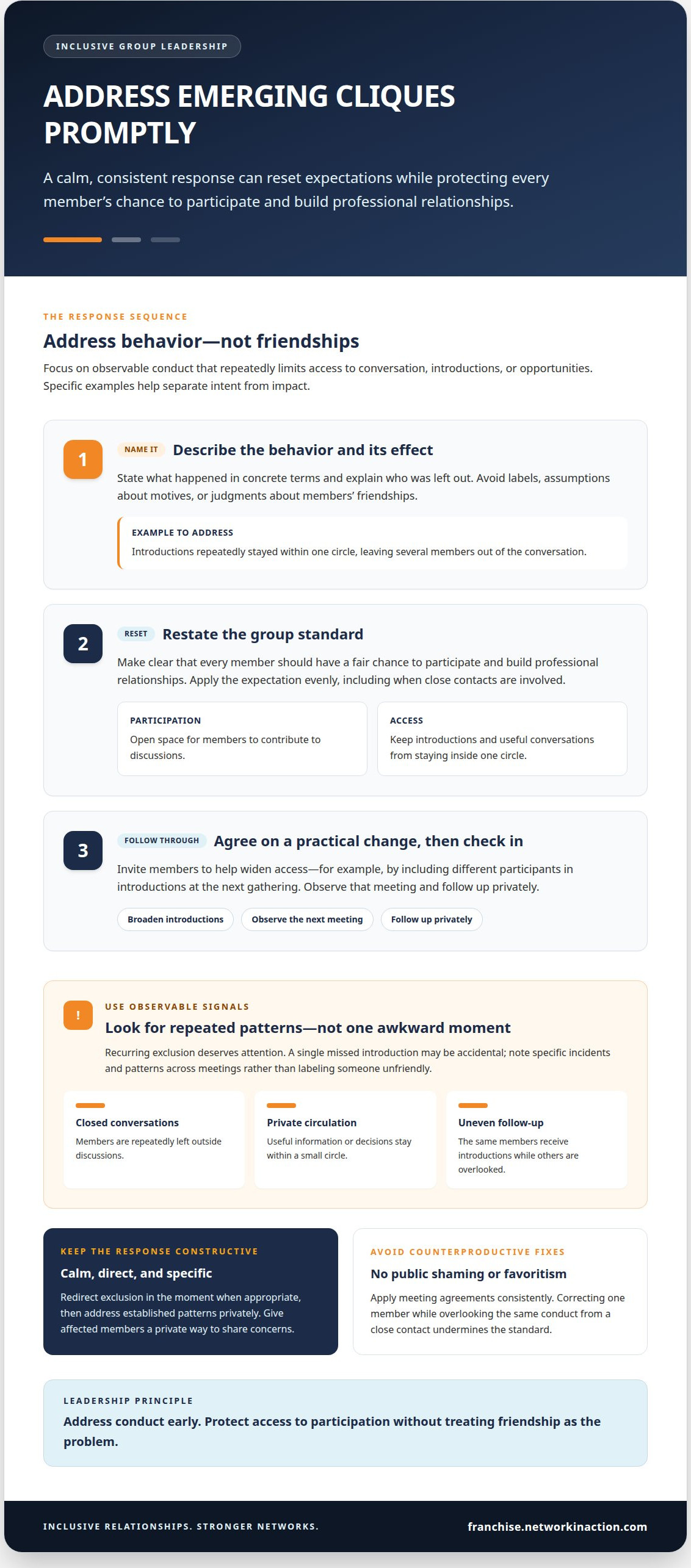
Act when exclusion starts, not after it becomes the group’s norm. Address a clique when you see it beginning rather than waiting to see whether it goes away. A networking leader can apply the same principle: interrupt a closed conversation by welcoming an overlooked member, or redirect an introduction toward someone outside the familiar circle. A timely, calm response resets expectations without turning a small incident into a public dispute.
For an established clique, speak privately with its members. Describe observable conduct, such as repeatedly excluding others from discussions, rather than labeling people or questioning their friendships. Explain the group standard: every member should have a fair chance to participate and build professional relationships. Then invite them to help widen access, perhaps by making introductions beyond their usual contacts at the next gathering. This addresses behavior while preserving dignity.
Use a clear sequence. First, name the specific behavior and its effect: “The last introductions stayed within one circle, so several members missed the conversation.” Next, restate the expectation and agree on a practical change, such as including different participants in introductions. Finally, observe the next meeting and follow up privately. A direct conversation paired with a visible adjustment is more useful than a vague reminder to “be inclusive.”
Keep the response consistent across the group. If leaders correct one member for dominating a discussion but ignore the same behavior from a close contact, favoritism undermines the standard. Apply meeting agreements evenly, redirect exclusion in the moment, and give affected members a private way to share concerns. Avoid naming or shaming people in front of the room; public blame can trigger defensiveness and deepen divisions. Instead, explain the expected conduct to everyone, then address repeated incidents directly with those involved. Consistent leadership makes inclusion a group norm, not a personal dispute.
4. Designing events that connect members
An event agenda should give members a reason to engage beyond routine introductions. Open with a focused business question, then let members explore its practical implications through a shared activity. For example, a group could map the customer journey for a sample business and identify where different professional expertise adds value. Members contribute from their own experience, while the common task gives conversation a clear purpose.
Build a deliberate arc into the program. Start with context, move into collaborative work, then close with a reflection on what members learned from one another. Avoid filling every minute with presentations; leave room for participants to develop an idea together. A host can explain the activity’s outcome upfront, such as producing a short list of useful approaches, so members know how their contributions fit.
Choose activities that reward varied expertise rather than individual performance. A practical scenario, such as planning a business expansion, can draw useful perspectives from finance, marketing, operations, and legal professionals. Ask the group to consider the scenario from distinct angles, then combine those insights into a shared response. This gives members a concrete reason to value expertise beyond familiar specialties and something substantive to discuss afterward.
Make a new member’s first event easy to follow. Send the agenda in advance, explain activities in plain language, and identify the host who can answer process questions. During the meeting, give the newcomer a meaningful role suited to their experience, rather than putting them on the spot. Afterward, review which activities produced useful collaboration and which were difficult to join. Use that feedback to refine the next event’s flow.
Use online forums, discussion groups, and virtual networking opportunities to support connections beyond in-person events and help members stay connected between gatherings.
Network In Action
Network In Action offers a franchise opportunity for professionals who want to lead local business networking groups. Its model combines monthly meetings, a technology platform that keeps members connected, and training and support for franchisees building and managing groups. These tools can help leaders create a consistent structure for introductions, participation, and ongoing professional relationships. Inclusive community-building still depends on how leaders set expectations and guide interactions.
If you want to lead a group where members build strong connections beyond familiar circles, explore whether the Network In Action franchise fits your goals. Contact Network In Action to discuss the opportunity.
Build a Community People Want to Stay In
The strongest professional communities earn members’ trust through everyday leadership choices. Make openness part of how decisions are made, contributions are recognized, and members shape the group’s direction. Shared ownership gives people a meaningful stake in the community’s future.
Understanding how to prevent member cliques in a networking group can help you build a culture that supports lasting professional credibility and shared progress. If you’re ready to explore what community leadership could look like for you, contact Network In Action today.
Take the next step with curiosity and a clear sense of what you want to build. A more connected professional community starts with leaders willing to set a higher standard.
Frequently Asked Questions
What Is a Clique?
A clique is a close-knit group whose internal norms shape who gets influence and access. To distinguish a clique from ordinary friendship, consider whether members outside the circle can raise concerns, contribute to decisions, and receive fair consideration. For example, if a committee repeatedly consults the same friends before setting group priorities, the concern is unequal influence, not the friendship itself.
How can networking group leaders encourage members to mix with different people?
Give members a shared reason to seek perspectives beyond their usual contacts. A leader might invite participants to identify a challenge they’re facing, then ask the group to suggest relevant expertise or useful introductions. Keep the request voluntary and specific. This makes broadening professional connections useful in the moment, rather than a social exercise members may experience as forced.
What meeting formats help prevent cliques in professional networking groups?
Use a member-led roundtable where participants bring current questions and the group chooses which ones to explore. A rotating discussion lead can ensure the agenda reflects different professional interests, while a brief closing report captures insights for everyone. This format gives members a reason to share their knowledge and makes the meeting valuable even for those who aren’t presenting.
What role should facilitators play in preventing cliques at networking events?
Facilitators should set conditions for fair participation before the event begins. Clarify how members request the floor, keep discussion focused, and explain how decisions or follow-up actions will be handled. Afterward, a short debrief with the event team can identify whether the agenda or room setup created barriers. This operational review improves the format without singling out participants.
How can a networking group measure inclusion and member engagement?
Combine attendance records with a brief confidential pulse check. Ask whether members had a useful opportunity to contribute, learned something relevant, and know how to raise a concern. Review responses alongside voluntary reports of follow-up conversations or collaborations. Keep the questions consistent over time, and share what changes the group makes in response. Closing the feedback loop shows members their input matters.