
Set your income floor before you set a resignation date. Calculate the monthly income you need for personal essentials, business overhead, taxes, and benefits, then build a consistent baseline revenue for 3 consecutive months and keep 1 year of living expenses in savings. That’s a practical starting point for escaping the 9-to-5 corporate grind without making the leap on hope alone.
The pull of more autonomy is real, but so is the security of a predictable paycheck and employer benefits. A strong plan accounts for both: it names what you’re leaving, what your new income must cover, and how you’ll handle uneven revenue during the transition.
This guide helps you assess what keeps you in corporate work, plan for uncertainty, estimate the income and client capacity you’ll need, and weigh benefits you may have to replace. You’ll come away with a clearer financial threshold and a more deliberate way to decide when the move makes sense.
Key Takeaways
- Separate the reasons you want to leave from the financial security your job provides, then define what your next chapter must deliver.
- Build a transition plan around uneven revenue, business overhead, and the personal savings you’ll need to manage uncertainty.
- Calculate the income your household requires, then estimate the clients and workload needed to support that target.
- Factor health coverage and retirement saving into your income floor, and explore whether leading a professional networking franchise aligns with your goals.
Financial and psychological reasons people stay in corporate jobs
In the U.S., realistic alternatives include freelancing, consulting, remote employment, and building an independent business. Compare each path with your income needs, skills, and preferred work structure before deciding.
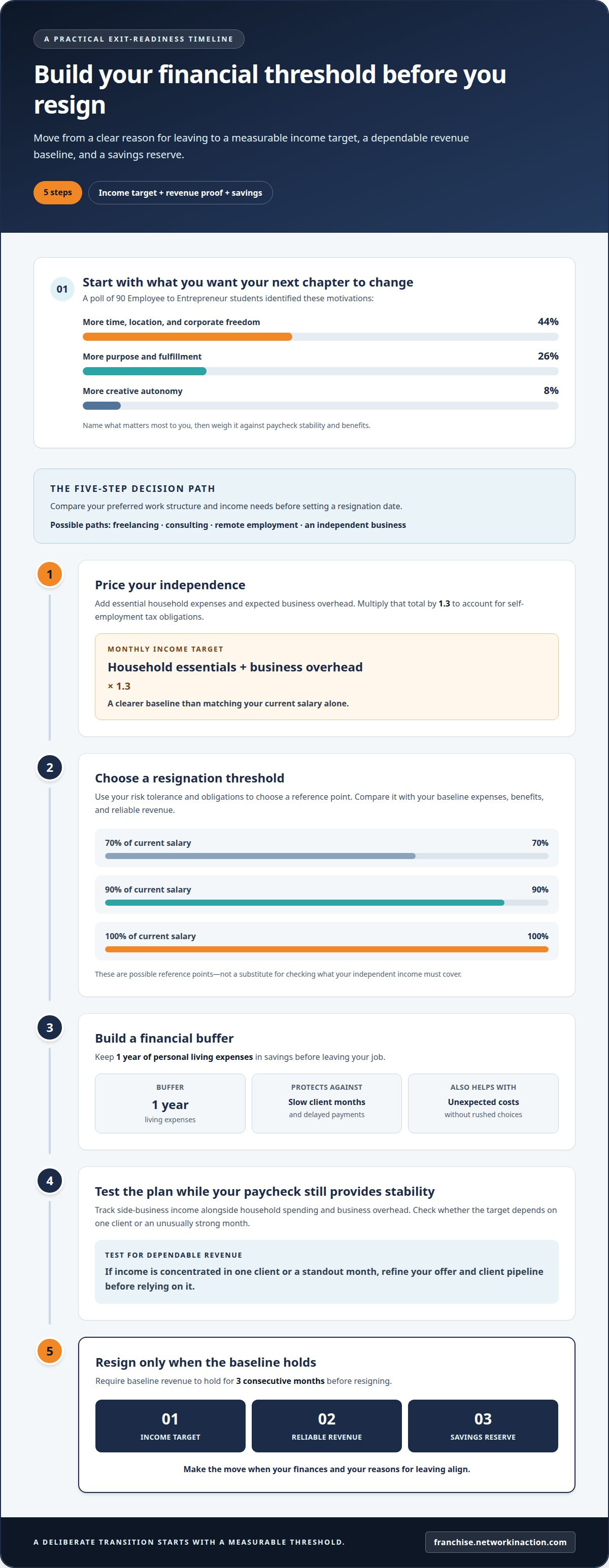
- Name what keeps you there. A poll of 90 Employee to Entrepreneur students found that 44% wanted time, location, and corporate freedom; 26% sought purpose and fulfillment, while 8% wanted more creative autonomy. Write down which of these matters most to you, then rank it against paycheck stability and benefits.
- Price your independence. Add essential household expenses and expected business overhead to find your monthly baseline. Multiply that total by 1.3 to account for self-employment tax obligations. This gives you a clearer income target than simply matching your current salary, which may not cover the full cost of working independently.
- Set a resignation threshold. Choose a target based on your risk tolerance and obligations. Possible reference points include 70%, 90%, or 100% of your current salary. Compare each level with your baseline expenses, benefits, and reliable revenue. Then require that baseline revenue to hold for 3 consecutive months before resigning.
- Build a financial buffer. Keep 1 year of personal living expenses in savings before leaving your job. That reserve can absorb a slow client month, delayed payment, or an unexpected household expense without forcing you to accept work that undermines your career goals.
- Test the plan before you leave. Track side-business income alongside household spending and business overhead. If your target depends on one client or an unusually strong month, refine your offer and client pipeline while your paycheck still provides stability. Make the move only when your finances and reasons for leaving align.
Managing uncertainty during the transition to self-employment
Remote jobs keep you employed and may eliminate the commute, though flexibility depends on the role. Contract work brings project-based income, while self-employment gives you more control over clients and schedule, along with responsibility for finding work and managing revenue.
- Calculate your post-employment income floor. List essential household costs, business overhead, debt payments, and the cost of replacing workplace benefits. Separate needs from discretionary spending, then total the monthly obligations your independent income must cover. This gives you a cash-flow-based decision point, not one tied to your former job title.
- Stress-test the transition. Model a slow client month, a late invoice, and an unexpected expense. The roadmap recommends setting aside 10-12 months of income before leaving. Keep that reserve separate from money assigned to taxes, operating costs, or planned purchases.
- Shift from employee to owner. Employees are often paid for an assigned role; owners must also generate demand, deliver value, and manage cash flow. Block out time each week for sales, client work, and administration. Track leads and revenue alongside completed projects to connect your effort with results.
- Connect your plan to your reason for leaving. Wanting flexibility, purpose, or creative control can shape your next move, but each goal needs a workable model. Remote employment preserves an employer relationship; consulting requires client acquisition; a business needs both a marketable offer and systems to deliver it.
- Review employment restrictions before acting. Read your agreement for terms covering confidential information, client relationships, outside work, and non-competes. Note the exact clauses and dates, then seek advice from a qualified employment attorney before approaching former clients or launching a competing offer. Contract language and applicable rules affect the risk.
- Use a measurable exit trigger. One transition guideline is to wait until side-hustle income reaches at least 50% of current income. Pair that signal with your expense floor, reserve, and dependable pipeline. This turns leaving from a mental leap into an owner-level decision based on several operating measures.
Calculating minimum viable income and client capacity
Startup costs depend on your business model: a service-based side hustle may need different tools and setup than a product business. Income potential depends on pricing, customer demand, repeat purchases, and the time you have to deliver.
- Define your monthly income target. Start with the amount your household needs after business expenses and taxes. Separate essential spending from discretionary goals, then translate the essential target into revenue. For example, if you earn from projects, count expected payments after delivery costs, not the full amount invoiced.
- Map startup costs before committing. List every expense required to serve your first customer: tools, materials, software, marketing, and any needed space. Mark each as essential or deferrable. A consultant may start with a laptop and specialized software, while a product seller may need inventory and packaging. This distinction helps limit early cash exposure.
- Calculate client capacity from delivery time. Estimate the hours each client requires, including preparation, communication, revisions, and administration. Then compare that workload with the hours you can reliably work. The sample daily-time calculation leaves 30 minutes of personal time each day, underscoring why available time must shape your client target, not just desired revenue.
- Work backward from achievable sales. Divide your revenue target by the amount you retain from each sale after direct costs. This gives you the sales volume needed, not a promise of demand. If a service requires substantial customization, account for fewer clients and more in-depth work. If delivery is repeatable, your capacity may depend more on fulfillment systems.
- Build multiple income streams in sequence. Start with one core offer, then add a complementary source that serves the same audience, such as ongoing support after a project. Track revenue and workload separately for each stream. This shows which activity contributes income without consuming the time needed to deliver the main offer or travel for client work.
Health insurance and retirement considerations
- Make healthcare a line item. Before leaving an employer-sponsored plan, identify how you’ll maintain coverage and what your household must budget. Compare available plan premiums, deductibles, prescriptions, and provider access with your current coverage. A lower premium can still mean higher costs when you need care, so consider total exposure rather than one figure alone.
- Plan for a coverage transition. Write down when your current benefits end and when replacement coverage could begin. Include ongoing prescriptions, regular appointments, and family members in your plan. If a spouse or partner has employer coverage, assess whether that option fits your household and timeline. A clear schedule helps prevent a gap from disrupting your lifestyle.
- Replace the retirement routine. Corporate employment may make retirement saving automatic through payroll. Self-employment means setting up that system yourself. Schedule recurring contributions based on cash flow, then review them alongside business expenses and personal withdrawals. Learn about individual retirement accounts and self-employed retirement plans before choosing an approach.
- Account for lost employer contributions. If your company contributes to a 401(k), include that value in your transition comparison. Estimate what you must save independently to maintain your long-term goal. Separate retirement contributions from emergency savings, so an unexpected expense doesn’t quietly become a reason to stop investing.
- Build benefits into your income floor. Include health coverage and retirement saving in your monthly business target, rather than treating them as optional extras after revenue arrives. If a client payment covers household expenses but leaves no room for either, your business hasn’t replaced the full value of employment. Revisit the plan as income, coverage needs, and work structure change.
Network In Action
Network In Action offers a franchise business opportunity for professionals ready to lead local business referral groups. Its model centers on curated, high-quality membership and relationship-building without forced referrals, giving community leaders a focused way to help business owners connect.
Monthly meetings and a technology platform help members stay engaged between gatherings. For franchisees, the subscription-based model offers recurring revenue, alongside the opportunity to build a business around personal priorities. It may suit professionals who want to lead a community, build credibility, and pursue greater autonomy through entrepreneurship.
Consider whether this opportunity fits your goals, experience, and preferred way of working. Contact Network In Action to discuss the franchise opportunity.
Make Your Next Move Deliberate
Your income floor is more than a resignation trigger. It’s a filter for choosing work that fits your priorities, risk tolerance, and preferred way to contribute. Use it to assess each opportunity by how it creates value, develops professional relationships, and supports the life you want to build. Escaping the 9-to-5 corporate grind becomes a stronger move when your next step reflects both your financial plan and your ambitions.
For professionals drawn to community leadership and relationship-driven growth, Network In Action offers a franchise business opportunity. Franchisees build and lead local business referral groups, combining entrepreneurship with the work of helping business owners develop valuable relationships.
Explore whether this model aligns with your goals, then decide what you want your next professional chapter to deliver. Contact Network In Action to discuss the franchise opportunity and take a thoughtful step toward work shaped by your own priorities.
Frequently Asked Questions
What does escaping the 9-to-5 corporate grind mean?
It means moving from a conventional corporate schedule or employment structure toward work that better fits your priorities. Options include freelancing, consulting, remote employment, or running a business. The goal isn’t simply fewer hours; it’s choosing how you earn, structure your work, and build professional relationships around the life you want.
How much savings should you have before quitting your job?
Set your savings target by considering essential obligations, household responsibilities, and how quickly your new income can become dependable. Keep personal reserves separate from operating cash so business purchases don’t consume money intended for household needs. For example, a parent with fixed childcare costs may need a different reserve plan from someone whose expenses can adjust more easily.
How do health insurance and retirement benefits work when self-employed?
Self-employed workers arrange their own coverage and retirement accounts, then manage the related records and decisions. Keep policy documents, payment records, and account statements separate from business transactions. Review beneficiaries and investment choices as part of an annual financial review, and update them after major life or business changes. A consistent recordkeeping routine makes it easier to track how these commitments evolve.
What are the risks of quitting a stable job, and how can you reduce them?
Beyond income uncertainty, a business can become overly dependent on one customer, referral source, or offer. Reduce that exposure by tracking where opportunities come from and documenting which services clients buy. If one source dominates, strengthen other relationship channels before relying on it. Clear project scopes also help prevent unplanned work from eroding capacity.
What steps should you take to leave corporate work without financial hardship?
Plan the operational handoff as carefully as the financial transition. Document ongoing responsibilities, organize work files you’re entitled to retain, and prepare a professional handover for colleagues. Set a weekly owner’s schedule for sales, delivery, and administration before your final day. This gives your independent work a practical rhythm, instead of leaving every new task to compete for attention.