
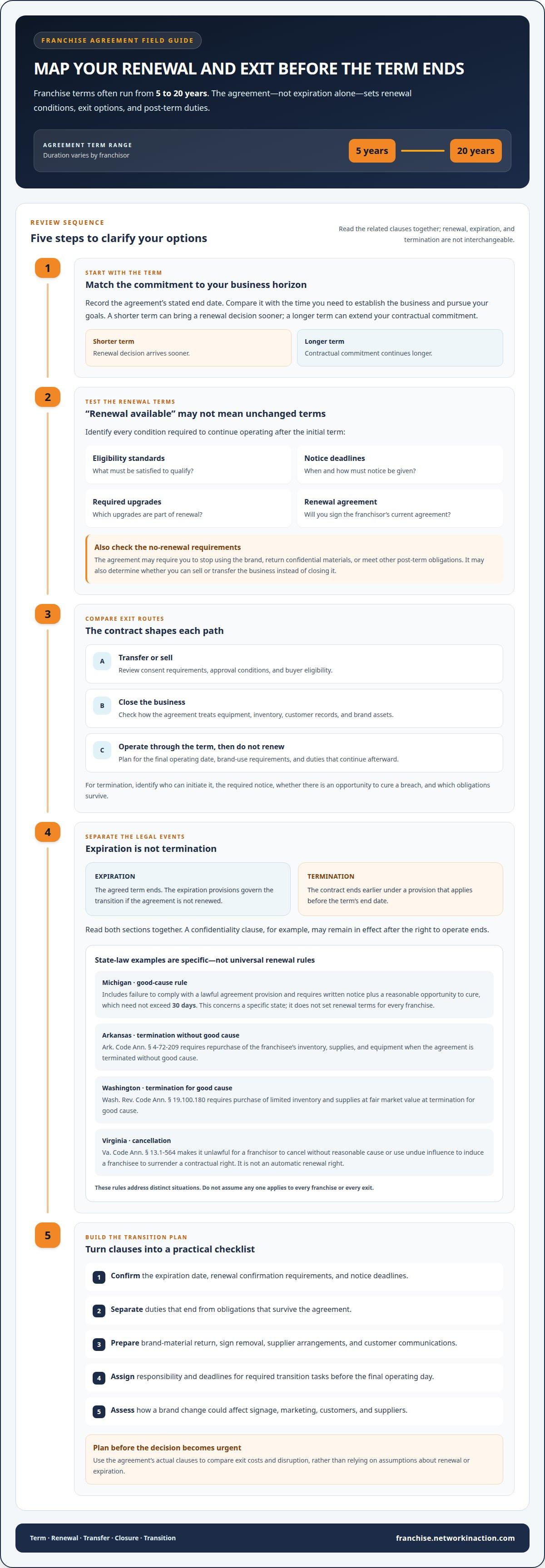
A franchise agreement often runs for 5 to 20 years, and expiration doesn’t automatically mean renewal. The agreement determines whether you can renew, what conditions apply, and what happens if you leave or the term ends. The franchise agreement renewal clauses to review before buying can shape your options long before that decision arrives.
A long term can support a business plan, but it also makes renewal and exit terms part of your investment decision from day one. Learn what typical term lengths mean, how renewal conditions and expiration can affect your next move, and which exit provisions deserve close attention. The goal is practical clarity: understand the commitment, identify the clauses that affect flexibility, and plan for the agreement’s end well in advance.
Key Takeaways
- Compare the agreement’s term with your business horizon so the commitment supports your longer-term plans.
- Identify what the contract requires for renewal, including deadlines, conditions, and any changes that could affect your decision.
- Understand what expiration or an early exit could mean for your business, assets, and ability to continue operating.
- Plan for renewal and exit before either becomes urgent, using the agreement’s terms to guide your next move.
How long is a standard franchise agreement term, and what happens upon expiration?
Franchise agreement terms often range from 5 to 20 years, though duration varies by franchisor. Expiration doesn’t automatically renew the agreement; the contract sets the available options and conditions.
Agreement Duration
An agreement term is the period during which you may operate under the franchisor’s contract and system. A 5-year term and a 20-year term create different planning horizons for investment, operations, and potential exit. Compare the stated end date with the time you need to establish the business and pursue your goals. A shorter term may bring renewal decisions sooner, while a longer term can extend your contractual commitment.
Renewal Conditions
Renewal conditions are the contract requirements you must meet to continue operating after the initial term. Check eligibility standards, notice deadlines, required upgrades, and whether renewal means signing the franchisor’s current agreement. “Renewal available” does not necessarily mean the same terms will continue. For example, if the agreement requires written notice by a set date, meeting that deadline is essential, not just an administrative detail.
Check what happens if you don’t renew. The agreement may require you to stop using the brand, return confidential materials, or meet other post-term obligations. List each required action and deadline, then consider the effect on staff, customers, equipment, and ongoing commitments. The expiration terms may also determine whether you can sell or transfer the business instead of closing it.
Separate expiration from termination before assessing legal protections. Michigan’s good-cause rule includes a franchisee’s failure to comply with a lawful agreement provision and requires written notice and a reasonable opportunity to cure, which need not exceed 30 days, according to Michigan Legislature. That rule concerns a specific state; it doesn’t establish the renewal terms for every franchise. Read the agreement’s governing provisions alongside the rules that apply to the location. Track deadlines and conditions in a calendar before signing, so renewal rights don’t depend on memory.
Exit strategies
If the franchisor refuses renewal, the franchise ends at expiration under the agreement and applicable law. You may need to stop using the brand and complete post-term duties, such as removing signs or returning proprietary materials.
Before signing, map your exit routes: sell or transfer the business, close it, or operate until the term ends without renewing. Each route depends on the contract. A transfer clause may require approval, set conditions, or limit who can take over. A closure clause may specify how to handle equipment, inventory, customer records, and brand assets.
Inventory treatment can also depend on the reason for termination and state law. Arkansas law requires a franchisor to repurchase the franchisee’s inventory, supplies, and equipment if the agreement is terminated without good cause, under Ark. Code Ann. § 4-72-209. Washington law requires a franchisor to purchase limited inventory and supplies from the franchisee at fair market value at termination for good cause, under Wash. Rev. Code Ann. § 19.100.180. These are distinct rules; don’t assume either applies to every franchise or every exit.
Build an exit plan from the agreement’s actual clauses. Identify who can initiate termination, what notice is required, whether you have an opportunity to cure a breach, and which obligations survive. Then assess the operational impact: changing the brand could affect signage, marketing, customer communications, and supplier arrangements. A permitted transfer may preserve business continuity, but only if you meet its approval conditions.
- Transfer: Review consent requirements and buyer eligibility.
- Closure: List assets and post-term duties.
- Termination: Match notice and cure provisions to the stated grounds.
Use these steps to compare exit costs and disruption before committing. A clear plan lets you make a deliberate decision instead of reacting when a renewal decision or termination notice arrives.
Franchise term expiration
At the agreement’s end date, its expiration provisions govern the transition. Locate the expiration date, any renewal confirmation requirements, and duties that continue afterward. One clause may require written notice before the term ends, while another sets post-term responsibilities. Together, these terms determine whether you can continue operating under the brand after expiration.
Expiration and termination are different. Expiration occurs when the agreed term ends; termination ends the contract under a provision that applies earlier. Read both sections together. If the term ends without renewal, identify when brand use must stop and which obligations survive. A confidentiality clause, for example, may remain in effect after your right to operate ends.
Build a transition checklist from the agreement, not assumptions. Include the final operating date, required notices, brand materials, supplier arrangements, customer communications, and any transfer or closure process. If the contract requires removing branded signs, assign responsibility and set a deadline before the final day. If it covers customer records, check how that clause affects your transition plan.
- Confirm: Record the expiration date and notice requirements.
- Separate: Mark duties that end from obligations that survive.
- Prepare: Plan the brand transition, asset handling, and customer messaging.
State law can also affect what happens at the end of a franchise relationship. For example, Virginia law makes it unlawful for a franchisor to cancel a franchise without reasonable cause or use undue influence to induce a franchisee to surrender a contractual right, under Va. Code Ann. § 13.1-564. That provision concerns cancellation; it should not be treated as an automatic renewal right. The agreement’s expiration language and applicable law remain distinct issues.
Use a final-year plan to assess whether continuing makes business sense. Compare expected operating needs with post-term requirements, then decide whether renewal, transfer, or closure best fits your objectives. A written timeline turns the end date into a managed transition, not a last-minute scramble.
Planning for renewal or exit
Make renewal planning part of your operating plan, not a last-minute contract review. The franchise agreement renewal clauses to review before buying should guide your budget, assignment of responsibilities, and preparation for a leadership transition.
Required Renovations and Upgrades
Renewal upgrades are physical or operational changes required to continue using the franchise system. Separate required work from improvements you would make anyway, then assign each item to a budget cycle and responsible person. A planned equipment replacement may fit routine capital planning, while a new facility standard could affect site operations. This distinction helps you weigh renewal requirements against broader business priorities.
State Laws on Renewal and Nonrenewal
State laws can regulate franchise cancellation, good cause, and contractual choice of law, with protections varying by jurisdiction. New York’s dealer-franchise statute identifies failure to comply with a substantive agreement requirement and failure to act in good faith as examples of good cause under N.Y. Gen. Bus. Law § 199-c. Almost half of U.S. states have enacted statutes or rules restricting franchisors’ ability to include choice-of-law clauses.
For planning, identify the law chosen in the agreement and the state where the business operates. Compare those provisions before relying on a statutory example from another jurisdiction. Keep copies of contract versions, renewal communications, and operational decisions. These records can clarify how the parties handled obligations over time and provide a structured basis for evaluating a renewal offer.
Succession planning adds another layer. Identify who could take over day-to-day leadership, which relationships depend on your direct involvement, and what knowledge needs documenting. A successor, for example, may need operating procedures, vendor contacts, and customer-transition plans. Add transfer approval steps to your timeline so a leadership handoff does not begin only after you decide to exit.
Use the franchise agreement renewal clauses to review before buying as a planning tool: connect contract obligations to budgets, records, and succession responsibilities. That preparation helps make renewal or transition a deliberate business decision.
Network In Action: Franchise a business opportunity
Network In Action offers a franchise opportunity for professionals ready to lead local business referral groups. If you’re comparing franchise commitments, consider how this model fits your preferred work style, growth goals, and plans for community leadership.
Franchisees build and manage groups of small to mid-sized business owners focused on high-quality referrals. Monthly meetings and a technology platform support ongoing connections, while training and support help franchisees develop and manage their groups. The model offers a structured approach to relationship-driven growth, rather than relying solely on cold prospecting.
If leading a professional community fits your goals, explore the franchise opportunity details and consider whether the model aligns with your plans.
Make Your Next Move Deliberately
Your next decision should connect the franchise opportunity to the kind of business and professional life you want to build. Treat franchise agreement renewal clauses to review before buying as part of your investment thesis, not as details to leave until signing. Clear priorities can help you weigh operational control, long-term flexibility, and the responsibility of leading a business community.
Before moving forward, write down the conditions that matter most: the level of independence you want, the role you want to play in local business relationships, and how you’ll define progress. Use those priorities to assess whether a franchise model fits your ambitions and preferred way of working. The right next step is an informed exploration, with room to ask practical questions and consider alignment.
Network In Action offers a franchise business opportunity for professionals considering that path. Explore the opportunity with Network In Action and decide whether it fits your goals. Build your next chapter with intention.
Frequently Asked Questions
What renewal rights and options does a franchise agreement provide?
A renewal clause may provide an option to continue, describe a negotiated renewal, or leave renewal to the franchisor’s decision. Check whether the right belongs to the franchisee or requires mutual agreement, and whether it applies to the same location and territory. Compare it with related provisions, too: a transfer or ownership-change term may affect who can exercise the renewal option.
What notice deadline and renewal process must a franchisee follow?
The contract’s notice rules determine how to preserve a renewal request. Beyond noting the deadline, identify who is authorized to submit it and who in your business must approve the decision. Keep a dated copy of the request and any delivery confirmation with the agreement. A decision log can also record when leadership approved renewal and which assumptions informed that choice.
What financial conditions apply to franchise agreement renewal?
Financial conditions may combine amounts owed with the cost of meeting renewal requirements. Build a forecast that separates recurring obligations, one-time changes, and ordinary operating expenses. Then assess how each affects cash flow under your current operating plan. This analysis can show whether renewal requires a manageable transition budget or a larger commitment that changes the business case.
Can a franchisor change fees, royalties, or operating standards at renewal?
Renewal terms may differ from the current agreement if the contract allows updated terms or requires a new agreement. Assess each proposed change by its business impact, not just its label. For example, a revised reporting process may require staff time or new workflows even if fees do not change. A side-by-side comparison helps reveal the combined effect of operational and financial revisions.
Must a franchisee sign the franchisor’s current agreement to renew?
The agreement may require you to sign a replacement contract to renew, so examine how that document interacts with the existing one. Look for integration language that could replace earlier written arrangements, and check whether territory, ownership, or other negotiated terms carry forward. List the provisions that matter to your business, then compare them with the proposed renewal document before accepting it.
What performance requirements or defaults can prevent franchise renewal?
Renewal decisions may depend on how the agreement measures compliance, not simply on whether a problem occurred. Track the source, date, and resolution of each inspection finding or performance concern. If a metric is disputed, preserve the underlying reports and your calculation method. This record helps you compare the franchisor’s stated concern with the measurement standard in the contract.