
Time freedom is designed into a business; it doesn’t come from working harder and hoping to reclaim your calendar later. Building a business that gives you time freedom starts with defining what success looks like for you, then shaping your systems, capacity, and decisions around that goal. A focused 15-minute exercise can help you clarify what you want your business to make possible.
More revenue isn’t enough if every result still depends on your time. Building a business that gives you time freedom means creating operations and relationships that support growth without making you the bottleneck. That takes deliberate choices about what you do, how work gets done, and where your attention has the greatest value.
Here, you’ll learn how to define time freedom in practical terms, assess your capacity, and create repeatable systems that reduce day-to-day dependence on you. You’ll also see how to revisit those decisions as your business and priorities evolve, so growth supports the life you want instead of consuming it.
Key Takeaways
- Define what a successful business should make possible in your life, then use that vision to guide decisions.
- Identify the work that depends too heavily on you and look for repeatable ways to handle it.
- Build growth around strong professional relationships and community leadership, not just more activity.
- Explore whether a networking franchise opportunity aligns with your goals for flexibility, scalable growth, and meaningful impact.
Building a business that gives you time freedom
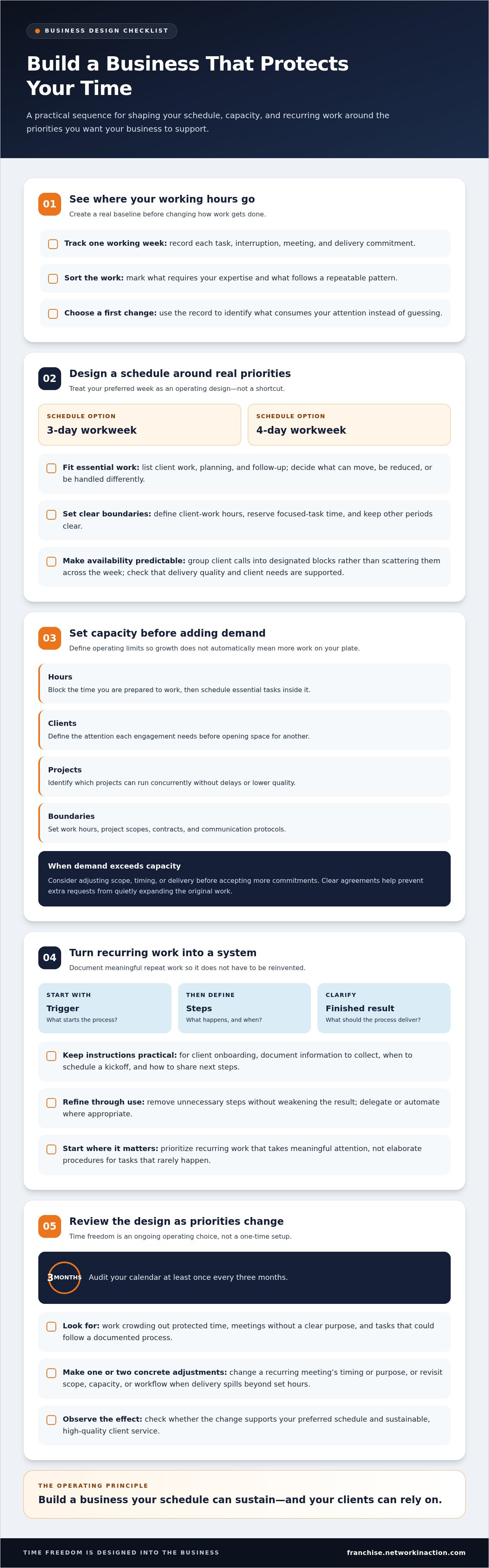
Building a business that gives you time freedom starts with seeing where your working hours actually go. For one working week, record each task, interruption, meeting, and delivery commitment. Mark which activities require your expertise and which follow a repeatable pattern. This gives you a practical baseline: rather than guessing why your days feel crowded, you can identify what consumes your attention and decide what to change first.
Design a schedule around real priorities
Use that record to sketch a workweek that fits your priorities. You might choose a three-day schedule or build around a four-day workweek. Treat either option as an operating design, not a shortcut. List the client work, planning, and follow-up that must fit, then decide what can be moved, reduced, or handled differently. Your schedule should reflect actual delivery needs and personal commitments.
Next, translate your preferred schedule into clear working boundaries. Set the hours for client work, reserve time for focused tasks, and keep other periods clear. For example, a consultant could group client calls into designated blocks instead of scattering them across the week. This gives project work a predictable place and makes availability easier to communicate. Review whether the arrangement works for clients and supports the quality of your delivery.
Set capacity before adding demand
Growth can reduce your flexibility if every new client adds more work to your plate. Assess your capacity by deciding how many hours you can work, how many clients you can serve, and how many projects you can handle at once. Treat these choices as operating limits. When demand exceeds them, consider adjusting scope, timing, or delivery before accepting more commitments.
- Hours: Block the time you’re prepared to work, then schedule essential tasks inside it.
- Clients: Define the level of attention each engagement needs before opening space for another.
- Projects: Identify which work can run concurrently without creating delays or lowering quality.
- Boundaries: Set work hours, project scopes, contracts, and communication protocols.
Clear boundaries make your schedule easier for clients and collaborators to understand. A defined project scope, for example, helps prevent extra requests from quietly becoming part of the original work. A communication protocol can specify where project updates belong and when you respond during working hours. These agreements protect your focus and make expectations easier to manage.
Turn recurring work into a system
Choose a task you perform repeatedly and document its process. Start with the trigger, the steps, and the finished result. A repeatable client onboarding process, for instance, can outline what information you collect, when you schedule a kickoff, and how you share next steps. Keep the instructions practical enough for someone else to follow, then refine them as the process changes.
Systems reduce reliance on memory and make routine work easier to delegate or automate where appropriate. They can also reveal unnecessary steps. Review a process after using it, and remove friction without weakening the result. Don’t build elaborate procedures for tasks that rarely happen. Start with recurring work that takes meaningful attention, then improve the workflow based on what actually occurs.
Review the design as priorities change
Time freedom isn’t a one-time setup. Business needs shift as your offers, responsibilities, and personal priorities evolve. Audit your calendar at least once every three months. Look for work that repeatedly crowds out protected time, meetings without a clear purpose, and tasks that could follow a documented process. Then make one or two concrete adjustments and observe their effect on your workload.
If a recurring meeting interrupts concentrated project work, for example, consider changing its timing or purpose. If client delivery regularly spills beyond your set hours, revisit scope, capacity, or workflow. These reviews keep your operating model aligned with your preferred schedule. The strongest design isn’t the one that looks efficient on paper. It’s the one your business can sustain while serving clients well.
Use systems and documented processes for recurring tasks, so routine work doesn’t have to be reinvented. Clear work hours, project scopes, thorough contracts, and communication protocols can help creative business owners protect their time freedom.
As your business grows and your priorities shift, adjust how you work. Audit your calendar at least once every three months to review commitments. A four-day workweek is one way to shape a lifestyle business around your preferred schedule.
Network In Action: Franchise a business opportunity
Network In Action offers a franchise opportunity for professionals interested in leading local business referral groups. Its model centers on curated, high-quality membership and relationship-driven growth, without forced referrals. Monthly networking meetings and a technology platform help members stay connected between gatherings. Franchisees receive training and ongoing support to build and manage their groups.
This opportunity may suit you if you want to lead a business community while building a more flexible professional path. Consider whether group leadership, relationship-building, and developing a local network fit your strengths and priorities. The franchise model offers a way to pursue community impact alongside business growth.
Contact Network In Action to explore how its franchise opportunity aligns with your goals.
Make Your Next Move Deliberate
Your next business decision can protect the priorities you’ve defined or pull you back into a model built around constant availability. Before pursuing an opportunity, decide what you want your leadership role to involve, which responsibilities fit your strengths, and what kind of schedule you intend to sustain. Those choices give you a practical way to evaluate whether an opportunity matches your vision.
Network In Action offers a franchise opportunity for people interested in leading professional communities. Consider whether that path aligns with how you want to work and the impact you want to make. Building a business that gives you time freedom means choosing an operating model that supports your priorities, then leading it with intention.
Explore the opportunity and decide whether it fits your direction. Review the Network In Action franchise opportunity, and take your next step with clarity and confidence.