
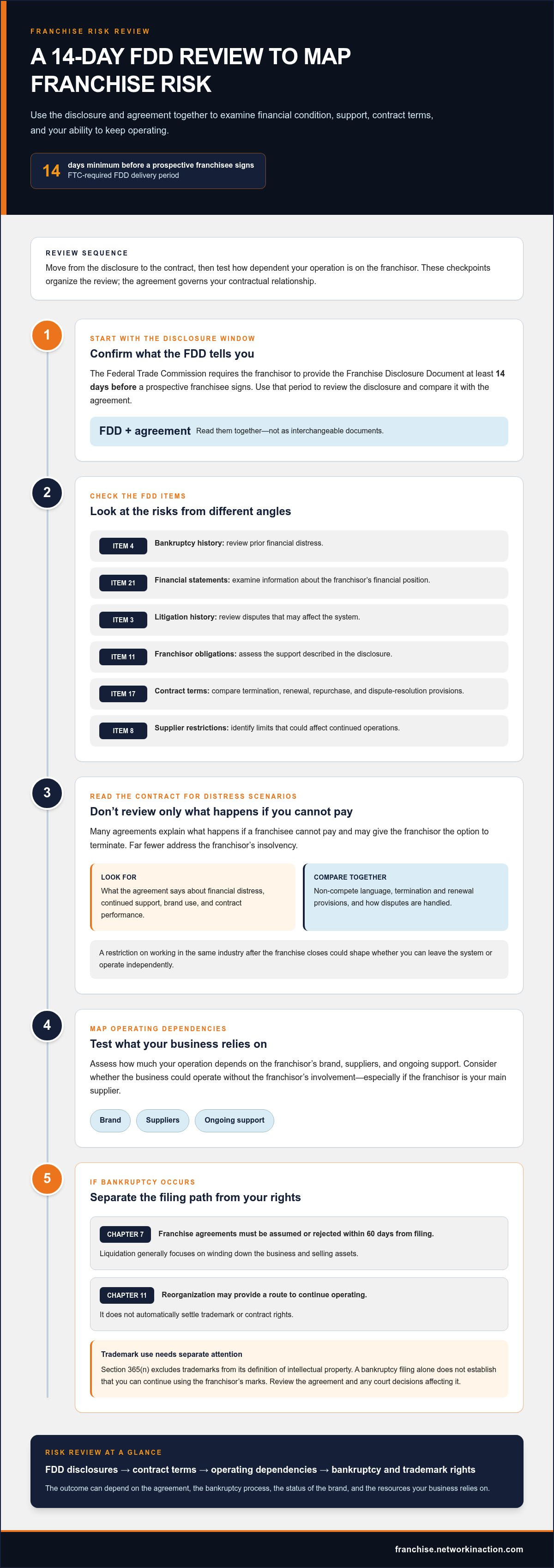
If a franchisor goes out of business, your right to use its trademarks can be at risk, and the outcome depends partly on whether it liquidates or reorganizes. Under Chapter 7, franchise agreements must be assumed or rejected within 60 days from filing bankruptcy. Chapter 11 may give the franchisor a path to reorganize, but it doesn’t automatically settle your trademark or contract rights.
That uncertainty matters: you may need to weigh the brand’s value against your ability to keep operating without the franchisor’s support. To understand what happens if a franchisor goes out of business, look beyond the bankruptcy filing. Consider the franchise agreement, the status of the brand, and the resources your business depends on. This article explains how trademark use, contract terms, operations, and personal financial exposure may be affected, helping you assess the risks and decisions ahead.
Key Takeaways
- Separate the franchisor’s bankruptcy path from your trademark rights; the outcome can affect whether you keep operating under the brand.
- Review the Franchise Disclosure Document and agreement for provisions on financial history, termination, renewal, and dispute resolution.
- Assess how much your business depends on the franchisor, including its brand, suppliers, and ongoing support, before making operating decisions.
- If you’re exploring a franchise opportunity built around leading a professional community, consider how Network In Action aligns with your business goals.
Can I continue using the franchisor’s trademarks if they file for bankruptcy?
Not automatically. Your right to use the brand depends on the franchise agreement, the bankruptcy process, and whether the franchisor continues operating or sells its assets.
Liquidation Versus Reorganization
Chapter 7 generally involves liquidation, while Chapter 11 gives a franchisor a route to reorganize and seek to continue as a viable company. The difference matters because a liquidator’s priority is winding down the business and selling assets, while reorganization may preserve operations. The treatment of a franchise agreement may depend on the bankruptcy process, so its status can change.
Trademark rights need separate attention. Under 11 U.S.C. § 365(n), licensees have options for certain intellectual-property licenses, but trademarks are excluded from that provision’s definition. A bankruptcy filing alone therefore doesn’t establish that you can keep using the franchisor’s marks. Review the agreement and any court decisions affecting it before relying on continued brand use.
Reorganizing or Closing the Franchise
Chapter 11 can allow a franchisor to propose a repayment plan, restructure loans, and seek to keep a potentially profitable business operating. The alternative may be an orderly closure, sometimes with the business continuing without its existing branding. For you, the distinction affects whether the brand, supplier relationships, and support systems your operation relies on remain available.
Even if a buyer acquires the franchisor’s assets, continued trademark use depends on which rights are transferred and what your agreement says. The assets may include intellectual property used in the business, which franchisees may have an opportunity to acquire. Assess whether your business can operate without the franchisor’s involvement, especially if the franchisor is your main supplier.
Separate rules may apply to particular industries. According to the Office of the Federal Register, National Archives and Records Administration, in most cases a motor-fuel supplier must give a franchisee at least 90 days’ notice before termination or nonrenewal takes effect. That notice rule doesn’t resolve trademark rights in other franchise sectors. Identify the applicable contract terms and industry rules before making operational decisions.
Franchise Disclosure Document and contract terms
The Franchise Disclosure Document (FDD) gives you a structured starting point for assessing a franchise system’s financial and legal risks. The Federal Trade Commission requires franchisors to provide the FDD at least 14 days before a prospective franchisee signs. Use that review period to compare the disclosure with the franchise agreement, which controls your contractual relationship.
Focus on the FDD items that reveal different parts of the risk:
- Item 4: Review the franchisor’s bankruptcy history for prior financial distress.
- Item 21: Examine the franchisor’s financial statements for information about its financial position.
- Item 3: Review litigation history for disputes that may affect the system.
- Item 11: Assess the franchisor’s obligations, including the support described in the disclosure.
- Item 17: Compare termination, renewal, repurchase, and dispute-resolution terms.
- Item 8: Identify supplier restrictions that could affect your ability to keep operating.
Then read the agreement for provisions addressing the franchisor’s financial distress, not just your own. Many agreements explain what happens if a franchisee cannot pay, often giving the franchisor the option to terminate. Far fewer address the franchisor’s insolvency, leaving questions about continued support, brand use, and contract performance to be resolved under the agreement and through the bankruptcy process.
Look closely at non-compete language, too. Some franchise agreements may restrict your work in the same industry after the franchise business closes. That restriction could shape your options if you need to leave the system or operate independently. Compare the clause with the termination and renewal provisions in Item 17, and note how the agreement handles disputes. These terms can affect your choices if the franchisor’s financial condition deteriorates, so assess them together rather than treating the FDD as a standalone document.
Chapter 7 liquidation and franchise rights
Chapter 7 liquidation turns the franchisor’s assets into value for creditors and can put your franchise agreement before the bankruptcy court. Under 11 U.S.C. § 365, the court can address whether franchise agreements, commercial leases, supplier contracts, and non-compete agreements are assumed or rejected. That decision affects more than your brand. It can shape your contractual rights and the resources available to operate.
If the franchisor’s agreement is rejected, the outcome can depend on the governing law and the court. In the U.S. Eleventh Circuit and the U.S. Bankruptcy Court for the Middle District of Georgia, a non-debtor party has been held not to have to continue performing after rejection. That ruling applies to those jurisdictions, not universally. The contract terms and location of the case matter.
Section 365(n) may let a licensee retain certain intellectual-property rights after a trustee rejects a license, while continuing royalty payments. That option does not automatically preserve trademark use, because the provision excludes trademarks from its definition of intellectual property. Separate rights in software or other licensed materials may still matter to your operation. Identify which assets your agreement actually licenses.
A sale by the franchisor may include intellectual property used across the franchise system. Franchisees may have an opportunity to acquire those assets if they want to continue under the same brand. Treat that possibility as a business transaction, not an automatic right. Before pursuing a purchase, assess the liabilities attached to the business with experienced advisers.
Rejection also doesn’t guarantee that royalties or other claims disappear. An administrator may lack the resources or inclination to pursue franchisees who stop paying or seek to leave, but that doesn’t prevent enforcement. If you sublease your premises from the franchisor, you may be able to negotiate improved terms directly with the landlord. Map each contract, payment obligation, and property arrangement before deciding how to proceed.
Financial risks of buying and operating a franchise
Franchise failure can expose you to losses beyond falling sales. Royalties and marketing fees are typically calculated on gross income, not profit. Fees may therefore remain due even as rising costs squeeze your margin. Before committing capital, map fixed costs, royalty calculations, debt payments, and dependence on suppliers. A strong revenue figure alone doesn’t show whether your business can withstand disruption.
NPC International illustrates the scale of system-wide exposure. It operated more than 1,600 Pizza Hut and Wendy’s locations and filed for Chapter 11 bankruptcy in 2020. Its bankruptcy process included closing about 300 Pizza Hut locations. A large brand network doesn’t eliminate risks at individual locations. If a franchisor restructures or closes, evaluate whether your unit can trade without its usual supplier access, brand support, or operating systems.
Personal guarantees create a separate risk. If you personally guarantee a franchise loan, business failure can put personal assets, including a home and retirement savings, at risk. List every guarantee attached to business borrowing, leases, and other obligations. Chapter 11, Subchapter V may provide a route to address certain types of business debt. Individual Subchapter V, Chapter 7, or Chapter 13 bankruptcy may address personal liability on a guarantee.
Bankruptcy can also affect creditor pressure and secured debt. The automatic stay can pause collection efforts, lawsuits, evictions, and foreclosures, and prohibit wage, income, and bank-account garnishment. Bankruptcy may allow secured loans to be reduced to the value of pledged assets. These mechanisms don’t make a franchise profitable, but they can affect the cash available to keep operating.
Build a downside plan before financial pressure peaks. Compare monthly cash inflows with royalties, payroll, rent, loan payments, and supplier bills. Separate business debts from personal guarantees, then identify which assets secure each loan. If the franchisor’s finances weaken, seek legal advice early and preserve financial records. This preparation helps you assess whether restructuring, continued trading, or an orderly exit best protects your business and personal finances.
Network In Action: Franchise a business opportunity
Network In Action offers a franchise opportunity for entrepreneurs who want to lead local business referral groups. If you’re weighing franchise ownership, assess the operating model alongside the contract, financial exposure, and support structure. NIA holds monthly meetings and uses a technology platform to keep professional connections active between gatherings. Franchisees receive training and support to build and manage groups of small to mid-sized business owners.
This opportunity may suit you if you value community leadership, structured relationship-building, and a flexible business model. It’s a different decision from acquiring a distressed franchise system: you’re considering a path to lead a local group, not taking over another franchisor’s assets or liabilities. Consider whether the role and operating approach align with your goals and desired level of involvement.
Contact Network In Action to explore whether its franchise opportunity fits your next business move.
Choose Your Next Business Move With Clarity
Understanding what happens if a franchisor goes out of business can sharpen how you assess uncertainty in any major business decision. Look beyond the immediate opportunity and consider how it fits your priorities, appetite for responsibility, and definition of long-term success. A clear personal benchmark can help you compare options without letting urgency drive the decision.
Use that benchmark to identify what matters most in your next move: meaningful work, greater autonomy, or a stronger role in your professional community. Then assess each opportunity against those priorities and the time and energy you’re prepared to commit. A deliberate decision starts with knowing what you want to build.
Continue your exploration with Network In Action and take your next step with confidence.
Frequently Asked Questions
What Actually Happens When a Franchisor Goes Out of Business?
Your franchise location doesn’t automatically close when the franchisor stops operating. Franchisee-owned businesses are owned and operated separately from the franchise owner, as the U.S. Census Bureau explains. Day-to-day operations can still be affected if the brand, supply arrangements, or support you rely on change. To understand what happens if a franchisor goes out of business, distinguish ownership of your location from the future of the franchise system.
What Happens When a Franchisor Files for Bankruptcy?
A bankruptcy filing can lead to very different operating outcomes. Party City kept about 760 stores open during its Chapter 11 restructuring, while Logan’s Roadhouse closed all 261 corporate locations as part of its reorganization. These examples show why a filing alone doesn’t tell you whether a particular location or system will continue. Track formal communications and assess how each announced change affects your own location.
What Happens to Your Personal Guarantees?
Start with the signed guarantee, not just the franchise agreement. Match the lender, borrower, any co-guarantors, and covered obligations against the executed document and related loan papers. Review amendments, notice requirements, and terms addressing a sale or transfer. Keep dated copies of signed documents and lender correspondence together. An organized record helps distinguish what you agreed to from obligations described in other business paperwork.
What If You Still Owe Royalties?
For a disputed balance, prepare a transaction-level reconciliation before responding. Compare sales reports, royalty statements, marketing assessments, credits, payments, and the contract’s reporting periods. Flag discrepancies, such as duplicate entries or adjustments posted to the wrong period. Preserve the source records and written communications about the dispute. A precise reconciliation identifies the contested figures instead of relying only on the account’s total balance.
What Legal Protections Do You Have?
Your protections come from the written agreement and the rules applied in the bankruptcy proceeding. Preserve signed contracts, amendments, payment records, notices, and messages about operational changes. Organize them by date and identify which terms concern brand use, support, suppliers, premises, or termination. That record helps explain your position and show how a proposed system change affects specific rights and obligations.