Yes, a career change for 40 year old professionals can be worth it when it builds on your strengths, supports your priorities, and makes financial sense. Your experience isn’t a reset button; it’s an asset you can carry into a new field. The key is to plan the move rather than leap without a clear direction.
Wanting more meaningful work, better balance, or room to grow doesn’t erase the responsibilities you’ve built around your career. It does mean weighing ambition against the practical realities of income, family commitments, and the time it takes to develop new skills. A focused transition can help you move forward without treating everything you’ve accomplished as something to leave behind.
This guide shows you how to assess transferable skills, test your interests against real career options, build a support network, and address age bias with confidence. You will also learn how to compare potential risks and rewards with your financial and family needs, so your next move is deliberate, credible, and designed for the long term.
Key Takeaways
- Map your strongest transferable skills to work that fits your interests and long-term priorities, then identify the capabilities your target role still requires.
- Address age bias with clear evidence of your impact, relevant skills, and readiness to contribute, rather than letting assumptions define your next move.
- Plan the transition around your household’s income needs, family responsibilities, and available time for retraining before committing to a new path.
- Compare career options by weighing their fit with your experience, the learning required, and the day-to-day work involved.
- If you’re drawn to entrepreneurship and community leadership, explore whether a Network In Action franchise opportunity aligns with your goals.
Assessing transferable skills and interests
To create a career-change plan at 40 or older, audit your skills, clarify your goals, compare target roles, and test gaps through focused learning. Then build evidence of your ability and set a practical transition timeline that reflects your priorities.
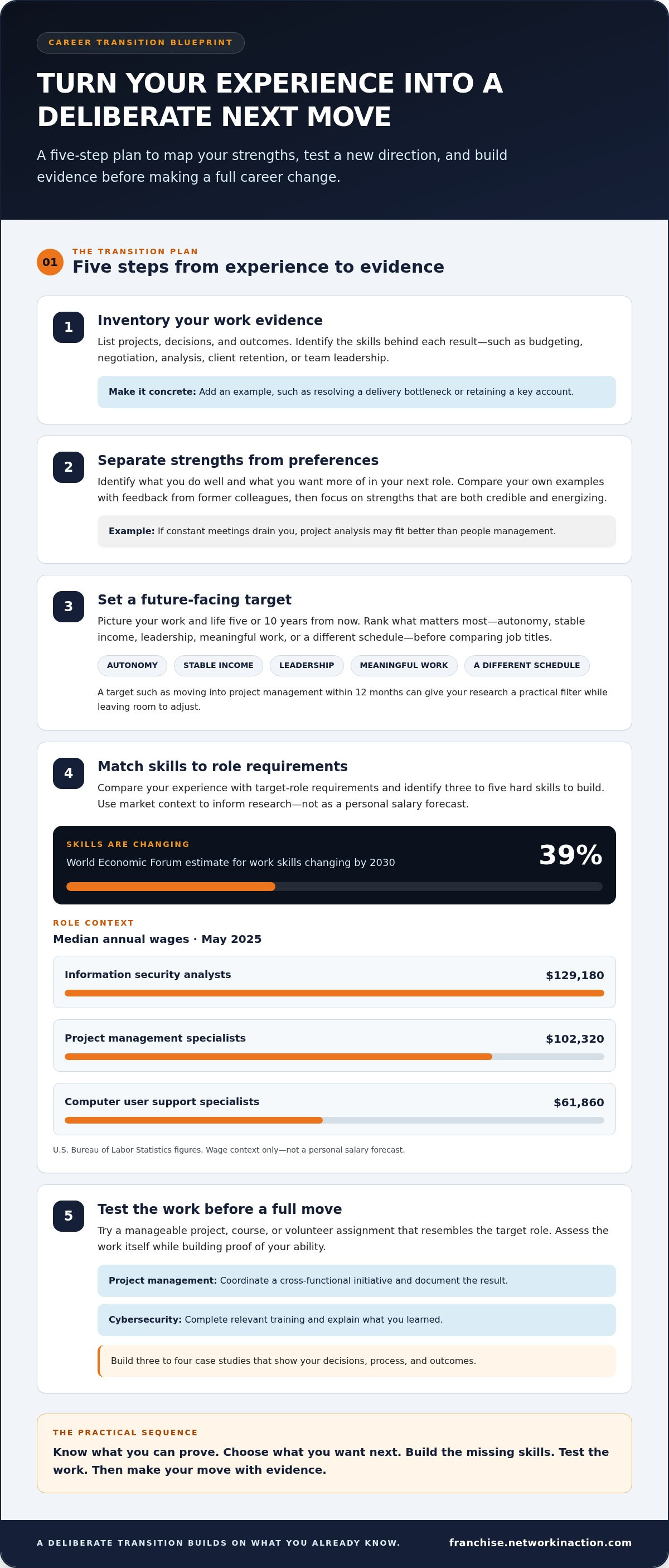
- Inventory your work evidence. List projects, decisions, and outcomes from previous roles. For each one, identify the skill behind the result: budgeting, negotiation, analysis, client retention, or team leadership. Add a concrete example, such as resolving a delivery bottleneck or retaining a key account. This turns broad experience into proof you can present to employers in another field.
- Separate strengths from preferences. Note which tasks you do well and which you want in your next role. A skilled manager who dislikes constant meetings might prefer project analysis to people management. Ask former colleagues which strengths they have seen you demonstrate. Compare their feedback with your own examples, then focus on skills that are both credible and energizing.
- Set a future-facing target. Picture your work and life five or 10 years from now. Decide what matters most: autonomy, stable income, leadership, meaningful work, or a different schedule. Rank these priorities before comparing job titles. A target such as moving into project management within 12 months gives your research a practical filter, while leaving room to adjust based on skills and family needs.
- Match skills to evidence and market context. Compare your experience with role requirements, then identify three to five hard skills to build. The World Economic Forum estimates 39% of work skills will change by 2030, making current capabilities worth reviewing. For context, according to the U.S. Bureau of Labor Statistics, the median annual wage for project management specialists was $102,320 in May 2025. According to the U.S. Bureau of Labor Statistics, the median annual wage for information security analysts was $129,180 in May 2025. According to the U.S. Bureau of Labor Statistics, the median annual wage for computer user support specialists was $61,860 in May 2025. Treat these figures as role context, not a personal salary forecast.
- Test before making a full move. Choose a manageable project, course, or volunteer assignment that resembles the target role. If you are considering project management, coordinate a cross-functional initiative and document the result. If cybersecurity interests you, complete relevant training and explain what you learned. Build three to four case studies showing your decisions, process, and outcomes. This evidence helps you assess the work itself and strengthen your next application.
Age bias, confidence, and career gaps
- Prepare evidence that challenges assumptions. A career change for 40 year old professionals can prompt assumptions about adaptability, salary expectations, or technology skills. Don’t answer an unspoken assumption with an apology. Prepare two examples showing how you learned a new tool, improved a process, or handled a changing business need. For example, describe adopting a customer relationship management platform and improving follow-up. Keep the focus on relevant results and what you can contribute next.
- Make your experience easy to evaluate. Tailor your résumé to the role instead of giving every position equal space. Lead with relevant achievements, current capabilities, and the problems you can solve. For an operations role, highlight a process improvement, budget decision, or cross-team project. Use clear language and concrete outcomes. A hiring manager should quickly see how your experience relates to the job, without having to infer your value from a long career history.
- Build confidence through targeted practice. Demonstrate readiness rather than relying on broad claims. Choose a current skill the target role requires, then practise it through a course project, portfolio sample, or realistic work exercise. For example, create a dashboard using a tool named in job descriptions. Ask a trusted colleague to review it and flag unclear explanations. Use that feedback to sharpen your example and interview response. Confidence grows from evidence you can explain.
- Explain career gaps directly. Prepare a concise, truthful account of a gap caused by caregiving, study, relocation, or another life event. You can explain your readiness without sharing private details. If relevant, state what you did during that period and connect it to your current goal. For example, you might say, “After taking time away for family caregiving, I am ready to return to project coordination.” Then highlight a recent skill, course, or achievement that supports your application.
- Use focused networking to test your positioning. Speak with professionals in your target field and ask how they interpret your experience. A former finance leader moving into consulting could ask which client challenges best match their background. Use each conversation to refine your introduction and identify unfamiliar expectations. Research cited for the United States says 82% of career changers over 45 successfully transition into new roles. For a career change for 40 year old professionals, turn that possibility into specific next actions: pursue relevant conversations, close skill gaps, and practise explaining your value.
Balancing career change with family and finances
You can change careers while keeping your current job by learning part-time, testing the new field through manageable projects, and waiting to resign until your transition plan is workable. For example, stay in your current role while completing relevant training and building evidence of your skills.
Yes. U.S. grants, scholarships, and workforce programs can help eligible adult learners pay for training. Requirements and eligible education vary, so include funding research in your plan.
- Set a household income floor. Calculate what your household needs for housing, food, healthcare, debt payments, and caregiving. Compare that amount with your current take-home pay and likely income during the transition. If a target role requires training before you can apply, identify how you will cover essential expenses in the meantime. Discuss the plan with anyone who shares those responsibilities, and agree on which costs could change.
- Protect income while you test the path. Keep your current job while building relevant skills through evening study, a part-time course, or a small project. Someone moving into data analytics, for instance, could practise with a sample dataset and create a portfolio project before applying. This approach lets you find out whether the work suits you without immediately giving up a reliable paycheck.
- Compare training with the time you can commit. Choose a learning route that fits your schedule and target role. A career changer with caregiving duties may not be able to spend four years away from work attending college full time. Compare part-time study, focused courses, and practical projects based on the skills they teach and the evidence you can show employers. Set specific study times around work and family commitments.
- Build a transition budget. List training expenses, recurring household costs, and expected income changes during the move. Separate essential spending from costs you can pause, such as optional subscriptions or non-urgent purchases. Then set a decision point: for example, review your budget after finishing a course module or getting feedback on a portfolio. Clear checkpoints help you adjust the plan before financial pressure forces a rushed choice.
- Evaluate the full financial return. Compare more than starting pay. Consider benefits, schedule, commuting, training time, and future opportunities alongside salary. About 50% of career changers over 45 see a meaningful pay increase, but an individual outcome depends on the role and transition. Use that figure as context, not a promise. A role with lower initial pay may still fit if its long-term prospects and household impact support your priorities.
- Research funding before paying for training. Look for grants, scholarships, and workforce programs that match your location, career target, and eligibility. Compare what each program covers, its application requirements, and deadlines. Ask the education provider how its course supports your specific skill goals, then weigh any funding against the time commitment. Include funding decisions in your household plan so training supports the transition without disrupting essential expenses.
Reasons professionals change careers at 40
A career change can take longer when the target role requires new skills, credentials, or a different level of experience. Set your timeline by mapping those requirements, choosing a realistic learning route, and deciding whether to transition while employed or after securing another role.
- Identify what stagnation is telling you. A plateau may signal that your current role no longer offers meaningful growth, not that your experience has lost value. About 50% of people over 45 want to switch careers within the next three years to escape stagnation. Use that motivation to name the specific problem: limited advancement, repetitive work, or shrinking influence. Then compare potential career paths against that problem instead of chasing change for its own sake.
- Decide what a better working life means. A new title won’t solve a poor fit if the daily demands remain unchanged. In 2026, 59% of workers prioritized work-life balance over “the hustle.” Turn that priority into practical criteria. For example, define whether you need fewer evening calls, more control over your schedule, or work that feels more sustainable. Use those criteria to assess role descriptions and conversations with people already doing the work.
- Respond to changing skill demands. Career shifts can be proactive responses to industry changes, not just reactions to dissatisfaction. An executive survey reported that many executives believe half of the skills people need for their jobs today will not be relevant within two years. Review what your target field values now. For example, an experienced sales leader exploring customer analytics might strengthen data interpretation skills while retaining client strategy expertise. Build your transition around complementary skills.
- Separate a temporary setback from a lasting mismatch. Before leaving, identify what specifically drains your motivation. If a difficult manager is the problem, a new employer in the same profession may help. If the work itself feels misaligned, a broader change may be warranted. Write down three energizing tasks and three persistent frustrations from a typical workweek. Compare them with the actual responsibilities of a target role, not just its title or perceived status.
- Measure the change against your long-term direction. Consider how a move could affect your responsibilities, income needs, and future growth options. Someone moving from corporate operations into consulting, for example, may value greater autonomy but need to build a client pipeline. Test your assumptions through conversations, short projects, or relevant training before committing. A strong reason to change is specific: the new path better matches your priorities and the work you want to do.
- Turn the reason into a decision rule. Write one sentence defining what your next career must improve, such as “I want more analytical work and fewer overnight travel demands.” Use it to compare opportunities consistently. If a role solves that problem but creates a bigger conflict with family or finances, revise your target. This discipline makes the change intentional rather than a reaction to one frustrating week.
What are the best career change options for professionals over 40 in the United States?
The strongest option matches your experience, learning capacity, income needs, and preferred daily work. Compare the role’s entry requirements with your existing strengths before choosing a training path or committing to a transition.
- Explore business consulting if you know an industry deeply. Professionals with 15-20 years of experience in any industry may apply that knowledge to business consulting. Identify a problem you’ve solved repeatedly, such as reducing operating friction or improving client retention. Then define the type of organization that needs that expertise. This path can build on your existing credibility, but consulting also requires you to communicate value and develop client relationships.
- Consider IT support for a structured technical entry point. The listed entry salary range is $45K-$55K, with a qualification time of 3-6 months and no degree required. Compare the role’s practical tasks with your strengths. Troubleshooting, clear communication, and patience with users can transfer from operations or customer service. Review training options and practise resolving common technical problems before applying.
- Test data analytics if you enjoy evidence-based decisions. The listed entry salary range is $55K-$70K, with a qualification time of 4-8 months and no degree required. Data scientists and advanced analysts had median pay of $112,590 per year in 2024. Distinguish these roles from entry-level analytics positions. Practise turning a dataset into a clear business recommendation, then use that work to demonstrate analytical thinking.
- Evaluate cybersecurity if risk analysis interests you. The listed entry salary range is $55K-$75K, with a qualification time of 4-8 months and no degree required. Changing demand for information security work may create opportunities for career changers. Consider how your experience with compliance, technology, or incident response may support the transition. Build foundational knowledge and document a practical example of identifying or reducing a security risk.
- Look at human resources if you excel at people and process. The listed entry salary range is $45K-$60K, with a qualification time of 3-6 months and no degree required. HR can suit professionals with experience in management, training, employee support, or organizational change. Compare specialties such as recruiting and employee development. Choose the route that best fits your strengths, then demonstrate relevant work through a clear example.
- Compare options using the same decision criteria. Compare each role’s training demands, entry pay, daily responsibilities, and connection to your prior experience. For example, an experienced operations manager might weigh consulting against data analytics: one draws on industry judgment, while the other requires technical practice. Choose the path that best fits your priorities, then validate it through a project or conversations with people doing that work.
Network In Action: Franchise a business opportunity
Network In Action offers a franchise opportunity for professionals who want to lead local business referral groups. The model centers on relationship-driven growth and community leadership, offering a way to build professional credibility while helping business owners connect. Its subscription-based structure offers recurring-revenue potential, and franchise ownership may appeal if you are seeking greater flexibility, scalability, and lifestyle autonomy. Consider how leading a local group fits your strengths, financial plans, and preferred way of working. This entrepreneurial path differs from moving into another salaried role, so weigh its responsibilities against your goals. Contact Network In Action to explore whether the franchise opportunity aligns with your next move.
Make Your Next Move Deliberate
A career change for 40 year old professionals is strongest when it’s treated as a strategic decision, not a reaction to one difficult season. Give your next move a clear test: does it match the work you want to do, the life you need to support, and the direction you want your experience to take? That standard keeps ambition connected to practical choices.
If entrepreneurship appeals more than another salaried role, consider whether leading a professional community suits your strengths and goals. Network In Action offers a franchise business opportunity for people ready to explore that path. Take time to assess the fit, the responsibilities, and the kind of work you want to build.
Explore the Network In Action franchise opportunity and consider whether it aligns with your next chapter. Your experience can become the foundation for a purposeful move forward.
Frequently Asked Questions
Is It Worth Changing Your Career at 40?
A career change can be worthwhile if the new direction better fits your priorities and offers a realistic path to employment. Compare the daily work, preparation required, and effect on your household before deciding. For example, an experienced operations manager might test a move into consulting by advising a small organization on a defined project. That practical trial can show whether the work suits you before you commit to a larger transition.
Which careers are in demand and pay well for midlife career changers?
Project management, cybersecurity, data analytics, IT support, human resources, and business consulting are options to explore. The right choice depends on your existing expertise, training needs, and local opportunities, not salary alone. Compare current job postings to spot recurring requirements, then speak with professionals doing the work. For example, a finance leader considering analytics can assess whether employers expect specific software skills, industry knowledge, or both before choosing a learning path.
How can professionals over 40 identify transferable skills for a new career?
Start with three projects where your work produced a clear result, then name the actions behind each outcome. A product launch, for example, may demonstrate budgeting, stakeholder communication, and risk management. Match those capabilities to responsibilities in target job descriptions. Ask a former colleague to challenge your interpretation, then prepare a concise example explaining the situation, your decisions, and the outcome. This turns broad experience into evidence a hiring team can assess.
How can older career changers address age discrimination in hiring?
Focus your application on the role’s current needs and show recent examples of relevant work. If a position requires collaboration software, describe a project where you used similar tools rather than emphasizing how long you have worked. Practise concise interview answers that connect your experience to business results. If an interviewer raises concerns about adaptability, respond with a specific example of learning a new process and applying it successfully.
What financial risks should professionals consider before changing careers?
Consider more than a possible salary change. Review how training costs, benefits, retirement contributions, commuting, and time away from paid work could affect your household budget. A move into self-employment may also bring uneven client income, while a new employee role may have different benefits or schedules. Model a conservative transition using your actual expenses, and identify which discretionary costs you could reduce if your income changes.
How long does a career change typically take for professionals over 40?
There is no single timeline: one example is targeting a move within 12 months, while listed training routes take 3-8 months. The right schedule depends on the role, your learning needs, and family and financial commitments.