Entity first. Forming an LLC or corporation before signing a franchise agreement can separate personal and business obligations, but it won’t prevent personal liability if you sign a personal guarantee. To understand how to protect your personal assets when buying a franchise, keep business finances and records separate, follow the entity’s formalities, and review any guarantee as a direct personal exposure before committing.
It’s reasonable to expect a business structure to create a clear boundary between your investment and personal finances. The key is understanding where that boundary holds and where it doesn’t. This guide explains how entity choice, personal guarantees, trusts, and asset ownership affect creditor exposure, so you can make a more informed decision before buying a franchise.
Key Takeaways
- Choose a business entity with the separation you need, then maintain its records, finances, and required formalities.
- Read personal guarantees closely: an entity structure may not shield you from obligations you personally guarantee.
- Understand the limits of a revocable living trust; retaining control of assets can limit its value for creditor protection.
- Review how assets are titled and held, since ownership structure can affect which assets are exposed to business claims.
- Examine indemnification clauses alongside guarantees to understand how the agreement allocates responsibility and potential costs.
1. What Are the Strategies Available for Asset Protection?
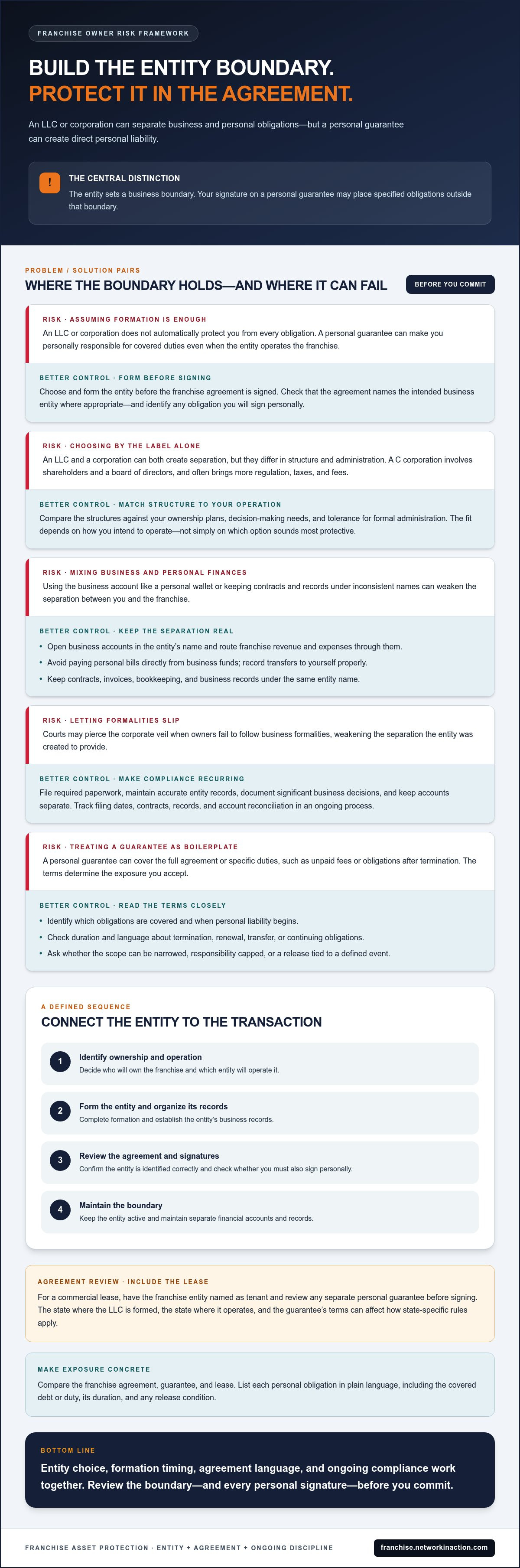
Start with the business structure, before signing the franchise agreement. In the United States, forming an LLC or corporation can separate personal finances from business obligations. That separation helps define which assets belong to the franchise business and which remain personal. It isn’t an automatic shield: a personal guarantee can still make you liable for specific obligations. Choose the structure before signing, so the agreement names the correct business entity where appropriate.
An LLC is one option for establishing a legal boundary between you and the franchise’s obligations. A corporation creates a similar separation, but its structure and administration differ. A C corporation involves shareholders and a board of directors, and often brings more regulation, taxes, and fees. Compare those demands with your ownership plans, decision-making needs, and tolerance for formal administration. The right fit depends on how you intend to operate, not simply on which structure sounds most protective.
Keep the separation real after formation. Open business accounts in the entity’s name, route franchise revenue and expenses through those accounts, and avoid paying personal bills directly from business funds. For example, if you own an LLC, record a transfer to yourself properly instead of treating its account like a personal wallet. Keep contracts, invoices, bookkeeping, and business records under the same entity name. Clear boundaries help show that the franchise and your personal finances are distinct.
Follow the formalities required by your chosen structure. File required paperwork, maintain accurate records, and document significant business decisions. Courts may pierce the corporate veil when owners fail to follow business formalities, weakening the separation the entity was created to provide. Build a recurring compliance process around filing dates, entity records, contracts, and account reconciliation. A missed document or mixed account can undermine an otherwise sound setup.
Use a defined sequence before committing. First, identify who will own the franchise and which entity will operate it. Next, form that entity and organize its records. Then review the franchise agreement to see whether it identifies the entity correctly and whether you must sign personally. Finally, keep the entity active and its financial records separate. These steps connect the legal structure to the actual franchise transaction.
Asset protection depends both on the structure and how you use it. An LLC or corporation can establish separation, while disciplined paperwork helps preserve it. Neither removes exposure created by a personal guarantee. Evaluate entity choice, formation timing, agreement language, and ongoing compliance as one decision. This practical framework is the foundation for assessing personal risk before you buy a franchise.
2. Personal liability for personal guarantees
A personal guarantee changes the risk calculation. The franchise entity may sign the agreement, but you also promise personally to meet specified obligations. Many franchisors require franchisees to sign a personal guarantee, so identify each guarantee before committing. If the business fails to meet a covered obligation, the guarantee can create personal liability, even when an LLC or corporation operates the franchise. Your signature matters.
Read the guarantee alongside the franchise agreement. Mark which obligations it covers, when liability begins, and how long it continues. Check whether it applies to the full agreement or specific duties, such as unpaid fees or obligations after termination. These terms determine the exposure you accept. Don’t assume the guarantee ends when you stop operating the location; look for language describing termination, renewal, transfer, or continuing obligations.
Before signing, ask whether the franchisor will narrow the guarantee’s scope, cap your responsibility, or release you after a defined event. Treat each request as a negotiation point, not an assumed right. Compare the guarantee with the franchise agreement and any related documents. If the franchise entity is named as the operator, confirm whether you also sign personally and which clauses impose that obligation.
State law affects LLC asset protection and personal liability because entity rules and relevant legal principles vary by state and can change. The state where the LLC is formed, the state where it operates, and the guarantee’s terms can all shape how those rules apply. Read the agreement with those state-specific factors in mind.
For a commercial lease, have the franchise entity named as tenant and review any separate personal guarantee before signing. Seek narrower covered obligations, a defined limit, or a release tied to specific conditions; the lease language determines your exposure.
LLC formation and maintenance costs depend on the state’s filing charges and ongoing paperwork requirements. The practical steps are to choose the formation state, file the required formation documents, create company records, and maintain required filings and separate financial accounts. Track each obligation in a compliance calendar.
Use a document review process before signing: compare the franchise agreement, guarantee, and lease, then list every personal obligation in plain language. For each item, record the covered debt or duty, duration, and any release condition. This makes the decision concrete. An entity creates a business boundary, while a personal guarantee can create a direct obligation outside that boundary. Assess both before you commit.
3. Revocable living trusts and creditor protection
A revocable living trust can support estate planning, but it generally offers limited creditor protection during your lifetime. You retain control of its assets, which means transferring property into the trust doesn’t automatically place it beyond creditors’ reach. For a franchise buyer, that distinction matters: a trust should not replace reviewing personal guarantees or separating business obligations from personal ownership.
Start by identifying the trust’s purpose. If you want to organize ownership or plan how assets are managed, list each asset you expect to place in the trust. For example, a home, brokerage account, and franchise interest may have different ownership documents and obligations. Record the current owner, proposed owner, and any existing loan or contractual commitment. That inventory clarifies what the trust would hold and what remains outside it.
Next, examine who controls the trust. In a revocable living trust, the grantor retains control during life and can generally change the arrangement. That control is central to understanding why the trust usually provides limited creditor protection. If you continue to manage or benefit from an asset, don’t assume the trust name alone changes your exposure. Review the trust terms alongside the asset’s title and the obligations connected to it.
Keep the franchise transaction separate from estate planning decisions. If the business entity signs the franchise agreement, document the ownership and role of any trust carefully. If you personally guarantee an obligation, placing other assets in a revocable trust doesn’t erase that promise. Compare the guarantee, trust documents, and ownership records before signing, so each document reflects the intended arrangement rather than creating conflicting records.
Timing matters. Transfers made after a lawsuit is filed, or after a claim is known to be likely, may be challenged as fraudulent conveyances and undone by a court. Don’t move property in response to a specific creditor claim and assume the transfer will hold. Instead, make ownership decisions as part of advance planning, while documenting the purpose and keeping accurate records of each change.
Use a practical review before placing assets into a trust. Confirm the trust is revocable, identify who controls each asset, and note whether a guarantee or business agreement already applies. Then distinguish estate-management goals from creditor-protection goals. That final step prevents a common mistake: treating a revocable trust as a shield when retained control limits its protection. For franchise owners, the trust’s role should fit into a broader ownership plan, not replace careful review of each obligation.
4. Understanding asset ownership and creditor exposure
Creditor exposure starts with ownership: identify who owns each asset, who owes each obligation, and which documents connect them. A franchise operated as a sole proprietorship exposes the owner’s personal assets to business liabilities. By contrast, holding business and personal property separately helps clarify which assets belong to the franchise entity. Start with a written inventory of real estate, accounts, vehicles, business property, and personal guarantees.
For investment properties, a common strategy is holding each property in a separate LLC. That structure can help limit claims involving one property from reaching assets held by another entity or personal holdings. For example, record the owner of each property and its related debts, insurance, and lease agreements. Keep accounts and records distinct; shared ownership or mixed finances can complicate the picture.
Spouses and co-owners should document who owns the franchise, each person’s role, and any personal guarantee. Use the operating agreement and related ownership records to show contributions, decision-making rights, and distributions. Don’t assume marriage or co-ownership alone protects one person’s assets from another’s obligations; title, agreements, guarantees, and applicable state law matter.
Bankruptcy, unpaid taxes, and payroll obligations can change the practical exposure of a franchise owner’s assets. Separate business records help identify which entity incurred a debt, while a personal guarantee can connect an owner directly to a covered obligation. Keep tax, payroll, loan, and franchise records organized by entity, and distinguish business debts from obligations signed personally. The documents and ownership structure shape the assessment.
Business insurance addresses a different risk than asset ownership. Set coverage by reviewing the franchise agreement, lease requirements, business activities, employees, and potential claims; coverage limits should reflect those exposures and contractual terms. Compare the policies with the obligations the business has accepted, and identify any gaps between insured business risks and personal guarantees. Insurance does not change who owns an asset or remove a personal promise.
Some assets have specific protections. Retirement accounts such as IRAs and 401(k)s carry federal protections that make them difficult for creditors to reach. Life insurance proceeds paid to a named beneficiary generally pass outside probate and beyond the reach of most creditor claims. These protections have limits; don’t treat an account or beneficiary designation as a universal shield for every debt.
For Massachusetts homeowners, a Declaration of Homestead can shield a substantial portion of home equity from certain creditor claims. According to The General Court of the Commonwealth of Massachusetts, a homestead estate is exempt from attachment, judgment execution, and sale to pay debts, but not from federal, state, and local taxes, assessments, claims, and liens. That example shows why location and asset type matter. Map each asset to its title, obligations, and applicable protections before making ownership changes.
5. How do franchise indemnification clauses affect an owner's personal liability?
An indemnification clause allocates responsibility for specified losses, claims, or expenses between parties. In a franchise agreement, it may require the franchisee to reimburse the franchisor for covered costs connected to the franchisee’s conduct. That obligation is separate from a personal guarantee. Read both provisions: indemnification defines which losses the franchisee must cover, while a guarantee may make an individual personally responsible for particular business obligations.
Start by identifying who owes the indemnity. If the franchise entity promises to indemnify the franchisor, the clause creates a contractual obligation for that entity. If you also sign personally, check whether the signature makes you an indemnifying party or guarantees the entity’s performance. For example, a signature block naming you individually can create a different risk than signing only as the entity’s authorized representative.
Next, mark the clause’s scope. Look for the events it covers, such as claims arising from operating the location, employee conduct, customer interactions, or alleged agreement breaches. Then identify exclusions and conditions. A clause covering “all claims” may reach further than one tied to specific acts. Defined terms elsewhere in the Franchise Agreement can change the meaning, so read cross-references rather than reviewing one sentence alone.
Pay close attention to process requirements. The agreement may specify how quickly you must notify the franchisor, who controls the defense, and whether you can approve a settlement. For example, a notice deadline may affect your ability to tender a claim under the clause. Record each required action in a compliance calendar, and identify who will respond if a claim arrives.
Compare indemnification with insurance provisions and any separate guarantee. Insurance may address certain covered losses, while indemnification allocates contractual responsibility. Neither document automatically cancels the other. If the clause covers claims beyond the policy’s scope, the franchise entity may face an uncovered obligation. If you personally guarantee that obligation, your own exposure may extend beyond the entity’s assets.
Before signing, make a clause map with four entries: the responsible party, covered events, notice and defense steps, and any personal signature or guarantee. Use that map to flag unclear wording, broad coverage, and obligations continuing after termination. Request precise language that identifies covered conduct and limits ambiguity. Keep the signed Franchise Agreement and related insurance documents together, so the terms can be compared during renewal, transfer, or a claim.
Indemnification can shift financial responsibility, but it doesn’t automatically protect personal assets. The agreement’s wording, the identity of each signatory, and any separate guarantee determine how the obligation connects to you. Review those terms as one package before committing.
Network In Action: Franchise a business opportunity
Network In Action offers a franchise opportunity for entrepreneurs interested in leading local business referral groups. After reviewing your personal exposure and franchise agreement, consider whether building a relationship-driven business fits your goals. The model uses monthly meetings and a technology platform to keep members connected, with training and ongoing support for franchisees managing their groups.
This opportunity is worth exploring if you want to lead a local business community and help owners build professional connections through referrals. It’s a distinct business decision, separate from legal or financial planning for your personal assets. Review the franchise model and consider how its structure aligns with your priorities.
Explore the Network In Action franchise kit to learn more about the opportunity.
Make your next move with clarity
A deliberate approach to deciding how to protect my personal assets when buying a franchise starts before the business begins operating. Treat risk planning as part of your wider ownership strategy, not an administrative task to postpone. The decisions you make now can shape how clearly you separate business commitments from personal goals.
Use this point to consider the kind of business you want to build, the role you want to play, and the level of responsibility you’re ready to take on. Strong decisions come from aligning an opportunity with your priorities, then moving forward with a clear view of what ownership involves. That’s a more focused way to assess your next entrepreneurial step.
If you’re exploring that direction, contact Network In Action to discuss whether its franchise opportunity aligns with your goals. Take the next step thoughtfully, and keep building toward a business path that fits your ambitions.
Frequently Asked Questions
What Are the Strategies Available for Asset Protection?
To protect your personal assets when buying a franchise, create an asset map before signing. List each major asset, its current owner, any co-owner, and the business or personal obligations connected to it. Then compare that map with the proposed franchise ownership and agreement. This gives you a practical way to spot unclear ownership and decide which questions to resolve before completing the purchase.
What does an LLC not protect against?
An LLC cannot make every obligation or asset automatically separate. Pay particular attention to documents signed in your individual capacity, rather than assuming the business name covers every commitment. For example, check the signature blocks on financing, lease, and franchise paperwork. Record whether you sign for yourself or as an authorized representative of the business, and keep copies together so the capacity is clear later.
Why Is Having an Attorney Review Your Franchise Disclosure Document and Franchise Agreement Important?
An attorney can help you understand how disclosure information and contract terms fit together before you commit. Ask for a focused review of provisions that affect your decision, including obligations, restrictions, renewal, transfer, and termination. Bring related documents, such as proposed lease or financing papers, so the review considers the transaction as a whole. Request a concise list of open issues and decisions to resolve before signing.
Should I form an LLC or corporation to buy a franchise and protect personal assets?
Choose based on your ownership plan, management preferences, and ability to maintain the structure’s records, rather than assuming one entity always offers better protection. Write down who will own the business, who will make decisions, and how you expect ownership to change. Compare those needs with the entity’s administration and the franchise documents. The right structure is the one that fits the planned operation and can be maintained properly.
When can franchise owners be held personally liable despite an LLC?
An owner may face personal exposure when a document creates an individual obligation or when the owner’s actions create liability under applicable law. Review each signature, guarantee, and agreement in context, and distinguish personal commitments from business commitments. Keep a copy of the signed version and note any amendments or renewals. A later change to the franchise arrangement can affect responsibilities, so track documents throughout ownership.
What personal guarantees do franchise agreements and lenders typically require?
Franchise agreements may require a personal guarantee, while financing documents can contain separate terms that need their own review. Don’t assume one signature covers only one document or that the franchise agreement explains a lender’s requirements. Identify who is signing, which obligations each document addresses, and whether later amendments affect the commitment. Compare the executed copies before accepting funding or taking possession of the location.
What legal and financial due diligence should I do before signing a franchise agreement?
Build a decision file before signing: organize the disclosure document, franchise agreement, proposed lease, financing terms, and financial assumptions. Compare projected revenue and expenses with the questions you ask current franchisees about their actual experience. Note unanswered questions and resolve them before committing. Also assess whether the business model fits your available time, leadership strengths, and goals, not only whether the projected opportunity appears attractive.