A 10% failure rate among new franchises shows that a recognized brand and established model don’t remove business risk. The common reasons new franchises fail include unrealistic revenue estimates, weak management, compliance problems, intense competition, and choosing a concept that doesn’t fit the market or the owner. Each can undermine performance before the business has built reliable momentum.
It’s easy to assume that buying a franchise means stepping onto a proven path. But the concept still has to match local demand, the financial assumptions need to hold up, and day-to-day operations require disciplined leadership. Small miscalculations can compound, leaving too little room to adapt.
This article explains how revenue projections, management decisions, compliance, competition, and concept choice can contribute to failure, and what to consider when assessing each risk. You’ll get a practical framework for evaluating a franchise opportunity, spotting operational vulnerabilities, and choosing a business model that fits your strengths and goals.
Key Takeaways
- Test revenue projections against local demand and realistic operating assumptions before committing to a franchise concept.
- Build strong day-to-day management habits, clear accountability, and thoughtful hiring practices to reduce operational risk.
- Assess how competition affects customer demand and whether the concept has a clear reason for customers to choose it.
- Choose a franchise that fits your capabilities, goals, and the needs of its target market.
- Plan for cash-flow pressure as well as startup costs, so the business has room to meet expenses while revenue develops.
How Do Poor Revenue Estimates Affect a New Business?
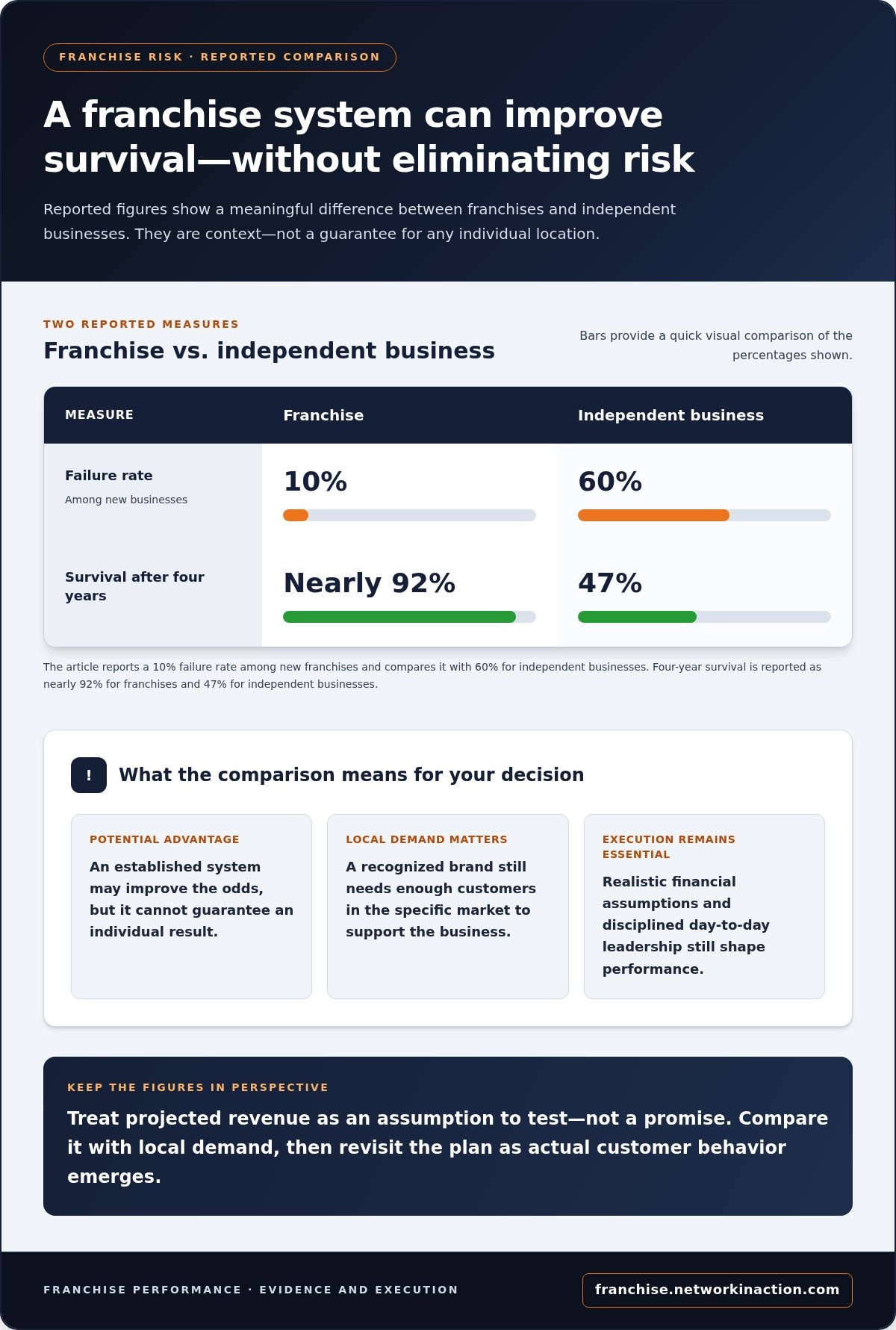
Revenue estimates shape a franchise’s financing, staffing, and launch decisions. If projections assume customers arrive immediately, business owners may commit to expenses before sales support them. The reported failure rate among new franchises is 10%, compared with 60% for independent businesses. That difference is meaningful, but it doesn’t make a weak forecast safe. A franchise business model still depends on realistic demand, sound finance, and strong execution.
Survival comparisons offer more context. Independent businesses had a 47% survival rate after four years, while franchises had a survival rate nearing 92% after four years. These figures point to a potential advantage in an established system, not a guaranteed result for every location. A recognizable brand can help customers understand an offer, but local demand still determines whether enough people buy. Treat projected revenue as an assumption to test, not a promise.
Start by defining the target market in practical terms. Identify who is likely to buy, what problem the concept solves, and how often customers need it. Then compare those assumptions with the proposed location. For example, a service aimed at office professionals may struggle in an area with few workplaces. A convenient site can still underperform if it lacks the right customer base, access, or visibility. Map nearby alternatives and clarify why customers would choose this business.
Location and visibility work together. A storefront can attract passing customers, while a service business may rely more on referrals and a credible online presence. Social media can help explain the offer, share useful updates, and keep a business visible to local prospects. But posting alone doesn’t prove demand. Track which channels generate inquiries and sales, then revise the plan if engagement doesn’t translate into customers.
A practical business plan connects sales assumptions to operating decisions. Build a conservative scenario alongside the expected one. For each, estimate customer volume, average purchase frequency, and the time needed to build awareness. Use these scenarios to decide when hiring or expansion makes sense. If the plan works only when every month meets an ambitious target, it leaves little room for delays, seasonal swings, or weaker-than-expected demand.
Partnership conflict can also disrupt revenue. Two owners may disagree about reinvesting earnings, changing prices, or taking on daily responsibilities. Those disputes can slow decisions when a new business needs fast, consistent execution. Before launch, document decision-making rights, financial reporting, work expectations, and a process for resolving disagreements. A written agreement won’t prevent every conflict, but it gives partners a shared reference when priorities diverge.
Among the common reasons new franchises fail, inaccurate estimates are especially dangerous because they distort several decisions at once. Revisit projections as actual customer behavior emerges. Compare planned and actual sales, identify which assumptions missed, and adjust staffing, marketing, or spending accordingly. A forecast is useful when it guides decisions, not when it merely supports the initial investment case.
Management, operations, and regulatory compliance
A strong franchise system still depends on the person leading each location. Problems within the management team account for 65 percent of business failures. For franchise owners, weak oversight can turn routine issues into persistent losses. A missed customer concern, inconsistent service, or delayed follow-up can damage trust. Daily attention helps you spot small operational gaps before they affect the customer experience or the business’s performance.
Commitment means understanding the work, not simply holding the title. A franchisee who reviews customer feedback, checks staff schedules, and monitors service quality can respond faster than an absentee owner. For example, if customers report long waits, the owner can observe the busiest periods and adjust staff coverage. Delegating tasks can help, but the owner remains responsible for setting expectations and following up on results.
Outsourcing can free time for leadership, but it doesn’t remove accountability. A bookkeeping provider may organize financial records, while a payroll company may process employee pay. The owner still needs to review reports, confirm the information is accurate, and act on discrepancies. Before outsourcing, define the task, expected output, reporting schedule, and who handles exceptions. Keep access to essential records so outside support doesn’t become a blind spot.
Compliance also depends on repeatable habits. Requirements vary by business activity and location, so owners need to identify the rules that apply to their operations. Build a calendar for recurring filings, renewals, inspections, and staff training, where relevant. Keep organized records of completed tasks and assign a specific person to each responsibility. For example, a manager responsible for checking renewal dates can flag upcoming deadlines during regular operating reviews.
Consistency is the operating system behind an established brand. Customers expect the same product or service quality whether they visit on Monday or Saturday. Create clear procedures for opening, customer interactions, quality checks, and handling complaints. Then observe whether the team follows them. If one location or shift handles a process differently, coach the specific behavior and document the updated standard. Clear routines make it easier to train new employees and provide a reliable customer experience.
Hiring decisions affect service, team stability, and daily execution. Plan interviews around the role’s actual tasks, assess candidates’ skills and fit, and conduct reference checks. A candidate for a customer-facing position, for instance, should demonstrate clear communication and calm problem-solving. After hiring, use structured onboarding so every employee learns the same core procedures. Owners who skip these steps may spend more time correcting preventable mistakes than developing the business.
Use recurring reviews to keep operations accountable. A quarterly review can examine revenue, customer feedback, staffing, and unresolved compliance tasks. Pair the numbers with a SWOT discussion: identify strengths, weaknesses, opportunities, and threats, then assign an owner and deadline to each action. This turns discussion into action. Buying an established franchise may provide operating guidance, but successful management still requires consistent follow-through, informed decisions, and attention to performance.
Market saturation and competition
A franchise can enter a market where customers already have several similar options. That pressure can limit sales, push businesses to discount, and make customer loyalty harder to earn. Compare nearby competitors by location, pricing, opening hours, customer reviews, and service gaps. For example, a new tutoring franchise may face established centers, independent tutors, and online platforms competing for the same families.
National statistics can provide context, but they don’t reveal local demand. The United States has over 750,000 franchise establishments across various industries. That total doesn’t show how many directly compete in one neighborhood. Entrepreneurs need local research: map competing locations, speak with potential customers, and review credible sources such as local business directories and community reports. Separate direct competitors from alternatives that solve the same customer problem.
Marketing and public relations should explain why customers should choose the business. A campaign that only announces a grand opening may create brief attention without building repeat demand. Set a clear objective, such as increasing trial visits or generating inquiries, then choose channels used by the target audience. Track responses by source. If a local campaign earns clicks but few bookings, revise its message, offer, or audience rather than repeating it unchanged.
Market research should test the concept, not simply confirm enthusiasm. Ask prospective customers what they currently use, what frustrates them, and what would prompt them to switch. A survey can help, but pair responses with observable behavior, such as actual bookings or purchases. Review the findings before launch and revisit them when customer preferences, local employers, or competing offers change. A campaign that worked last season may not fit the next season’s market.
Franchise fees, royalties, and startup costs can undermine profitability if sales can’t support ongoing obligations and operating expenses. Weak franchisor support, limited training, or a business model that doesn’t match local conditions can leave owners without the practical tools to compete and operate consistently.
To assess risks in a Franchise Disclosure Document, review the financial performance information, initial and ongoing fees, estimated startup expenses, franchisor obligations, and outlet openings and closures. Compare those details with the proposed territory and your operating plan. Treat unclear or inconsistent information as a reason for further analysis, not as proof of local demand.
Early warning signs include declining inquiries, weak repeat business, rising customer complaints, and marketing campaigns that fail to convert. Reduce risk by reviewing local competition, tracking results by campaign and customer source, and responding quickly to market changes. For example, test a revised message with one customer segment before committing the entire marketing budget. Regular review turns market signals into timely decisions.
Choosing the right franchise concept
A compelling brand can attract attention, but concept fit determines whether the venture suits your skills, goals, and market. Start by identifying the work you want to lead each day. A food franchise, for example, may require hands-on oversight of staffing, inventory, and customer service. A professional service concept may depend more on relationship-building, local credibility, and consistent follow-up. Choose the operating reality, not just the image of ownership.
Next, connect your capabilities to the business model. List the tasks you already handle well, then compare them with the concept’s core demands. If your strengths include community leadership and building professional relationships, a relationship-based service may feel more natural than a product business centered on inventory and daily transactions. Identify gaps honestly. A concept that requires skills you don’t want to develop can make routine management a persistent strain.
Define the customer before judging the opportunity. Describe who needs the product or service, what problem it solves, and why customers would choose it over existing alternatives. For example, a business serving local professionals should explain how it fits their schedules and helps them reach a meaningful outcome. Speak with prospective customers and compare their priorities with the concept’s offer. Belief in an idea matters, but customer demand must support it.
Study how the model earns revenue and delivers value. Look beyond brand recognition to the customer experience, repeat-purchase potential, and the work required to attract and retain customers. A successful business needs an operating model that matches its audience. If customers expect convenient digital interactions but the concept relies on slow manual processes, that mismatch can weaken loyalty. Examine how the business creates value, then decide whether you can deliver it consistently.
Assess the economic environment around the concept. Consider local employers, customer routines, available alternatives, and changes that could affect demand. A service aimed at office workers may face a different outlook in a community where remote work is common. Don’t assume a national brand’s performance will translate directly to your territory. Compare local conditions with the concept’s customer profile and identify what could make demand durable.
Look beyond the sales presentation. Kevin Lacey advises prospective franchise buyers to speak with franchisees who have been in the system for at least five years. Ask how the concept has changed, which operating challenges recur, and what distinguishes thriving locations from struggling ones. Compare their day-to-day experience with your expectations. Their answers can reveal whether the franchise’s actual work, support structure, and growth path fit your priorities.
Finally, test the concept against your preferred lifestyle and leadership role. Write down the responsibilities you’re willing to own, the schedule you can sustain, and the impact you want to make. Then compare those priorities with the franchise’s routine demands. Choosing well means aligning your capabilities, customer need, and operating reality. That fit gives your venture a stronger foundation than enthusiasm for a familiar name alone.
How do inadequate working capital and cash-flow problems cause franchise failure?
Working capital keeps a franchise operating while sales build. A business can attract customer interest yet struggle to pay suppliers, staff, rent, and other recurring expenses on time. The gap between money going out and revenue coming in matters. Some franchisees may take several years to turn a profit, so opening-day funds alone may not cover the full ramp-up period.
Cash flow tracks when money enters and leaves the business, while profitability measures whether revenue exceeds expenses over time. Those measures aren’t interchangeable. For example, a franchise may record strong sales but still face a cash shortage when customer payments arrive after payroll and supplier invoices are due. Owners need to map expected payment dates against actual obligations, not rely on sales totals alone.
Build a rolling cash-flow forecast that shows incoming revenue and outgoing commitments by period. Include rent, payroll, inventory, royalties, utilities, insurance, marketing, and scheduled debt payments, where applicable. Then compare the forecast with actual transactions and update it when sales or costs shift. If a supplier changes payment terms or demand softens, the revised forecast can reveal pressure early enough for owners to adjust spending.
Working capital can also disappear through small, repeated decisions. Extra inventory ties up cash before customers buy it. Hiring ahead of demand adds payroll before the extra capacity generates revenue. A discount may attract customers but reduce the cash available for bills. For each decision, estimate its timing and effect on available funds. For example, compare the cash cost of holding more stock with the likely sales benefit.
Plan more than one operating scenario. A base forecast can reflect expected demand, while a conservative version accounts for slower customer growth or higher operating costs. Identify which expenses are fixed, which can be adjusted, and which obligations have firm due dates. Set a review trigger, such as a sustained gap between projected and actual receipts, then decide who will respond and what spending can be postponed.
Cash discipline depends on reliable routines. Reconcile bank activity, review outstanding invoices, and separate business funds from personal spending. If several owners are involved, agree on who approves payments and how financial updates are shared. A weekly review can highlight late receivables or rising costs before they compound. For a seasonal business, compare cash needs with the timing of busy and quiet periods.
Among the common reasons new franchises fail, underfunding can intensify other problems: delayed marketing, understaffing, or missed supplier payments can weaken customer service and revenue. Treat liquidity as an operating priority, not a reserve to spend freely. As you compare cash-flow assumptions, review the franchise planning details alongside your forecast.
Network In Action: Franchise a business opportunity
Network In Action offers a franchise opportunity for professionals who want to lead local business referral groups. Its model replaces weekly networking routines with monthly meetings and a technology-enabled platform. Curated groups prioritize high-quality professional relationships without forced referrals, giving franchisees a structured way to build local business communities.
The opportunity may suit you if you value community leadership, flexibility, and relationship-driven growth. Its subscription-based recurring revenue model and group structure support a business built around greater lifestyle autonomy. It calls for a commitment to serving business owners and building professional credibility, rather than simply seeking quick returns.
Explore the Network In Action franchise opportunity and consider whether its model aligns with your strengths and goals.
Choose your next move with purpose
Ownership becomes more deliberate when you define what success means before choosing a business. Decide which responsibilities you want to lead, what kind of working life you want to build, and how you’ll judge progress beyond revenue alone. Those priorities give you a personal standard for evaluating opportunities and staying focused after launch.
Use the common reasons new franchises fail as prompts for sharper questions, not as a verdict on entrepreneurship. Consider how you respond to uncertainty, what support helps you perform at your best, and whether the day-to-day role fits your strengths. Clear answers can help you recognize trade-offs early and avoid pursuing a concept simply because it looks familiar or prestigious.
Then turn your priorities into a decision framework. Write down the conditions an opportunity must meet, the compromises you can accept, and the warning signs that would make you pause. Revisit that framework as you learn more. A disciplined choice creates a stronger starting point for the work ahead, and your judgment can keep shaping the venture as it grows.
Frequently Asked Questions
What is the most crucial factor for a successful franchisee?
The most crucial factor is the ability to lead consistently while using the franchise system well. That means making timely decisions, communicating expectations clearly, and responding constructively to feedback from staff and customers. For example, an owner who receives repeated questions about the same service can clarify the team’s explanation and review whether the process is easy to understand. Strong leadership turns everyday observations into focused improvements.
Why do some new franchisees fail while others succeed?
Franchisees differ in how well they match an opportunity’s demands and how deliberately they use available guidance. One owner might seek coaching after a difficult customer interaction, while another lets the same issue become a pattern. Differences in decision-making, follow-through, and willingness to learn can shape results. Before committing, consider whether you’ll actively lead the operation and engage with the system, not just rely on its brand recognition.
What are the most common reasons new franchise businesses fail?
Failure can result from weak execution, a poor fit between the concept and its owner, or limited support as a franchise network grows. Rapid expansion can strain a franchisor’s ability to maintain consistent guidance and marketing support. Prospective owners can explore this risk by asking how support is delivered, how franchisee concerns are handled, and whether the operating system can keep pace with network growth.
What percentage of new franchise locations fail, and how is failure defined?
There isn’t one universal percentage that applies to every franchise system and timeframe. A study may count locations that close, while another may also account for transfers, sales, or changes in ownership. Those events don’t always mean the same thing for a franchisee’s outcome. When reviewing a failure rate, identify its time period, the locations included, and exactly which events the source classifies as failure.
How do poor location selection and weak local demand affect a new franchise?
A location can be hard to reach or poorly matched to customers’ routines, even if it appears busy. Consider practical details such as parking, transit access, visibility, nearby destinations, and whether operating hours suit the intended audience. For example, a service aimed at working professionals may lose potential customers if appointments are available only during standard work hours. Test the customer journey from discovery through arrival before choosing a site.
How do inexperienced owners and poor management contribute to franchise failure?
Inexperienced owners can struggle when they treat a franchise as a passive investment rather than an operating responsibility. A useful test is whether the owner can explain who handles customer complaints, staff questions, and urgent operating decisions during an absence. If those responsibilities have no clear owner, issues may go unresolved. Build a simple coverage plan, communicate decision boundaries, and make sure the team knows how to escalate problems.
How do competition, market saturation, and changing customer preferences affect franchise success?
Customers may choose substitutes rather than direct competitors, so owners should examine how people solve the same problem in different ways. A local fitness franchise, for example, may compete with home exercise programs as well as nearby studios. Watch for shifts in customer questions, booking behavior, and reasons for cancellations. These signals can reveal changing preferences earlier than overall sales figures, helping owners adjust their offer while preserving its core value.
How do franchise failure rates compare with independent small businesses?
Franchise systems can give owners an established brand and shared operating guidance, while independent businesses develop their own systems. That structural difference can influence the risks each group faces, but comparisons depend on how studies define survival and which businesses they include. A useful comparison looks beyond a single rate: consider the type of franchise, the owner’s role, available support, and whether the system’s operating approach suits the local market.