Don’t resign first. Leaving corporate to buy a franchise can be a strategic route to business ownership, but it’s wiser to evaluate the opportunity while you still have a salary. A franchise gives you an established system to operate within; starting independently offers more control but means building the model yourself.
If your corporate role feels limiting, the appeal is real: more autonomy, meaningful work, and the chance to build an asset. But enthusiasm alone isn’t a business plan. Weigh the investment, understand the agreement, and decide whether the day-to-day work fits your strengths and financial priorities.
This guide compares franchise ownership with starting independently, outlines financial, contractual, professional, and personal risks, and explains which executive skills can transfer. You’ll also learn how to assess franchise opportunities, ask current owners useful questions, and review an FDD. The goal is a deliberate transition, not a rushed exit: one grounded in fit, realistic expectations, and a clear picture of what you want to build.
Key Takeaways
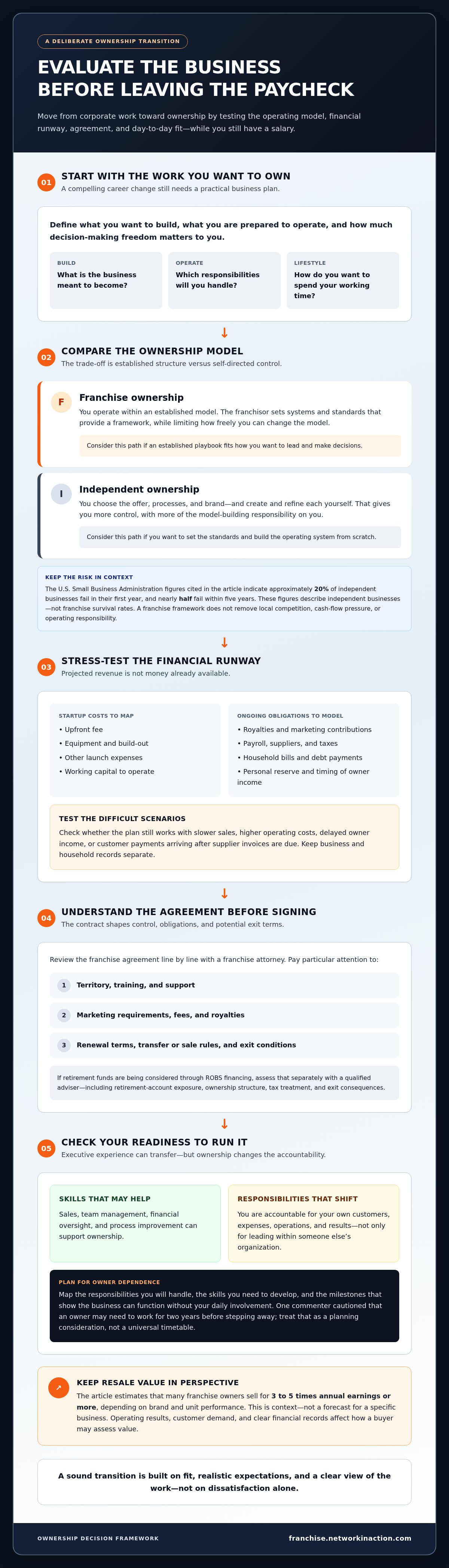
- Compare the structure and support of a franchise with the control and responsibility of building independently before choosing your path.
- Map startup and ongoing costs, review agreement terms, and plan for cash flow before making a career move.
- Translate executive strengths such as leadership, sales, and operations into the daily demands of business ownership.
- Evaluate franchise opportunities through careful due diligence, including what FDD Item 19 can and cannot tell you.
- Define what you want from your next chapter so your decision is driven by a clear business and lifestyle goal, not just dissatisfaction with your current role.
1. Franchise ownership compared with starting a business independently
Franchising gives you an established operating model; independent ownership starts from scratch. A franchisor sets systems and standards that franchisees are expected to follow. That structure can guide how the business runs, but it also limits your freedom to change the model. As an independent owner, you choose the offer, processes, and brand, and create and refine each yourself.
The choice changes your workload, not the need to execute. According to the U.S. Small Business Administration, approximately 20% of independent businesses fail in their first year, and nearly half fail within five years. Those figures describe independent businesses, not franchise survival rates. A franchise system can provide a framework, but it doesn’t remove local competition, cash-flow pressure, or the responsibility of managing operations.
Allow time to build before expecting the business to run without you. One commenter cautioned that an owner may need to work for two years before stepping away. Treat that as a planning consideration, not a universal timetable. Before leaving a corporate role, map the responsibilities you’ll handle, the skills you need to develop, and the milestones that would show the business can function without your daily involvement.
Your corporate skills can transfer, but the context changes. A former vice president of operations described spending 22 years building another company before becoming a multi-unit franchise owner. That example shows a career transition can draw on accumulated leadership experience. Sales, team management, financial oversight, and process improvement may help in ownership. Still, leading someone else’s organization differs from being accountable for your own customers, expenses, and results.
Franchise ownership trades some independence for a defined playbook. You may value that structure if building every process alone feels like unnecessary reinvention. If you want to set every standard yourself, independent ownership may fit better. For someone leaving corporate to buy a franchise, the practical test is whether the system’s requirements match how you want to lead, make decisions, and spend your working time.
Equity depends on business performance and the terms of a future sale. The article estimates that many franchise owners sell for 3 to 5 times annual earnings or more, depending on brand and unit performance. Treat that range as context, not a forecast for a specific business. Strong operating results, durable customer demand, and clear financial records shape how a buyer may assess value.
Compare the paths by listing what you want to build, what you’re prepared to operate, and where you need an established system. Then weigh those needs against franchise standards and the independence of starting from scratch. This connects your career skills to the actual work of ownership, rather than assuming executive experience alone determines business success.
2. Financial, contractual, professional, and emotional risks
Protect your personal financial runway before committing capital. Franchise startup costs can include an upfront fee, equipment, build-out, and other launch expenses. Ongoing royalties and marketing contributions can also affect cash flow. Model each obligation against realistic sales scenarios, household expenses, debt payments, and the time needed to reach stable operations. The biggest risk is treating projected revenue like money already available.
Build a written financial plan before leaving your career. List the funds needed to open, the working capital required to operate, and the personal reserve that keeps household bills covered. Then stress-test the plan against slower sales, higher operating costs, and delayed owner income. A business may fit your goals strategically but still strain your finances if its launch requires more capital than you have available.
Cash flow needs active management from day one. Regularly forecast revenue, payroll, supplier payments, royalties, marketing contributions, and taxes. Compare actual results with projections, then adjust spending before a shortfall becomes urgent. For example, if customer payments arrive after supplier invoices are due, timing alone can create pressure despite reported sales. Keep business and household records separate.
Review the franchise agreement line by line with a franchise attorney before signing. Focus on territory, training and support, marketing requirements, fees and royalties, renewal terms, and exit conditions. Each clause affects your control and obligations. Ask how the agreement handles a transfer or sale, and identify deadlines or approvals that could shape an exit. A franchise agreement is a business commitment, not simply an operating manual.
Analyze ROBS financing separately before counting retirement funds as available startup capital. Ask a qualified adviser to model the retirement-account exposure, ownership structure, tax treatment, and exit consequences. Compare this approach with other funding sources and your personal runway. The decision should reflect both the business plan and the role those retirement assets play in your wider financial future.
Financial pressure can quickly become emotional pressure. One buyer panicked two days before a planned flight, agreement signing, and payment. Treat that moment as a reason to slow down, revisit the numbers, and resolve unanswered questions before signing. If you’re the sole provider for a family of six, include household needs in your risk plan. Franchise ownership carries risk and doesn’t guarantee financial success.
Before resigning, follow a clear sequence: review the agreement, verify startup and ongoing obligations, model cash flow, protect personal reserves, then set a resignation threshold. Keep your current income while evaluating the opportunity where possible. This helps you judge whether the established business model fits your goals without letting a looming exit date dictate the decision.
3. Transferable executive skills for franchise ownership
Your corporate career may have trained you to lead, forecast, and make decisions under pressure. Franchise ownership tests those skills more directly: you’re accountable for daily operations, customer experience, and business results. A franchise buyer described leading sales and marketing organizations worth multiple billions of dollars across North America. That experience can inform growth planning, but running a local business still requires hands-on attention.
Start with a skill inventory. For each major responsibility from your corporate role, identify where it applies to franchise operations and where you need practice. A sales executive, for example, may know how to set targets and review pipeline performance. They may still need to build local relationships, follow up with individual prospects, and earn customer trust without a large company’s name behind them.
Operational leadership transfers when it leads to repeatable execution. If you’ve managed teams, set clear expectations, coach performance, and address problems early. If you’ve improved processes, track service quality and remove bottlenecks. Then compare those approaches with the franchisor’s established systems. Franchise standards may shape how you operate, so assess whether you can lead within a defined model.
Financial fluency matters, too. Budgeting, forecasting, and interpreting performance reports can help you spot pressure before it becomes a crisis. But franchise ownership makes the numbers personal: payroll, customer demand, and operating costs affect your business directly. A practical test is to explain how you’d respond if sales missed plan. Your answer should name the first figures you’d review and the actions you’d consider.
Assess risk tolerance through decisions, not personality labels. Consider how you handle uncertain income, changing priorities, and responsibility when a corporate team isn’t there to absorb every task. Write down which decisions you can make confidently and where you’d seek guidance. For example, a strong manager may excel at coaching staff but feel less prepared to sell directly. Deliberate practice can help address that gap.
Scrutinize time commitment as closely as skills. List the responsibilities you expect to own, from hiring and customer issues to local business development. Then compare that list with your current schedule and personal obligations. Entrepreneurship can offer greater autonomy, but that doesn’t mean every week follows a corporate calendar. The work shifts from managing a role to building and sustaining an operation.
Capital is another part of readiness. A commenter emphasized having enough capital to acquire a franchise and support it through lean periods. Pair that capacity with a realistic plan for your time, responsibilities, and risk tolerance. Before committing, identify the skills you’ll apply immediately, the gaps you’ll need to close, and the routines that will keep execution consistent. This turns executive experience into an ownership plan, not an assumption.
4. Evaluating franchise opportunities and FDD Item 19
Start with fit, not a brand name. Write down the work you want to do, the customers you want to serve, and the leadership role you want to take on. Then compare each opportunity against those priorities. A corporate professional seeking hands-on community leadership may assess a relationship-driven model differently from someone prioritizing asset-heavy operations or large teams.
Build a comparison sheet for each franchise opportunity. Record the operating model, franchisor support, territory terms, required owner involvement, and how customers are acquired. Note which responsibilities suit your experience and which require new skills. For example, a strong sales leader may enjoy building local relationships but prefer an operation with clear processes and structured training.
Use the FDD as a due-diligence document, not a sales brochure. In particular, examine FDD Item 19 for any financial performance information presented. Identify what the figures measure, which locations or operating periods they cover, and whether the information helps answer your specific questions. Don’t treat a reported result as a promise of your future income. Compare the disclosed information with the business model and your operating assumptions.
Ask franchisees direct questions that connect reported performance to real operations. The recommended questions include what the business looks like at 12 months, 24 months, and 36 months. Ask how owners spend their time, what drives customer acquisition, and which operating demands surprised them. Compare responses across franchisees rather than relying on one account. Differences can reveal how location, execution, or owner involvement affects results.
Use a consistent review sequence: study the operating model, examine the FDD, speak with franchisees, then test your financial and lifestyle assumptions. One buyer spent about six months researching opportunities and conducting due diligence. That example illustrates the value of sustained exploration, not a fixed timetable. Keep notes after each conversation, and record what evidence supports or challenges your expectations.
Let risk tolerance shape your shortlist. Ask whether you can manage uncertainty in sales, owner workload, and the time needed to build local credibility. Consider a concrete scenario: if customer growth is slower than expected, would you still accept the required involvement and financial exposure? If that possibility conflicts with your priorities, remove the opportunity from consideration.
Finally, compare each opportunity with your transition goals. Rank options by operating fit, leadership demands, available evidence, and the role you want in daily operations. A franchise that looks attractive on paper may still be a poor fit if its standards or owner responsibilities conflict with how you want to work. Choose based on documented details and conversations, not momentum alone.
5. Reasons corporate professionals consider franchising
Corporate professionals often want more control over their position, schedule, and impact. Dissatisfaction is one motivator: 24 percent of franchise owners reportedly left corporate jobs because they were unhappy. Another 29 percent wanted to be their own boss and set their schedule. Those reasons can start the exploration, but they don’t explain what you want to build or whether running a business fits your goals.
Independence also has measurable appeal. BizBuySell reports that 46% of buyers identified as corporate refugees pursuing business ownership. Some executives consider franchising after reaching a career plateau or facing weaker job security. Others want to avoid a corporate role that demands 60 hours per week. Before acting, define the change you want: more decision-making authority, community leadership, or a different operational role.
Financing can include personal capital, borrowed funds, and potentially an SBA 7(a) loan. The SBA 7(a) program has a size limit, which larger deals can exceed. Compare funding choices against the full investment, repayment obligations, and cash needed to keep the business operating. A financing structure should support the transition, not leave the new owner without room to manage ordinary business demands.
Licenses, permits, and local rules depend on the franchise activity, location, premises, and operations. A food business and a home-based business, for example, may face different local requirements. Identify the rules that apply to the specific business and jurisdiction before opening; no single nationwide checklist covers every franchise.
Royalties, fees, and contract terms affect the income left after operating expenses. The agreement sets financial obligations and may define territory, marketing requirements, renewal, and exit terms. Model those obligations alongside expected sales, then assess how much revenue remains for owner compensation and reinvestment.
Leaving corporate employment can also change how you plan for taxes, health insurance, and retirement. Instead of relying on an employer’s benefits structure, you’ll need to account for these costs and arrangements in your personal and business plans. Compare your current compensation package with expected owner income, including the value of benefits, before deciding whether the transition works financially.
Use one decision test: write down what you want to change, what responsibilities you’ll accept, and what financial trade-offs you can manage. If autonomy matters most, assess the day-to-day work and leadership demands, then compare them with the details of the franchise opportunity as part of your structured evaluation.
Network In Action: Franchise a business opportunity
Network In Action offers a franchise opportunity for professionals ready to lead local business referral groups. The model centers on curated, high-quality relationships, not forced referrals or simply increasing membership numbers. Monthly meetings and a technology platform support ongoing connection and a more flexible approach to community leadership.
For owners, the opportunity centers on building groups through relationship-driven growth, with the potential to scale the business and develop recurring revenue. It may suit professionals seeking greater autonomy while applying their leadership skills to meaningful local impact.
Explore how the franchise opportunity fits your goals and the kind of business you want to build.
Turn Your Next Move Into a Deliberate One
If you’re leaving corporate to buy a franchise, make your next move from a position of clarity, not urgency. Define the kind of work you want to own, the leadership role you want to play, and the trade-offs you’re prepared to accept. Then use those priorities to decide which opportunities deserve closer attention.
Your corporate experience can be a strong starting point, but ownership asks you to apply it differently. The opportunity is to build something purposeful, lead relationships in your community, and shape a professional life around goals that matter to you. Give the decision the same discipline you’d bring to a major business initiative.
Network In Action offers a franchise business opportunity for professionals interested in leading local business referral groups. If that direction aligns with your goals, explore the franchise opportunity and consider whether it fits the next chapter you want to build. A thoughtful decision is a powerful first step.
Frequently Asked Questions
Should You Quit Your Job & Buy a Franchise?
Usually, explore and evaluate the franchise while you’re still employed, then decide when the business and your finances support a transition. Keeping your salary during research can reduce pressure to accept an opportunity before understanding its demands. Set clear exit conditions, such as completing due diligence, arranging funding, and planning who will handle your corporate responsibilities during the handover.
What About the Risk?
Franchise ownership involves financial, operational, and personal risk, and it doesn’t guarantee success. Consider a practical scenario: the launch takes longer than expected, but rent, payroll, or loan payments continue. Could your household and business plan absorb that pressure? Review your financial exposure, time commitment, and fallback options together rather than treating each risk as a separate decision.
What Is a Corporate Refugee?
A corporate refugee is someone who leaves traditional corporate employment to pursue independence through business ownership. The phrase describes a motivation, not a qualification or business model. For example, an executive may want more control over decisions or a more direct connection between effort and results. Define what you want to change before choosing a franchise, so dissatisfaction alone doesn’t drive the decision.
How much does it cost to buy and open a franchise in the United States?
Costs vary by concept and setup. These are broad market ranges, not quotes for a particular franchise. Include startup expenses and ongoing obligations in your comparison, not just the initial franchise fee.
How do I evaluate whether a franchise opportunity is profitable?
Assess profitability by comparing realistic revenue assumptions with operating expenses, royalties, marketing contributions, debt payments, and the owner’s expected compensation. Use FDD Item 19, if it presents financial performance information, to understand what the figures represent and which businesses they cover. Then test those assumptions against conversations with current franchisees and your own operating plan. A disclosed result isn’t a promise of future income.
What should I review in a franchise disclosure document before investing?
Review the entire FDD, paying close attention to fees, estimated investment, franchisor obligations, litigation and bankruptcy disclosures, franchisee turnover, and any financial performance information in Item 19. Compare the document’s statements with the proposed agreement and your business assumptions. Keep a written list of unclear terms and review the FDD with a franchise attorney before signing, so important obligations don’t get lost in the sales process.
What are the steps to leave a corporate job and become a franchise owner?
When leaving corporate to buy a franchise, move through deliberate stages: define your ownership goals, compare business models, review disclosure documents, speak with franchisees, arrange funding, and plan your departure. Set a decision point after each stage. For example, don’t give notice until you’ve assessed the agreement, operating requirements, and transition plan. A clear sequence helps keep enthusiasm from outrunning due diligence.
How much working capital should I have before leaving my job to run a franchise?
Set working capital by estimating the business’s operating costs and the time required for revenue to cover them, then account separately for household expenses. Build scenarios for slower customer growth, delayed payments, and unexpected operating needs. The right reserve depends on the business model, financing obligations, personal commitments, and expected ramp-up. Keep business funds separate from personal reserves so each has a clear purpose.