
A franchise’s headline fee is rarely the full financial story. The hidden costs of buying a franchise can come before launch, build month by month, or arise only when a specific event occurs. The key question isn’t just what you’ll pay to enter. It’s when cash must leave the business and whether your financial plan can absorb it.
Look beyond the advertised investment. Fee categories and agreement language can be difficult to interpret, and a business concept may require more capital or operating time than you expect. A realistic assessment starts with the timing and terms of each cost, not a single headline number.
This guide helps you identify startup, recurring, and conditional expenses, map their effect on cash flow, and assess whether a franchise fits your goals and preferred role. The operating structure matters, too. Network In Action uses monthly networking meetings and a technology platform to support member engagement. Its subscription-based revenue model describes how revenue is generated, not a promise of franchisee profit. Review the numbers first, then decide with confidence.
Key Takeaways
- Uncover the hidden costs of buying a franchise by looking beyond the initial fee to expenses that may be overlooked, mistimed, or misunderstood.
- Sort potential expenses into startup, recurring, and conditional costs so you can see when they may affect cash flow.
- Compare premises-based, inventory-led, and relationship-led models by their cost drivers, while accounting for operating expenses in every model.
- Use a structured review to compare the investment estimate, disclosure materials, agreement, and operating assumptions for consistency.
- Assess how Network In Action’s monthly meeting model, technology platform, 40-hour corporate training, and ongoing support fit your time and resource plans.
What Counts as a Hidden Cost When Buying a Franchise?
A cost can be hidden in plain sight. It may appear in a disclosure document or agreement but be easy to miss, difficult to interpret, or scheduled for a point when cash is already under pressure. The hidden costs of buying a franchise aren’t automatically secret charges or improper fees. Often, the challenge is understanding what a cost covers and when you’ll need to pay it.
A franchise cost is “hidden” when its visibility, timing, or meaning makes it easy to leave out of your financial plan, even if it appears in written materials. A disclosed expense can still catch you off guard if its due date, frequency, or conditions aren’t clear in your cash-flow forecast.
Think in three time frames: startup investment before or around launch, ongoing operating expenses that recur as you run the business, and conditional obligations that arise only if a particular event or decision triggers them. Categorizing costs is useful, but timing turns a list into a workable ownership budget.
When Is a Franchise Cost Hidden Rather Than Simply Overlooked?
A genuinely undisclosed charge is different from a cost that was disclosed but overlooked, misunderstood, or left out of your budget. The Franchise Disclosure Document provides background on how franchise information is organized; Items 5, 6, and 7 address initial fees, other fees, and estimated initial investment. Review written materials alongside the agreement. For each amount, note what it covers, when it is due, whether it repeats, and whether a particular condition triggers it.
For example, a recurring charge may be listed in a document but feel unexpected if you haven’t connected it to its billing schedule. That’s a planning gap, not proof of concealment. Rather than treating every additional cost as suspicious, focus on clarity, consistency, and timing.
Why the Headline Franchise Fee Is Not the Whole Investment
The initial franchise fee is one line in the ownership budget, not a complete measure of the capital needed to launch and operate. Startup expenses, recurring commitments, and conditional obligations affect your finances at different points. A single headline figure can’t show how payments may overlap or how much working capital you’ll need in between.
The mix depends on the business model. A premises-based concept, an inventory-led operation, and a service or relationship-led franchise can have different cost drivers and resource demands. Build your assessment around the specific model and its written terms rather than assuming every franchise has the same expense profile.
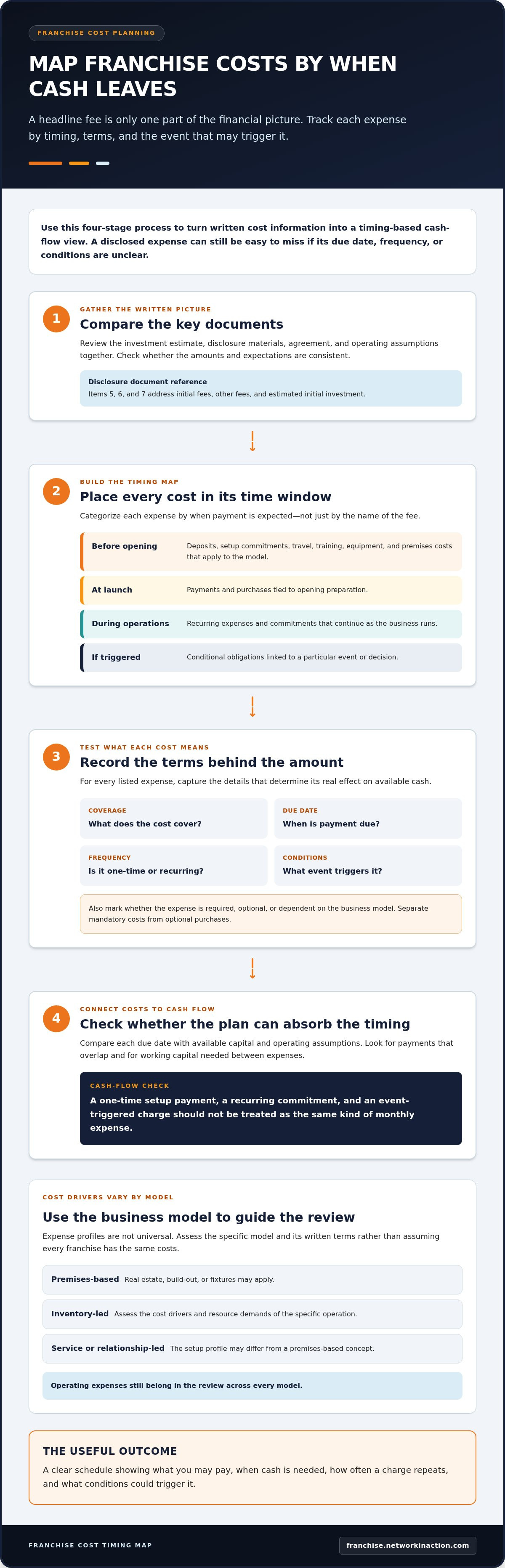
Start with a timing map. For each stated expense, record whether it is due before opening, at launch, on a recurring schedule, or only if a specified event occurs. Compare that schedule with your available capital and operating assumptions. The goal isn’t to label every cost “hidden.” It’s to see the full financial commitment clearly enough to decide on your terms.
Which Franchise Costs Can Appear Before Opening and During Operations?
Build your cost picture around payment timing, not just category names. Some expenses are due before launch, others recur during operations, and some arise only when a specific event occurs. A useful checklist distinguishes one-time, recurring, and event-triggered expenses. It also notes whether each cost is required, optional, or dependent on the business model. This makes it easier to see when cash is needed.
Startup and Pre-Launch Expenses to Map
Start with the investment estimate and agreement materials. Depending on the franchise model, pre-opening spending may include training-related travel, setup, equipment, professional services, deposits, or launch preparation. Premises-based concepts may also involve real estate, build-out, or fixtures. These aren’t universal franchise costs: a service or relationship-led model may have a different setup profile.
For each item, record its expected due date and whether payment is required before opening, at launch, or later. A deposit due early affects available cash differently from the same amount due closer to opening. Also distinguish a one-time setup expense from a recurring commitment so you don’t carry the wrong figure into your monthly forecast.
Recurring and Conditional Costs After Launch
After opening, examine recurring expense categories without assuming every franchisor charges them. Potential items include royalties, marketing contributions, technology fees, insurance, and other operating expenses. Where a fee applies, note its calculation basis, billing frequency, and any conditions in the relevant documents. A percentage-based charge and a fixed recurring charge affect planning in different ways.
Then separate obligations that arise only under specific circumstances. Renewal, transfer, required technology upgrades, and exit-related terms may be relevant depending on the agreement. Distinguish mandatory expenses from optional purchases, and record the event that triggers each conditional payment. Don’t treat a possible charge as an annual operating expense if it applies only when a particular decision or event occurs.
Use a simple timing view to make the list actionable:
- Before opening: capture deposits, setup commitments, travel, training, equipment, and any premises costs that apply to the model.
- At launch: identify payments and purchases tied to opening preparation.
- During operations: map recurring charges alongside ordinary business expenses, such as insurance and operating costs, where applicable.
- At a triggering event: note potential renewal, transfer, upgrade, or exit obligations and the conditions attached to them.
This timeline makes the hidden costs of buying a franchise easier to evaluate without treating every possible fee as concealed or inevitable. Compare each category with the written terms, then check whether the timing fits your available cash and operating plan. The franchise opportunity details can also help you understand a specific model as you build your review.
How Do Franchise Business Models Change the Hidden-Cost Picture?
The business model shapes where investment and operating demands sit. A premises-based franchise may rely on a physical location, while an inventory-led concept may depend on stock, storage, and purchasing. A service or relationship-led model can involve fewer physical assets, but still requires consistent operations, customer development, and resources to deliver the business. The hidden costs of buying a franchise are easier to assess when you compare these cost drivers instead of assuming one model is automatically cheaper.
Use this comparison as a starting point, not a cost estimate. Each category depends on the specific franchise, its operating requirements, and the agreement.
| Cost driver | Premises-based model | Inventory-led model | Service or relationship-led model |
|---|---|---|---|
| Space | Location, lease, or build-out may apply. | Retail or storage space may be needed. | May require less dedicated space; meeting or work locations can still matter. |
| Equipment | Fixtures and operating equipment may be required. | Storage or sales equipment may apply. | Tools and equipment depend on the service. |
| Staffing | Staffing needs depend on operating hours and service delivery. | Labor may support sales, stock, and fulfillment. | Owner time and any support roles depend on the model. |
| Inventory | May apply if products are sold. | Purchasing and replenishment can be central cost drivers. | Physical inventory may be limited or irrelevant, depending on the offer. |
| Technology | Systems may support transactions and operations. | Systems may support sales and inventory workflows. | Platforms may support client or member engagement. |
| Recurring obligations | Operating and agreement-based charges may apply. | Operating, sourcing, and agreement-based charges may apply. | Operating and agreement-based charges may apply. |
Premises- and Inventory-Heavy Models Versus Service-Based Models
Physical locations and product-based operations can bring property, build-out, equipment, inventory, or staffing requirements. A service franchise may shift the emphasis toward expertise, customer acquisition, technology, and owner involvement instead. Neither profile guarantees lower costs or simpler ownership. Use the franchise’s stated requirements to identify what applies, then assess cash needs alongside the time and work required to operate it.
Where Network In Action Fits in a Cost-Structure Comparison
Network In Action is a local business networking group franchise. Its monthly networking groups are industry-exclusive, with one professional per industry in each group. The technology platform includes a smartphone app, CRM system, member engagement automation, and monthly agendas. These features help define the model’s operating structure and inform your assessment of technology, space, and owner time, but they don’t eliminate operating expenses. You’ll still need to review the applicable startup and recurring costs and consider the work involved in leading a professional community, building credibility, and growing relationships consistently.
That work matters. A model with fewer physical assets can still depend on disciplined business development, strong community leadership, and reliable follow-through. Compare the financial structure with your preferred way of working: how much time you’ll devote to relationship-building, what operational routines the business requires, and whether its subscription-based recurring revenue model aligns with your goals. A revenue model is not a guarantee of profit.
How Can You Audit Franchise Costs Before Making a Decision?
A useful franchise cost audit turns documents into a cash-flow plan. Don’t rely on one estimate or a verbal summary. Collect the written investment estimate, disclosure materials, agreement, and operating assumptions, then compare them line by line. The goal is to identify what’s stated, when payment may be due, and where your own plan depends on an estimate.
Build a Cost and Timing Worksheet
Create one row for every stated expense and use consistent fields: category, amount or range stated, due date or timing, recurrence, and the document or agreement section where it appears. Label amounts as fixed, estimated, variable, or event-triggered. This makes unclear timing and mismatched assumptions easier to spot, without treating every uncertainty as evidence of a problem.
Use this sequence to build and verify the worksheet:
- Gather the documents. Assemble the investment estimate, disclosure materials, agreement, and any written operating assumptions relevant to the opportunity.
- List every cost once. Capture initial, recurring, and conditional expenses, including any stated payment basis or trigger.
- Map the timing. Mark when each payment may be due, how often it repeats, and whether the date or amount is estimated.
- Cross-check the sources. Compare documents for differences in category names, amounts, payment frequency, or assumptions. Record discrepancies rather than silently choosing one version.
- Add your own requirements. Include working capital needs and personal time commitments, even when they aren’t presented as franchise fees.
Keep unanswered questions in a separate decision-risk column. Note exactly what needs clarification, which document prompted the question, and how the uncertainty could affect your cash plan. This gives you a focused due diligence agenda and prevents an assumption from being mistaken for a confirmed cost.
Stress-Test the Numbers Against Your Own Plan
Next, test whether your available cash can cover expected expenses if launch takes longer or revenue develops more slowly than your plan assumes. Don’t insert generic industry averages or unsupported revenue projections. Use conservative assumptions that fit your situation, then see which costs remain payable and how long your reserves could support operations.
Pay close attention to charges tied to revenue, fixed schedules, or required systems. Record how any royalty or technology fee is calculated, when it is payable, and whether the relevant materials describe conditions or changes. Then compare the operating demands with your preferred ownership role: hours available, sales responsibilities, community leadership, and the consistency required to run the business. A sound financial fit also has to fit your life.
Use the same disciplined review to evaluate a relationship-led franchise opportunity. Explore Network In Action’s franchise opportunity details as part of your broader comparison, then assess the stated costs and operating assumptions against your worksheet.
How Does Network In Action Approach Franchise Ownership Costs?
Once you’ve built a neutral cost review, consider how a specific franchise supports day-to-day ownership. Network In Action provides comprehensive training, including 40 hours of training from corporate staff, plus ongoing support. Its NEST intranet provides e-learning and resources around the clock. As you evaluate the opportunity, consider how those resources fit your learning style, operating routines, and approach to leading a local business community.
What the Network In Action Franchise Model Includes
NEST is one part of the franchise’s operating framework. Network In Action also provides a technology platform with a smartphone app, CRM system, member engagement automation, and monthly agendas to support its monthly networking groups. Consider how these tools and training fit into your work habits and the day-to-day demands of operating the business. They are features of the model, not a promise of business results. Your assessment should also account for developing professional relationships, building credibility, and guiding a community of local business owners.
Explore the Opportunity With a Clear Financial Lens
Bring your cost worksheet to your Network In Action review. Connect each applicable expense with the business activity or resource it supports, and note any assumptions that still need to be resolved in your planning. Network In Action’s initial franchise license fee is a one-time payment for the right to operate a territory for a specific term and covers initial onboarding and territory reservation. Ongoing monthly royalties are based on a percentage of gross revenue or a flat fee, providing continued brand use and access to corporate resources. Include the applicable terms in your cash-flow plan rather than relying on a general description of the fee structure.
If the opportunity aligns with your goals, explore the available details and use the downloadable Franchise Kit to continue your evaluation. A considered next step can help you decide whether this model belongs in your plans.
Choose a Franchise That Fits Your Next Chapter
The right ownership decision is about more than whether the numbers work on paper. It should also reflect how you want to spend your time, the kind of leadership you want to provide, and the professional relationships you want to build. A clear financial plan gives you room to assess those priorities without mistaking a promising concept for an automatic fit.
For a model grounded in relationship-led growth, Network In Action has more than 300 groups operating across four countries. That footprint offers context as you consider whether leading a local business community aligns with your goals. Keep your due diligence practical: understand the applicable costs, consider the work involved, and decide whether the operating model supports the future you want to build.
Take the next step at your own pace. Explore the Network In Action franchise opportunity and assess whether it fits your financial plan and ownership priorities. With a clear view of the hidden costs of buying a franchise, you can move forward with greater confidence and purpose.
Frequently Asked Questions
Can franchise fees be financed?
Sometimes, but financing depends on the lender, the borrower’s qualifications, and the terms of the financing arrangement. Don’t assume a loan will cover every franchise-related expense or that borrowing will align with the timing of payments. Separate the initial fee from other startup needs, then model repayment obligations alongside operating expenses. The hidden costs of buying a franchise can include the added cash-flow pressure of debt, not just the amount borrowed.
Are franchise royalty fees based on revenue or profit?
They may be based on gross revenue or structured as a flat fee, depending on the franchise agreement. A revenue-based royalty is calculated using the agreement’s stated revenue definition, so understand what sales are included and when the amount is due. Don’t assume a fee is tied to profit. Check the applicable terms and use the stated calculation method in your financial model.
Is an initial franchise fee refundable?
Refundability depends on the written terms, so don’t assume an initial fee will be returned if you change plans. Review the agreement for language on refunds, cancellation, termination, and any conditions that affect payment. Note when the fee becomes due and what happens if the opportunity doesn’t proceed as planned. If the wording is unclear, record that uncertainty as a due diligence question before making a commitment.
What happens to franchise costs if you sell the business?
Selling may involve agreement-specific steps or costs, such as a transfer fee or conditions tied to a change in ownership. The terms may also address outstanding obligations and the buyer’s qualifications. Before valuing an exit, identify which costs could apply, who is responsible for them, and whether the sale process affects ongoing payments. Treat the transfer provisions as part of your ownership plan, not a detail to review only when selling.
Do franchisees pay expenses before their business opens?
Yes, some franchise expenses may be due before opening, although the categories depend on the business model and agreement. For example, an advance payment or deposit could be due before the business begins generating revenue. Map each pre-opening payment against its due date and your available cash. This helps you avoid relying on future sales to cover an obligation that arrives during preparation.
Can franchise startup expenses be tax-deductible?
Some expenses may receive different tax treatment from others, so deductibility can’t be determined from the label “startup cost” alone. The answer depends on the expense, your circumstances, and applicable tax rules. Keep invoices and records that show what each payment covered, when it was made, and how it relates to the business. A qualified tax professional can assess how those details apply to your situation.