What if the franchise fee is the least useful number in your ownership decision? Understanding the total cost of ownership for a franchise means looking beyond the entry price to the costs that continue, change, and affect cash flow over time. The fee matters, but so do working capital, owner compensation, recurring obligations, and expenses that shift with the business model.
A clear picture helps you make a stronger decision before committing. This guide shows you how to separate one-time, recurring, and variable costs, then build a realistic ownership-cost model from documented figures. You’ll also learn how to compare franchise opportunities on a like-for-like basis, so a low entry cost doesn’t distract from ongoing demands or the financial runway you may need.
That full-lifecycle view matters for a subscription-based networking franchise such as Network In Action. Monthly meetings, locally led groups, and technology-enabled engagement shape its operating model differently from inventory-heavy or premises-intensive businesses. The goal isn’t to chase the lowest headline number. It’s to assess the full opportunity and decide whether its costs, operating rhythm, and potential for recurring revenue align with your financial and lifestyle goals.
Key Takeaways
- Use understanding the total cost of ownership for a franchise to look beyond the entry fee and account for costs across the ownership lifecycle.
- Group expenses into initial payments, launch costs, recurring fees, variable operations, working capital, and owner compensation.
- Compare franchise models using the same time horizon and cost categories to reveal trade-offs that headline investment figures can hide.
- Build a practical cost model from franchise documents, separating documented figures from estimates and personal assumptions.
- Assess how Network In Action’s subscription-based model, monthly meetings, technology platform, and 40-hour training program fit your financial and lifestyle goals.
What Does Total Cost of Ownership Mean for a Franchise?
A franchise’s entry figure is a starting point, not a complete picture. Total ownership cost is the full financial and time commitment of launching, operating, and sustaining a franchise across its ownership lifecycle. It includes one-time costs, recurring obligations, expenses that vary with activity, and the time you devote to the business.
This broader lens connects to the general concept of Total Cost of Ownership (TCO), which considers costs beyond an initial purchase. For a franchise, the useful question isn’t simply what you pay to enter. It’s what resources the model requires, when you need them, and how long you expect to operate the business.
How total ownership cost differs from the initial franchise investment
An initial investment figure captures selected costs at a particular stage, often around the time you prepare to open. It may not show the full pattern of operating expenses or the personal time required to lead the business. Separate launch spending, such as setup and professional services, from recurring obligations and variable expenses that can shift with business activity.
Timing matters. Two costs with similar totals can create different pressure if one is due before launch and the other is spread over later months. Track both the amount and timing of each expense instead of combining everything into one startup number.
Why franchise costs must be evaluated over time
Cash demands change as the business moves from launch to early operations and then toward a more established rhythm. Launch may concentrate setup costs. Early operations may require working capital while revenue and expenses evolve. Later, recurring obligations continue, while variable costs may rise or fall with activity. A single figure can’t show these stages or the cash available at each one.
Keep ownership cost distinct from related financial measures. Cost is what the business and its owner commit; cash flow tracks money moving in and out over a period; profit reflects revenue minus expenses under the accounting method used. Owner compensation is a separate decision about how much the owner takes for their work. A cost model can inform these questions, but it doesn’t answer them automatically.
Build a practical assessment from documented franchise materials, and make the boundaries visible:
- Documented costs: figures stated in franchise materials, categorized by type and timing.
- Estimates: projections based on assumptions, clearly labeled as estimates.
- Owner-managed inputs: personal choices such as time commitment and compensation, kept separate from franchisor-provided figures.
This separation makes understanding the total cost of ownership for a franchise more rigorous. You can see which numbers come from the opportunity’s documents and which depend on your operating plan, so later comparisons rest on consistent evidence rather than a headline figure alone.
Which Franchise Ownership Costs Should You Include?
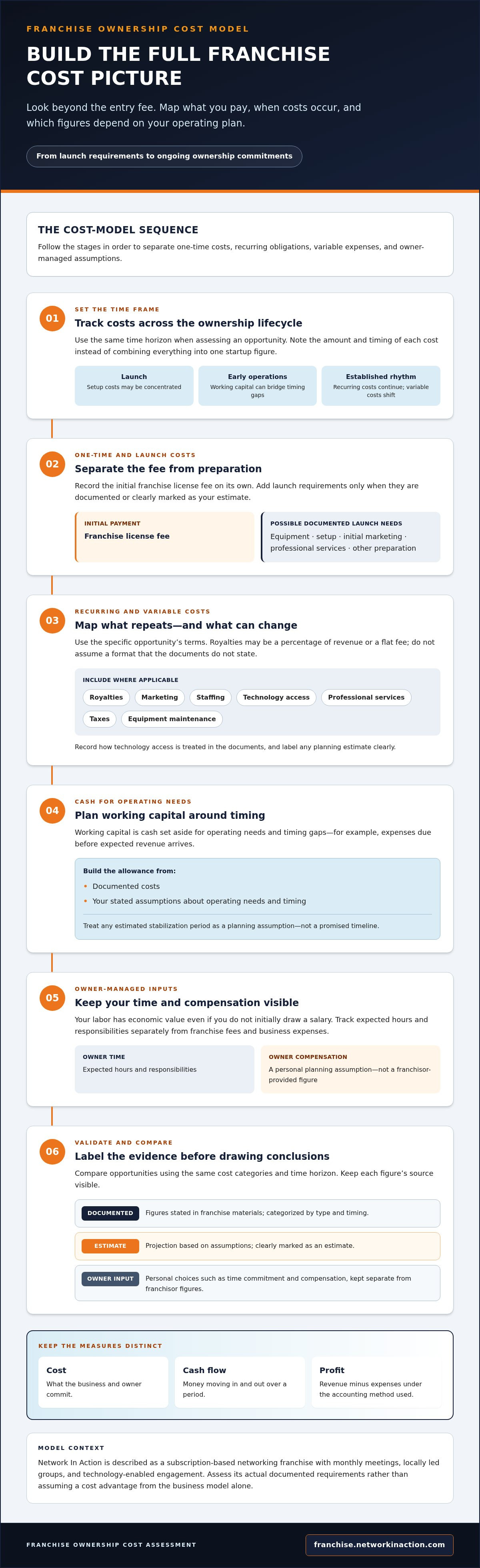
A reliable cost model needs more than a startup total. Sort expenses by when they occur and how they behave: initial franchise-related payments, launch costs, recurring obligations, variable operating expenses, and working capital. Keep owner time and compensation visible as separate planning inputs. This structure helps you spot costs that might otherwise disappear inside a broad estimate.
One-time startup costs and launch requirements
Record the initial franchise license fee as its own one-time category. Add other launch expenses when they’re supported by franchise documentation or clearly identified as your own estimates. Depending on the business model, documented requirements may include equipment, setup, initial marketing, professional services, or other preparation costs. Keep these separate from ongoing fees so you can distinguish what it takes to start from what continues after launch.
Recurring fees, operating expenses, and working capital
Next, map costs that repeat or change with activity. Ongoing royalties may be structured as a percentage of revenue or a flat fee; use the terms stated for the specific opportunity rather than assuming one format. Include marketing, staffing, technology access, professional services, taxes, and equipment maintenance where applicable. Record the documented treatment of technology access and label any planning estimate clearly.
Working capital is the cash set aside to meet operating needs and manage timing gaps, such as expenses falling due before expected revenue arrives. Build an allowance for the period before operations stabilize, using documented costs and your own stated assumptions. Treat any estimated stabilization period as a planning assumption, not a promised timeline. A franchise with limited physical infrastructure may have different cost categories from one that relies heavily on premises, inventory, or equipment. Assess those differences from actual requirements rather than assuming savings.
Owner time and compensation belong in the analysis
Your labor has economic value, even if you don’t initially draw a salary. Track expected hours and responsibilities separately from franchise fees and business expenses. Model owner compensation as a personal planning assumption, not as a franchisor-provided cost unless the materials explicitly state one. If the business requires more involvement than your schedule allows, or delays income beyond your financial runway, the opportunity may not fit your goals even if its documented costs appear manageable.
For each category, capture the amount, timing, whether it repeats, and the source of the figure. Mark figures as documented, estimated, or owner-assumed. This is the practical discipline behind understanding the total cost of ownership for a franchise: your model reflects both the franchise’s terms and the real demands you expect to manage.
For a closer look at the opportunity’s structure and documented cost categories, explore the Network In Action franchise kit as you build your assessment.
How Can You Compare Franchise Costs Without Missing the Trade-Offs?
A fair comparison starts with consistent inputs. Choose the same ownership horizon for each opportunity, then apply the same cost categories and assumptions. Otherwise, one franchise may look less expensive simply because its recurring obligations or owner time aren’t shown alongside its entry costs. A lower initial fee doesn’t automatically mean a lower total commitment.
Compare fee structure, support, and operating requirements
Separate one-time license payments from ongoing royalties and other recurring obligations. Then weigh the documented support, training, technology, and brand resources against the time and resources you’ll contribute. Network In Action provides a 40-hour comprehensive training program led by corporate staff, plus ongoing support. Assess the practical value of those features without treating them as a guarantee of revenue or results.
Use a consistent framework to make differences visible:
| Cost category | What to compare |
|---|---|
| Fixed | Recurring payments that don’t directly change with sales, plus documented one-time license payments. |
| Revenue-linked | Royalties or other charges calculated from revenue, using each opportunity’s documented terms. |
| Variable | Operating costs that change with activity, such as staffing, supplies, equipment, premises, or marketing where relevant. |
| Owner-managed | Your expected hours, responsibilities, and compensation assumptions, assessed separately from business expenses. |
Keep the comparison period and assumptions aligned. If one model’s projections use a different level of activity or exclude owner compensation, mark that difference instead of treating the figures as directly comparable. The aim isn’t to force every business into identical cost structures. It’s to compare each model’s demands using the same lens.
Compare business models by their real operating demands
Look at what each model actually requires. Staffing, premises, inventory, equipment, and technology may be central in one franchise and less relevant in another. Network In Action’s locally led groups meet monthly, supported by a technology platform with a smartphone app, CRM system, member engagement automation, and monthly agendas. These features describe the operating model; they don’t establish a specific saving. For more context, explore the business networking franchise model.
Next, compare the resources behind recurring obligations. Does the documented training address the work you’ll lead? What support is provided, and what responsibilities remain with you? Consider whether the operating rhythm fits your schedule, financial runway, and goals for flexibility. A business with fewer physical requirements may still demand substantial relationship-building, community leadership, or owner involvement.
This is where understanding the total cost of ownership for a franchise becomes a strategic comparison, not a price contest. Evaluate the full commitment, support structure, and operating model together. The strongest fit is the opportunity whose documented demands and owner responsibilities align with your goals, not simply the one with the smallest entry figure.
How Do You Build a Realistic Franchise Ownership Cost Model?
A useful franchise cost model is a working decision tool, not a polished forecast. Build it from documented figures, map when cash may be needed, and make every estimate visible. This gives you a clearer way to test whether the opportunity fits your available capital, operating plans, and personal goals.
Gather and organize the figures before calculating
Start with the franchise disclosure and related materials. Capture documented initial payments, recurring charges, and any operating expense information provided. In the Franchise Disclosure Document, review Item 7 for estimated initial investment, Item 6 for other fees, and Item 19 for any financial performance representations. Treat each item according to what it states; don’t fill gaps with invented figures.
Create a worksheet with a row for each cost and separate columns for:
- Amount: the documented figure or clearly labeled estimate.
- Timing: when the cost is due or expected to arise.
- Frequency: one-time, recurring, or variable.
- Source: franchise material, outside estimate, or personal assumption.
This simple structure separates documented costs from projections. If a figure is missing, mark it as an unanswered question rather than silently inserting a guess.
Stress-test cash flow, timing, and owner involvement
Once costs are categorized, map them across the operating period you want to assess. A total can appear manageable while cash is tight at a particular stage, especially if expenses come due before revenue arrives. Working capital and timing matter because a business must meet obligations as they arise, not only cover its projected total costs.
Build conservative, expected, and stronger operating scenarios by changing assumptions such as the pace of activity, timing of receipts, and variable expenses. These are planning cases, not promised outcomes. For each scenario, note the effect on working-capital needs and the timing of owner compensation. Add your expected hours and responsibilities too. A scenario that depends on more time than you can commit isn’t realistic, even if its cash assumptions look workable.
Use the model to identify unanswered decision questions
Compare the documented investment with your planned operating budget. Flag any gap, then separate questions about costs from assumptions about demand, revenue, or profitability. Cost documents can support an expense estimate; they don’t establish that customers or revenue will arrive as projected. Keep those assumptions distinct so the model remains useful rather than overstated.
Review the worksheet whenever a key assumption changes. Understanding the total cost of ownership for a franchise means testing the full commitment, not treating one scenario as a forecast. If you’re assessing Network In Action, apply the same discipline to its documented opportunity details and your own operating assumptions. You can download the Franchise Kit to explore the franchise opportunity as part of that review.
How Does Network In Action Fit Into a Franchise Cost Assessment?
Network In Action’s subscription-based model gives you a distinct revenue structure to evaluate, but it doesn’t remove the need for careful cost analysis. Assess the opportunity using its documented terms rather than generic franchise averages. Show the initial franchise license fee separately from ongoing royalty obligations, then assess how those commitments relate to your operating assumptions. Recurring-revenue potential is not a promise of income or return.
Assess NIA’s model through the same ownership-cost lens
Include technology and platform access as a category in your assessment, using the details in franchise materials rather than assuming a particular fee. Network In Action’s platform includes an app, CRM system, member engagement automation, monthly agendas, and NEST, a 24/7 e-learning and resource platform. Consider these resources alongside your financial obligations and owner responsibilities. NIA’s approach centers on curated professional relationships and no forced referrals, so evaluate whether you’re prepared to lead a community where trust and relationship-driven growth matter. Those qualities shape the work of ownership, even when they don’t appear as a line item in a cost estimate.
Keep the financial analysis grounded. Separate documented figures from your assumptions about member activity, revenue timing, expenses, and owner compensation. This makes the model more useful for testing fit without implying that a recurring-revenue structure guarantees a particular result.
Match the opportunity to your priorities and next steps
Consider whether community leadership, professional credibility, and relationship-based business development align with your strengths and goals. Weigh the time you expect to invest against the flexibility and lifestyle you want from franchise ownership. Geographic fit matters too. Review available franchise territories as part of deciding whether the opportunity matches your plans.
Understanding the total cost of ownership for a franchise means assessing both the financial model and the work of leading it. If NIA’s structure merits a closer look, explore the Franchise Kit and compare the documented opportunity with your goals, resources, and preferred way of working.
Make Your Next Move With Clarity
A sound franchise decision is about more than whether the numbers appear workable. It’s about whether the ownership model supports the professional life you want to build: the relationships you’ll develop, the community you’ll lead, and the flexibility you need to stay effective over time. Understanding the total cost of ownership for a franchise gives you a stronger basis for that decision, but alignment matters just as much as affordability.
Use your cost model to identify what deserves a closer look, then weigh the opportunity against your priorities and capacity. Network In Action offers a relationship-driven path to community leadership and recurring-revenue potential, without guaranteeing financial outcomes. The right next step is informed exploration, not a rushed commitment.
Ready to assess the model against your goals? Explore the Network In Action Franchise Kit and decide whether this opportunity fits the business and lifestyle you’re aiming to create.
Frequently Asked Questions
What costs are included in owning a franchise?
Include the obligations that apply to the specific franchise, not every cost that might occur in the industry. Review the disclosure materials and operating documents for required payments, then note which expenses depend on your choices or business activity. This helps distinguish mandatory commitments from optional spending and personal budget items. If an expense is unclear, mark it for follow-up in your analysis rather than treating it as zero.
Are franchise royalties included in the initial investment?
Don’t assume they are included or excluded. Check how the initial investment estimate treats any royalty payment that may fall due near launch, and compare that with the separate royalty terms. This prevents two common modeling errors: overlooking an early payment or counting it twice. Show the source and timing of each amount in your worksheet so the distinction remains clear when you update assumptions or compare opportunities.
How much working capital should you include when evaluating a franchise?
There’s no universal amount; estimate it from the franchise’s operating requirements and your financial plan. Keep business working capital separate from personal living reserves, so the same funds aren’t counted twice or treated as interchangeable. Consider what resources must remain available to the business and what you need personally while building ownership income. Label both figures as your own planning assumptions unless the franchise materials provide them.
Does a lower franchise fee mean the franchise costs less overall?
Not by itself. Find out what the initial fee provides, what it excludes, and the territory or term associated with the license. Then assess whether the rights and resources match what you expect to operate. A fee comparison without that context can mislead: two figures may represent different scopes of opportunity. Use the documented terms to understand what you’re acquiring before weighing the fee against your broader business plan.
Can a franchise guarantee a return on investment?
No. A projected or historical result isn’t a guarantee of what your business will earn. Treat financial performance information as material to evaluate, not as an individualized forecast. Test the assumptions behind any projection, including the costs and operating conditions it relies on, then consider how changes could affect your own plan. Your decision should account for uncertainty rather than depend on a promised return.
How do you compare the total cost of two franchise opportunities?
First make sure the figures represent comparable operating scopes, such as similar territory assumptions and levels of owner involvement. Then check whether each estimate includes the same types of items and uses the same treatment for exclusions. Test how each opportunity looks if a key assumption changes. That reveals which model is more sensitive to uncertainty and helps you weigh fit beyond a headline estimate.