What if your next career move didn’t require starting over? The strongest career change opportunities for sales managers build on what you already know: leading people, developing relationships, and turning a pipeline into long-term growth. The key is choosing work that fits your priorities, rather than trading one set of pressures for another.
It’s reasonable to question whether your experience will translate beyond sales and what a change could mean for your income, autonomy, and time. Your leadership skills can apply across several fields, but each path involves a different learning curve, level of risk, and day-to-day responsibility.
This guide compares five practical options, from adjacent leadership roles to consulting and franchise ownership. You’ll see where your strengths transfer, what each transition may involve, and how the realities differ. For sales leaders drawn to relationship-driven work, a Network In Action franchise offers a shift from managing sales activity to leading a professional community. Franchisees use monthly meetings, a technology platform, comprehensive training, and a subscription-based revenue model. The goal is to identify a clear next step that puts your experience to work without relying on vague promises.
Key Takeaways
- Separate a temporary rough patch from a lasting mismatch with sales targets, pace, or daily responsibilities before making a move.
- Compare career change opportunities for sales managers by how much they reshape your work, from adjacent leadership to advisory roles and independent ownership.
- Assess each path against your strengths, retraining needs, desired autonomy, business responsibilities, and income structure.
- Use informational conversations and small experiments to test a direction before making an irreversible career decision.
- Consider whether leading a relationship-driven local business aligns with your strengths in coaching, facilitation, and professional relationship-building.
Why sales managers consider a career change, and what they want next
Changing direction doesn’t erase the value of years spent leading sales teams. It means deciding where that experience can create value next. Sales managers develop skills in coaching, setting priorities, interpreting performance, and guiding customer relationships. Those strengths can travel, even when the next role has a different title or operating model.
Before you move, identify what is driving the decision. A difficult quarter, a new manager, or a frustrating sales cycle may call for a change of employer or team, not a complete career reset. A deeper mismatch may be present if target pressure, the pace of work, or the daily focus on forecasting and performance management consistently drains you, even when the company and team are strong.
The distinction matters because career change opportunities for sales managers vary widely in how much they change your work. Start by examining the role itself. Sales management involves more than closing deals; it includes guiding sales activity and developing team performance. If those responsibilities still energize you, an adjacent leadership role may be a better fit than leaving the field altogether. If the core rhythm no longer suits you, look for work with a different balance of autonomy, relationships, and risk.
Experienced sales managers bring valuable skills to new work because they know how to develop people, build trust, and turn clear goals into coordinated action. That value doesn’t remove the practical trade-offs. A new path can involve unfamiliar responsibilities, retraining, rebuilding credibility, or a different income structure. The goal isn’t to avoid every challenge. It’s to choose challenges that align with the working life you want.
Is it time to change careers or change your sales environment?
Make the question concrete. Write down the responsibilities that energize you and those that repeatedly drain your attention. Consider coaching, recruiting, forecasting, conflict resolution, customer conversations, and internal reporting. Then ask whether your frustration is tied to one employer, leadership team, or sales cycle, or whether the profession’s core demands have become a persistent mismatch.
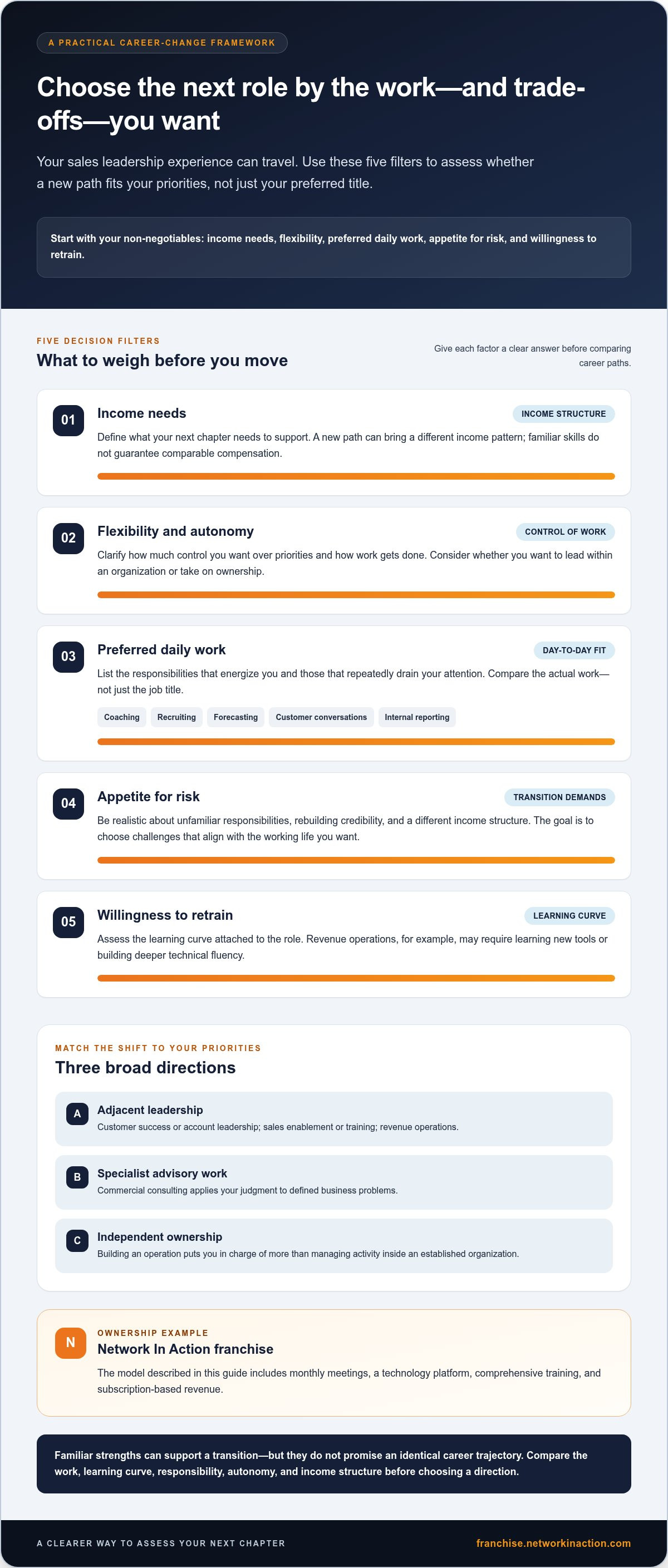
List your non-negotiables before weighing alternatives: income needs, flexibility, preferred daily work, appetite for risk, and willingness to retrain. This turns a general desire to escape into criteria you can use to assess real options.
What sales managers want from the next chapter
For some, the draw is greater autonomy: more control over priorities and how work gets done. Others want broader influence or relationships that develop over time, rather than interactions shaped mainly by the next target. Some are attracted to ownership, where leadership means building a professional community or business, not just managing activity inside an established organization.
There are real concerns, too. Starting over can mean re-establishing credibility and adjusting to a different income pattern. A useful next move doesn’t have to discard your experience. Look for a different operating model that still lets you lead, build trust, and use sound judgment, while being honest about the risks and learning curve.
Career change opportunities for sales managers that use existing strengths
The best next move may change your work without discarding your expertise. Sort options by the size of the shift: adjacent leadership keeps you close to commercial teams, specialist advisory work applies your judgment to defined problems, and independent ownership puts you in charge of building an operation. The U.S. Bureau of Labor Statistics Occupational Outlook Handbook for Sales Managers provides a useful reference for typical duties. Compare those duties with the work you want more of, not just the title you want next.
Each path has different demands and income structures. Familiar skills can help you make the transition, but they don’t guarantee comparable compensation or an identical career trajectory.
Adjacent moves: customer success, enablement, and revenue operations
These roles keep you within a business environment while shifting the focus of your day-to-day work:
- Customer success or account leadership: Relationship management, expectation-setting, and navigating difficult conversations can support work focused on customer engagement and ongoing account relationships.
- Sales enablement or training: Coaching, observation, and performance feedback can translate into developing learning programs, supporting onboarding, or helping sellers strengthen specific skills.
Assess the actual responsibilities, not just the title. Some roles still carry commercial targets; others focus more on coaching, customer experience, or internal capability-building. Review job descriptions for recurring responsibilities and ask how success is measured in the roles you’re considering.
Revenue operations and commercial consulting
Forecasting, pipeline oversight, and process design can prepare you for revenue operations, where the emphasis is on how teams, workflows, and systems support commercial activity. The move may require learning new tools or building deeper technical fluency, especially if your current role has focused more on people leadership than system administration.
Commercial consulting offers another way to use that experience. You might help a business examine its sales process, improve forecasting discipline, or clarify team responsibilities. The work shifts from managing an internal team to diagnosing a client’s specific problem, defining the scope, and communicating recommendations. To make your expertise clear to a potential client, describe the problem you solve, the work you deliver, and the evidence that supports your approach.
Independent paths: consulting, entrepreneurship, and franchise ownership
Independent work offers more control, but it also changes who carries responsibility for creating opportunities and delivering the work. As a consultant, you package expertise into defined engagements. As an entrepreneur, you choose what to build and take responsibility for operating and growing the business. Neither path is simply a salaried role with a new title.
Franchise ownership provides a different structure for business ownership. Network In Action franchisees lead local professional communities, drawing on skills in relationship-building, facilitation, and business development. It’s a shift from managing a company’s sales activity to leading a relationship-driven business, not a direct replacement for a salary. Explore the Network In Action franchise opportunity alongside advisory work and independent entrepreneurship.
Use the comparison to identify where your strongest skills meet the work you want to do. The right career change opportunities for sales managers aren’t defined by prestige alone. They’re the paths whose responsibilities, learning curve, and business realities fit your priorities.
How to compare career paths, trade-offs, and the work you want
A title can sound like progress while the daily work stays much the same. Compare the operating reality of each path: what fills your calendar, which strengths you’ll use, what you must learn, how much autonomy you’ll have, and what business responsibility comes with the move. Career change opportunities for sales managers are easier to assess when you measure them against the work and risk you actually want.
Employment
Daily work: Lead a team, function, or customer relationship within an organization. Skills: Coaching, performance management, and cross-functional leadership. Transition: Learn the new function, industry, or operating systems. Autonomy and responsibility: Work within an established structure, with accountability for assigned outcomes. Income structure: Compensation is set by the employer and role.
Consulting
Daily work: Diagnose client problems, define engagements, and deliver recommendations. Skills: Commercial judgment, communication, and process insight. Transition: Build expertise in a specific problem area and learn to scope and sell your own work. Autonomy and responsibility: Greater control over engagements, alongside responsibility for finding and serving clients. Income structure: Revenue depends on paid client work.
Ownership
Daily work: Build and operate a business, with responsibilities shaped by its model. Skills: Leadership, relationship-building, and execution. Transition: Learn the operating system and business obligations involved. Autonomy and responsibility: More control over the operation, with direct accountability for its development. Income structure: A franchise such as Network In Action uses a subscription-based recurring revenue model, but that structure is not an earnings promise.
Which path fits your leadership style and risk tolerance?
Consider where you do your best work. Do you prefer developing a team inside an established organization, delivering focused work independently to clients, or leading a local professional community? Each calls for a different kind of leadership. Organizational roles provide defined structures; consulting puts more weight on individual delivery; ownership asks you to build and run an operation.
Be direct about uncertainty. How much responsibility for business development, changing priorities, and operating decisions can you realistically accept? A path isn’t a better fit just because it offers more independence. It must also suit your appetite for risk and the support or structure you need to perform well.
How to assess transition effort and income structure
List the gaps between your experience and each path’s requirements. You may need new credentials, industry knowledge, or fluency with unfamiliar technology. Separate essential learning from skills you can build after starting; that distinction helps you estimate the effort without assuming every transition requires a full reset.
Then map income mechanics, not just headline compensation. Employment may offer salary-based pay, while consulting depends on client revenue and ownership follows the business model. For compensation figures, use current, reliable labor-market sources and compare like with like, including role, location, and experience level. A good career pivot connects the skills you’ve built to work you want to do, with the trade-offs clear before you commit.
A practical transition plan for moving beyond sales management
A career pivot deserves the same discipline you brought to a sales plan: clear criteria, reliable information, and deliberate review. Don’t make an irreversible move based on a compelling title or a burst of enthusiasm. Use this sequence to test whether a new direction fits your capabilities, priorities, and tolerance for uncertainty.
- Set your criteria. Define what the next chapter must deliver. Consider the daily work you want, income requirements, flexibility, desired level of autonomy, and how much operating responsibility you’re prepared to take on. Separate must-haves from preferences so one attractive feature doesn’t overshadow a poor overall fit.
- Research the real work. Review job descriptions for employment options, and study the operating details of consulting or ownership models. Map each path’s actual responsibilities against your experience in coaching, planning, managing performance, and building relationships. For ownership, compare the business model, ongoing responsibilities, and support structure.
- Talk with people doing the work. Use informational conversations to learn how a typical week is spent, what challenges recur, and which capabilities matter in practice. Ask about the transition from their previous role and what they wish they had understood earlier. Look for specific examples, not just broad assurances.
- Run a small test. Before resigning or committing significant resources, find a low-risk way to experience the work. That could mean taking on a relevant project, teaching a short session, or testing a consulting offer with a clearly defined scope. For an ownership path, study the operating model and the day-to-day responsibilities.
- Review the evidence and decide. Set a date to assess what you’ve learned against your criteria. Decide what evidence would justify pursuing an employment role, building a consulting practice, or exploring business ownership. If key questions remain unanswered, identify the next test rather than forcing a premature decision.
Test career options before making a full transition
Make the tests specific. Compare your strengths with real role requirements, then keep notes on where you have direct evidence and where you’d need to develop new skills. Conversations can reveal the gap between a role’s public description and its daily demands. Validate a new path with evidence before you commit your time, income, and professional reputation to it.
Prepare your story, finances, and next-step criteria
Translate your leadership record into clear examples: how you coached a team, improved planning discipline, handled performance challenges, or built durable business relationships. These examples help employers, prospective clients, or business partners understand the value you bring beyond a sales title.
Assess your personal financial runway using your own obligations and resources, rather than generic estimates. Consider how a change in income timing or structure could affect your decision. Then write down the evidence that would make each path compelling, such as a role matching your priorities, a credible client need, or an ownership model whose responsibilities fit your strengths.
If business ownership merits a closer look, explore the Network In Action franchise information as part of your research. Treat it as one option to evaluate against your criteria, not a decision you need to make before the evidence is in.
Could a Network In Action franchise fit your next career chapter?
A Network In Action franchise gives sales managers a way to apply commercial judgment in a locally led business. The shift is substantial: instead of directing a company sales team, you take responsibility for developing professional relationships and guiding a community of business owners. Your experience can help, but the role calls for an ownership mindset and a willingness to build professional credibility in a new context.
Consider what motivates you. If you enjoy connecting people, creating structure, and helping professionals make meaningful connections, community leadership can put those strengths to work. Network In Action groups meet monthly, with one professional from each industry in a group. The model uses a modern meeting agenda and a technology platform that includes a smartphone app, CRM, and automated member engagement. If your preference is a clearly defined role with responsibilities set by an employer, business ownership may be a less obvious fit. The decision turns on the work you want to own, not simply the skills you already have.
From leading a sales team to leading a professional community
Sales leadership can develop skills that matter in community-based work: facilitating productive conversations, following through on commitments, and helping people build trust. The focus changes from coaching employees against a sales plan to supporting professionals as they strengthen their own relationships and credibility.
That distinction matters. You’ll need to lead without treating every interaction as a transaction or assuming that a strong network develops automatically. Think about whether you can make space for different business goals, encourage thoughtful participation, and stay consistent in your role as a community leader. Those are practical questions to consider alongside the appeal of owning a business.
Explore the ownership model and assess personal alignment
Ownership means taking responsibility for business development and ongoing operations, while using the franchise model as a framework for your work. Network In Action provides a 40-hour training program delivered by corporate staff, along with ongoing support and access to its 24/7 e-learning and resource platform, NEST. Before moving forward, consider how the responsibilities fit your priorities, how you’ll build local relationships, and what evidence you need to assess the opportunity. The business networking franchise ownership guide can help you examine the broader decision through an ownership lens.
Use the Network In Action franchise kit to explore the opportunity and its requirements at your own pace. If local ownership is part of your evaluation, you can also explore available franchise territories. Compare what you learn with the criteria you’ve set for your next career chapter.
Make your next move a deliberate one
Your next chapter doesn’t need to erase your sales leadership experience. It should put that experience to work in a way that fits your priorities, whether you choose a new role, independent advisory work, or business ownership. The strongest career change opportunities for sales managers are the ones you can evaluate against real responsibilities, personal criteria, and a clear view of the trade-offs.
If community leadership and relationship-driven growth appeal to you, take a closer look at what franchise ownership involves. Explore the model, consider how its day-to-day work aligns with your strengths, and decide whether it merits a place in your transition plan.
Explore the Network In Action franchise opportunity as a practical next step. A well-chosen move can build on what you’ve already achieved while opening a more purposeful direction for the future.
Frequently Asked Questions
Can sales managers change careers without starting over?
Yes. Career change opportunities for sales managers can build on leadership, coaching, planning, and relationship skills you’ve already developed. The new path will still have its own expectations, tools, and industry knowledge to learn. Compare those requirements with your current experience, identify the gaps, and test the day-to-day fit before changing roles. Your experience can transfer without guaranteeing the same seniority or compensation.
What skills from sales management are most transferable?
Coaching, communication, negotiation, forecasting, performance management, and customer understanding can all carry value, depending on the role. For example, in an interview for a training position, frame coaching as a specific case: explain how you identified a team skill gap, gave targeted feedback, and tracked progress. Use concrete examples, but connect each skill to the new role’s priorities rather than assuming the hiring team will make the link for you.
How can a sales manager explain a career change in an interview?
Keep your explanation concise, positive, and connected to the role. Name what attracts you to the work, then show how your leadership experience prepares you to contribute. For example, describe a time you aligned a team around a customer need if the new role emphasizes client outcomes. Avoid criticizing former employers or framing the move as an escape from sales. A clear reason and relevant evidence make the transition easier to understand.
Do sales managers need additional training to move into another career?
It depends on the role and industry. Review current job descriptions and note which qualifications appear consistently, then distinguish essential capabilities from preferred ones. If a role emphasizes a particular software platform, look for a practical way to learn and demonstrate it. Don’t assume a credential is required unless the employer or role specifies it. Targeted learning can close relevant gaps without turning a career change into unnecessary retraining.
Is consulting a realistic career change for an experienced sales manager?
It can be, especially if you can turn commercial experience into a clear solution to a client problem. For instance, you might help a company examine its forecasting process or improve how it coaches sellers. Consulting also requires defining an offer, finding clients, and delivering work clients can evaluate. Test whether businesses value your proposed expertise, and consider how pursuing clients differs from leading a team with an established pipeline.
Can franchise ownership be a career change for a sales manager?
Yes, if you view it as building and operating a business, not accepting a job. Ownership brings responsibility and business risk, so assess how the work and model fit your goals before deciding. Consider the day-to-day decisions you’d need to make, how you would develop local relationships, and whether you’re ready to take responsibility for business development. Evaluate the opportunity on its operating realities, not on assumptions about earnings or outcomes.