Can a franchise create a meaningful next chapter without putting essential retirement savings at unacceptable risk? If you’re asking, “Is buying a franchise a safe way to invest for retirement?” the answer depends on your capital, income needs, risk tolerance, and willingness to run a business. A proven operating model can offer structure, but it can’t guarantee returns or remove the risks of ownership.
That distinction matters. Recurring revenue describes how a business earns income; it doesn’t promise that you’ll earn a particular amount or recover your investment. Franchise ownership may complement retirement planning, but it shouldn’t replace a diversified financial strategy or put your financial flexibility out of reach.
This guide will help you compare franchise ownership with your retirement priorities, identify due-diligence questions to address before committing capital, and weigh the realities of workload and income consistency. You’ll also see how Network In Action’s relationship-driven model, built around monthly meetings and a technology-enabled platform, may fit a next chapter centered on community leadership and professional connections. The goal is a clear-eyed decision that aligns your capital, time, and ambitions.
Key Takeaways
- Answer “is buying a franchise a safe way to invest for retirement” by weighing your risk tolerance, liquidity needs, and retirement priorities, not by relying on the franchise model alone.
- Compare the business’s likely workload and income assumptions with the time, autonomy, and financial flexibility you want in retirement.
- Use a step-by-step due-diligence process to examine official franchise documents, fees, ongoing obligations, renewal terms, and exit provisions.
- Evaluate features such as technology, training, and community leadership against the support and lifestyle fit you’re seeking.
- Explore whether Network In Action’s relationship-driven franchise model aligns with your strengths, goals, and preferred way to build professional connections.
Is Buying a Franchise a Safe Way to Invest for Retirement?
After a long career, wanting income, purpose, and more control over your time is reasonable. Business ownership may offer an active next chapter, but it also puts your capital, attention, and effort at risk. So, is buying a franchise a safe way to invest for retirement? There’s no universal yes. The fit depends on your risk tolerance, liquidity needs, and retirement priorities.
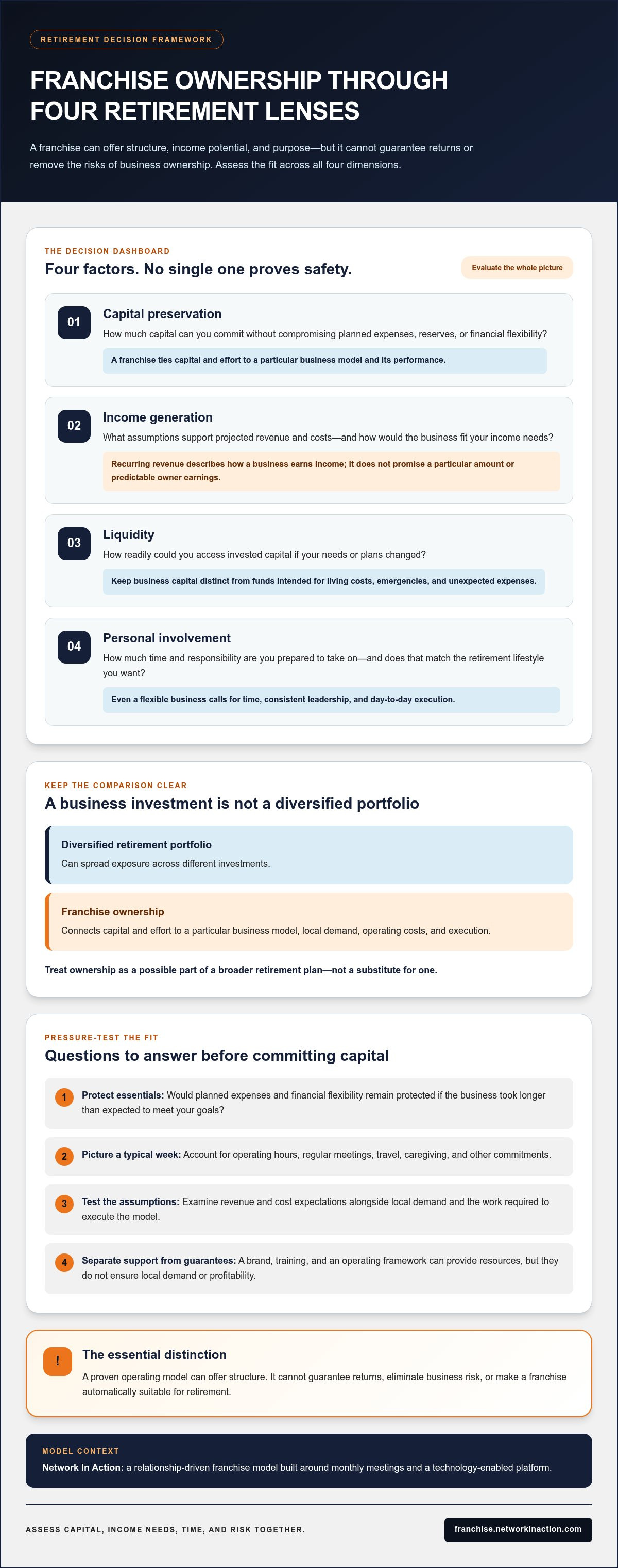
Start by defining what “safe” means to you. Capital preservation means limiting the possibility of losing money. Income generation means earning revenue from an operating business. Liquidity is how readily you can access invested capital if your needs change. Personal involvement is the time and responsibility you’re prepared to take on. A franchise may score differently on each measure, so don’t treat one strength as proof of overall safety.
A business investment is also different from a diversified retirement portfolio. A portfolio can spread exposure across different investments; a franchise ties capital and effort to a particular business model and its performance. That doesn’t make ownership automatically unsuitable. It means the decision should fit within your broader retirement plan, not stand in for one. Consider whether your essential expenses and financial flexibility would remain protected if the business took longer than expected to meet your goals.
What “safe investment” means in a retirement decision
Set your priorities before evaluating a brand. If access to capital matters most, identify how much you can commit without compromising planned expenses or reserves. If income is the priority, examine the assumptions behind projected revenue and costs. If purpose and control matter, be equally clear about the operating hours and responsibilities you’re willing to accept. A fit on one dimension doesn’t guarantee a fit on the others.
Why a franchise model does not remove business risk
A franchise system can provide a brand, training, and an established operating framework. These resources can help you understand how the business is intended to run, but they aren’t financial guarantees. Franchising is a business relationship built around an established brand and operating system; that structure doesn’t ensure local demand or successful execution.
Demand, operating costs, your time commitment, and day-to-day execution all affect results. A documented operating process may help you plan activities, but local market conditions and your ability to lead the business still shape performance. Examine those variables rather than assuming brand recognition resolves them.
Franchise support may reduce uncertainty, but it cannot guarantee profitability. Treat training and systems as operating resources, not protection against financial loss. A sound retirement decision starts with clear personal limits, realistic assumptions, and an honest assessment of the work you want your next chapter to involve.
How Franchise Ownership Can Fit, or Conflict, with Retirement Plans
A franchise can add structure, purpose, and a new source of business revenue to your post-career plans. It can also require ongoing leadership, relationship-building, and attention to operations. The key question isn’t simply whether the model generates recurring revenue. Recurring revenue describes how a business earns income; it doesn’t assure predictable earnings for its owner. Your fit depends on what you need financially and how actively you want to work.
Match the owner role to the retirement lifestyle you want
Picture a typical week, not just the long-term vision. Leading a professional community may suit you if you enjoy building relationships, developing credibility, and creating value through a strong network. It may conflict with a hands-off retirement plan. Even a flexible business calls for time and consistent leadership.
- Availability: Identify the hours you can reliably devote to operating and growing the business.
- Travel and family: Consider how trips, caregiving, and other commitments could affect your schedule.
- Work rhythm: Decide whether you want regular meetings and ongoing business activity or longer stretches with fewer obligations.
- Transferable strengths: Sales, leadership, and relationship-building experience can help you lead a community, but they don’t remove the need to execute the business model.
For a broader view of post-career possibilities, compare franchise ownership with other paths described in Top Executive Business Opportunities in 2026: Beyond the C-Suite. A good next chapter should fit your interests as well as your finances.
Pressure-test financial flexibility before committing
Retirement fit depends on both financial capacity and willingness to operate the business. Keep the capital you’re considering for a franchise distinct from money intended for living costs and emergencies. Then test the decision against these priorities:
- Liquidity: Preserve access to funds you may need for unexpected expenses or changing plans.
- Personal spending: Map the income required for your regular retirement lifestyle independently of possible business revenue.
- Other goals: Account for travel, family support, healthcare, and the financial plans already in motion.
- Business assumptions: Model revenue, costs, and your time commitment without treating projected or recurring revenue as guaranteed owner income.
Independent financial, tax, and legal advice can help you assess the decision in light of your circumstances. If a relationship-driven franchise still fits your goals, review the franchise opportunity details as one input to your broader evaluation. Proceed only when the business role and capital commitment make sense for the retirement you want.
How to Evaluate Franchise Risk Before Using Retirement Capital
Strong due diligence turns a broad question into a sequence of decisions. Start with a clear question: is buying a franchise a safe way to invest for retirement? Define what you can risk, then test the opportunity against evidence rather than optimistic projections. Write down your assumptions so you can spot gaps, compare promotional claims with the written documents, and pause if the numbers or obligations don’t fit your boundaries.
Build a personal risk and liquidity checklist
Set personal guardrails before reviewing brands. Separate essential savings and near-term expenses from capital you’re considering for a business. Consider how long you could handle uncertainty without relying on franchise income. Record the loss you could accept, the workload you’re willing to take on, and the conditions under which you would want to exit. These limits help keep enthusiasm from setting the terms.
- Define your objectives. Write down what the business needs to contribute to your retirement plan, whether that’s purposeful work, additional income potential, or community leadership. Distinguish must-haves from preferences.
- Set financial and lifestyle boundaries. Identify the funds that need to remain available for living costs, emergencies, and other priorities. Note your acceptable workload and how long you could manage uncertainty without business income.
- Read the official franchise materials. Review the disclosure documents and agreement carefully with qualified legal and financial advisers. Identify fees, ongoing obligations, renewal terms, and exit provisions. Don’t rely on a summary or verbal explanation in place of the written terms.
- Test the operating assumptions. Examine how the business expects to attract and retain customers or members, what local demand could support, and what activities the owner must perform. Build a realistic view of costs and time, including the work required before revenue develops.
- Assess support and responsibilities. Understand what training, resources, and ongoing support involve, then identify what remains your responsibility. Compare the documented support with the practical demands of operating the business.
Investigate the agreement and business assumptions
Look beyond the headline opportunity. For a relationship-driven business, assess how local professionals might respond to the offer, how the owner is expected to build a qualified community, and what ongoing engagement requires. A strong operating framework can clarify the process, but it can’t establish demand in your market or do the work of leading the business.
Review documented obligations and local demand before estimating a franchise’s role in retirement income. Have independent advisers review the assumptions and terms before you commit. Their perspective can help reveal financial, tax, or legal questions that promotional materials may not answer. A disciplined review keeps the decision grounded in your circumstances, the written agreement, and a realistic operating plan.
Which Franchise Features Matter Most for a Retirement-Focused Owner?
The right franchise features are the ones that fit your preferred work rhythm, strengths, and goals. A relationship-driven business may suit you better than an inventory-heavy or highly operational model if you enjoy leading a professional community and building lasting connections. But “relationship-driven” doesn’t mean effortless. You still need to understand the work involved in attracting members, leading groups, and sustaining engagement.
Use this comparison to focus your evaluation. It highlights operating considerations to explore, not a promise of performance.
| Feature | What to assess | Retirement-fit question |
|---|---|---|
| Workload | Member recruitment, group leadership, meeting preparation, and relationship management | Can you commit to these activities consistently without crowding out the life you want? |
| Revenue structure | How subscriptions are organized and what supports member retention | Do the operating assumptions and ongoing obligations suit your business goals? |
| Technology | How the platform supports communication and business operations | Will the tools help you work in a structured way while leaving you responsible for execution? |
| Training and support | What training covers and what ongoing support involves | Will these resources help you perform the owner’s role? |
| Community leadership | The effort required to develop professional credibility and useful connections | Does leading a curated network feel meaningful, not merely manageable? |
Compare operating demands with the lifestyle you want
Network In Action’s model includes monthly meetings and one professional per industry in each group. Compare that cadence with traditional networking models that may schedule meetings more frequently, then consider the work between sessions: recruiting members, building trust, and keeping relationships active. A monthly meeting schedule alone doesn’t define the workload. Flexibility depends on local execution and the choices you make as the owner.
Assess training, technology, and support as practical resources
Network In Action provides 40 hours of corporate training and ongoing support, alongside its technology platform and NEST e-learning and resource platform, available 24/7. These tools support a structured operating approach. Evaluate how each resource fits your skills and where you’ll need to take direct responsibility for building and leading the business.
If you’re asking, “Is buying a franchise a safe way to invest for retirement?” assess the ownership model against your preferred role and schedule. For a deeper discussion, explore Business Networking Franchise: The Executive Guide to Modern Ownership. If Network In Action’s community-led model aligns with your goals, review the franchise opportunity details as part of your evaluation.
Could Network In Action Be a Retirement Business Opportunity?
Network In Action offers a franchise built around leading local, industry-exclusive networking groups. Its model combines monthly meetings, one professional per industry in each group, a technology platform, and subscription-based operations. If you enjoy building professional relationships, this offers a defined way to lead a local business community and create value through connection. The role still calls for active leadership and consistent attention to relationships.
Network In Action guarantees ROI on every membership. That guarantee does not extend to franchisee income or the return on a franchise investment. Keep those claims distinct as you review the opportunity, and read the applicable materials to understand the terms and scope of the membership guarantee.
What the Network In Action model offers, and what it requires
Community leadership is central to the owner’s role. You’ll need to build professional credibility, attract the right local participants, and foster useful connections among people from different industries. Monthly meetings create a regular gathering point, while the platform supports the business’s ongoing activity. NEST, the e-learning and resource platform, is available 24/7 for franchisees to access learning materials and resources.
Consider whether these activities suit your strengths and the pace you want. The model may appeal if you enjoy relationship-building and creating a focused professional community. It may not fit if you’re seeking an ownership role with minimal involvement. The practical test is whether leading and growing a group matches the lifestyle you’re aiming to build.
Explore the opportunity with clear expectations
Before moving forward, examine the territory, owner responsibilities, documented obligations, and activities involved in developing a local group. Assess how the operating model aligns with your retirement priorities and how you would approach relationship-building in your market. Network In Action’s scale and recognition provide context, but they don’t predict how an individual franchise will perform. Evaluate the opportunity’s terms and operating expectations on their own merits.
The key is to decide whether the model and its responsibilities fit the next chapter you want, not simply whether the concept sounds appealing. The downloadable Franchise Kit can help you review the opportunity as part of your due diligence.
If the model aligns with your goals, explore the Network In Action franchise and consider your next step at your own pace.
Choose Your Next Chapter with Clarity
Ask yourself: is buying a franchise a safe way to invest for retirement? The answer depends on whether the opportunity fits your financial boundaries and the kind of work you want your next chapter to involve. A franchise should complement your broader retirement plan, not carry the full weight of it. Give yourself room to assess both the business opportunity and the life you want to build around it.
Network In Action operates more than 300 groups across four countries. That scale offers context, not a forecast for an individual franchise. Examine the opportunity’s documented terms, local potential, and owner responsibilities, then decide whether community leadership and relationship-driven growth align with your goals.
Explore the model at your own pace and make the decision based on fit, not urgency. Explore the Network In Action franchise as you consider a purposeful, well-informed next move.
Frequently Asked Questions
Can you buy a franchise with retirement savings?
Yes, retirement savings may be one source of funds for a franchise, but the method and consequences depend on your account, circumstances, and financing structure. Before moving money, get independent advice from qualified tax, legal, and financial professionals. Ask them to explain potential costs, risks, and effects on your wider retirement plan. The question “is buying a franchise a safe way to invest for retirement” has no universal answer; it depends on your situation.
How much should you invest in a franchise for retirement?
There’s no universal amount that’s appropriate for every retirement-focused buyer. Start with the franchise’s official investment information and calculate the full commitment, including ongoing obligations and working capital needs. Then compare it with your living expenses, emergency reserves, and other retirement goals. If a business requires more capital than you can risk without disrupting essential plans, reassess the opportunity rather than stretching your budget.
Can a spouse or partner co-own a franchise?
Co-ownership arrangements depend on the franchisor’s requirements, the franchise agreement, and how ownership is structured. Before proceeding, discuss who will contribute capital, make operating decisions, and handle responsibilities if one partner steps back. Have a qualified lawyer review the proposed arrangement and its effect on both partners. A clear written plan can reduce misunderstandings about authority, workload, and ownership if circumstances change.
Can you sell a franchise when you want to retire?
You may be able to sell or transfer a franchise, but don’t assume you can exit on any timeline or terms you choose. The franchise agreement and related documents set out the applicable transfer, renewal, and termination provisions. Review them with a qualified lawyer before committing. A future buyer, timing, and business performance can affect the options available, so don’t treat a sale as guaranteed access to your invested capital.
What happens to a franchise if the owner becomes unable to operate it?
The outcome depends on the ownership structure and the franchise agreement. Before launch, plan for illness or incapacity: identify who could manage essential responsibilities, how that person would access necessary business records, and what decisions require formal authority. Review the agreement with a lawyer and discuss contingency planning with relevant advisers. Don’t assume a spouse, partner, or family member can automatically take over or continue operating the franchise.
Does owning a franchise affect Social Security or other retirement benefits?
It can affect your overall financial picture, but the impact depends on the benefit program, your income, and personal circumstances. Franchise revenue isn’t necessarily the same as your personal earnings, so avoid estimating benefit effects from gross business revenue alone. Before making a decision, speak with the relevant benefits administrator and a qualified tax or financial professional. Ask them to assess your specific situation, including how business income and work activity may be treated.