What if the best part-time franchise opportunities aren’t the ones that promise the fewest hours, but the ones built around work you’re already good at? For an executive balancing a demanding career, franchise listings can make very different businesses look equally manageable. The useful question is whether the operating model fits your schedule, strengths, and appetite for hands-on work.
That concern is justified. A business that depends on daily staffing, inventory, or a physical location can quickly become a second full-time job. A flexible label doesn’t tell you how often you’ll need to respond to customers, manage operations, or make decisions. You need a clear view of the responsibilities, time demands, and growth path behind the opportunity.
This guide compares franchise models by operating demands and flexibility, so you can assess what may realistically fit alongside your career. You’ll also explore a relationship-driven alternative: Network In Action’s franchise model, built around monthly meetings, technology support, curated professional communities, and subscription-based recurring revenue. It isn’t passive ownership. It’s a structured opportunity for professionals who want to lead communities, build credibility, and grow through relationships rather than cold prospecting. The right fit starts with knowing how you want to invest your time.
Key Takeaways
- Judge part-time ownership by its recurring responsibilities, not the label. A flexible calendar doesn’t automatically mean a light workload.
- Compare part-time franchise opportunities by delivery demands, customer interaction, staffing, and scheduling before narrowing your options.
- Map your available time, strengths, goals, and territory to the business’s regular tasks to see whether the schedule is realistic.
- Review franchise obligations and supporting documents carefully so you understand the commitment before making a decision.
- Explore whether Network In Action’s monthly meetings, industry-exclusive groups, NEST, and technology platform align with your strengths in community leadership and relationship-building.
What makes a franchise opportunity genuinely part-time?
A genuinely part-time franchise is a business whose recurring responsibilities may fit alongside another career, based on the owner’s available time and the operation’s actual demands. “Part-time” describes a possible structure, not a promise of limited effort. Even a flexible calendar can include regular commitments, customer needs, and decisions that require your attention.
Franchise listings rarely show the full workload. To assess fit, examine the work behind the business rather than relying on the label. The Franchising model combines a defined business approach with ownership responsibilities, but operating demands vary by system. Compare:
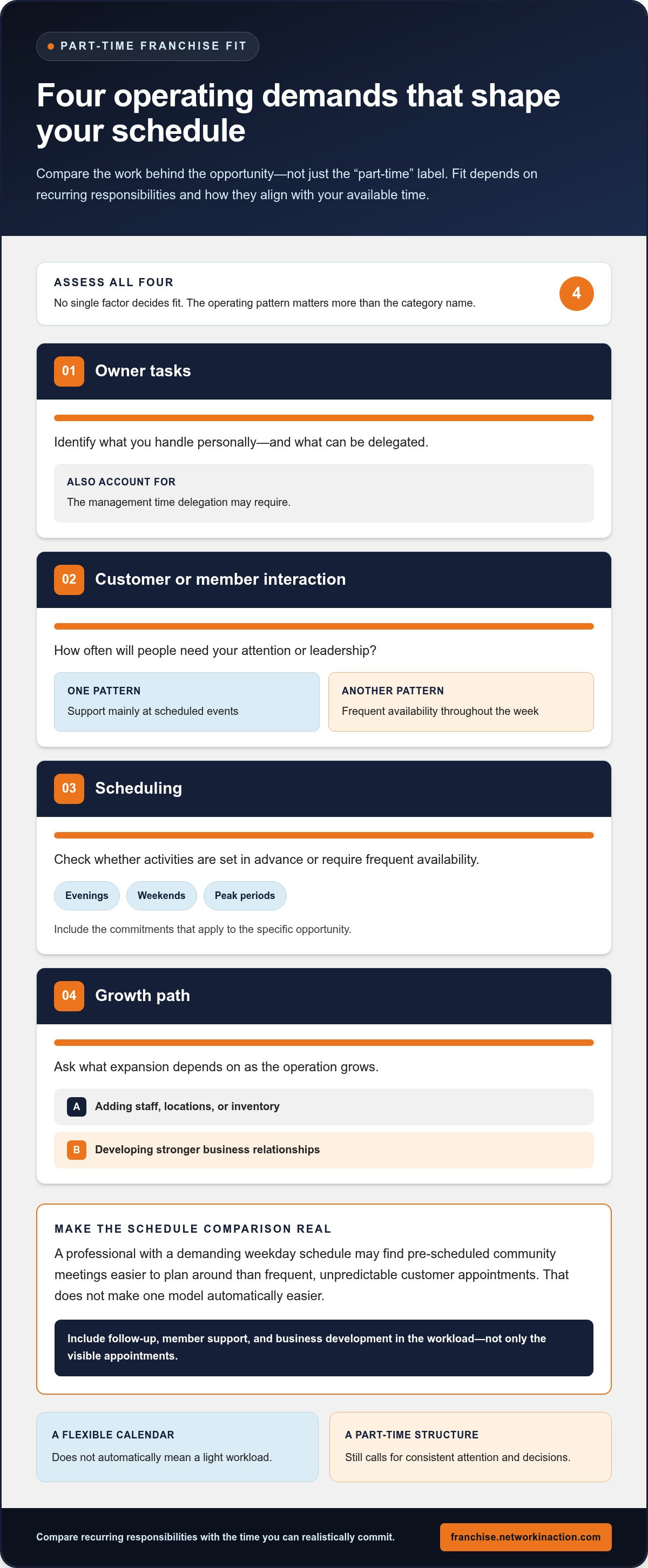
- Owner tasks: What must you handle personally, and which tasks can be delegated? Consider the management time delegation may require, too.
- Customer or member interaction: How often will people need your attention or leadership? Does support happen mainly at scheduled events or throughout the week?
- Scheduling: Are activities set in advance, or do they require frequent availability? Note evening, weekend, and peak-period commitments.
- Growth: Does expansion depend on adding staff, locations, or inventory, or on developing stronger business relationships?
For example, a professional with a demanding weekday schedule might find pre-scheduled community meetings easier to plan around than frequent, unpredictable customer appointments. That doesn’t make one model automatically easier. It shows why schedule fit depends on the operating pattern, not the category name. Include the less visible work, such as follow-up, member support, and business development, in your comparison.
How is a part-time franchise different from a side hustle?
A side hustle can be an informal way to earn income through flexible, project-based work. Franchise ownership is different: you operate within a defined business model and support system, with responsibilities tied to that model. The structure may offer clearer processes, but it doesn’t remove the need to make decisions, manage ongoing tasks, or give the business consistent attention. Part-time ownership is a commitment, not an occasional activity.
That distinction helps you compare options realistically. A franchise may have scheduled activities and established operating practices, while gig work may let you choose individual assignments. Neither path is automatically more suitable. Consider whether you prefer building an ongoing business with a framework or keeping work more project-based and self-directed. Then compare the recurring tasks and obligations of the specific opportunity.
Which professionals may be considering franchise ownership?
Executives and other experienced professionals may be looking for a structured route to business ownership without immediately leaving their current role. Some are drawn to community leadership, professional credibility, and relationship-based growth. Others want to apply strengths such as strategic planning, communication, or business development in a new setting. Those interests can point toward a relationship-led model, where quality connections matter more than cold prospecting.
Career transition is a personal decision, not an inevitable result of ownership. You might explore a franchise as a parallel business, a longer-term growth path, or a way to build toward a future change. Start by matching the model’s recurring responsibilities to the time and leadership you’re prepared to invest. A practical first step is to block out the fixed commitments in your calendar, then see how much capacity remains for flexible work and unexpected needs.
Which part-time franchise models should professionals compare?
Categories are a starting point, not a workload forecast. Compare what the owner does regularly: deliver a service, manage products, coordinate a schedule, or build a professional community. Then look at how customers or members interact with the business, whether staffing is involved, and what changes as the operation grows. The same category can work very differently across franchise systems.
This model-by-model view makes part-time franchise opportunities easier to assess. Use the table to identify the operating demands that deserve closer attention, then account for the specific franchise system, territory, and growth plans.
| Operating model | Day-to-day focus | Questions to assess |
|---|---|---|
| Service-based | Delivering or coordinating a service, often around customer appointments. | Who performs the core service? How are requests scheduled and handled? |
| Home-based | Running the business from home, with work shaped by its particular service or product. | What tasks still require your attention, and when do customers need access? |
| Product-based | Managing product sales, fulfillment, inventory, or a customer-facing location, depending on the model. | Who manages stock and transactions? Does the model depend on a physical site? |
| Relationship-led | Convening professionals and developing business relationships through a structured community. | What leadership and member-support work recurs between scheduled gatherings? |
How do service and product-based franchises differ?
Service models center on completing work for customers. Their operating rhythm may depend on appointment volume, who delivers the service, and how customer requests are coordinated. Product models center on selling goods, so inventory, fulfillment, transactions, or location needs may shape the owner’s routine. Neither category inherently means fewer hours or lower investment. Identify who handles the core delivery, how demand is managed, and what happens when demand rises before deciding whether the structure fits.
Where does a relationship-led franchise fit?
A relationship-led model puts community leadership at the center. Network In Action franchises bring professionals together in industry-exclusive monthly groups, with one professional per industry in each group. The owner’s role is not simply to host a gathering. It includes developing business relationships and supporting an ongoing professional community. This may suit an executive who values credibility and quality connections over cold prospecting, while still requiring consistent attention between meetings.
Compare this structure against other models by looking at its recurring calendar, member interaction, and growth path. Network In Action’s technology platform supports the group experience with a smartphone app, CRM system, member engagement automation, and monthly agendas. The Network In Action franchise kit can help you explore how this ownership model is structured as you assess its fit with your professional goals.
How can you judge schedule fit, flexibility, and growth potential?
A workable schedule is more than a calendar with open spaces. You need to understand the work that repeats, the tasks that shift with demand, and the time required to develop the business. A monthly meeting, for example, is one visible commitment, not a complete measure of the owner’s workload. Member or customer support, relationship-building, and business development may also take consistent attention.
Build a realistic picture across three stages: launch, routine operation, and expansion. Responsibilities can change as the business develops. Separate fixed commitments, such as scheduled meetings, from flexible tasks that still need to get done. Then compare the model with your actual career calendar, including peak periods, travel, and responsibilities that are difficult to move. A simple weekly plan can help: mark immovable work commitments first, add franchise activities next, and reserve time for follow-up and administration.
What questions reveal the real time commitment?
List recurring tasks and note when they occur, not just how long they appear to take. Ask which responsibilities the owner must handle, what support the franchise system provides, and how business development fits into a typical week. Consider how those demands may shift during launch or growth. This exposes the difference between a flexible schedule and a low workload.
Use questions like these to make the assessment concrete:
- Which tasks recur daily, weekly, or around scheduled gatherings?
- How much member or customer support takes place outside those events?
- What business-development activity is needed to build and sustain the operation?
- Which tasks could be delegated, and what management would delegation require?
How should you evaluate recurring revenue and scalability?
A subscription-based structure can create recurring revenue, but it isn’t a promise of earnings. Business health also depends on whether members continue to see value, whether relationships deepen, and whether groups develop at a pace that fits the owner’s capacity. Treat revenue structure and owner workload as separate questions: predictable billing doesn’t automatically mean predictable effort.
Scalability also needs a practical definition. Growth might mean strengthening one operation or developing additional groups, but more activity can bring more relationship management and support needs. Assess the pace you want, then consider whether the operating system and your available time can support it. Don’t assume staffing or delegation is part of a model unless the franchise details establish that.
| Decision factor | Questions to ask yourself |
|---|---|
| Career fit | Can recurring commitments coexist with your work calendar? |
| Leadership strengths | Do you enjoy convening people, building trust, and supporting relationships? |
| Support | What training, technology, and ongoing guidance are part of the franchise system? |
| Desired pace | Are you aiming to maintain a focused operation or pursue measured growth? |
For professionals assessing part-time franchise opportunities, this framework turns “flexible” into questions you can answer. Compare your available time, preferred leadership role, support needs, and growth ambitions with the model’s actual operating expectations. The strongest fit is the one you can sustain, not simply the one that looks easiest to schedule.
What should you investigate before choosing a part-time franchise?
Make the decision with evidence, not a “part-time” label. A franchise should align with your goals, available time, strengths, and preferred territory, while its obligations and support fit the way you want to operate. Use a structured review to separate documented features from assumptions about workload, flexibility, and growth.
- Set your objective. Decide what you want ownership to contribute, such as building a business alongside your career, leading a professional community, or developing a longer-term transition path.
- Define your capacity. Map your work constraints and realistic availability. Include time for regular operations, business development, and decisions, not only scheduled events.
- Match your strengths. Identify whether you’re most effective at relationship-building, organizing, sales, leadership, or managing delivery. Then determine which of those capabilities the owner role actually requires.
- Assess the territory. Geographic fit can influence whom you serve and how you build the business. Review available franchise territories as part of deciding where the model fits your goals.
Next, study the franchise agreement and disclosure materials, along with any other documents that explain the operating model. Focus on the franchisee’s responsibilities, financial obligations, support, and any restrictions or ongoing commitments. Summarize what the documents say in practical terms: what you own, what you must do, and what the franchisor provides. If a responsibility or cost is unclear, identify it as an open question in your decision notes rather than treating an assumption as a fact.
How do you test a franchise against your career and strengths?
Compare the model’s recurring cadence with the calendar you actually have, including predictable work peaks and travel. Identify tasks that require your direct participation, then distinguish those from tasks supported by the system or other resources. A strong personal fit means the operating role uses your strengths without relying on time you can’t consistently commit. For example, if you travel frequently, ask whether the fixed activities can be planned around those trips and account for the work that still needs attention while you’re away.
What support and operating details should you understand?
Examine how training prepares you to operate, what the technology platform supports, and what ongoing guidance covers. Network In Action’s franchise includes 40-hour comprehensive training provided by corporate staff and ongoing support. Its NEST intranet is an e-learning and resource platform available 24/7. Treat these as elements of the operating system, not proof that the business requires little effort. Understand the franchisee’s role alongside the tools and guidance provided.
Use this checklist to keep claims grounded:
- Evidence: Responsibilities, support, training, and operating features stated in franchise materials.
- Assumption: Expected hours, ease of balancing work, or growth pace that hasn’t been established.
- Your test: Whether the documented commitments fit your calendar, strengths, and objectives.
For a closer look at how Network In Action’s franchise model is structured, explore the franchise opportunity and ownership details. A disciplined review helps you pursue ownership with clarity, not guesswork.
Could the Network In Action franchise fit your part-time ownership goals?
For professionals who want to lead a community and build meaningful business relationships, Network In Action offers a distinct franchise model. Its focus is not inventory or a customer-facing location. It’s a structured professional community supported by technology. The model may align with your strengths if you enjoy connecting people, building credibility, and helping professionals develop trusted relationships.
Member experience is central to the approach. Groups are curated for high-quality professional connections, with no forced referrals. Monthly meetings provide a defined rhythm, but they aren’t the whole owner role. Group development, member support, and business growth also call for consistent attention. The model is structured, not passive, so consider its ongoing demands alongside your career schedule.
What distinguishes the Network In Action franchise model?
Network In Action groups meet monthly and are industry-exclusive, with one professional per industry in each group. The model is designed to encourage relationship-led growth rather than transactional referral requirements. Its technology platform includes a smartphone app, CRM system, member engagement automation, and monthly agendas. The NEST intranet provides e-learning and resources 24/7. Together, these tools support the operating system, while the subscription-based structure creates recurring revenue for the business. That revenue model is a feature, not a projection or promise of earnings.
The company states that a new franchise can be launched in 42 minutes. That is a stated launch capability, not a measure of the time or effort required to operate and grow the business. Network In Action has over 300 groups operating in four countries. Ongoing responsibilities include leading groups and developing a strong professional community.
What is a practical next step for an interested professional?
Test the opportunity against your own priorities. Can you make room for monthly gatherings and the work around them? Do community leadership and professional relationship-building match your strengths? Does the territory support the business you want to build? Answering these questions helps you decide whether this model fits your goals and capacity.
As you evaluate the franchise, consider the structure of its technology and ongoing support alongside the responsibilities you would take on. Tools can support execution, but your time commitment and leadership role still matter.
If the model merits a closer look, use the downloadable Franchise Kit to explore the franchise details and assess alignment with your schedule, strengths, and territory interests. It’s a practical next step, not a commitment. The right ownership decision starts with understanding the work and deciding whether it fits the professional life you want to build.
Choose a Model That Moves You Forward
The right ownership decision isn’t about squeezing another commitment into an already full calendar. It’s about choosing work that fits your ambitions, uses your strengths, and supports the kind of professional life you want to build. As you assess part-time franchise opportunities, focus on the owner role you’re ready to take on, not just the flexibility a business appears to offer.
For professionals energized by community leadership and relationship-driven growth, Network In Action offers a path to explore on its own merits. Consider how its approach aligns with your priorities, territory interests, and capacity for consistent involvement. A thoughtful next step can clarify whether the opportunity deserves a place in your longer-term plans.
Explore the Network In Action Franchise Kit and evaluate the model at your own pace. Your next chapter can start with a well-informed decision, grounded in the work you want to do and the impact you want to make.
Frequently Asked Questions
Can you own a franchise part-time while keeping a full-time job?
Yes, if the franchise’s commitments can coexist with your employment and you can meet both sets of responsibilities. Before moving forward, review any obligations in your employment agreement that could affect outside business activity, and consider potential conflicts of interest. You’ll also want to decide how you’ll protect time for franchise decisions during workdays. A clear boundary plan can help you assess whether the two roles are compatible.
What are the best part-time franchise opportunities for corporate professionals?
The strongest candidates are those that use skills you already want to apply, such as leading a community, developing professional relationships, or organizing a business operation. For example, an executive with a strong local network may find a relationship-led model more aligned than work centered on product handling. Treat this as a personal fit question, not a universal ranking, and consider which owner responsibilities you find motivating.
How much time does a part-time franchise require?
There isn’t one standard time requirement. To create a useful estimate, ask for examples of a typical operating cycle and identify work that could cluster around existing commitments. Then consider what happens when a member needs support or a business-development opportunity arises at an inconvenient time. A calendar exercise can reveal practical conflicts, while the franchise’s operating materials explain its specific expectations.
Is a franchise side hustle a passive source of income?
No. A franchise is an operating business, so ownership involves decisions and responsibility even if you retain another job. A useful test is to imagine an ordinary week when a routine task needs attention: would you handle it, arrange appropriate help, or postpone it? If the model depends on your involvement, income shouldn’t be treated as automatic. Evaluate the business as active ownership, not a hands-off investment.
What should you compare when choosing a part-time franchise?
Look beyond category names and compare what the franchise agreement and disclosure materials say about the owner role, operating obligations, support, territory, and growth. Also consider whether the model’s customer or member experience fits your professional style. For instance, someone who prefers ongoing relationship-building may value a different kind of work from an owner who prefers managing transactions. Keep a written comparison so assumptions don’t become decision criteria.
Can a networking franchise generate recurring revenue?
A networking franchise can be built around subscription-based revenue, as Network In Action’s model is. Recurring billing describes how revenue is structured; it doesn’t establish how much a franchise will earn. For a more useful evaluation, consider what ongoing value supports subscriber retention and what the owner must do to maintain that value. Review the franchise’s business materials for the revenue model and responsibilities rather than relying on the word “recurring” alone.
What training does Network In Action provide franchisees?
Network In Action provides 40-hour comprehensive training delivered by corporate staff, along with ongoing support. To evaluate how those resources may serve you, note which parts of franchise ownership feel unfamiliar, then compare those needs with the training and support described in the franchise materials. You might focus on areas such as operating the model, using its platform, and leading a professional community. This helps you assess support in relation to your own experience, rather than assuming it replaces owner involvement.
How quickly can you launch a Network In Action franchise?
Network In Action states that a new franchise can be launched in 42 minutes. Treat that as a stated launch capability, not a measure of the time needed to operate and grow the business. Separate initial setup from establishing an operating rhythm and developing a professional community. As you review the opportunity, identify which launch steps are defined in the franchise materials and which responsibilities continue afterward. This gives you a more practical planning picture than treating launch as the finish line.