What if a networking group built trust by making useful help, not referrals, the expectation? Members want relevant connections, but generosity should not become a performance or an unpaid second job. Knowing how to create a culture of givers in a networking group starts with making support practical, voluntary, and specific to the people in the room.
When members focus only on their own leads, the group’s shared value stays out of reach. But when giving feels one-sided or obligatory, participation can fade. Leaders can build a stronger norm without tracking favors or promising business in return.
This article shows you how to make useful help visible, set clear expectations, and encourage follow-through before, during, and after meetings. You’ll find practical ways to invite thoughtful introductions, share expertise, and build trust while respecting members’ time and choice. The goal is consistent generosity, stronger relationships, and referrals that can emerge naturally, without pressure.
Key Takeaways
- Define what useful, voluntary support looks like so generosity becomes a clear group norm.
- Learn how to create a culture of givers in a networking group by modeling helpfulness and recognizing thoughtful follow-through.
- Make requests easier to answer by clarifying the need, the kind of help sought, and any relevant boundaries.
- Use focused meeting prompts and simple follow-up habits to surface member expertise and potential introductions.
- See how monthly, industry-exclusive groups and structured agendas can support professional relationships without forced referrals.
What Does a Giving Culture Mean in a Networking Group?
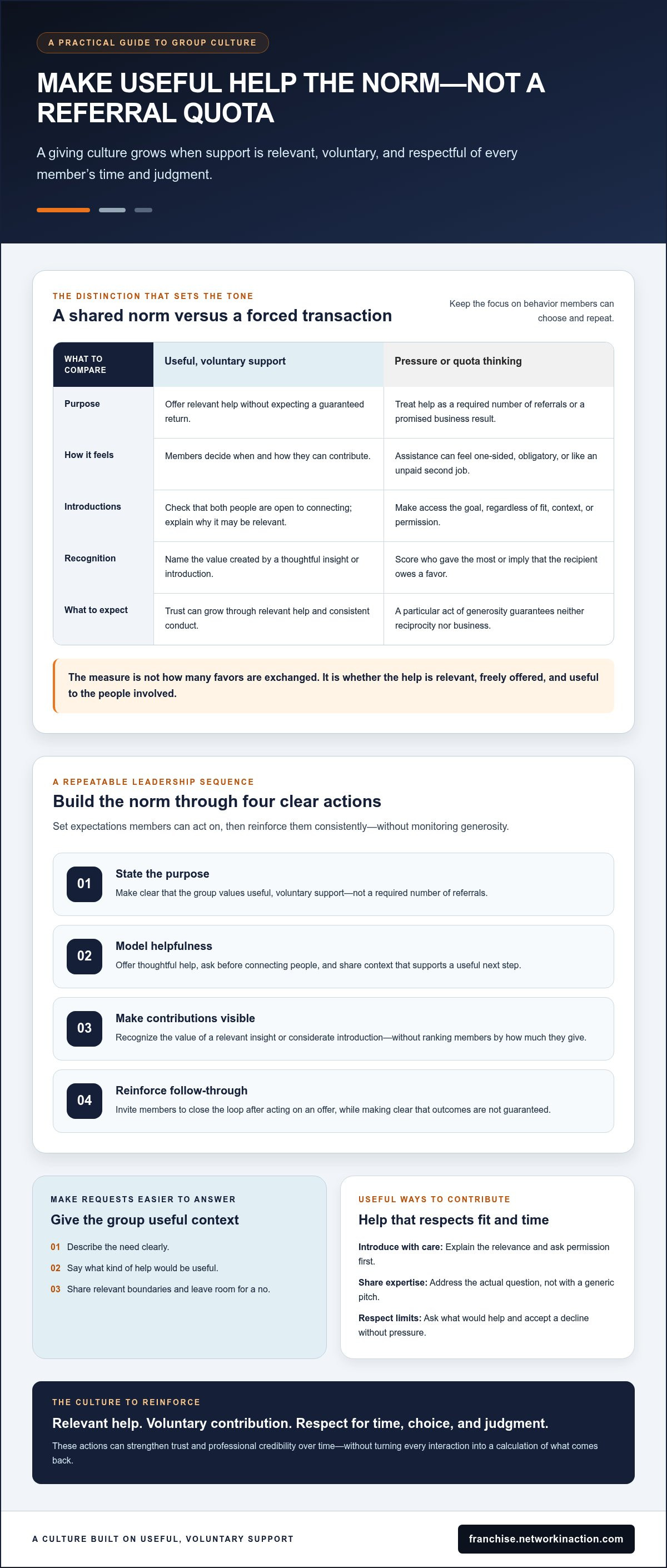
A giving culture isn’t a referral quota or a promise that every introduction will produce business. It’s a shared expectation that members look for relevant ways to help, offer that help voluntarily, and respect one another’s time and judgment. That distinction matters in professional networking, where pressure to produce leads can crowd out the trust that makes an introduction worthwhile.
A giving culture is a shared group norm of offering relevant, voluntary help without expecting a guaranteed return.
Understanding how to create a culture of givers in a networking group starts with paying attention to actions, not assigning identities. Members contribute in different ways, depending on their expertise, capacity, and relationship with the person asking.
How givers, takers, and matchers show up in a group
A member acting as a giver might share a practical insight or make an introduction when there’s a genuine fit. A member acting as a taker might repeatedly ask for access or advice without showing interest in others’ needs. A matcher tends to look for balance, offering help while noticing whether support is mutual. These are behavior patterns, not permanent personality types or diagnoses.
Context counts. A member may be generous with expertise but cautious about making introductions, or ask for help during a demanding period and contribute more later. Group leaders should look at observable patterns over time rather than label someone after one meeting. The aim is to make constructive behavior easier to practice and recognize.
Why generosity matters beyond exchanging leads
Useful help builds professional trust because it shows attention and sound judgment. A well-considered introduction signals that the connector understands both people’s needs. A concise insight can help a fellow member make a clearer decision. Relevant context can prepare someone for a conversation and make follow-up more thoughtful.
These actions matter even when they don’t create immediate business. Members learn who listens carefully, shares expertise responsibly, and follows through. That credibility can strengthen working relationships over time without turning every interaction into a calculation of what comes back. The idea of people contributing toward a shared purpose also appears in this overview of giving circles, though a professional group applies generosity through expertise, context, and connections.
- Make introductions with care: Explain why the connection may be relevant, and get permission before connecting people.
- Share knowledge in context: Offer an observation that addresses the member’s actual question, not a generic pitch.
- Respect limits: Ask what kind of help would be useful, and let members decline without pressure.
Generosity does not guarantee referrals, revenue, or reciprocity from a particular person. It creates a stronger professional environment where members can recognize needs, contribute appropriately, and develop trust through consistent conduct. The measure is not how many favors are exchanged, but whether help is relevant, freely offered, and useful to the people involved.
How to Build Trust and Shared Giving Norms
Good intentions need a repeatable structure. To put how to create a culture of givers in a networking group into practice, leaders can make the purpose clear, demonstrate the behaviors they want to see, acknowledge useful contributions, and encourage follow-through. The aim isn’t to monitor generosity. It’s to show members what helpful participation looks like while leaving them free to choose when and how they contribute.
A clear group norm invites relevant, voluntary help. A compulsory referral quota demands a transaction.
Set expectations members can act on
Replace broad instructions like “support one another” with actions members can repeat: describe the kind of connection that would help, share a relevant insight, or offer an introduction only when there’s a genuine fit. Ask each member to explain their expertise, ideal clients, and the situations where an introduction would be useful. That context helps the group respond with precision instead of guessing.
For introductions, members can first check that both people are open to connecting, then briefly explain why a conversation may be relevant. A respectful request states what help is sought and leaves room for a no. These practices keep assistance specific, appropriate, and manageable.
A leader can establish the norm with a simple sequence:
- State the purpose. Explain that the group values useful, voluntary support, not a required number of referrals.
- Model helpfulness. Make thoughtful offers, ask before connecting people, and share context that helps members take the next step.
- Make contributions visible. Acknowledge a useful insight or considerate introduction by naming the value it created, not by scoring who gave the most.
- Reinforce follow-through. Invite members to close the loop when they’ve acted on an offer, while making clear that outcomes aren’t guaranteed.
Make leadership model the culture
Consistency matters more than a polished speech. Use the same language in meetings and follow-up: ask what help would be useful, recognize thoughtful responses, and thank people for respecting a request or boundary. Recognition should spotlight the behavior, not imply that the recipient owes a favor. The Cultures of Giving Network offers an example of how shared purpose and collaboration can shape a giving culture.
Leaders can also review whether the group’s routines make it easy to participate. Are members clear about the help they can offer? Do requests include enough context? Is follow-through acknowledged without turning it into a ledger? Small changes to meeting prompts and leader language can reset expectations before unhelpful patterns become habits.
For professionals interested in leading a structured, relationship-driven networking community, the Network In Action franchise opportunity offers a way to explore that role.
How to Make Giving Useful Without Making It Transactional
Generosity works best when it addresses a real need without creating a new obligation. Members can be intentional about the time, advice, or introductions they offer while choosing what fits their expertise and capacity. That balance is central to how to create a culture of givers in a networking group: useful support should be encouraged, never extracted.
Sustainable giving respects boundaries. Help offered freely is more valuable than help given under pressure.
Make help specific, relevant, and permission-based
Before offering a solution, clarify the request. A member asking for “help with marketing” may need feedback on a campaign, a specialist recommendation, or an introduction to a particular type of buyer. A brief question can prevent wasted effort: “What outcome are you aiming for?” or “What kind of connection would move this forward?”
For an introduction, explain the relevance and give both people enough context to decide whether a conversation makes sense. Rather than forwarding someone’s contact details without warning, ask permission to connect them and describe the purpose in a short note. That protects trust on both sides.
A thoughtful decline can be just as responsible. If a request falls outside a member’s expertise, capacity, or relationships, a clear response protects their time and avoids a careless recommendation. When appropriate, they can suggest a narrower request or another direction without promising to deliver it.
- Clarify the need: Ask what result would be useful and what kind of support the member wants.
- Choose a fitting offer: Give advice or make an introduction only when there’s a relevant basis for doing so.
- Set a limit: Be clear about the time or scope available instead of agreeing to an open-ended favor.
Protect generosity from scorekeeping and pressure
A favor ledger changes the meaning of help. Once members track who owes whom, an introduction can feel like a debt and advice can become an invoice in disguise. Reciprocity is healthier as a group pattern: different members contribute in different ways and at different times, based on what they know and what others need. Each exchange does not have to balance immediately.
That principle keeps shared norms from becoming a referral demand. Members should never be expected to recommend a business just to prove participation. A referral is useful only when the member can stand behind its relevance. Otherwise, pressure risks credibility and weakens relationships. Without forced referrals, members can focus on fit and trust, not quotas.
Leaders can reinforce this distinction through everyday language. Ask, “What would be useful?” rather than “Who can you refer?” Recognize a well-scoped offer, a respectful boundary, or an honest decline as signs of sound judgment. Those behaviors make it easier for members to help without overcommitting or keeping score, creating the conditions for reciprocal trust to develop over time.
How to Build Giving into Meetings and Follow-Up
A group’s values become real through its routines. A focused agenda makes needs easier to hear, offers easier to match, and next steps easier to remember. To put how to create a culture of givers in a networking group into practice, connect meeting conversations to respectful follow-up without turning participation into a referral target.
Use meeting structure to surface useful ways to help
Give members a brief, consistent prompt that invites a specific business need and its context. For example: “What are you working to move forward, and what kind of insight or connection could help?” Leave room for members to offer relevant expertise, not just promote their own services. Keep the prompt focused so each person can contribute without extending the meeting or sharing more than they choose.
Leaders can capture requests and offers as possible next steps, not obligations. A member who knows a useful resource can offer to share it. Another who sees a potential fit can ask permission to make an introduction. This is also the foundation of a trust-based referral marketing strategy: context and relevance matter more than the number of names exchanged.
Turn good intentions into thoughtful follow-through
Close the meeting by making commitments clear. Members can note what they offered, who owns the next step, and any timing they agreed on. Afterward, they can send the resource, make the permission-based introduction, or update the person if plans change. A simple follow-up supports reliability without implying that every request must be fulfilled.
Technology can support this rhythm. A group platform, CRM, or engagement reminder can help members keep track of connections and agreed next steps. Tools improve visibility, but they don’t decide whether an introduction is appropriate. That judgment still depends on understanding the people involved and respecting their preferences.
A practical meeting-to-follow-up sequence might look like this:
- Surface: Invite a concise request, including the outcome sought and relevant context.
- Match: Let members identify expertise, resources, or possible connections that genuinely fit.
- Confirm: Have the person offering help clarify the next step and get permission before connecting others.
- Close the loop: Follow up on the commitment, noting whether it was completed or needs an update.
Assess engagement by usefulness and reliability. Did the offer address a real need? Was the agreed action completed or clearly updated? Referral volume alone can’t answer those questions. A well-run group makes meaningful contributions visible while leaving members free to choose how they participate.
Network In Action combines structured monthly agendas with a technology platform that includes a smartphone app, CRM, and member engagement automation. For professionals interested in building a relationship-driven networking business, the Network In Action franchise kit explains the opportunity.
How Network In Action Supports a Culture of Givers
Strong giving norms need more than goodwill. They need a group design that makes useful participation practical and repeatable. Network In Action (NIA) brings together monthly, industry-exclusive networking groups, with one professional from each industry in a group. That structure gives members time to understand one another’s expertise and recognize where a relevant introduction or insight may help.
There’s no forced-referral requirement. Members can build familiarity and share support when there’s a genuine fit, without treating referrals as proof of participation. That keeps the emphasis on relationship-driven growth, not a tally of transactions. Business outcomes aren’t guaranteed, but a structured environment can make it easier to build trust and meaningful professional connections.
Structure the group around relationships, not referral pressure
Monthly meetings create a recurring opportunity for members to learn what others do, what they’re working toward, and which connections might be useful. Industry exclusivity can sharpen that understanding: members aren’t competing with another professional in the same industry within their group, and they can build familiarity with a distinct set of expertise. That knowledge helps members identify introductions thoughtfully, while keeping each offer relevant and voluntary.
Use systems to support consistent participation
NIA’s monthly agendas provide structure for meetings, while its technology platform includes a smartphone app, CRM system, and member engagement automation. These tools help members stay connected and keep engagement visible between meetings. They don’t replace personal judgment. A member still decides whether an introduction makes sense, what context to share, and whether they can follow through.
That combination matters for community leaders. A clear agenda makes room for relationship-building, while engagement tools support the practical work of maintaining connections. The system can create consistency. Trust still comes from how members listen, make relevant offers, respect boundaries, and act on commitments.
For anyone exploring how to create a culture of givers in a networking group, NIA brings structure and technology together without requiring members to exchange referrals. Its approach supports consistent participation and professional relationships rather than a rigid referral quota. Members remain free to decide when a recommendation or introduction is appropriate, and no platform can promise a specific business result.
Community leadership may also appeal to professionals interested in owning a business networking franchise. NIA franchisees receive comprehensive training and ongoing support to build and manage groups. The training program includes 40 hours of training provided by corporate staff, giving franchisees a foundation for leading a structured networking community.
Make Generosity Part of Your Leadership Strategy
A giving culture doesn’t appear because a group talks about generosity. It grows when leaders create an environment where useful contribution feels natural, respected, and sustainable. For professionals considering how to create a culture of givers in a networking group, the opportunity is to lead differently: build a community where trust develops through deliberate participation, not pressure or scorekeeping.
That approach can also shape a business opportunity. Community leadership gives you a way to bring professionals together around shared value and meaningful connections. As you consider your next move, think about the kind of professional community you’d be proud to lead, and whether that role fits your strengths, goals, and vision for your working life.
Explore the Network In Action franchise model to discover whether leading a relationship-driven networking community aligns with your ambitions. Review the model and consider how it fits your plans. A more intentional way to build professional value starts with the culture you choose to create.
Frequently Asked Questions
How do you encourage members to give without expecting something in return?
Set the expectation that members can contribute when they have something relevant to offer, not because they’re owed a favor. For example, a member might share a contact’s public guide or explain a lesson from a recent project. Leaders can thank them for the usefulness of the contribution without tracking who gives most. Thoughtful actions can strengthen trust over time, but they can’t promise referrals or business.
What is the difference between a giver, a taker, and a matcher in a networking group?
A giver tends to offer useful support without asking for an immediate return. A taker tends to focus on what others can provide, while a matcher looks for a balanced exchange. These terms describe behavior, not fixed identities. For example, a member may gladly coach a peer but hesitate to share a client contact. Leaders should respond to repeated, observable actions rather than assume one interaction defines someone’s character.
Can a networking group create a giving culture without requiring referrals?
Yes. A group can make knowledge-sharing, resource recommendations, and thoughtful follow-up part of its routine without requiring members to pass referrals. For example, a member who can’t introduce a prospective client might still help a peer prepare for a meeting by sharing relevant industry context. Learning how to create a culture of givers in a networking group means making contribution possible in different forms, while leaving referral decisions to professional judgment.
How can you tell whether a networking group has a genuine giving culture?
Look at what happens between meetings, not just what members say during them. Members may send a resource they promised, clarify that a proposed connection isn’t a fit, or check whether an introduction is welcome before making it. Leaders also handle declined requests respectfully. Those details show whether helpfulness is grounded in attention and reliability rather than performance or pressure to appear generous.
How can group leaders prevent members from taking advantage of generous people?
Make it acceptable to define the scope of help before agreeing. A member might offer a brief perspective on a proposal but not ongoing consulting, or suggest a resource instead of making a personal introduction. If requests repeatedly ignore those limits, leaders can address the specific pattern privately and professionally. Protecting members’ time helps prevent one person’s willingness to contribute from becoming the group’s default resource.
What meeting activities help build a culture of giving?
Try a short “skill and need” round: each member names one current challenge and one area where they can offer insight. A facilitator can note potential matches and invite the members involved to decide whether to follow up. Another option is a brief case discussion, where a member presents a business decision and peers offer focused perspectives. Keep participation optional, with clear time limits and a defined question.
Does technology create a stronger giving culture in a networking group?
Technology can help a group keep useful context from disappearing after a meeting. For example, members can record a promised follow-up or note the type of connection a peer is seeking, then revisit it when an opportunity arises. A CRM or engagement system can support that continuity, but it can’t judge whether an introduction is appropriate. Trust still depends on listening, discretion, and members choosing to act thoughtfully.