
An exclusive seat can make a networking group look more focused without making its relationships more valuable. That is the problem with single-industry seat exclusivity: it may reduce direct competition, but it can also narrow collaboration and make referrals feel like an obligation. The appeal is understandable. Clear categories can help members know who does what and where an introduction might fit. But a seat rule alone can’t create trust, useful connections, or a strong return on the time you invest.
You want a network that creates relevant connections, not pressure to refer or limits on who you can learn from. This article examines what industry-exclusive seats can solve, where they can restrict member choice and network breadth, and how to assess a group’s structure. It also considers meeting cadence, technology, and relationship-first culture. Network In Action’s monthly meetings, technology-enabled platform, and no-forced-referral approach offer a different way to think about professional communities and business growth.
Key Takeaways
- Separate category rules from networking results: an exclusive seat defines access, but doesn’t guarantee referrals, revenue, or a strong fit.
- Understand the problem with single-industry seat exclusivity by weighing clearer introductions against narrower member choice and potential pressure to refer.
- Compare the whole networking system, including category boundaries, opportunities to connect, meeting rhythm, and how members stay in touch.
- Assess a group against your business goals, the relationships you need, your preferred level of structure, and the time you can invest.
- Explore how Network In Action’s monthly meetings, proprietary platform, training, and franchise support can help you lead a relationship-driven professional community.
What single-industry seat exclusivity means in a business networking group
In a business networking group, single-industry seat exclusivity means the group limits a defined business category to one member. For example, one financial adviser might hold the group’s financial-advice seat while members in other seats represent different professions. The boundaries depend on how the group defines each category. A business offering several services may not fit neatly into one label, so the category description matters.
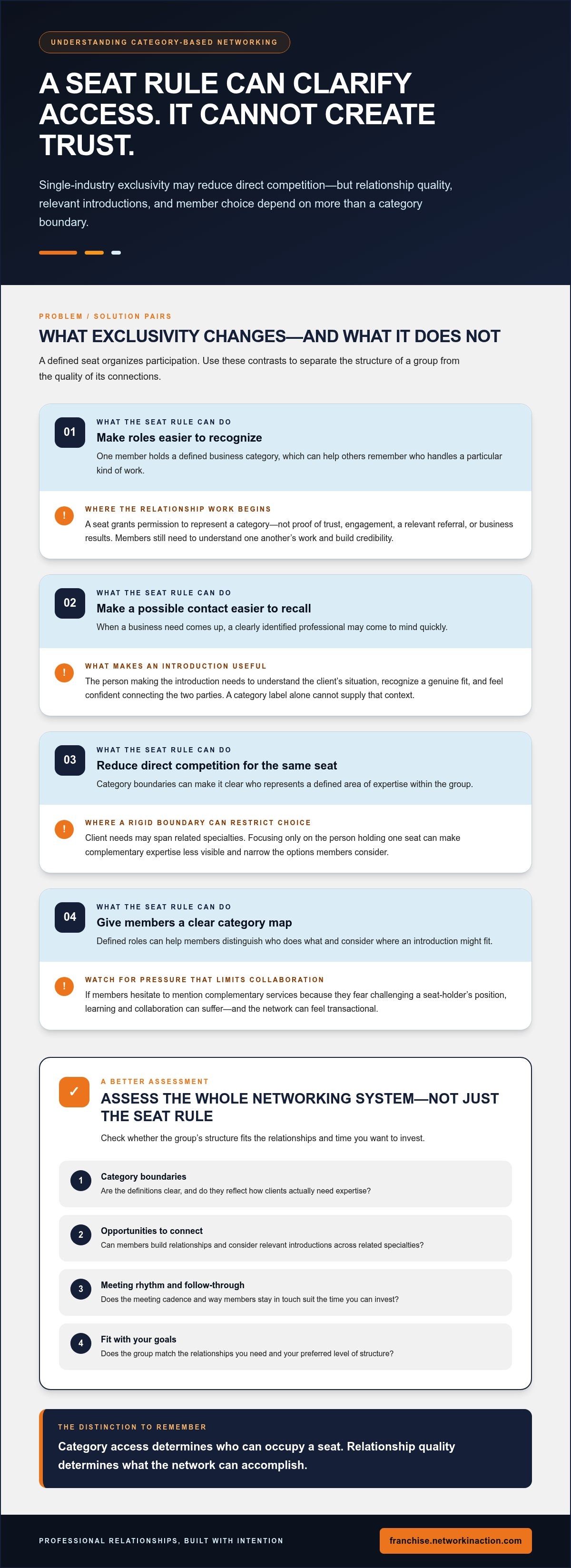
A seat rule organizes participation; it doesn’t promise commercial results. It can’t establish that members will build relationships, that an introduction will be relevant, or that a referral will generate revenue. Category access determines who can occupy a seat; relationship quality determines what the network can accomplish. That distinction is central to understanding the problem with single-industry seat exclusivity.
What does an exclusive seat promise, and what does it not?
An exclusive seat reserves a defined category for one member and limits direct competitors from holding the same seat. That can make roles easier to distinguish, but a seat is permission to represent a category, not proof of trust or engagement. Members still need to understand one another’s businesses, build credibility, and develop relationships over time.
Exclusivity alone can’t guarantee leads, referrals, or business results. A useful introduction depends on context: the person making it must recognize a real need, understand who can address it, and feel confident connecting the two parties. A rule can define the boundary, but it can’t create that judgment or trust. The broader purpose of networking is to form and use professional connections, as outlined in What is Business Networking?
Why traditional networking groups adopted category-based rules
The appeal is practical. When each person has a recognizable role, members can more easily answer, “Who in the group handles this?” A group may use category boundaries to reduce direct competition for the same opportunities and make members’ expertise easier to remember. That structure can help members consider relevant introductions, especially while they’re still getting to know one another.
Imagine a business owner whose client needs accounting support. If the group has identified an accountant, the owner may quickly recall whom to contact rather than searching a roster of broad or overlapping descriptions. That’s a useful starting point, not a referral outcome. The client may also need help with payroll, legal advice, or financial planning, needs that may not fit within one seat’s definition.
Defined categories can create clarity and help members remember who does what. The practical question is whether that clarity reflects how clients actually need expertise, or whether category labels become more important than understanding those needs. Assess the structure by looking beyond how simply it assigns seats.
How single-industry exclusivity shapes referrals, relationships, and group dynamics
A defined category can give members a mental shortcut: a business need arises, and they recall the person associated with it. That can make an introduction easier to consider when members understand one another’s work and know what makes a good fit. But a clear label is only the starting point. A useful referral depends on whether the person making it understands the client’s situation, trusts the professional’s capability, and makes the connection thoughtfully.
A seat rule organizes participation; relationships give introductions context. Without that context, a referral can feel like passing along a name instead of making a useful connection. Strong networking asks more: What does the client need? Is this professional suited to that need? Would the introduction help both sides build credibility?
When exclusivity can make introductions easier
One recognizable contact for a defined need can reduce uncertainty. If a member hears that a business is seeking bookkeeping support, a clearly identified bookkeeper may come to mind quickly. That recall can help move a conversation toward a relevant introduction. Still, knowing who holds a category doesn’t establish that a referral will happen, suit the client, or lead to business. Trust and informed judgment do the real work.
Where a rigid category boundary can constrain the network
Client needs rarely follow a group’s category chart. A growing company may need help with hiring, payroll, employment advice, and financial planning as it expands. If members focus only on the person holding one seat, related expertise can become less visible, even when another professional is better suited to a specific need.
This is where the problem with single-industry seat exclusivity becomes more than a question of labels. A boundary designed to avoid direct competition can also narrow the options members consider. Protecting against a genuine conflict is not the same as limiting professional choice simply because two businesses serve related needs. A thoughtful referral process leaves room to consider fit, expertise, and the client’s circumstances.
Rigid boundaries can also shape group dynamics. Members may hesitate to mention complementary services or collaborate across related specialties if they worry that doing so challenges a seat-holder’s position. That hesitation can limit learning and make the network feel transactional: members guard categories instead of building trust and collaborating. Clear expectations matter, but so does a culture where members can discuss a client need and relevant expertise openly.
For a practical test, pay attention to the needs raised in member conversations. Do introductions reflect the client’s situation, or default to the nearest category label? Do members explain why a connection fits and follow up after making it? These signals reveal more about referral quality than the seat map alone.
For professionals interested in shaping a community around purposeful connections, explore leading a professional networking group as a potential franchise opportunity.
Single-industry seats versus flexible networking: compare the whole system
A seat policy is one design choice, not a complete measure of a networking group’s value. Exclusivity can make roles easier to distinguish, while a more flexible structure can leave more room to connect across related specialties. Neither approach guarantees useful introductions. Compare how the whole group operates, from member choice to the ways relationships continue between meetings.
| What to compare | Exclusive-seat structure | More flexible structure |
|---|---|---|
| Category boundaries | Defined categories can clarify who represents a particular field, but narrow definitions may make adjacent expertise less visible. | Related professionals may have more room to participate, though overlapping roles can require clear communication. |
| Member choice | A one-member-per-category rule limits direct competition within that category, but also narrows the group’s representation. | More than one professional in a field may be present, giving members broader choice while requiring attention to fit and potential conflicts. |
| Meeting rhythm | Seat rules don’t determine how often a group meets or whether its schedule suits your workload. | Flexible categories don’t automatically mean a lighter time commitment; assess the actual cadence. |
| Ongoing connection | Exclusivity doesn’t establish how members communicate or follow up between meetings. | A flexible roster still needs ways to support sustained interaction and relevant introductions. |
What a fair comparison should measure
Look beyond category labels. Consider whether the structure helps members make relevant introductions and build continuity, how much time participation requires, and how they stay connected between meetings. A monthly meeting paired with a technology-enabled platform creates a different rhythm from a group organized around more frequent in-person meetings. Assess whether the meeting cadence and connection tools support quality relationships without adding unnecessary demands to your schedule.
For a deeper look at the ownership side of structured networking, explore this business networking franchise guide.
Why seat exclusivity alone cannot answer the value question
The problem with single-industry seat exclusivity is that it can draw attention away from the systems that sustain participation. A category rule doesn’t explain how group leaders support engagement, whether members are a strong fit for one another, or how introductions are handled. Those factors shape the experience alongside the seat policy. Assess the complete model against your priorities: relevant relationships, manageable time demands, and room to build professional credibility. The right structure supports those goals, not simply the clearest category chart.
How to assess whether an exclusive seat fits your networking goals
A networking structure earns its place when it supports the relationships your business needs within the time you can realistically invest. Evaluate the seat rule in context, not in isolation. Use this sequence to make your decision practical:
- Define your business goals. Identify the priorities the network should support, such as building referral relationships, finding strategic partners, or strengthening professional credibility.
- Map the relationships you need. Consider the customers, collaborators, and professional connections that could advance those priorities. Decide whether they sit within one industry or span complementary fields.
- Inspect the group structure. Understand how categories are defined, where members can connect across specialties, and whether the rules clarify relevant introductions or restrict access to expertise you need.
- Assess the time fit. Weigh meeting frequency alongside the ways members stay connected between meetings. A schedule is useful only if it leaves enough room for consistent participation and relationship-building.
Start with the relationships your business actually needs
Get specific. A useful introduction might connect you to a prospective client, a trusted adviser, or a complementary business serving the same audience. Decide what makes an introduction valuable for your goals, then map which professions could create it. Because trust supports credible referrals, this referral marketing strategy guide can help frame the relationship-building behind them.
Now test the category structure against that map. If your best opportunities involve professionals across several industries, a narrow seat rule may make important connections harder to access. If a clear category boundary helps members recognize relevant expertise without limiting the relationships you value, exclusivity may support your aims.
Match the group structure to your time and leadership priorities
Review the full participation rhythm: scheduled meetings, communication between them, and the effort required to keep relationships active. Consider whether the group’s technology supports continuity and whether its leadership encourages useful connections rather than activity for its own sake. The strongest fit is structure aligned with your goals, not rules alone.
The problem with single-industry seat exclusivity isn’t simply that a group has categories. It’s that a rule can be mistaken for a complete growth strategy. Look for signs of relationship quality: members understand one another’s work, introductions have a clear purpose, and follow-through feels natural rather than pressured. That standard keeps your decision focused on value, not just the seat map.
For professionals drawn to building a community around purposeful business relationships, explore Network In Action franchise opportunities as a path to leading a structured networking model.
A modern networking model: evaluate Network In Action beyond seat rules
A seat policy describes one boundary inside a group. It doesn’t tell you whether leading that community is the right business direction for you. Network In Action offers franchise opportunities for people interested in building local professional referral groups. Consider the opportunity from an ownership perspective: rather than securing a place in a network, you can build an environment where professionals develop credibility and meaningful business relationships.
That calls for a different set of questions. Do you enjoy bringing people together around shared business interests? Are you motivated to foster a community where members value relevance and trust? Your answers can reveal more about your fit than a debate over category rules alone.
How the broader model changes the decision
Evaluate the model by considering your potential role as a community leader, rather than assuming that any particular seat arrangement determines how groups operate. Think about the professional culture you would want to cultivate, how you would help members find opportunities to connect, and whether building a local community aligns with your strengths. The structure matters, but so does the person guiding it.
Keep expectations grounded. A business opportunity provides a framework for pursuing community leadership, but your decision should reflect your own goals, capabilities, and appetite for the work involved. The central question is whether you want to help shape a professional community, not whether a seat rule promises a particular outcome.
When leading a professional community becomes the opportunity
For entrepreneurs drawn to relationship-driven growth, franchise ownership offers a path to put community leadership at the center of a business. It’s worth considering if you value connecting professionals and building credibility in a local business community. A strong fit starts with alignment between the opportunity and the work you want to lead.
If that direction interests you, explore the Network In Action franchise opportunity and consider whether it matches your priorities. Take the next step as an informed decision about the community you want to build.
Choose the network you’re ready to build
Decide what kind of professional community deserves your time and leadership. A seat policy is one design choice. It shouldn’t replace asking whether a group helps people build trust, share expertise, and create connections that fit real business needs. The problem with single-industry seat exclusivity emerges when the rule itself is treated as proof of value.
For an entrepreneur, that distinction raises a bigger question: are you looking only for a place to network, or are you interested in shaping how professionals connect in your community? Leading a network can put relationship-driven growth and purposeful collaboration at the center of a business opportunity. The right fit depends on your goals, strengths, and vision for community leadership.
Explore the Network In Action franchise opportunity to consider whether its approach aligns with the professional community you want to build. Make your next move with clarity and confidence.
Frequently Asked Questions
What is single-industry seat exclusivity in a networking group?
It’s a group rule that reserves a defined business category for one member, such as one seat for a commercial insurance broker. The rule determines who can represent that category within the group; it doesn’t determine how members collaborate outside it or prevent clients from working with other professionals. Look at how categories are defined, especially if your business spans several specialties or serves different types of clients.
Does industry exclusivity guarantee more referrals?
No. Exclusivity can help members remember a representative for a category, but it can’t ensure that a referral will be made, suit the client, or turn into business. Consider what happens when a client’s need doesn’t fit the category neatly. The problem with single-industry seat exclusivity is assuming that a protected seat creates demand; referrals still depend on members recognizing a genuine need and choosing to make a relevant introduction.
Can a networking group work well without exclusive industry seats?
Yes. A group can operate without one-person-per-industry rules if members understand one another’s expertise and communicate clearly about potential conflicts. For example, two consultants serving different client sizes or specialties may bring distinct perspectives, provided their roles are clear. The key is not simply allowing overlapping categories. Members need to explain their focus, identify the right fit for a client, and collaborate without confusion.
Are exclusive seats the same as forced referrals?
No. An exclusive seat limits who may represent a category in a group. A forced-referral expectation pressures members to recommend someone or pass business to them. Those are different policies, and one doesn’t automatically imply the other. If a referral doesn’t match a client’s needs, recommending it can undermine trust. A healthy professional relationship leaves room to make an introduction when it’s appropriate, not because a rule demands it.
How should you decide whether an exclusive networking seat is worth it?
Judge the seat against your goals, not its label. Identify the connections you need, then consider whether the group’s category boundaries make those connections easier or block access to complementary expertise. Weigh the time commitment and how you’ll participate between meetings. A seat may be worthwhile if the structure supports meaningful, relevant relationships for your business; it’s less compelling if the restriction outweighs the connections you expect to build.
What should you look for besides industry exclusivity in a business network?
Look at how members get to know one another’s work, how introductions are made, and whether there’s a practical way to maintain contact between gatherings. Notice whether members can discuss client needs openly and make connections based on fit. Compare the meeting schedule with your availability, too. These details reveal whether the network supports consistent participation and professional credibility beyond the category rules on paper.
How does Network In Action approach professional networking?
Network In Action offers franchise opportunities for entrepreneurs interested in leading local business referral groups. This is an ownership path centered on building and managing a professional community, rather than simply taking part as a network member. Consider your interest in community leadership, your ability to bring professionals together, and whether developing local business relationships aligns with your longer-term goals. Explore the Network In Action franchise opportunity to learn more.