A franchise forecast can look profitable and still leave you short on cash. That’s why financial modeling for a franchise purchase should show more than projected revenue. It should map your investment, when cash moves, and how the business performs when assumptions fall short. A polished projection is only as useful as the evidence behind its inputs.
Upfront and recurring costs can be difficult to pin down, while sales forecasts depend on assumptions that need testing. And profit on paper doesn’t guarantee enough working cash to cover timing gaps or a slower start. A useful model makes those pressures visible before you commit.
This guide walks you through building a decision-ready model from documented investment inputs, operating costs, revenue assumptions, and financing terms. For a relationship-driven opportunity such as Network In Action, include the monthly meeting cadence, technology platform, and responsibilities of community leadership in your operating review. Test break-even, cash flow, and downside risk with adjustable scenarios, then assess whether the franchise fits your financial and lifestyle goals.
Key Takeaways
- Build financial modeling for a franchise purchase around documented inputs, clearly labeled estimates, and linked schedules.
- Compare base, downside, and upside scenarios, then vary key assumptions one at a time to see what drives the results.
- Validate financial inputs against current official franchise materials, and flag unresolved items rather than treating them as facts.
- Compare projected cash needs and time commitments with your funding capacity, downside limits, and personal goals.
- Include Network In Action’s meetings, technology, and franchisee training and support in your operating review, without treating them as proof of financial outcomes.
What Financial Modeling for a Franchise Purchase Should Tell You
A franchise model should connect four things: the investment required to enter, the assumptions behind daily operations, the timing of cash coming in and going out, and the risks that could change the result. Financial modeling for a franchise purchase is not just a sales forecast. It’s a decision tool that shows how assumptions affect the business and your personal financial position.
That structure reflects the broader purpose of Financial Modeling: turning inputs into linked projections that inform decisions. For a franchise, inputs may include documented fees and expenses, your estimates of operating activity, and proposed financing terms. Make each input traceable. Label estimates clearly so you can challenge and adjust them.
A decision-ready franchise model shows how documented costs and adjustable assumptions affect cash, obligations, and downside exposure. It informs your decision but can’t guarantee returns or replace due diligence.
Which decision should the model help you make?
Start with the decision, not the spreadsheet. You’re assessing whether the opportunity is affordable, whether its operating demands suit your skills and schedule, how much financing you may need, and what downside you can tolerate. Those questions define the model. Without them, even a detailed forecast can answer the wrong question.
Keep your personal financial capacity separate from projected franchise performance. The business may show positive operating results while the initial outlay, debt payments, or ramp-up period still exceed what you can comfortably fund. Set your available capital and acceptable exposure independently, then compare them with the model’s cash requirements.
Be equally clear about time and lifestyle. Identify the work you expect to do, the time you can commit, and the flexibility you need before forecasting. In a relationship-driven business, community leadership and professional credibility are part of the operating fit. They may shape your decision, but they don’t prove future revenue.
Which financial outputs deserve separate attention?
Separate startup investment from recurring obligations. Startup inputs capture the cash required to launch; recurring inputs show costs that continue during operations. Keeping them distinct makes the initial funding need and ongoing burden easier to assess.
Then distinguish four measures. Accounting profit reflects revenue and expenses under the model’s accounting assumptions. Operating cash flow tracks cash generated and used by business activity. Owner compensation is what you plan to pay yourself, and debt obligations are scheduled repayments. These measures affect one another, but they aren’t interchangeable. Profit can look positive even when cash is tight or payments are due.
Track the cash balance over time, not just the final result. Flag any period when available cash may fall below modeled expenses, required payments, or planned owner compensation. That pressure point can show when you may need more working capital or a closer review of your assumptions. The goal isn’t to make the numbers look attractive. It’s to see the trade-offs before you commit.
How to Build a Franchise Purchase Model Step by Step
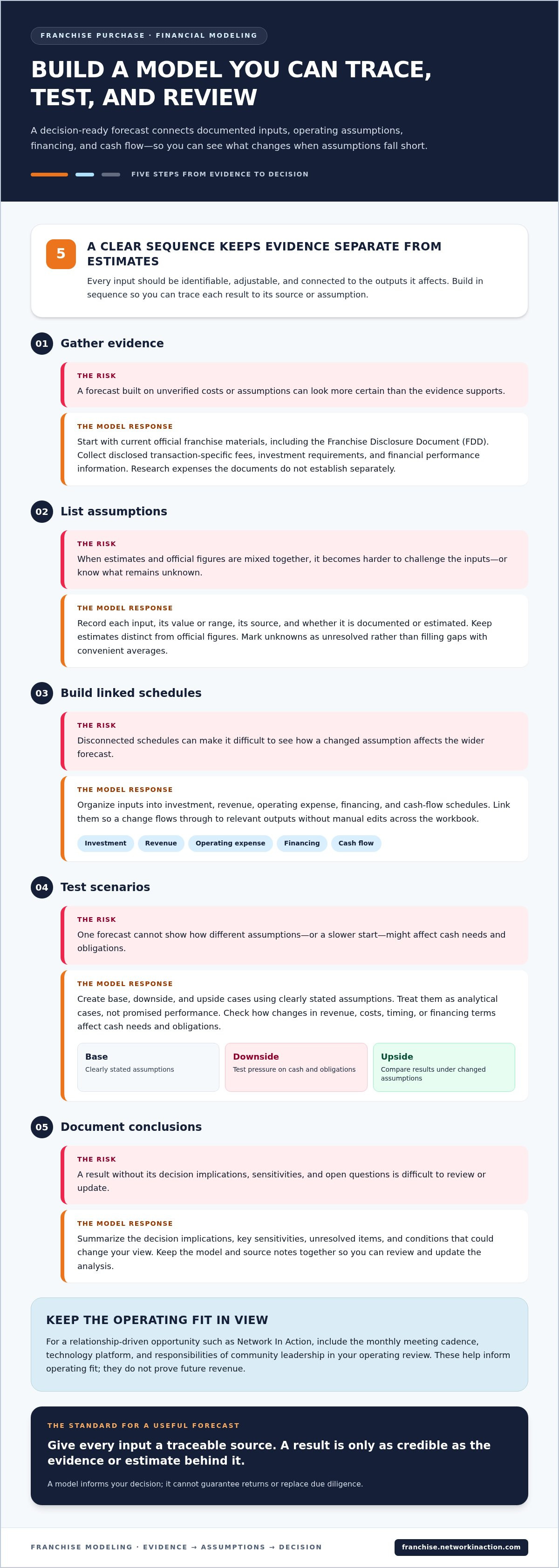
Build the model in a sequence that keeps evidence separate from estimates. That discipline matters more than spreadsheet complexity. In financial modeling for a franchise purchase, every input should be identifiable, adjustable, and connected to the outputs it affects. A result is easier to test when you can trace it back to its source or assumption.
- Gather evidence. Start with current official franchise materials, including the Franchise Disclosure Document (FDD). Collect disclosed transaction-specific fees, investment requirements, and financial performance information. Research expenses that the documents don’t establish separately.
- List assumptions. Record each input, its value or range, its source, and whether it is documented or estimated. Keep your estimates distinct from official figures. Mark unknowns as unresolved instead of filling gaps with convenient averages.
- Build linked schedules. Organize inputs into investment, revenue, operating expense, financing, and cash-flow schedules. Link them so a change in an assumption flows through to relevant outputs without manual edits across the workbook.
- Test scenarios. Create base, downside, and upside cases using clearly stated assumptions. These are analytical cases, not promised performance. Check how changes in revenue, costs, timing, or financing terms affect cash needs and obligations.
- Document conclusions. Summarize the decision implications, key sensitivities, unresolved items, and conditions that could change your view. Keep the model and source notes together so you can review and update the analysis.
Give every forecast input a traceable source. A result is only as credible as the evidence or estimate behind it.
Build the investment and operating-input schedule
Use current official materials to record transaction-specific investment requirements. Keep the initial franchise or license fee separate from ongoing royalties and technology or platform fees. Enter each obligation according to its documented terms. Don’t assume a fee structure or apply a generic rate. Add other operating costs only when supported by official documentation or your own research, and note the source beside each line.
Connect assumptions to cash flow
Link revenue assumptions to operating expenses, recurring fees, and financing inputs so you can see their effect on cash over time. Keep owner compensation distinct from cash needed to run the business and meet obligations. If an input is missing, label it unresolved and show how the model behaves without presenting the gap as a verified figure. For transaction-specific interpretation of financial or legal terms, use qualified professional advice.
For a Network In Action opportunity, the franchise opportunity details can help frame which documented inputs belong in your review. Connect those inputs to your own operating assumptions, then revisit your conclusion when the evidence changes.
How to Stress-Test Franchise Economics Without Trusting One Forecast
A single forecast can make an opportunity seem more certain than it is. Stress-testing helps you examine a range of outcomes instead. For financial modeling for a franchise purchase, use the same model structure across scenarios, then change the assumptions that drive revenue, expenses, and cash needs.
A scenario is a “what if” test, not a prediction or an earnings promise. Label each case and state its assumptions. Don’t treat an upside case as the expected result or a downside case as the worst possible outcome.
| Case | Assumption approach | What to examine |
|---|---|---|
| Downside | Slower growth or higher operating needs, based on plausible inputs you can explain | Cash shortfalls, funding needs, and whether the workload remains manageable |
| Base | Your best-supported working assumptions, with estimates identified as estimates | Expected cash timing and whether the opportunity fits your stated limits |
| Upside | More favorable inputs, kept within a defensible range | How improved results affect cash, obligations, and capacity to grow |
Don’t change every input at once. Hold the other assumptions steady and adjust one variable, such as revenue growth pace. Then test another, such as recurring costs. This sensitivity check shows which inputs move the results most and where better evidence could materially improve your decision.
Which assumptions should you challenge first?
Start with the revenue ramp and the pace of customer or member acquisition, using evidence that fits the specific opportunity. Model retention only when you have a reasonable basis for doing so. Next, vary recurring expenses and applicable royalty terms using documented contractual inputs. Finally, test delayed growth or higher operating needs to see how long cash may need to support the business before revenue catches up.
How do you read break-even and downside results?
Break-even is the point at which modeled revenue covers the costs included in your calculation. It’s a threshold, not a guarantee, and it moves when assumptions change. Check when it occurs in each case and whether your available cash can cover obligations before then. If the result exceeds your funding capacity, acceptable downside, or time limits, the opportunity may not fit your constraints.
Set your limits before interpreting the outputs. If the downside case requires more capital than you can commit, demands an unsustainable workload, or creates a cash gap beyond your tolerance, identify which assumptions would need to change. Don’t rely on a more optimistic forecast to erase a constraint. Use scenarios to pinpoint the trade-off, then decide whether the evidence supports moving forward or further diligence.
How to Validate Assumptions Before You Commit to a Franchise
A model is decision-ready only when its inputs can withstand scrutiny. Before relying on projected outputs, trace each important assumption to an official document, buyer research, or a clearly labeled estimate. This evidence trail shows where the numbers are documented, where judgment is involved, and which gaps could change your decision.
For each input, record:
- The assumption: the amount, rate, timing, or operating condition used in the model.
- The source: the current franchise document, buyer research, or other basis for the input.
- The review date and reviewer: when it was checked and who is responsible for validating it.
- The status: documented, buyer-estimated, or unresolved.
Keep official franchise terms separate from buyer estimates. For example, an expense stated in current official materials is a documented input; a local cost estimate based on your research remains a buyer estimate. Don’t make an unresolved item look precise just because the spreadsheet needs a value. Record the gap, identify which outputs it affects, and revisit it if it could materially change the results.
Create an evidence trail for each model input
Review the source behind each high-impact assumption, not just the final spreadsheet total. Check that the model reflects current official materials and applicable terms, and that estimates have a basis in your own research. If an important input lacks evidence, mark it unresolved and show how that uncertainty affects the model rather than treating it as settled.
Check whether the opportunity fits your real constraints
Compare modeled funding needs with the capital you can commit while preserving the reserves you consider necessary. Then assess whether the operating role fits your available time and preferred leadership style. An ownership decision should support your career priorities and lifestyle aims, not just a spreadsheet result. Reviewing the broader executive business opportunity landscape can help put that fit into perspective.
Use a practical decision check before moving forward:
- Funding: Do modeled cash needs fit your available capital and reserve requirements in the scenarios you consider acceptable?
- Downside: Does a less favorable case exceed your financial limits or leave too little room to manage cash pressure?
- Time: Can you commit the time and leadership attention the operating model requires?
- Evidence: Are unresolved assumptions significant enough to delay a decision or change the model?
Financial modeling for a franchise purchase helps you ask better questions, but it doesn’t replace professional judgment. For transaction-specific financial or legal interpretation, seek qualified professional advice. Then use documented inputs, conservative scenarios, and your personal constraints to decide whether the opportunity fits.
If you’re evaluating Network In Action, the franchise information kit is a useful starting point for your review. Compare its information with your model and note assumptions that need further validation.
Applying the Model to a Network In Action Franchise Decision
A Network In Action franchise model should reflect the work of leading a local professional referral group, not just the numbers in a forecast. Consider how you would build professional credibility, foster relationship-driven growth, and lead a curated, high-quality membership. The no-forced-referrals approach is an operating distinction, not a promise of referrals, income, growth, or a particular workload.
Use current official franchise materials for financial inputs, including applicable fees, ongoing obligations, and any performance representations. Keep documented terms separate from your estimates. Treat franchisee training and support as context for understanding the operating role, not as an unverified dollar value or a reason to assume less time and judgment will be required to lead a community.
Translate the operating model into questions for your forecast
Map the leadership work you expect to take on, including the time needed to develop professional relationships and support group participation. Consider how training and support fit into your learning and management plan, then identify the responsibilities that remain yours. These are workload and fit questions, not automatic revenue drivers. If a forecast depends on member acquisition or retention, state the basis for those assumptions and test how different outcomes affect your decision.
Relationship-driven growth may appeal if you prefer building trust and leveraging a professional network over relying primarily on cold prospecting. That preference can inform your personal-fit assessment, but it doesn’t establish a financial outcome. Keep the operating case realistic and grounded in evidence.
Make the next decision with evidence, not momentum
Bring the financial and operating views together. Assess whether the opportunity aligns with your preferred leadership role, whether cash needs fit your capacity, and whether the downside case stays within your limits. List unresolved assumptions and set the thresholds that matter to you, such as a maximum funding need or a sustainable workload. The business networking franchise ownership model offers context as you consider whether this form of ownership fits your goals.
Territory context can help focus which local assumptions deserve closer examination. Use the available franchise territories information to guide that review, while keeping observations distinct from verified financial inputs.
Financial modeling for a franchise purchase is most useful when it tests whether the opportunity fits your goals, limits, and working style. Compare the documented details in the Network In Action franchise kit with the decision thresholds you’ve set.
Turn Your Analysis Into a Confident Next Step
The strongest decision isn’t always an automatic yes. It’s a choice grounded in what you can verify, what you’re prepared to risk, and the kind of professional life you want to build. Use financial modeling for a franchise purchase to set clear decision thresholds, then let those thresholds guide your next move instead of momentum or an appealing forecast.
If the opportunity merits a closer look, compare its current official details with your model and personal priorities. Consider how leading a relationship-driven business could align with your goals for flexibility, community leadership, and long-term growth. A measured next step keeps the decision yours.
Explore the Network In Action franchise opportunity and assess whether it fits the future you’re building. Move forward with clarity, on your terms.
Frequently Asked Questions
What should a financial model for a franchise purchase include?
A financial model for a franchise purchase should connect startup funding, sales assumptions, operating expenses, financing, and cash timing. Include separate lines for owner compensation and debt payments so business performance isn’t confused with what you can personally take out. For example, a model may show a profitable period alongside a cash deficit if customer receipts arrive after bills are due. Keep inputs traceable and easy to update.
How do you calculate the break-even point for a franchise?
Divide fixed costs for the period by the contribution margin ratio to estimate the revenue needed to cover those costs. The contribution margin reflects the share of revenue left after variable costs, including any revenue-based royalty shown in the applicable terms. Treat this as an operating break-even estimate, not a cash break-even date. Startup spending, debt payments, and payment timing can create separate funding needs.
Can a franchise financial model predict how much an owner will earn?
No. A model can estimate possible outcomes under stated assumptions, but it can’t establish what an owner will earn. Results depend on actual revenue, expenses, operating choices, financing, and other conditions that may differ from the inputs. Review any financial performance representations in current official franchise materials, and distinguish business profit from owner compensation. Treat each projection as a planning case, not a personal-income promise.
How do you stress-test a franchise investment?
Test a reverse scenario alongside base, downside, and upside cases. Identify the revenue level, expense change, or timing delay that would push cash below your minimum acceptable reserve, then trace which assumptions create that shortfall. For example, slower client acquisition combined with unchanged recurring obligations may pressure cash earlier than a profit summary suggests. Use evidence-based ranges and label hypothetical changes clearly.
Which franchise fees should be included in a purchase model?
Include the initial franchise license fee, ongoing royalty obligations, and technology or platform fees when applicable under current official materials. Record each payment’s amount, timing, and calculation basis as documented. Add other required charges stated in those materials rather than assuming common industry fees apply. This helps show which payments occur before opening, recur during operations, or change with revenue.
Should you use an accountant or attorney to review a franchise model?
Qualified financial and legal professionals can review different parts of the decision. An accountant can examine financial assumptions, model mechanics, and how results are presented; an attorney can interpret transaction documents and contractual terms. Their review doesn’t replace your own diligence or guarantee the forecast. Share source documents, assumption notes, and scenario outputs so their feedback addresses the actual opportunity and transaction.
What happens if a franchise’s actual results differ from the model?
Compare actual results with the forecast regularly, identify the drivers of each variance, and revise future assumptions based on the evidence. Separate timing differences, such as delayed receipts, from persistent changes in sales or expenses. If results weaken, revisit spending, available cash, and operating plans rather than relying on the original projection. A useful model adapts as real information replaces estimates instead of defending an outdated forecast.