A low franchise fee can still lead to a high-maintenance business. The real test of low overhead franchise opportunities is not the price to get started, but whether ongoing costs, operating demands, and revenue mechanics leave room for a business that fits your goals. Recurring obligations and owner workload can reshape an opportunity long after launch.
A lean model should make effective use of your time, strengths, and relationships, without promising passive income or effortless growth. Network In Action, for example, gives franchisees the opportunity to lead local business referral groups. Monthly meetings and a proprietary technology platform help members stay connected. That structure offers a different operating model, but the day-to-day fit still depends on what you want from business ownership.
This article gives you a practical way to compare franchise overhead, from fixed and variable costs to recurring fees and owner responsibilities. You’ll learn how to assess revenue models, separate lean operations from low-cost marketing claims, and weigh community leadership against your lifestyle priorities. The goal is a clearer decision based on how the business actually runs.
Key Takeaways
- Evaluate low overhead franchise opportunities by comparing recurring costs and owner workload, not just the upfront investment.
- Map fixed expenses, variable costs, fees, and local operating needs to understand what the business demands over time.
- Compare revenue mechanics and support systems, separating documented details from assumptions that need financial review.
- Set clear limits for capital, time, flexibility, and leadership responsibilities before weighing franchise models.
- Consider whether leading a local business referral group aligns with your strengths, professional goals, and preferred way to build relationships.
What Makes Low Overhead Franchise Opportunities Different?
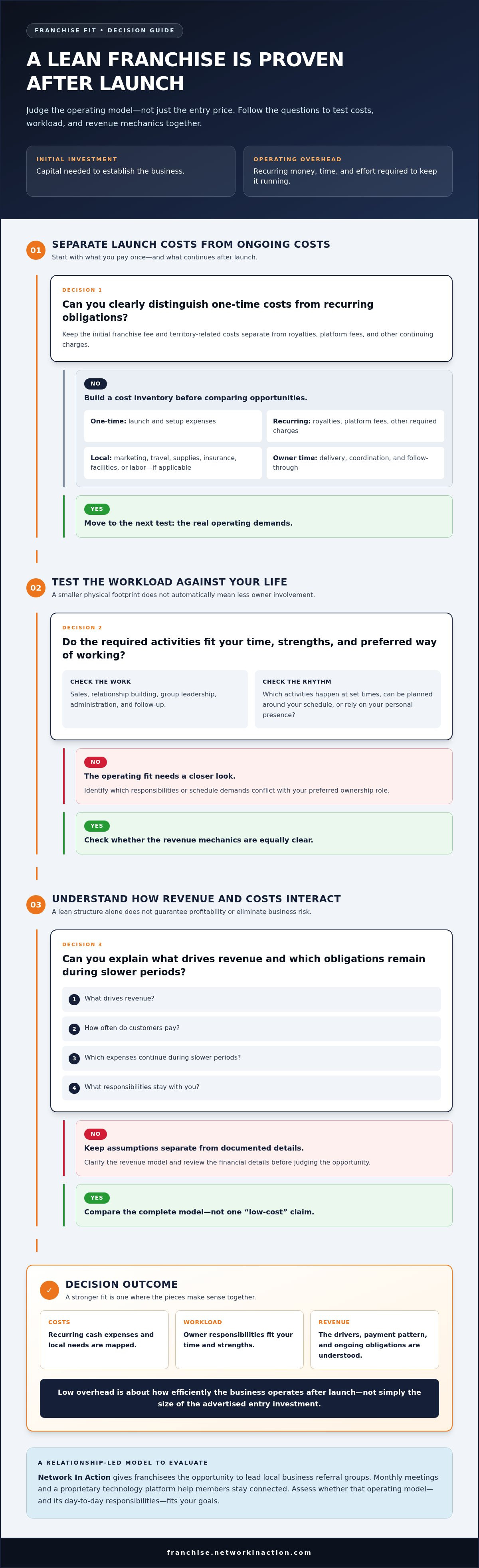
A lean franchise is defined by how efficiently it operates after launch, not simply by the size of its advertised entry investment. A model may require a modest initial outlay but still carry recurring fees, local expenses, or substantial owner responsibilities. Conversely, a larger startup investment does not automatically mean high ongoing overhead.
Operating overhead is the recurring money, time, and operational effort required to keep a franchise running; initial investment is the capital needed to establish the business. Keep those measures separate. A general overview of Franchising can help explain how a franchise relationship works, but each opportunity’s costs and obligations depend on its specific model and agreements.
For a useful comparison, look beyond the headline fee. Track recurring cash expenses, the work required to deliver the service, and the complexity of coordinating it. Your time matters even when it does not appear as a line item in the operating budget.
What costs count as franchise overhead?
Separate costs by timing and purpose. An initial franchise fee and territory-related costs are generally part of entering or setting up the business. Royalties, platform fees, and other required recurring charges belong in your ongoing-cost calculation. Local expenses may include marketing, travel, supplies, insurance, facilities, or labor, depending on the model.
Not every category applies to every franchise. A location-dependent concept may involve premises, equipment, or staffing, while a relationship-led service may rely more on local outreach, scheduling, and maintaining professional relationships. These are examples of cost drivers, not proof that either model is automatically cheaper.
Build a simple inventory before comparing options:
- One-time costs: Separate launch expenses from ongoing obligations.
- Recurring fees: Identify royalties, platform charges, and other continuing payments.
- Local expenses: List the resources needed to operate in your market.
- Owner workload: Record the time and coordination required to deliver consistently.
This makes hidden complexity easier to spot. A low cash outlay can still demand substantial owner involvement.
Does low overhead mean low risk or higher profit?
No. Lower operating demands do not guarantee profitability or eliminate business risk. Results also depend on customer demand, pricing, execution, and the effort required to attract and serve customers. A lean structure can reduce some pressures, but it cannot create demand or replace effective operations.
Assess the whole model, not a single “low-cost” claim. Ask what drives revenue, how often customers pay, which expenses continue during slower periods, and what responsibilities remain with you. Then compare those demands with your strengths, available time, and financial boundaries. The best fit is not necessarily the franchise with the fewest expenses. It is the one whose costs, workload, and revenue mechanics make sense together.
How Franchise Business Models Shape Ongoing Costs and Workload
The business model determines which resources you need, what work must happen consistently, and where your time goes. A location-dependent franchise may rely on premises, equipment, and staff to deliver its service. A relationship-led operation may depend more on local outreach, group leadership, and follow-through. Neither structure is automatically leaner. Compare how each model works in your market and what it asks you to manage.
Look beyond visible expenses. A model with fewer physical requirements may still rely heavily on the owner’s ability to build relationships and sustain engagement. A business with a larger local footprint may have more facility-related needs but established routines for serving customers. These trade-offs shape your day-to-day work, so assess them alongside the financial obligations.
Apply the same categories to every opportunity. This helps reveal whether a streamlined structure genuinely simplifies operations or shifts more work onto you.
Which operating costs should you compare?
Review recurring franchise charges alongside the costs of local delivery. Royalties and technology fees may apply; staffing, facilities, travel, and marketing depend on the concept. Identify which expenses continue, what triggers them, and whether they change with activity or location. Variable costs still matter even when they are not fixed monthly commitments.
Then connect each expense to the work it supports. A customer-facing location may require coordination around premises and service delivery. A relationship-led business may call for regular local engagement and careful follow-through. These examples describe different operating demands, not proof that one model costs less.
How do workload and flexibility affect the real cost?
Time is an operating resource. Estimate the effort required for sales, relationship building, group leadership, administration, and follow-up. A business can have limited physical infrastructure and still depend on consistent owner involvement. Consider which activities happen at set times, which you can plan around your schedule, and where your personal presence is central.
Ownership structure matters as much as expense structure. Network In Action’s opportunity centers on leading local business referral groups, so consider whether developing a professional community matches the work you want to do. Think about how you prefer to build credibility: through recurring relationships and community leadership, or through a different operating role. For a closer look at the ownership model, explore the franchise information kit.
Before deciding, sketch a realistic weekly schedule and mark the work you are willing to own. Compare it with each franchise’s operating expectations. Low overhead franchise opportunities should support an operating rhythm that fits your priorities, not simply look efficient on paper.
How to Compare Low Overhead Franchise Opportunities
Put every opportunity through the same test. Do not let a low fee or small physical footprint stand in for sound unit economics. Compare the money required, the work required, and how the business generates revenue. Mark what is documented, what is an estimate, and what needs deeper financial review.
Use this framework to build a side-by-side comparison. Enter figures and details from each opportunity’s disclosure materials rather than relying on broad marketing claims.
| Comparison area | What to record | What to clarify |
|---|---|---|
| Initial investment | Startup expenses and when they’re due | Which costs are estimates, and what working capital may be needed? |
| Recurring fees | Each royalty, platform, or other continuing fee | How is each fee calculated, and when does it apply? |
| Operating demands | Local expenses, owner responsibilities, and time commitments | What resources does consistent delivery require? |
| Support | Training, ongoing support, and technology described | How do these resources relate to your obligations? |
| Revenue mechanics | How the business earns revenue and what activity supports it | What assumptions affect repeat business and sales? |
Which franchise metrics belong in your comparison?
Record every disclosed fee by type, amount, and timing. Keep one-time expenses separate from recurring charges. Compare training, support, and technology with the operating responsibilities they are meant to support. Review any financial performance information carefully: distinguish reported results from projections or assumptions, and treat neither as a promise of your future performance.
Label each entry as documented, estimated, or unresolved. This simple discipline keeps assumptions from turning into “facts” as you compare options.
How can you assess recurring revenue potential responsibly?
Start with the revenue mechanism. Identify who pays, what value they receive, how often revenue may recur, and what ongoing activity is needed to retain relationships or generate sales. Repeat business may be part of a model, but it is not guaranteed or passive. Your execution, customer demand, and continued effort still matter.
For broader ownership context, consider how an opportunity aligns with your career priorities and preferred leadership role. The executive business opportunities guide offers another lens for assessing that fit.
Finally, weigh the numbers against your strengths. A relationship-led franchise may suit someone who enjoys community leadership and building professional credibility; another model may better match different skills or schedule preferences. Low overhead franchise opportunities deserve a closer look when operating demands, revenue mechanics, and personal fit make sense together, not just when one cost appears low.
A Practical Checklist for Choosing a Lean Franchise
Use a repeatable process before comparing franchise brands. Start with your own limits, then test each model against its operating demands and financial details. That sequence keeps a persuasive headline from setting the terms of your decision.
What should you clarify before evaluating opportunities?
Set boundaries first. Decide how much capital you can commit, how much time you can consistently give the business, what flexibility matters to you, and which leadership responsibilities you are prepared to own. List the strengths you want to use, such as sales, facilitation, or relationship building. These priorities become your filter, not an afterthought.
How do you test fit beyond the headline investment?
Look at the operating rhythm behind the opportunity. Consider how training, technology, and ongoing support relate to the work you will be expected to perform. Compare claims with the franchise materials and fee structures, separating documented details from estimates and unresolved questions. A low advertised investment is only one part of the decision.
Move through this checklist in order:
- Set your boundaries. Write down your capital range, available time, preferred schedule, and desired level of owner involvement.
- Match the role to your strengths. Consider whether you want to sell, lead a team, facilitate a community, build relationships, or manage local service delivery.
- Map the operating model. Identify recurring tasks, local requirements, use of technology, and the work needed to maintain customer or professional relationships.
- Review the financial structure. Separate initial expenses from recurring fees. Note when each fee applies and what assumptions shape the estimates.
- Assess the revenue mechanics. Understand what creates revenue, what ongoing activity supports it, and which factors could affect demand or repeat business.
- Test lifestyle and location fit. Compare the required schedule and leadership role with your priorities, then consider whether the territory aligns with your local knowledge and growth plans.
Be disciplined about unknowns. Put unanswered financial or operational questions in writing and resolve them through careful review of the opportunity materials before making commitments. Do not turn a projection into a promise or treat a broad marketing phrase as a substitute for specific terms.
For a relationship-led franchise, assess whether community leadership and professional relationship building fit the work you want to do. A model supported by structured monthly meetings, technology, and training offers a distinct operating rhythm, but it still calls for active leadership. The right fit should match both your business goals and the way you prefer to contribute.
Once your priorities are clear, compare available franchise territories against your location and growth goals. Use that exploration to assess alignment, not to rush the decision.
Network In Action: A Relationship-Driven Franchise Model to Evaluate
Network In Action offers a franchise opportunity centered on leading local business referral groups. Its approach puts professional relationships at the heart of local business development, with an emphasis on curated, high-quality connections rather than contact volume. The model avoids forced referrals, giving relationships room to develop through professional value instead of rigid referral expectations.
That distinction shapes the owner’s role. You are not simply investing in a concept and stepping away. You build credibility as a local community leader and help create an environment where business professionals can develop trusted connections. The opportunity may suit someone who values relationship-driven growth and wants to contribute directly to a professional community.
How does the Network In Action model operate?
Franchisees lead local business referral groups and cultivate an environment focused on valuable professional connections. The central question is whether you are prepared to guide a community, support productive interaction, and build relationships with local business owners. Consider how your leadership style can encourage meaningful engagement without making referrals feel transactional.
Evaluate the role through the work it involves: developing local credibility, attracting professionals who value strong business relationships, and maintaining a community-oriented approach. These responsibilities call for active leadership and follow-through, not passive ownership.
Who may align with this franchise opportunity?
This model may appeal to experienced professionals who enjoy connecting people, facilitating business conversations, and building trust over time. Sales, communication, and community-building strengths can support the work, but the key fit is a genuine interest in helping local professionals form useful relationships. Consider whether that purpose energizes you enough to lead consistently.
Flexibility and recurring-revenue potential may factor into your evaluation, but neither is guaranteed. Focus on the responsibilities you would own, the professional community you want to develop, and how the opportunity fits your broader business and lifestyle priorities. That is a more useful test than assuming relationship-based ownership is automatically hands-off.
If this leadership role fits your ambitions, explore the franchise opportunity kit to learn more and assess alignment at your own pace.
Make Your Next Move With Clear Priorities
The best low overhead franchise opportunities are not defined by a single cost claim. They are opportunities you can evaluate against the business you want to build, the work you are prepared to lead, and the professional impact you want to create. Keep your standards clear, examine the full ownership model, and choose based on alignment rather than momentum.
For professionals who want to build influence through meaningful local relationships, Network In Action offers a path to explore community leadership as a business opportunity. Learn about the model, consider how it fits your goals, and decide whether it merits a closer look.
Explore the Network In Action franchise opportunity and consider whether its relationship-led business model aligns with your goals.
Frequently Asked Questions
Are low overhead franchise opportunities more profitable?
Not automatically. Low overhead franchise opportunities can leave more revenue available after operating expenses, but profitability also depends on sales, pricing, customer acquisition, royalties, and execution. A lean business with weak local demand may underperform a higher-cost model with strong customer demand. Compare revenue assumptions with all ongoing obligations, and consider how the business might perform during a slower sales period before drawing conclusions about profit potential.
Can you own a low overhead franchise part-time?
Possibly, if the franchise’s required tasks and your growth plan fit the hours you can reliably commit. Map a typical week, including sales, customer or member follow-up, administration, and scheduled activities. Then consider whether those responsibilities fit alongside your current work without delaying essential tasks. Do not assume part-time ownership from a small footprint or lean cost structure; operating expectations matter more.
What is the difference between low startup costs and low overhead?
Startup costs relate to launching the business; overhead concerns the resources needed to keep it operating. They affect different parts of your financial plan. A business may be inexpensive to establish but require ongoing paid advertising, software, or travel. Model launch funding and monthly cash needs separately to see whether an attractive entry point remains manageable after opening.
Do low overhead franchises require less work?
Not necessarily. Lower facility or staffing needs can reduce some tasks while leaving sales, service delivery, customer retention, and administration with the owner. Technology may streamline coordination, but it still requires active use and oversight. Before choosing, list the recurring work and identify which responsibilities can be scheduled, delegated, or handled through available systems. A lean cost structure does not mean a hands-off operation.
How much does a low overhead franchise cost to start?
There is no single startup cost that applies to every franchise. The total depends on the concept, territory, launch requirements, and working capital needed for the business. Review the total initial investment estimate in the franchise disclosure materials, not only the franchise fee. Build a cash plan that separates one-time launch expenses from ongoing obligations, and assess whether it leaves enough room to operate through the early stages.
Can a business networking franchise create recurring revenue?
It may, depending on how the franchise earns revenue and what ongoing payments or activity support it. Regular customer relationships alone do not guarantee repeat income. Examine who pays, what value they receive, how revenue is collected, and what effort is needed to maintain participation. The specific revenue mechanics and agreement matter; do not assume recurring revenue is passive, predictable, or assured.
Do you need franchise experience to lead a local business group?
Franchise experience can be useful, but it is not the only way to assess readiness. Consider whether you can explain the group’s value clearly, initiate conversations with local professionals, and follow up reliably. Map the business communities you already know, identify whom you would feel comfortable approaching, and outline how you would introduce the opportunity without promising referrals or results. Then compare those tasks with your strengths and goals.