What if the problem isn’t your ambition, but the path you’re being asked to follow? If you’re weighing what to do when your corporate career feels stagnant, waiting another year for recognition may seem easier than making a change. But staying put without understanding what’s holding you back can narrow your options over time.
Feeling stuck doesn’t automatically mean you need a new employer or that corporate life no longer fits. The constraint could be your current role, limited opportunity within the organization, or a career direction that no longer matches what you want. The right next step starts with identifying which one it is.
This article will help you pinpoint the source of stagnation, compare practical moves, and build a plan to test your options while preserving your leverage. You’ll consider whether a stretch role, a move to another organization, or a shift toward business ownership better aligns with your ambitions. For professionals drawn to relationship-driven work, leading a local business community through a franchise may be one path to explore. The goal isn’t to make a dramatic exit. It’s to choose your next move with evidence, intention, and a clearer view of what you want your career to deliver.
Key Takeaways
- Separate a lasting career pattern from a difficult quarter or one missed promotion before deciding it’s time to leave.
- Pinpoint whether limited role scope, access, learning, recognition, or organizational structure is holding you back.
- Compare internal moves, external roles, skill development, and entrepreneurship by fit, trade-offs, reversibility, and the evidence you still need.
- Use focused conversations and small experiments to test your next move while preserving your options and leverage.
- When deciding what to do when your corporate career feels stagnant, consider whether leading a local business community through a franchise fits your long-term ambitions.
Recognizing the Pattern of Career Stagnation
You can deliver strong work, meet demanding expectations, and still feel no closer to the next meaningful goal. The work may no longer challenge you. Your contributions may go unrecognized, or your responsibilities may grow without a corresponding increase in influence. That frustration deserves attention, but it doesn’t automatically mean your career is in crisis.
Career stagnation is a sustained gap between the growth, recognition, and progress you want and what your work consistently makes possible. A difficult quarter, a delayed promotion, or a temporary reorganization isn’t enough to establish a pattern. Look for repeated signals across projects and performance cycles. A short-term disruption may call for patience, while a persistent constraint calls for a deliberate response.
Also distinguish stagnation from burnout. Exhaustion can make meaningful work feel pointless, while stagnation can leave you energized but underused. A temporary change may shift priorities or slow decisions without closing off future growth. And a mismatch with your current responsibilities may be role-specific, not proof that your organization or profession is wrong for you.
What to do when your corporate career feels stagnant: identify the constraint
Start by checking whether the plateau is showing up in your scope, skills, visibility, or access to advancement. Are you repeatedly delivering more without gaining decision-making authority? Have meaningful projects, learning opportunities, or exposure to senior leaders narrowed? Is there a credible next step, or do conversations about progression stay vague? These patterns can help you separate a temporary slowdown from a career constraint that needs action.
Which signals suggest a real career plateau?
Track concrete examples rather than relying on a general sense of being overlooked. Note projects you were considered for, responsibilities added or removed, feedback received, and skills you’ve had a chance to develop. Compare your experience with your own goals and past opportunities, not only with colleagues’ titles. Their timing, priorities, and circumstances may differ from yours.
Organizational hierarchies can also limit how far performance alone takes you. The Peter Principle describes how people may be promoted until they reach a role that no longer matches their abilities. It’s one possible explanation for stalled advancement, not a diagnosis of your workplace. Look at the evidence in your own role before drawing conclusions.
Is the problem your role, workplace, or career direction?
Start with recent examples. Which tasks drain your energy, and which still hold your attention? If you enjoy solving client problems but spend most of your time on internal approvals, the issue may be role design. If the work itself has lost meaning across several responsibilities, your broader direction may need a closer look.
Then test the workplace factor. Would the same frustration likely remain under a different manager or on another team? If the core work appeals to you but access, recognition, or decision-making feels blocked, the organization may be the constraint. If the work no longer fits your interests regardless of who leads it, changing teams may offer only temporary relief.
For a clearer picture of what to do when your corporate career feels stagnant, write down two recent moments: one that left you frustrated and one that felt engaging. Identify what differed, such as autonomy, challenge, purpose, or visibility. Repeated patterns are more useful than a single bad day. They point toward the source of the plateau and give your next decision a stronger foundation.
How to diagnose what is keeping your corporate career stuck
Once you’ve noticed a recurring plateau, move from frustration to diagnosis. The aim isn’t to prove that your employer is at fault or talk yourself into staying. It’s to identify the specific constraint, then decide whether it can change. The right next step depends on the constraint, not frustration alone.
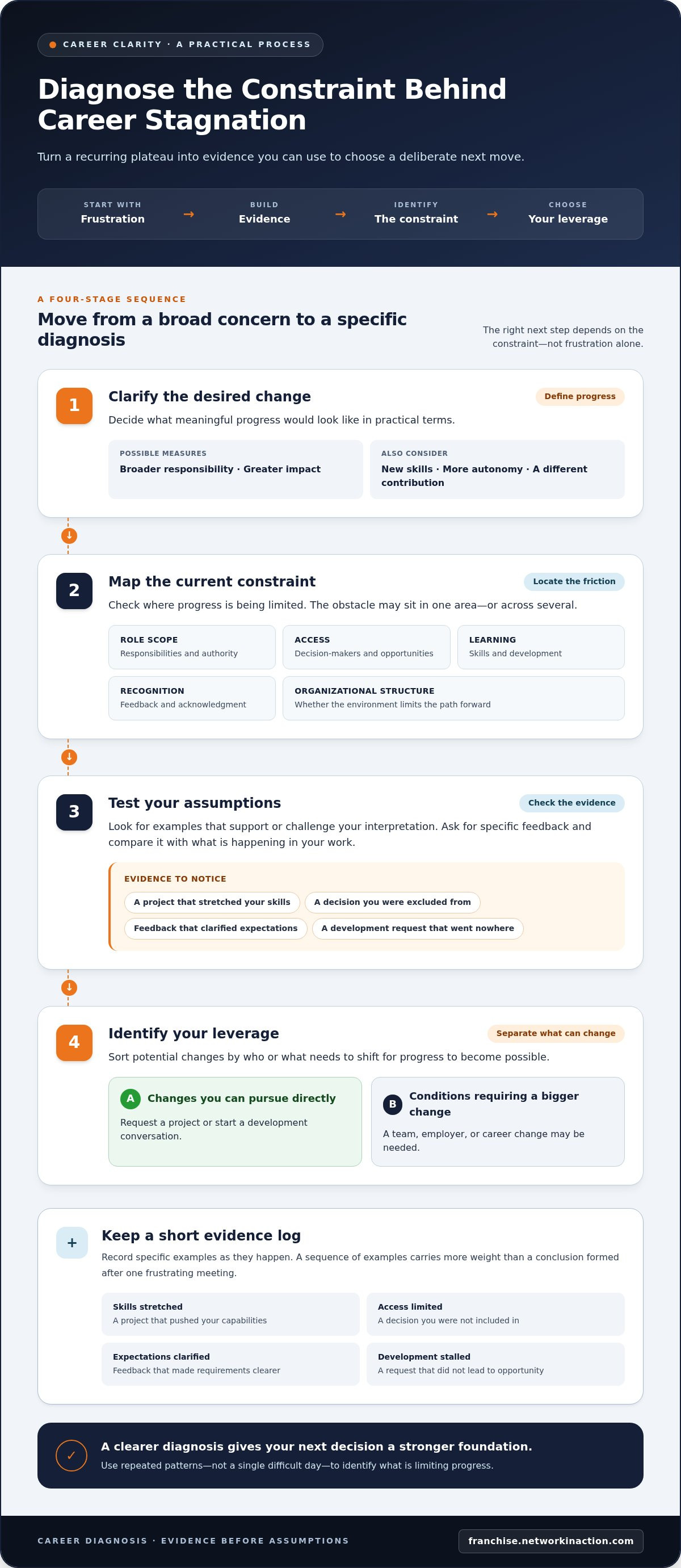
Use this sequence to turn a broad concern into evidence you can act on:
- Clarify the desired change. Decide what progress would look like in practical terms: broader responsibility, greater impact, new skills, more autonomy, or a different kind of contribution.
- Map the current constraint. Examine whether role scope, access to decision-makers, learning opportunities, recognition, or organizational structure is limiting that progress.
- Test your assumptions. Look for examples that support or challenge your interpretation. Ask for specific feedback and compare it with what is happening in your work.
- Identify your leverage. Separate changes you can pursue directly, such as requesting a project or development conversation, from conditions that require a team, employer, or career change.
Keep a short evidence log. Record a project that stretched your skills, a decision you were excluded from, feedback that clarified expectations, or a development request that went nowhere. A sequence of examples carries more weight than a conclusion formed after one frustrating meeting.
Map the gap between your current work and desired progress
Choose one or two measures of progress that matter most to you. Then note which responsibilities support those goals and which repeatedly block them. For example, if you want greater strategic influence, identify how often you shape decisions rather than only execute them. Mark each obstacle as within your influence, dependent on organizational support, or outside your current role’s reach.
Test whether the organization can offer a credible path
Bring focused questions to a development conversation: What broader scope could you take on? Which skills would demonstrate readiness? What opportunities could give you relevant experience? Listen for concrete next steps, ownership, and follow-through, not encouraging language alone. A path is credible when practical opportunities can move you toward it, not when it consists only of a title or promise.
Strengthen your diagnosis with a trusted professional perspective. A mentor, former manager, or experienced colleague can help test whether your expectations match the role and identify options you may have missed. Share specific examples, not only your conclusion, and ask what evidence would change their view.
If you’re weighing what to do when your corporate career feels stagnant, use your diagnosis to narrow your choices before making a major move. A role-scope problem may call for a targeted conversation. A structural limit may require a different team or employer. A deeper mismatch may point toward a new direction. That distinction gives your next step purpose and keeps temporary frustration from making the decision for you.
Compare your options before making a major career move
A persistent plateau doesn’t mean you have to resign immediately. You can change your role, change employers, build a skill that opens new doors, or test whether business ownership suits your ambitions. Each route addresses a different constraint. Compare them against the progress you want, not the appeal of a fresh title or the urge to escape a bad week.
Use this matrix to identify what each option could solve, what it may demand, and what you need to learn before committing. Reversibility isn’t absolute, but it helps clarify how much flexibility you retain while exploring.
| Option | Best fit | Likely trade-offs | Reversibility | Evidence to gather |
|---|---|---|---|---|
| Internal role change | You want different work or broader scope, and the organization has credible opportunities. | New responsibilities may come with a learning curve, while some structural limits may remain. | Often easier to adjust than leaving the employer, depending on the role. | Specific openings, expected responsibilities, decision-making authority, and a clear path to move. |
| External opportunity | Your current organization appears to limit the work, growth, or recognition you’re seeking. | A new employer brings uncertainty, and a different title may not mean better fit. | Less reversible after you leave, so compare the role carefully. | How the position uses your strengths, what success requires, and whether its scope matches your goals. |
| Targeted skill development | You can name a capability gap that is blocking a specific next step. | Training takes time and may not create advancement if the real barrier is structural. | Highly flexible; new skills can support several paths. | Whether the skill appears in roles you want and whether you can apply it in a real project. |
| Entrepreneurial exploration | You’re drawn to autonomy, community leadership, and building a business. | Ownership means operating a business and accepting responsibility and uncertainty, not simply changing employers. | Harder to reverse once you commit substantial time and resources. | Your appetite for operating responsibilities, the business model, and its fit with your priorities. |
When an internal move or employer change may fit
An internal move makes sense when the organization can offer a real shift in scope, skills, or decision-making, not just a new title attached to the same constraints. An external move deserves attention if limited opportunities or organizational structure appear to be the main barrier. Compare roles against defined goals: a more impressive title won’t help if the work still lacks the influence or learning you want.
When business ownership deserves consideration
Consider ownership if you want to lead, build relationships, and create value beyond a corporate role. A franchise is an operating commitment, with uncertainty as well as autonomy. Network In Action offers a franchise opportunity centered on leading a local business referral group. Assess whether the day-to-day responsibilities align with your ambitions before deciding.
To decide what to do when your corporate career feels stagnant, select the option that addresses the diagnosed constraint and preserves room to learn. You don’t need to make the boldest move first. You need a move that gives you better evidence about the future you want.
Build a low-risk plan to regain momentum at work
You don’t need to make a high-stakes decision before you have useful evidence. Set a near-term goal, take focused action, and assess what changes. That gives you a way to regain momentum while keeping your options open.
Build your plan around observable signals, not vague hopes. For example, if you want more strategic responsibility, test whether you can lead a planning discussion or own a defined piece of a cross-functional project. If you’re considering a new field, speak with people doing that work and try a small project that uses relevant skills. Choose experiments that reveal what the work is actually like.
- Set one practical goal. Define the change you want to test, such as taking ownership of a project, developing a specific capability, or learning about a different career path.
- Start the right conversations. Discuss growth with your manager and seek perspectives from professionals who understand the roles or paths you’re exploring.
- Track what happens. Record commitments, opportunities, feedback, and your response to the work. Look for patterns, not one-off reactions.
- Choose a personal review point. Decide when you’ll assess the evidence based on your commitments and circumstances. There’s no universal deadline; the point is to avoid letting an experiment drift without a decision.
Networking can make these tests more useful when you prioritize relevant relationships over collecting contacts. A candid conversation with someone whose responsibilities resemble your target role can reveal the real trade-offs, skills, and working rhythm behind a polished job title. Approach each discussion with a specific question and listen for details you can compare across perspectives.
Turn career goals into a focused development conversation
Bring concrete examples of your contributions and explain what kind of growth you’re aiming for. Ask which responsibilities, skills, or experiences could prepare you for that direction. For instance, if you want more client-facing work, ask about a suitable project or presentation opportunity. Close by agreeing on observable next steps, such as taking on a defined assignment or getting feedback after presenting a proposal. Follow up and review whether those actions happen.
Use targeted conversations to test possible paths
Speak with people whose roles or career paths connect to the options you’re considering. Ask what fills their working days, which responsibilities they find most demanding, and what they wish they’d understood before choosing that path. After each conversation, note what surprised you, what several people described similarly, and which assumptions still need a real-world test.
If you’re working out what to do when your corporate career feels stagnant, use small experiments to distinguish a path that sounds appealing from one that fits your strengths and priorities. If business ownership becomes part of your plan, review the franchise opportunity as one option to evaluate. Treat it as research, not a commitment.
If corporate work remains limiting, explore a new model of leadership
A corporate role isn’t the only way to lead, build influence, or contribute to business growth. If your diagnosis points to limits that another team or employer may not resolve, business ownership could be worth exploring. It’s a different career model, not an escape hatch: you take on the work and responsibility of operating a business.
For professionals who value relationship-driven growth, leading a local business community offers a distinct kind of challenge. Network In Action franchisees build and manage local business referral groups. Monthly meetings and a proprietary technology platform help members stay connected, while the model emphasizes curated, high-quality membership rather than forced referrals. This approach may suit professionals seeking a different way to structure their work, but it can’t guarantee a particular level of flexibility or outcome.
What a networking franchise leadership path involves
The work centers on cultivating a strong local group, supporting useful professional relationships, and creating an environment where members can build credibility and grow through their networks. That calls for community leadership and steady attention to the business, not simply hosting meetings or collecting contacts. The focus on quality relationships can appeal to professionals who prefer meaningful connections over high-volume, transactional networking.
This path may appeal if you enjoy bringing professionals together, helping a community develop, and building a business around connection. It may be a poor fit if you’re seeking a role with no operating responsibility or predictable outcomes. A franchise is ownership, with decisions and obligations that differ from employment.
How to explore ownership without rushing a decision
Evaluate the opportunity against your goals, working style, and appetite for responsibility. Ask yourself:
- Do you want to lead a local business community, not just change corporate employers?
- Does relationship-driven work energize you, including the ongoing effort of building professional credibility?
- Are you prepared to assess the business model, operating commitments, and uncertainty before deciding?
- Does this direction support the kind of contribution and work-life fit you want, without relying on an assumed outcome?
Use those questions to guide your research and conversations. The business networking franchise model offers one specific ownership path to examine. For a broader review of the opportunity, explore the franchise opportunity guide. Treat the information as a starting point for evaluating fit, not a promise of income, lifestyle, or success.
Choosing what to do when your corporate career feels stagnant begins with understanding what kind of work and leadership you want next. If local business community leadership aligns with your ambitions, explore the franchise opportunity at your own pace and decide whether the model deserves a closer look.
Choose a next step that expands your options
Your next move doesn’t have to be a dramatic exit. It can be a deliberate test of what gives you energy, where your strengths create value, and how much ownership you want over your work. Use that evidence to shape a career that fits your ambitions, whether the right opportunity is inside an organization or beyond it.
If you’re considering business ownership, explore it as a distinct path, with real operating responsibilities rather than the structure of another corporate role. Network In Action has more than 150 locations across the United States and several other countries, giving professionals a model for leading local business referral groups and building relationship-driven communities.
The question of what to do when your corporate career feels stagnant can lead to more than one answer. Give yourself room to compare, ask practical questions, and move when the direction makes sense for you. To explore whether franchise ownership fits your next chapter, explore the franchise opportunity. A thoughtful next step can open a stronger path forward.
Frequently Asked Questions
Is career stagnation normal for experienced professionals?
Yes, an occasional plateau can be part of a career, but persistent dissatisfaction doesn’t have to become your permanent baseline. A role may change after a reorganization, a demanding project, or a shift in what matters to you professionally. Judge the situation by repeated patterns and your own goals, not a peer’s promotion timeline. If the pause continues to conflict with what you want from work, consider a deliberate response.
Can your corporate career feel stagnant even when your performance reviews are positive?
Yes. Positive reviews can confirm that you’re meeting expectations, but they don’t necessarily show that your role is expanding in ways you value. For example, you might receive strong feedback for reliable delivery while continuing to work on the same assignments. Compare review comments with changes in responsibility, learning, recognition, and access to new work. Positive feedback still matters, especially when it clarifies strengths you can build on.
How should you prepare for a conversation about career growth with your manager?
Prepare a concise case for the direction you want to explore. Bring examples of recent contributions, identify the development you’re seeking, and ask what responsibilities or skills could help you move toward it. For instance, if you want more client-facing work, ask about a suitable project or presentation opportunity. Listen for specific next steps, clarify who owns them, and agree on when to revisit progress without treating the discussion as an ultimatum.
Should you leave your job if your corporate career feels stagnant?
Not automatically. To decide what to do when your corporate career feels stagnant, first identify what is limiting progress and whether a realistic change within the organization could address it. Then compare that possibility with evidence about an external role or other path, such as its responsibilities and fit with your goals. A planned transition can give you more room to evaluate options than an impulsive resignation. Staying or leaving should follow your assessment.
Can a lateral move help when promotion opportunities are limited?
It can, if the move gives you useful experience, stronger working relationships, or access to decisions relevant to your longer-term goals. For example, moving from a specialist function into a cross-functional role might help you understand how different teams set priorities. But a lateral transfer isn’t automatically progress. Before accepting, examine the actual scope, learning curve, and opportunities to apply new capabilities. The value lies in what the move enables, not the title alone.
How often should you review your career development goals?
Review them often enough to notice meaningful changes, but don’t treat a fixed interval as a universal rule. A useful moment could be after you’ve completed an agreed development action, received new responsibilities, or experienced a workplace change that affects your options. Ask whether your priorities still fit, what evidence has emerged, and what adjustment makes sense. The purpose is to make informed course corrections, not to label every short-term slowdown a failure.
What should you consider before moving from corporate employment to franchise ownership?
Consider whether you want to operate a business and lead a local community, rather than simply move to another employer. Assess how the responsibilities fit your goals, working style, and appetite for business risk. Before deciding, examine what running the business would demand day to day and how you would evaluate progress beyond a job title or salary. Ownership involves uncertainty, so don’t assume it guarantees income, autonomy, or a particular lifestyle outcome.