
A franchise marketing fund’s headline rate is only the starting point. The hidden costs in a franchise marketing fund may include separate local advertising requirements, technology or software fees, and required marketing vendors, each with its own effect on your operating budget.
Looking beyond the contribution amount is a practical first step. The full obligation depends on what you pay, who controls the spending, whether the terms specify how funds may be used, and what reporting is provided. A low stated contribution does not tell you whether additional marketing costs apply or how much visibility you will have into fund management.
This guide explains how to identify direct and indirect obligations, compare fund terms using franchise documents, and assess the scope, control, and accountability behind the numbers. When you evaluate a relationship-driven opportunity such as Network In Action, this document-based approach helps you weigh recurring costs alongside the business model, its flexibility, and your priorities as an operator.
Key Takeaways
- Identify hidden costs in a franchise marketing fund by looking beyond the headline contribution to the full range of required marketing obligations.
- Separate central fund payments from local marketing budgets and other recurring charges to see the full commitment more clearly.
- Compare fund terms by who controls spending, where funds may be allocated, and what reporting you can expect.
- Use franchise disclosure and agreement documents to record each obligation, how it is calculated, and when it applies.
- Evaluate marketing costs alongside the complete franchise model, including its operating structure, support, and fit with your priorities.
What a Franchise Marketing Fund Covers, and What Its Contribution Does Not Tell You
A franchise marketing fund is generally a pool of franchisee contributions used for system-level marketing. Its purpose and administration depend on the franchise’s written terms. The shared investment may support brand promotion, but the details vary by system. The documents define how contributions are calculated, who controls the fund, and which expenses it may cover. For background on the broader topic, see this overview of Franchising and marketing fund regulation.
That distinction matters when you assess the hidden costs in a franchise marketing fund. A contribution rate describes one payment obligation, not necessarily every marketing expense you may carry. Review the full structure rather than judging the opportunity by its headline figure.
What does a franchise marketing fund typically pay for?
Depending on the agreement, a system-level fund may support brand campaigns, shared creative assets, or promotional resources intended for use across the franchise network. These are examples, not a promise that every fund pays for each item or provides a specific service. Some funds have a narrow scope, while others allow a broader range of marketing-related expenses.
Read the applicable disclosure and agreement language to identify permitted uses. Note how broadly those uses are described and who decides which initiatives receive funding. A fund’s name alone does not tell you how its money may be spent.
Why the stated contribution is not the complete picture
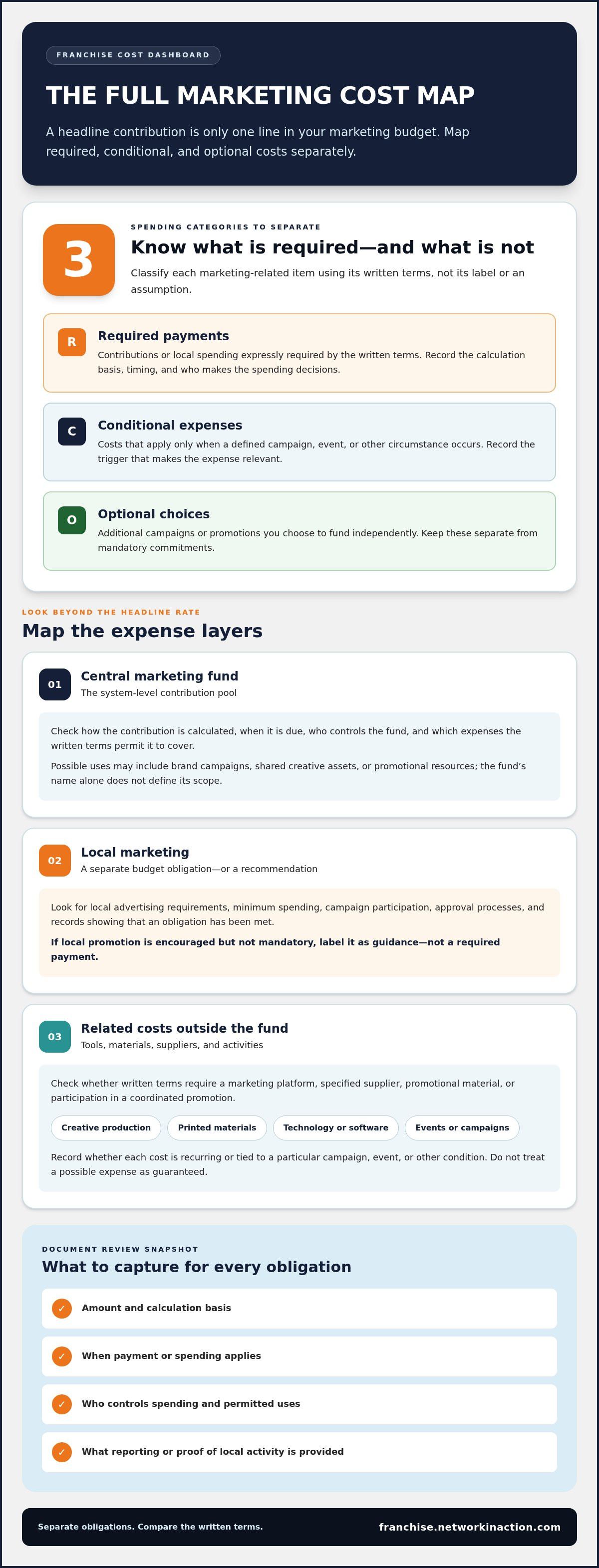
Your total marketing budget may include obligations outside the central fund. A franchise agreement could require local advertising or participation in a local marketing program. Another system may recommend local promotion without making it mandatory. You may also choose to fund additional campaigns. Separate what you must pay from what you may decide to spend, since these categories have different effects on your budget.
A marketing fund contribution is one line in your marketing budget, not a complete measure of your marketing obligations.
As you review a franchise opportunity, sort each marketing-related item into three groups:
- Required payments: Contributions or local spending expressly required by the written terms.
- Recommended spending: Activities the franchisor encourages, but the documents do not make mandatory.
- Optional choices: Additional campaigns or promotions you decide to fund independently.
For every required item, note the calculation basis, timing, and decision-maker. A local campaign budget, for example, is separate from a central contribution if the documents treat it as a distinct obligation. Do not assume that every franchise has the same categories or that a suggested budget is compulsory. Clear distinctions help you estimate the commitment and compare opportunities consistently.
Hidden Costs in a Franchise Marketing Fund: Map the Full Expense Picture
Build a complete expense map before deciding whether a marketing obligation is manageable. Start with the recurring contribution, then look for separate local spending, campaign requirements, and related purchases or services. A fund contribution alone cannot establish your total marketing spend. The documents determine which additional items are obligations and which remain your choice.
Direct charges and required local marketing
Record how the central contribution is calculated, when it is due, and whether the documents describe it as recurring. Then look for separate local advertising requirements, including minimum spending, campaign participation, or approval processes. These terms may vary by location, campaign, or operating circumstance. The FTC Franchise Rule and marketing fund disclosures guide offers broader context for reviewing franchise disclosure materials. The specific written terms define the obligations for the opportunity you are evaluating.
Keep central and local amounts separate in your worksheet. If local activity is required, record how the obligation is measured and what documentation shows it has been met. If the agreement only recommends local promotion, label it as guidance rather than a mandatory payment.
Indirect expenses that can affect the marketing budget
Some costs arise outside the fund contribution. They may apply when franchise documents require a particular tool, material, or activity. Look for charges tied to producing local creative, printing promotional materials, adapting a system campaign, hosting an event, or participating in a coordinated promotion. Identify the clause or written instruction that makes each item relevant rather than assuming it applies across all franchises.
Track technology separately. A required marketing platform or other system may carry a charge distinct from the advertising fund. A specified supplier or promotional material may also add expense if the written terms require its use. Record both the obligation and its trigger, such as a recurring subscription, a particular campaign, or a local event. This makes conditional expenses visible without treating them as guaranteed costs.
Classify every item using a consistent label:
- Contractual: The agreement or disclosure materials expressly require it.
- Conditional: It applies only when a defined campaign, event, or circumstance occurs.
- Optional: You choose whether to spend on it.
- Verify in documents: The item is mentioned, but its requirement or calculation needs clarification in the written materials.
This category map helps distinguish fixed commitments from choices and potential expenses. Use the same labels for each franchise opportunity you compare, then add the relevant clause and calculation method beside each item. For a broader look at the opportunity and its operating structure, include the Network In Action franchise kit in your research.
Compare Franchise Marketing Funds by Control, Allocation, and Accountability
A contribution rate reveals only part of a fund’s structure. To compare franchise opportunities, examine what the documents say the fund is for, who makes spending decisions, where money may be allocated, and what financial information you will receive. A larger or smaller fund is not automatically better. Focus on whether its terms are clear and predictable, and whether they align with the marketing support described to you.
Use the same comparison points for each opportunity. Record the written policy and note any discretion reserved in the agreement or disclosure materials. A description of intended system-wide campaigns may sit alongside terms that give the administrator latitude to choose specific spending.
| Comparison point | What to record | Why it matters |
|---|---|---|
| Fund purpose | Permitted uses and stated objectives | Shows what the pool is designed to support |
| Contribution basis | How the payment is calculated and when it is due | Helps you understand the obligation over time |
| Decision authority | Who administers the fund and approves priorities | Clarifies who controls spending decisions |
| Allocation | Whether use is described as system-wide, regional, or local | Shows how closely spending may connect to your market |
| Reporting | What information is shared, how often, and in what form | Indicates what visibility you can expect |
Who controls the fund and decides where it goes?
Identify the entity responsible for administering the fund and the person or group with authority over campaign priorities. Then note whether spending is described as system-wide, regional, or local. Look for stated limits, exclusions, or discretion. Avoid assuming practices beyond the written terms. These details help distinguish an intended allocation from a binding commitment.
Spending visibility and spending control are different measures. A report may show how money was used without giving franchisees authority over the decisions.
What reporting can franchisees expect?
Check the documents for reporting frequency, expense categories, and access to fund information. Note whether they describe financial statements, audits, advisory input, or another form of franchisee participation. If a sales presentation promises local impact or franchisee influence, compare that description with the written terms. You can assess a promise more clearly when you can identify where, and how specifically, it appears in the documents.
To assess the hidden costs in a franchise marketing fund, compare transparency and predictability, not just the amount collected. Clearly defined contributions with limited reporting may leave important questions unanswered. Broader reporting may improve visibility without changing who decides how the fund is spent. Record these dimensions separately to compare obligations and judge whether the fund’s governance fits your expectations.
How to Review Marketing Fund Terms Before Choosing a Franchise
Turn the documents into a working cost model, not just a stack of disclosures. A consistent review helps you separate written obligations from assumptions and compare opportunities on equal terms. Trace each marketing-related charge from its source to its effect on your business plan.
Build a document-based cost checklist
Start with the franchise disclosure materials and agreement. Locate the sections covering advertising, marketing, technology, and recurring fees. Record the exact language and page or section reference for each item. If a sales conversation describes an obligation differently, keep that explanation separate until you can match it to the written terms.
- Locate each relevant clause. Search for central marketing contributions, local advertising duties, technology charges, campaign participation, and other recurring payments.
- Record the mechanics. For every item, capture the amount or formula, calculation basis, due date, trigger, and any stated exception. If the payment depends on revenue, note how the documents define the revenue used in the calculation.
- Identify responsibility and oversight. Note who receives or administers the payment, who makes decisions, and what reporting commitment the documents describe.
- Flag uncertainty. Mark unclear terms, conflicting descriptions, or verbal explanations that do not appear in the documents. Keep these separate from confirmed written obligations during your franchise evaluation.
Stress-test the obligation against your business plan
Model each recurring charge as its own line item rather than folding everything into a single marketing estimate. If a contribution is percentage-based, test it against different revenue scenarios in your plan. This shows how the payment could change as revenue changes without treating an estimate as a promised outcome.
Use the same assumptions across every opportunity you compare. Keep required charges separate from conditional expenses and optional local marketing, then note when each could apply. For a fuller view of franchise economics, consider the related article, “Calculate Your ROI: NIA Franchise Economics,” alongside your own operating assumptions.
The goal is clarity, not false precision. Your worksheet should show which figures come directly from written terms, which are scenario inputs, and which questions remain unresolved. That makes the hidden costs in a franchise marketing fund easier to assess without confusing possibilities with obligations. A careful review also helps you judge the complete model, including its recurring commitments and fit with your priorities.
As you evaluate Network In Action’s relationship-driven franchise opportunity, use the same document-first approach and include the franchise kit and opportunity details in your research.
Evaluate the Whole Franchise Model: A Practical Next Step with Network In Action
Marketing obligations are one part of a franchise decision. Assess how the entire model fits your goals, preferred working style, and plans for your time. Consider the operating structure, training and support, recurring commitments, and the kind of business you want to build. A strong fit should make sense financially and in the way you want to lead and work.
Assess the operating model alongside its obligations
Network In Action offers franchise opportunities to lead local professional referral groups. The model centers on relationship-driven growth, with curated, high-quality groups and no forced referrals. This approach gives professionals a structure for building meaningful connections rather than relying on transactional interactions. Consider whether you are energized by bringing business owners together, guiding a local community, and helping members build professional credibility through relationships.
The operating model includes monthly meetings, training and support, and a proprietary technology platform. These elements provide structure for leading local groups while giving you room to assess how the opportunity could fit your working style and lifestyle priorities. For broader context on this type of ownership, consider Business Networking Franchise: The Executive Guide to Modern Ownership as you evaluate the role of community leadership in your plans.
Explore whether Network In Action fits your next move
Network In Action has more than 150 locations across the United States and several other countries. That footprint provides context for the brand, not a promise of individual results. Your decision should turn on how the operating requirements, support, and written obligations align with your objectives.
A relationship-driven franchise may appeal if you want to build a business around local leadership and professional connections. Assess whether the meeting rhythm, technology-enabled structure, and group-building responsibilities could support the flexibility and scalability you want. Lifestyle autonomy is not automatic. It depends on how the opportunity fits your priorities and how you choose to operate within its structure.
Reviewing the hidden costs in a franchise marketing fund is one part of evaluating the complete opportunity. If the model’s approach to community leadership and business networking aligns with your next move, explore the Network In Action franchise kit as a measured next step in your research.
Make Your Next Franchise Decision with Clarity
The right opportunity should fit the way you want to lead, work, and build long-term value. Use your review of the hidden costs in a franchise marketing fund as one input, then consider how the entire operating model aligns with your financial priorities and preferred lifestyle. A clear view of recurring obligations can help you move forward with confidence rather than mistaking a headline contribution for the full picture.
For Network In Action, the next step is exploration, not pressure. Review the franchise opportunity, consider the role of community leadership in your plans, and decide whether the model deserves a closer look. A sound choice is one you can evaluate on its terms and align with your ambitions.
Explore the Network In Action franchise kit and take a thoughtful next step toward your future as a business owner.
Frequently Asked Questions
What are hidden costs in a franchise marketing fund?
They are marketing-related obligations or expenses that are not obvious from the fund contribution alone. For example, a franchisee might pay into a central fund while also facing a separate local campaign requirement or a charge for materials required by the agreement. These costs do not apply to every system. Check each item against the written terms and label it as mandatory, conditional, or optional before adding it to your budget.
Can a franchise require local marketing spending in addition to a marketing fund contribution?
Yes, a franchise agreement may require local marketing spending in addition to a contribution to a central fund. The amount, calculation method, timing, and any approval process depend on that system’s documents. Create separate budget lines for the central contribution and local activity, then compare each with the relevant agreement or disclosure language. This prevents a local obligation from being mistaken for an optional recommendation.
How much should a franchise marketing fund contribution be?
There is no single contribution amount that makes sense for every franchise. Assess the formula alongside what the fund may pay for, how the contribution is calculated, and what information you will receive about spending. If it is based on revenue, check how the documents define that base and test the payment against your own projections. Compare the complete obligation across opportunities rather than judging the percentage in isolation.
What happens if a franchise marketing fund does not spend all its contributions?
The treatment of unspent contributions depends on the franchise’s written terms. The agreement may describe whether a balance carries forward, remains available for future marketing, or can be used for other permitted expenses. Do not assume unused funds are automatically refunded or reserved for your location. Look for language about year-end balances, fund termination, and remaining money, then include those terms in your evaluation.
Can franchisees control how a marketing fund is spent?
Franchisee influence varies by system and by the rights described in its documents. Some terms may provide a way to offer input while leaving final decisions with the fund administrator. Check whether franchisees can vote, serve on an advisory group, approve campaigns, or only receive information. These represent different levels of influence. Record the specific rights granted in writing rather than relying on a general description of collaboration.
What documents explain franchise marketing fund obligations?
Start with the Franchise Disclosure Document and franchise agreement. In the FDD, Item 11 addresses the advertising program, while Item 6 lists other fees. Review relevant addenda and written policies referenced by those documents, too. Keep sales presentations separate from contractual terms and note any differences for follow-up during your evaluation. A document-by-document record makes it easier to trace each obligation to its source and avoid relying on memory.