Franchise ownership rewards disciplined validation, not enthusiasm alone. The common mistakes first-time franchise owners make often begin before they sign: treating a polished sales pitch as proof, underestimating the capital and time needed to operate, or assuming a proven system will run itself.
A franchise can offer structure, training, and a path to building a business, but ownership still demands clear decisions and consistent leadership. Understand the financial commitments, assess the franchisor’s support, and decide whether the day-to-day work fits your goals. For a community-led model built around professional relationships, examine how the meeting cadence and technology support engagement between scheduled gatherings.
This article shows you how to evaluate an opportunity beyond its presentation, plan for working capital and operations, and avoid preventable decisions before and after signing. You’ll also learn how to follow the franchisor’s systems while establishing a repeatable ownership routine. The goal is a stronger foundation for leading with credibility, building quality relationships, and pursuing growth with a clear view of the work involved.
Key Takeaways
- Spot common mistakes first-time franchise owners make by testing assumptions against written information, financial realities, and firsthand perspectives.
- Use a deliberate due diligence sequence to assess whether the opportunity aligns with your goals and resources.
- Build operating discipline early with clear priorities, consistent outreach, and regular financial tracking.
- Document decisions, responsibilities, and key indicators so you can review progress and adjust with purpose.
- Explore how Network In Action’s training, ongoing support, monthly meetings, and technology platform can help you lead a local referral community.
Common mistakes first-time franchise owners make before committing
A franchise can offer an operating framework, brand recognition, and a defined path into business ownership. That structure is appealing when you want to build a business without starting from zero. But enthusiasm is not evidence of fit. The common mistakes first-time franchise owners make often begin when a compelling brand or promising pitch overshadows the work, resources, and responsibilities ownership requires.
Franchise due diligence is the structured verification of a business opportunity, its demands, and its fit with your goals before you commit. Think of the process in three stages: evaluate the opportunity, plan for launch, then build disciplined habits as an owner. A general overview of Franchising can help frame the model’s potential advantages and tradeoffs, but your decision should be grounded in the specific opportunity and your priorities.
Choosing a franchise for excitement instead of fit
Brand appeal can open the door, but it shouldn’t make the decision for you. Separate your interest in the concept from your willingness to handle its recurring responsibilities. Review the business model’s demands, then compare them with your strengths, preferred work style, and goals.
Be specific. How much time can you consistently commit? Do you enjoy leading people and building local relationships, or do you prefer focused, independent work? Are you prepared for the ongoing business-building tasks, not just the launch? In a community-led franchise, for example, the work may center on organizing professional connections, guiding a local group, and maintaining engagement between meetings. If those responsibilities don’t match your leadership preferences, enthusiasm alone won’t close the gap.
Treating a franchise system as a guaranteed outcome
A franchise system provides processes and guidance. It doesn’t guarantee revenue, strong local demand, or business success. Results depend in part on how consistently you execute, respond to local conditions, and lead the operation. Franchisor support can help you learn the model, but it doesn’t replace your responsibility to make decisions and follow through.
Set realistic expectations about the ramp-up. Learning the operating rhythm, developing professional credibility, and building quality relationships take sustained effort. A relationship-driven business depends on thoughtful local leadership and consistent engagement, not simply access to a brand or platform. Before committing, assess whether you’re ready to keep showing up, refine your approach, and build the operation over time.
Due diligence mistakes that weaken a first-time franchise decision
Good due diligence turns an appealing opportunity into a decision you can explain, test, and stand behind. Common mistakes first-time franchise owners make at this stage include moving too quickly, relying on verbal assurances, or assessing the opportunity without comparing it with their own resources. Use a clear sequence, and keep a written record of what each step reveals.
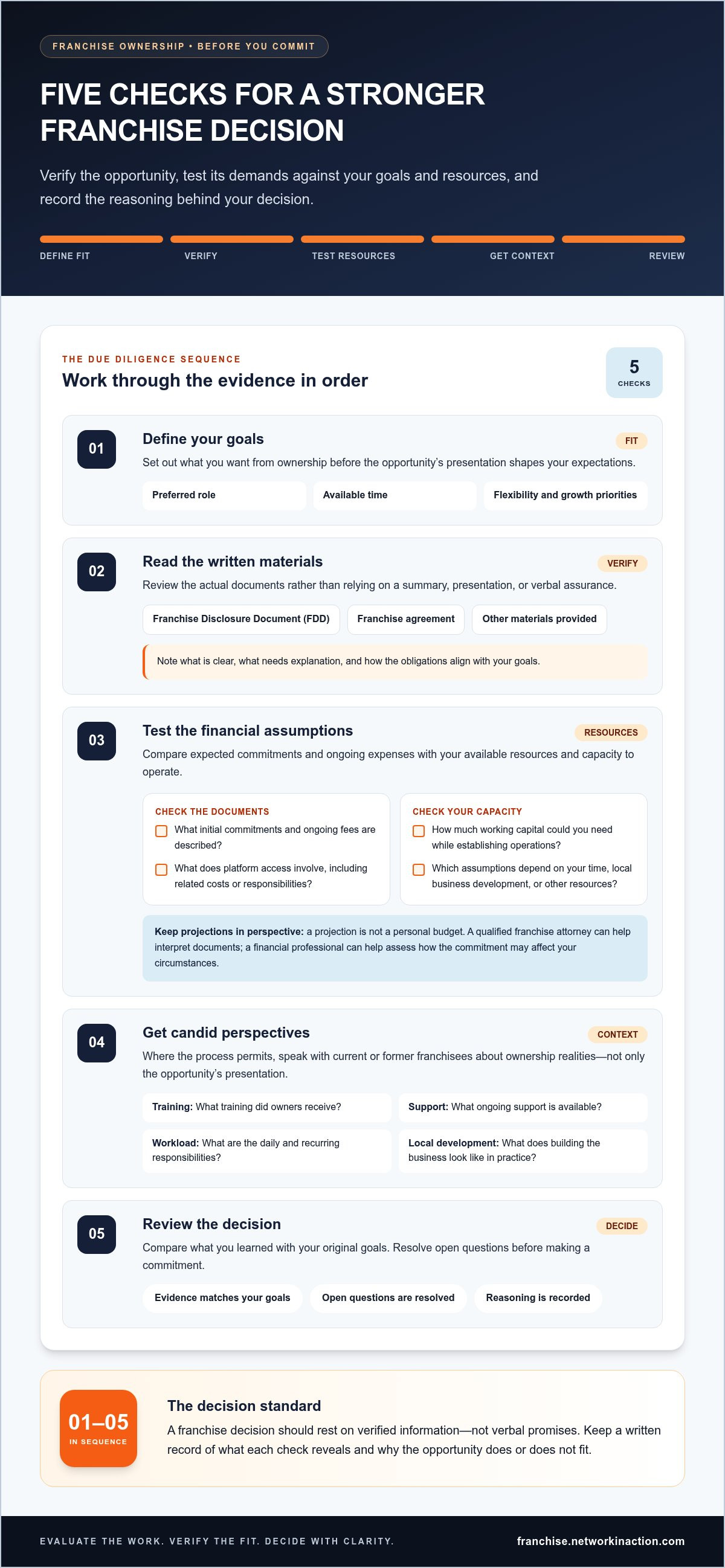
A franchise decision should rest on verified information, not verbal promises. Work through these five checks before deciding:
- 1. Goals: Define what you want from ownership, including your preferred role, available time, and priorities for flexibility and growth.
- 2. Written materials: Read the Franchise Disclosure Document (FDD), franchise agreement, and other materials provided for the opportunity. Note what is clear, what needs explanation, and how the obligations align with your goals.
- 3. Financial assumptions: Map expected commitments and ongoing expenses against your available resources, working capital, and operating capacity.
- 4. Conversations: Where the process permits, speak with current or former franchisees about the realities of ownership, not just the opportunity’s presentation.
- 5. Decision review: Compare the evidence with your original goals. Resolve open questions before making a commitment, and record the reasoning behind your decision.
Overlooking the franchise documents and financial assumptions
The FDD is a key source of information about the franchise opportunity. Study it alongside the agreement and related materials, rather than relying on a summary or presentation. As you review, build a practical checklist:
- What initial commitments and ongoing fees are described?
- What does platform access involve, and are there related costs or responsibilities?
- How much working capital could you need while establishing operations?
- Which assumptions depend on your time, local business development, or other resources?
Then test the numbers against your own financial position and capacity to operate. A projection is not a personal budget. A qualified franchise attorney can help interpret the documents, while a financial professional can help assess how the commitment may affect your circumstances.
Skipping candid conversations and personal-fit checks
Written materials show one side of the opportunity; conversations can add context. Ask franchisees about the training they received, the ongoing support available, the owner’s workload, and what local business development looks like in practice. Seek specific examples of daily and recurring responsibilities, including how owners build professional relationships and maintain engagement.
For a closer look at the ownership model, explore the Network In Action franchise kit as one resource in your evaluation. Use what you learn to revisit your goals, assumptions, and readiness before deciding.
Early operating mistakes that can derail a new franchise owner
Buying into a system gives you structure, not autopilot. Common mistakes first-time franchise owners make after launch often come down to execution: inconsistent outreach, shifting priorities, or financial records that don’t show what is happening in the business. Without a steady operating rhythm, urgent tasks can crowd out the work that supports local growth and service quality.
Reactive ownership means deciding what matters only when something demands attention. A repeatable routine gives you a clearer view of commitments, relationships, and business activity. It won’t guarantee results, but it can help you spot gaps earlier and respond deliberately.
Trying to do everything instead of setting operating priorities
Start by separating essential growth and service activities from routine administration. A weekly planning session can help you choose priorities, schedule follow-up, review finances, and protect time for community leadership. Keep the plan realistic. A short list of meaningful commitments is easier to execute than a packed calendar that changes every day.
For a local referral-group business, that might mean reserving time to prepare for a monthly meeting, connect with members between meetings, and handle administrative tasks in a separate block. The exact rhythm depends on the model and your responsibilities, but the principle is consistent: give relationship-building and operational work deliberate space.
Neglecting relationships, follow-up, and performance review
Professional relationships develop through relevant, consistent contact. Don’t treat a meeting or introduction as the finish line. Record next steps, follow up when promised, and look for ways to strengthen trust without making every interaction transactional. A technology-enabled platform can support engagement between scheduled meetings, while your judgment keeps those interactions personal and useful.
Review meaningful activity and outcomes regularly. Track information that helps you understand the health of the operation, such as completed follow-ups, participation, expenses, and progress on priorities. Set measures that fit your model rather than borrowing universal benchmarks. For more ideas on relationship-led growth, explore this referral marketing strategy guide.
Consistency creates visibility. With a workable routine, you can adjust based on what the business is showing you, not just what feels urgent.
A practical framework to avoid franchise ownership mistakes
Strong ownership depends on more than making a sound decision at the start. You need a process that connects what you want from the business with the evidence, resources, and habits required to operate it. This framework can help you avoid common mistakes first-time franchise owners make by turning uncertainty into questions you can answer and actions you can review.
Clarify your goals, validate assumptions, plan resources, execute consistently, and review the evidence. This repeatable cycle helps you make informed decisions before signing and adjust your approach as the business develops.
Build a decision scorecard before signing
Create a simple scorecard covering personal fit, financial readiness, expectations for franchisor support, and the work involved in daily ownership. For each category, record what you know, what remains uncertain, and what evidence would resolve the question. If you’re considering a relationship-driven business, include the time and leadership required to build local connections and maintain engagement.
Don’t treat unanswered questions as minor details. Identify who can clarify them and document the response. For financial exposure and contract terms, rely on qualified professional advice rather than assumptions or informal interpretations. A scorecard won’t make the decision for you. It will make the tradeoffs visible so you can decide with greater clarity. To compare ownership with other career paths, explore this executive business opportunities overview.
Create an owner routine that supports steady progress
Once you move into operation, turn your priorities into recurring calendar commitments. Make room for planning, local relationship-building, follow-up, financial review, and reflection on what’s working. Keep the routine realistic enough to maintain during busy periods. Structure should protect your focus, not become another system you struggle to keep up with.
Choose a small set of indicators that help you understand activity and progress in your specific business. These might include completed follow-up, participation or engagement, expenses, and movement on current priorities. Avoid arbitrary targets. Look for patterns and use them to guide your next steps.
Revisit your plan when local conditions shift, your responsibilities change, or experience reveals that an assumption no longer fits. Record the decision, the reason for it, who owns the next action, and when you’ll review it. For a closer look at a structured, relationship-led ownership model, explore the Network In Action franchise kit.
How Network In Action helps franchise owners avoid common first-year pitfalls
Preparation and disciplined routines matter. So does choosing a model that fits the way you want to lead and grow. Network In Action offers franchise opportunities centered on leading local business referral groups, with training and ongoing support to help franchisees build and manage their groups.
A relationship-led model supported by technology
Network In Action is built around quality professional relationships and a curated community, without forced referrals. Monthly meetings give local groups a regular structure, while a proprietary technology platform helps members stay connected between meetings. Together, these features offer a relationship-led alternative to more time-intensive traditional networking approaches.
The model has the potential for recurring revenue and growth as you develop local groups, but neither is guaranteed. Your results depend on execution, local conditions, and sustained leadership. The monthly cadence may offer more flexibility than weekly meeting formats, supporting a lifestyle-friendly approach to ownership while still requiring consistent follow-through. Training and ongoing support provide guidance, not a substitute for your decisions as a business owner.
Explore whether franchise ownership fits your next move
If community leadership, professional credibility, and a technology-supported model align with your goals, consider whether the responsibilities fit your preferred work style and desired flexibility. Explore the franchise opportunity kit to learn more, then review available franchise territories as part of your evaluation.
Take a measured next step and explore Network In Action franchise ownership to assess whether this opportunity fits the business and lifestyle you want to build.
Build Ownership on Clear Decisions and Consistent Action
Common mistakes first-time franchise owners make are easier to avoid when you test the opportunity before committing, plan around realistic resources, and lead with a steady operating routine. Strong ownership starts with fit and preparation, then grows through disciplined follow-through and regular review.
Network In Action offers a relationship-led franchise model supported by training and ongoing support. Monthly meetings create a regular structure for local professional connections, while a proprietary technology platform helps members stay connected between meetings. These are tools for building and managing a local referral group, not guarantees of business results.
If community leadership and a structured, technology-supported approach to networking align with your goals, take the next step at your pace. Explore Network In Action franchise ownership and consider whether the model fits the business and lifestyle you want to build. Thoughtful evaluation now can give you a more confident foundation for what comes next.
Frequently Asked Questions
What are the most common mistakes first-time franchise owners make?
Common mistakes first-time franchise owners make include choosing a brand without checking personal fit, underestimating the resources and time required, and relying on verbal assurances instead of reviewing written materials. After launch, inconsistent outreach, weak financial tracking, and drifting from established processes can create avoidable challenges. Take a disciplined approach: assess the opportunity, test assumptions, plan your operating routine, and review progress regularly.
How can you tell whether a franchise is a good fit for you?
A franchise is more likely to fit when its daily responsibilities, leadership demands, and financial commitments align with your goals and capacity. Look beyond the brand’s appeal. Consider how much time you can commit, whether you enjoy building relationships or managing operations, and how you’ll handle local business development. Compare those realities with your preferred work style and personal priorities before deciding.
What should you review before signing a franchise agreement?
Review the Franchise Disclosure Document, franchise agreement, and other written materials provided for the opportunity. Pay close attention to described commitments, recurring fees, support, responsibilities, and financial assumptions. List unanswered questions and resolve them before making a decision. A qualified franchise attorney can help interpret contractual documents, while a financial professional can help you assess the commitment in light of your personal circumstances.
How much working capital should a first-time franchise owner plan for?
There’s no single working-capital amount that fits every franchise. Estimate your likely operating costs, timing of expenses, personal financial needs, and the resources required while the business develops. Compare your assumptions with the opportunity’s written financial information, including the FDD, and consider how changes in revenue or expenses could affect your plan. A financial professional can help you assess your personal exposure and develop a realistic reserve strategy.
Can owning a franchise guarantee a stable income?
No. A franchise system, brand, and support can provide structure, but they can’t guarantee stable income or business success. Results depend on factors including local conditions, execution, operating costs, and your ability to build customer or referral relationships. Treat income expectations as assumptions to evaluate, not promises. Review the available written information, plan conservatively, and make decisions based on your resources and tolerance for business risk.
What happens if a franchise owner struggles to follow the operating system?
Difficulty following the system can make operations less consistent and weaken the value of established processes. Start by identifying the specific obstacle, such as unclear priorities, time constraints, or a process you don’t understand. Review the relevant guidance and use available franchisor support to address the gap. Before changing established practices, understand the agreement and discuss the issue through the appropriate support channels.
Is franchise training enough to run a business successfully?
Training can help you understand the model, but it isn’t a substitute for ongoing execution, sound decisions, and learning from local experience. You’ll still need to manage responsibilities, track relevant business activity, and build relationships consistently. Network In Action provides franchisees with training and ongoing support to help them build and manage local referral groups. Those resources offer guidance, not a guarantee of a specific outcome.