A polished feature list can make a franchise platform look powerful without showing whether it makes the business easier to run. To understand how to evaluate a franchisor's technology platform, look past the sales demo and focus on the work you’ll handle as an owner. Does the system make routine tasks clearer, help members stay connected, and give you a practical foundation for building a local group?
Franchise technology should connect the tools and information you need, not create another layer of work. Fragmented systems, unclear charges, limited training, or weak support can undermine even an impressive platform. A structured evaluation helps you distinguish useful capabilities from marketing claims and understand how the technology fits into the franchise’s operations and economics.
This guide covers what to examine: everyday usability, member value, information access, costs, training, support, and room to scale. It also puts technology in context. For Network In Action, the proprietary platform helps members stay connected alongside monthly meetings, curated membership, and no forced referrals. The goal is to decide whether the platform and the business model behind it align with your ambitions.
Key Takeaways
- Learn how to evaluate a franchisor's technology platform by matching its capabilities to the work you’ll actually manage as a franchisee.
- Assess usability, onboarding, information access, and support, rather than relying on a feature list.
- Compare technology charges with other franchise costs to understand the platform’s role in the business economics.
- Consider realistic workflows from a franchisee’s perspective to identify friction before making a commitment.
- See how Network In Action’s technology helps members stay connected as part of a relationship-driven model built around monthly meetings and curated membership.
Why a Franchisor’s Technology Platform Matters to Your Daily Operations
A franchisor’s technology platform is the connected systems and tools that support the work of running a franchise, from communication and training to operations and reporting. Its value isn’t measured by how many features appear on a screen. It’s measured by whether the tools fit your workflows and help you deliver the business’s core value.
That distinction matters in a franchise business model, where you operate locally while working within a broader relationship with the franchisor. Useful systems can make processes clearer, keep current information accessible, and support a consistent experience. Disconnected apps can do the opposite: create duplicate tasks, make it difficult to find up-to-date guidance, or leave you tracking routine work manually.
What should a franchise technology platform help you do?
Start with the responsibilities you’ll actually manage. Depending on the franchise’s operating model, these may include receiving updates, completing training, managing group activity, reviewing performance information, or keeping customers or members engaged. Match each task to the support you need. A relevant platform should help with the activities central to delivering the business’s promise.
Separate essential capabilities from extras. A straightforward way to find current guidance may matter more to your daily work than a feature you rarely use. Network In Action’s proprietary platform helps members stay connected, complementing monthly meetings and the relationship-driven model. That is a defined role within the business, not a claim that technology replaces personal connection.
Why does platform fit matter more than feature count?
A long feature list can hide a clumsy process. Imagine preparing a routine update. In a connected workflow, you can find the right information and complete the task without switching systems or re-entering details. In a fragmented process, you may need to search email, check separate files, and copy information manually. The difference is practical: each extra step takes attention away from other work.
How to evaluate a franchisor's technology platform starts with adoption, clarity, and usefulness, not novelty. Can you understand what to do? Can you find the information you need? Does the system support the way the franchise operates? A platform earns its place when it makes important work easier and helps you focus on members, relationships, and local business growth.
Look for fit, not spectacle. Technology should support consistent execution without adding complexity for its own sake. That gives you a stronger basis for assessing the platform as part of the franchise opportunity, rather than mistaking an impressive demonstration for an effective operating system.
How to Evaluate a Franchisor’s Technology Platform Step by Step
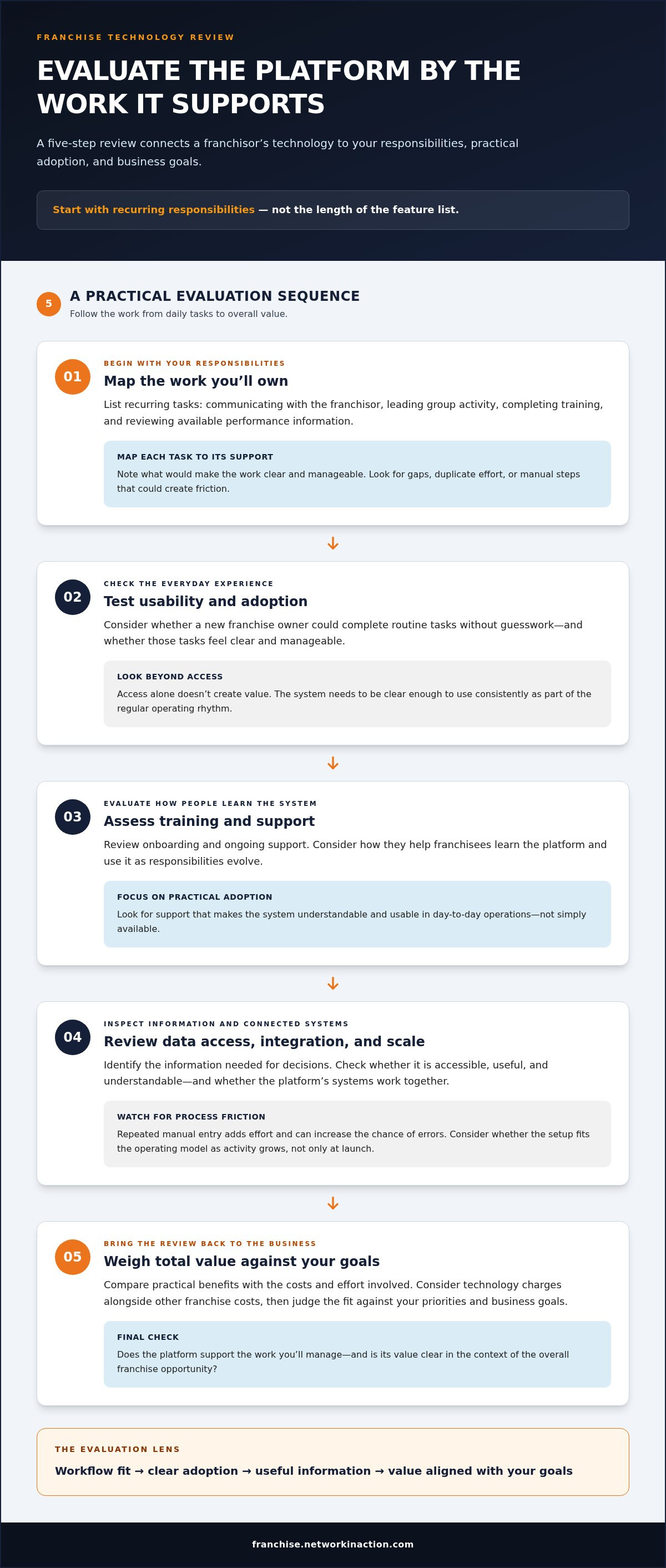
A feature list tells you what a platform claims to do. A structured review shows whether it supports the work you’ll own as a franchisee. Use these five steps to connect technology to your responsibilities, practical adoption, and business goals.
Map your essential franchisee workflows
Start with recurring work, not software categories. List tasks you expect to handle, such as communicating with the franchisor, leading group activity, completing training, and reviewing available performance information. For each task, note what would make it clear and manageable. This workflow map can reveal gaps, duplicate effort, or manual steps that may create friction.
Assess usability, training, support, and adoption
Consider whether a new franchise owner could complete routine tasks without guesswork. Then assess how onboarding and ongoing support help franchisees learn the system and use it as responsibilities evolve. Access alone doesn’t create value. The system needs to be clear enough to use consistently as part of the regular operating rhythm.
Review data access, integration, and scalability
Identify the information you need to make decisions and whether it’s presented in a useful, understandable way. Consider how the platform’s systems work together. Repeated manual entry can add effort and increase the chance of errors. Also consider whether the setup fits the franchise’s operating model as activity grows, rather than only at launch.
A practical five-step test is to map your work, inspect usability, assess training, review information access, and weigh the total value against your business goals. Use this repeatable framework for how to evaluate a franchisor's technology platform without getting distracted by novelty.
- Map workflows: Match each recurring responsibility to the support the platform should provide.
- Inspect usability: Consider whether routine tasks are clear and manageable.
- Assess training: Review how onboarding and ongoing support help you adopt the system.
- Review data: Evaluate access to relevant information and the work required to maintain it.
- Weigh total value: Compare practical benefits with the costs and effort involved, then judge the fit against your priorities.
Keep your responsibilities as a franchisee at the center of the review. To consider technology alongside the broader ownership opportunity, explore the franchise information kit as part of your research.
Compare Platform Value, Data Access, and Franchise Technology Costs
A platform’s value depends on what it helps you accomplish, what it takes to use, and how its costs fit into the franchise’s overall economics. Use the comparison below to assess practical value, not to predict financial returns. The aim is to understand what the technology supports and what you’re paying for under the franchise’s current disclosed terms.
| Evaluation area | What to compare | Useful diligence question |
|---|---|---|
| Workflow coverage | Whether the platform supports the recurring tasks you expect to own. | Which responsibilities does it help you complete? |
| Ease of use | How clearly you can move through routine tasks. | Can you complete common work without unnecessary steps? |
| Training | How onboarding and ongoing learning support adoption. | What guidance helps you use the system consistently? |
| Data visibility | Whether relevant operating information is accessible and understandable. | Can you find the information you need to make decisions? |
| Support | How platform-related questions and issues are handled. | What support is part of the technology arrangement? |
| Cost structure | Which charges relate to technology and what each covers. | Are recurring technology charges distinct from other franchise costs? |
| Portability and dependence | How data access, transfer, or continued use relates to the platform. | What do the disclosed terms say about data access and system dependence? |
How can you judge whether platform fees deliver value?
Separate technology-related charges from other franchise costs in your comparison. For each charge, record whether it covers platform access, training, support, or another stated component. Then weigh the cost against the work the platform helps you do, such as reducing repeated administrative steps or making relevant information easier to access. Don’t assume a fee is valuable because the platform has many features, or that technology alone produces a financial return. Use the franchise’s current disclosed terms rather than generic price benchmarks.
What should you understand about data and connected systems?
Clear access to relevant information can help you make better-informed operating decisions. Consider whether connected systems share information or require you to enter the same details repeatedly. Repeated entry may add work, while integration may simplify a workflow, depending on how the tools are configured.
Data portability and dependence on a particular system are practical diligence topics, not automatic red flags. Review what information you can access, how it can be used or transferred, and what happens to access if your relationship with a platform changes. These details help you compare the actual terms. A thorough evaluation weighs practical usefulness, clarity, and cost together, without confusing promised outcomes with demonstrated value.
How to Test a Platform Before Committing to a Franchise
A corporate overview can explain a platform’s purpose. A practical test shows what using it could feel like in your role. As you assess a franchise opportunity, focus on representative tasks, observable evidence, and how the technology supports the business model in practice.
Run representative tasks through the platform
During a demonstration or preview, follow realistic tasks from a franchisee’s perspective. For a business built around local professional relationships, that could mean finding relevant guidance, seeing how the platform supports member connection, or reviewing information available to owners. Don’t stop at watching someone else click through a presentation. Notice what you would need to do, where you would go, and whether the steps make sense.
- Can you locate the guidance needed for a routine responsibility?
- Is it clear how the platform supports communication or engagement?
- Can you understand the available information without extra manual work?
- Does the technology support relationship-building, or distract from personal interaction?
Note unclear navigation, repeated steps, or reliance on separate manual processes. These specific observations are more useful than a general impression based on a polished demonstration.
Evaluate onboarding and ongoing support
Access alone doesn’t guarantee confident use. Consider how platform learning fits into franchisee training and ongoing operational support. Clear guidance can help you build consistent habits, while relevant continuing support can help you apply the system as your responsibilities develop. Assess the learning experience against the actual work of operating the franchise, not just the software interface.
Compare evidence with the franchise model
Distinguish demonstrated processes from broad claims about innovation, efficiency, or growth. A capability is easier to assess when you can see how it relates to a real task and understand its role in the member experience. Network In Action’s proprietary platform helps members stay connected, complementing monthly meetings and a relationship-driven model. That context matters more than treating the platform as a standalone technology product.
As you consider how to evaluate a franchisor's technology platform, keep a short evidence log: the task you tested, what the platform supported, where you needed clarification, and how the process fits the franchise model. This turns impressions into a useful comparison.
For a broader view of the ownership opportunity, explore the Network In Action franchise guide alongside your platform assessment.
What Network In Action’s Technology Means for Franchise Owners
Network In Action’s proprietary platform helps members stay connected. It supports the relationship-building at the heart of the model, while franchise owners lead local groups and build professional communities. Technology plays a supporting role. Its value comes from how it fits alongside real conversations, thoughtful group leadership, and consistent engagement.
How does technology complement NIA’s networking model?
Monthly meetings give professionals a structured setting to connect, while the platform helps members stay connected between meetings. Together, these elements support ongoing relationships without making technology a substitute for personal interaction. The model also emphasizes curated, high-quality membership and no forced referrals. The focus is on credible connections and relationship-driven growth, not referral quotas or treating the platform as the whole experience.
For a franchise owner, technology is one part of the operating model. The work also involves building and managing local groups, fostering a strong community, and supporting meaningful professional connections. Network In Action provides franchisees with training and ongoing support for that work. The platform complements the human side of the role; it doesn’t replace community leadership.
How can you explore whether the model fits your goals?
Consider the work you want to lead. Do you enjoy bringing professionals together, strengthening local relationships, and building credibility within a business community? Does a structured, technology-enabled model fit the way you want to grow your influence and shape your working life? These questions help you assess personal alignment beyond the platform itself.
To continue your research, review the Network In Action franchise kit for information about the opportunity, then explore available franchise territories. Use those resources to understand the broader model and consider whether its mix of technology, monthly meetings, curated membership, and community leadership fits your goals.
The right technology should serve the work and relationships that make a business meaningful. A clear view of both can help you decide whether this franchise opportunity is a strategic fit for your next chapter.
Choose Technology That Supports the Business You Want to Build
A strong franchise platform isn’t defined by a crowded feature list. It earns its place by supporting real workflows, making useful information accessible, and fitting the economics and operating model you’re considering. To understand how to evaluate a franchisor's technology platform, focus on practical value: what the system helps you do, how you’ll learn to use it, and whether it supports your goals as an owner.
At Network In Action, proprietary technology helps members stay connected. It works alongside monthly meetings, curated membership, and no forced referrals, while franchisee training and support help owners build and manage local groups. The platform supports relationships; community leadership brings them to life.
The model may suit you if you want to build a relationship-driven business while shaping your work around your priorities. Monthly meetings and a defined role leading a local group offer a different structure to consider as you weigh flexibility and lifestyle autonomy. Outcomes depend on your goals and how you choose to build the business.
If this approach aligns with the future you want to create, explore the Network In Action franchise opportunity and consider whether its technology, community leadership, and operating model fit your ambitions.
Frequently Asked Questions
What should you look for in a franchisor’s technology platform?
Look for a platform that supports the work you’ll actually do as a franchisee. Assess whether it helps with relevant communication, training, operating tasks, reporting, or customer and member engagement. Check usability, onboarding, ongoing support, data access, and the structure of any technology charges. The best way to approach how to evaluate a franchisor's technology platform is to compare its practical value with your responsibilities and the franchise’s operating model.
How can you tell whether franchise technology is genuinely useful?
Judge usefulness by how well the technology supports real tasks, not by how impressive its feature list sounds. Consider whether you can follow a routine process clearly, find relevant information, and avoid unnecessary manual steps. A platform is more likely to be useful when franchisees can understand and consistently adopt it. Look for demonstrated capabilities tied to actual workflows, rather than relying only on broad claims about innovation or efficiency.
Should a franchisor’s platform include every tool a franchisee needs?
No. The right platform doesn’t have to contain every possible business tool. Its role is to support the essential workflows of that franchise model while avoiding needless complexity. A specialized business may rely on systems beyond the franchisor’s platform, while another model may need only a focused set of connected tools. Evaluate whether the overall setup supports your core responsibilities and member experience, not whether it claims to do everything.
How do you evaluate technology fees in a franchise opportunity?
Separate technology-related charges from other franchise costs, then compare each charge with the access, training, support, or other components it covers. Use the franchise’s current disclosed terms rather than generic benchmarks or assumptions. Consider whether a charge is recurring, how it is calculated, and whether its scope is clear. Assess the work supported by the technology, but don’t treat a platform fee as proof of a particular financial return.
Why does data access matter when evaluating franchise software?
Access to relevant, understandable information can help you make better-informed operating decisions. Consider what data you can view, how readily you can find it, and whether separate systems require repeated manual entry. Data portability and dependence on a particular platform are also reasonable diligence topics. They aren’t automatically problems, but understanding the applicable terms can help you assess how the system fits your responsibilities and plans for the business.
Can a franchise technology platform improve franchisee efficiency?
It can support efficiency when it makes important tasks clearer, reduces avoidable steps, or helps you access useful information. Results depend on how well the platform fits the operating model and whether franchisees receive effective training and support. Technology doesn’t automatically save time or improve performance. Assess the workflow itself: compare the steps required, note manual work, and consider whether the system helps you focus more attention on serving members or building professional relationships.
How should you test franchise software before choosing an opportunity?
Assess the platform from a franchisee’s perspective, using representative tasks rather than relying only on a corporate presentation. Try to locate guidance, follow a relevant communication process, and review the information available to owners. Note unclear navigation, repeated steps, and reliance on manual work. Also consider how onboarding and ongoing support prepare you to use the system consistently. Compare what you observe with the franchisor’s stated claims and the business model.