A council can bring franchisee experience to a franchisor, but it usually can’t make the final call. So what does a franchisee advisory council actually do, and how much influence can it have? The answer depends on its structure, the quality of its input, and whether franchisor leaders respond to what they hear.
If you’re unsure what members discuss, whether feedback leads to change, or how a council differs from a governing body or franchisee association, those are useful questions to ask. An advisory council is a channel for organized operator insight, not a guarantee of action or a substitute for independent franchisee advocacy.
This article explains a council’s common responsibilities and limits, what makes franchisee feedback useful, and how structured communication can support a healthier franchise relationship. These principles matter when you’re weighing franchise ownership and community leadership. Network In Action builds its franchise model around monthly group meetings, franchisee training and ongoing support, and a technology platform that helps members stay connected. Understanding how communication works can help you assess the people, systems, and leadership behind a franchise opportunity.
Key Takeaways
- Understand what a franchisee advisory council actually does, and where its advisory influence ends.
- Recognize how councils turn recurring operator concerns into system-wide discussion and recommendations.
- Assess effectiveness by looking beyond meetings to representation, agenda quality, access, follow-up, and communication.
- Distinguish a franchisor-led advisory council from a franchisee association or governing body.
- Use the quality of communication and support to evaluate whether a franchise opportunity aligns with your leadership goals.
What Does a Franchisee Advisory Council Actually Do?
A franchisee advisory council gives franchisee representatives a structured forum to share operator feedback with franchisor leaders and discuss issues affecting the wider system. It can surface practical insights from day-to-day operations, but it doesn’t automatically manage the business, represent every franchisee, or make binding decisions for the franchisor.
That distinction matters. Franchising involves an ongoing relationship between independent operators and a brand, with roles shaped by the system’s arrangements. A general overview of the franchising business model can provide context, but a council’s composition, scope, and influence depend on the individual franchise system and its documented structure.
Who usually takes part in a franchisee advisory council?
Franchisee representatives and franchisor leaders commonly participate. Representatives bring operator experience into discussions, while franchisor leaders can explain system priorities and hear how decisions affect operators. Selection and representation methods vary. The council’s structure determines how members are chosen and whose perspectives are included.
That operator perspective can make recurring concerns easier to recognize. For example, if franchisees in different locations report similar challenges with a process or technology rollout, the council can raise the pattern as a system-wide issue rather than treating each report as an isolated complaint. The value lies in identifying shared themes and giving them a clear route to decision-makers.
What makes the council advisory rather than governing?
Advice informs a conversation. It doesn’t, by itself, require the franchisor to adopt a recommendation. A council might discuss a proposed operational change, summarize franchisee concerns, and suggest adjustments. The franchisor may consider that input, but the council doesn’t automatically have authority to approve, reject, or direct the change.
That differs from ownership or management, which involves running or directing business operations, and from a legally governing board, whose authority comes from its formal role and governing documents. A council’s powers depend on its documented structure and context. Don’t assume its name gives it decision-making authority.
So, what does a franchisee advisory council actually do in practice? It creates a channel for structured operator insight, discussion, and recommendations. Its influence depends on the relevance and breadth of the input, how the franchisor engages with it, and how clearly the council communicates its role. For prospective franchise owners, that’s a useful lens: strong franchise systems need clear communication and practical feedback, while community leadership also depends on defined responsibilities and consistent support.
Which Franchisee Advisory Council Responsibilities Matter Most?
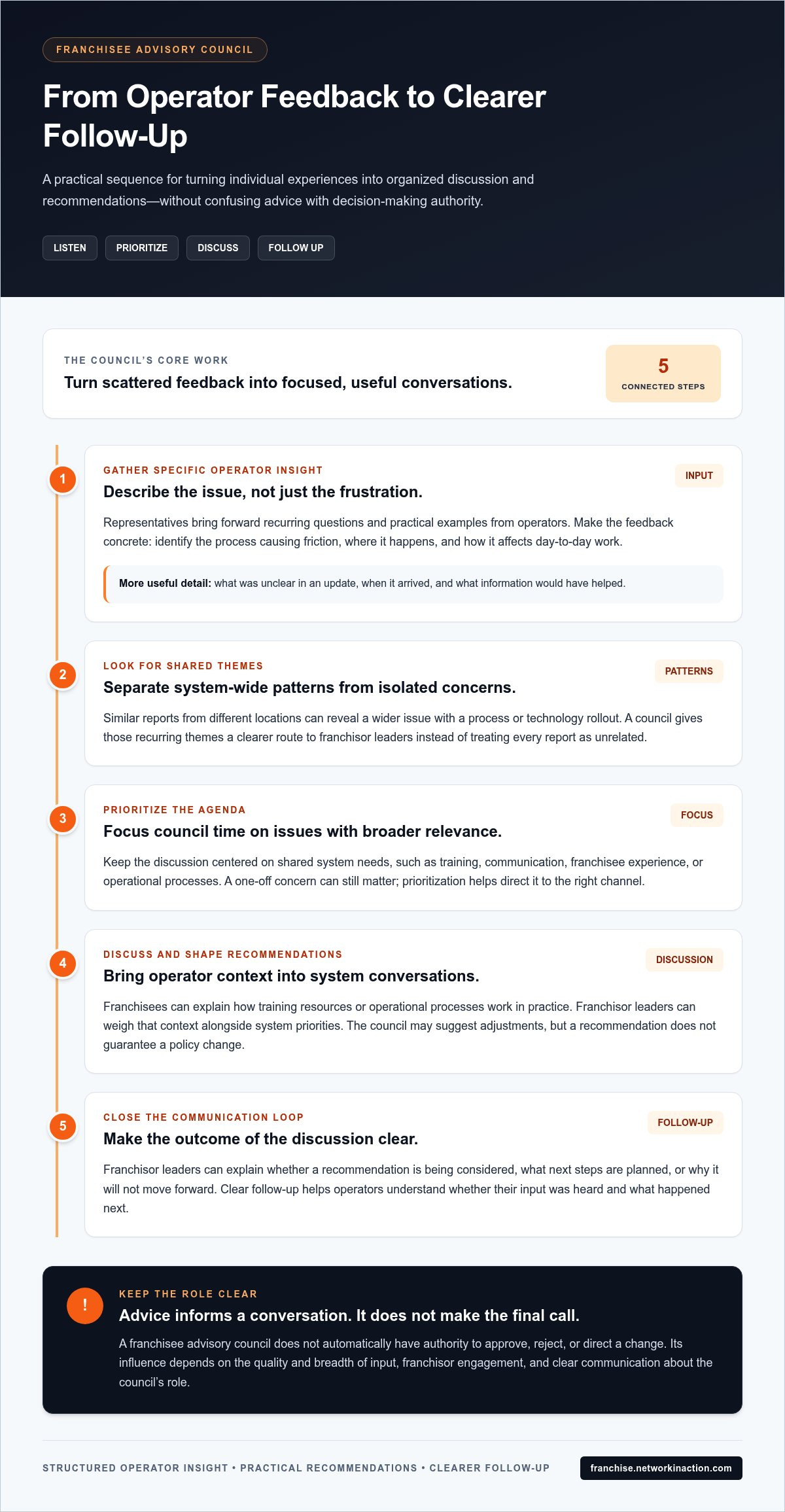
A council’s value comes from turning individual operator experiences into focused conversations the franchisor can use. Its core work is to listen, prioritize, discuss, and communicate. Topics may include training, franchisor communication, franchisee experience, or operational processes. The agenda should focus on shared system needs rather than become a collection of unrelated complaints.
A council turns scattered franchisee feedback into organized discussion, practical recommendations, and clearer follow-up. A well-structured conversation helps franchisor leaders understand what operators are experiencing and where similar issues may be appearing across the system.
How councils gather and prioritize franchisee feedback
Representatives can bring forward recurring questions and patterns they hear from operators. Specific examples make those patterns easier to assess: which process is causing friction, where the problem occurs, and how it affects day-to-day work. “Communication needs improvement” is a starting point. A clear account of when an update arrived, what was unclear, and what information would have helped gives the discussion something concrete to address.
Prioritization keeps the agenda useful. Councils can separate system-wide themes from individual concerns and focus on issues with broader relevance. That doesn’t make a one-off concern unimportant. It helps direct each issue to the right channel.
How recommendations can inform franchise system improvements
Once themes are clear, council discussions give franchisor leaders operator context to weigh alongside system priorities. For instance, franchisees may explain how a training resource works in practice or identify where an operational process is difficult to follow. Those insights can inform a recommendation, but they don’t promise a policy change or guarantee a particular outcome.
Clear follow-up matters. Franchisor leaders can communicate whether a recommendation is being considered, what next steps are planned, or why a proposal won’t move forward. Without that loop, operators may not know whether their input was heard or what happened after the discussion. The International Franchise Association’s article on structuring a franchisee advisory council offers further context on council design and franchisee participation.
For prospective owners, this is a practical way to assess a franchise system’s approach to communication: look for a clear path from operator insight to discussion and follow-up. If community leadership and relationship-driven growth are part of your goals, explore the Network In Action franchise kit to learn about the franchise opportunity.
How Does a Franchisee Advisory Council Work, and How Much Influence Does It Have?
A franchisee advisory council typically follows a practical feedback cycle: representatives gather input, leaders set an agenda, participants discuss recurring themes, the council shares recommendations, and the franchisor communicates follow-up. The details vary by system. Meeting cadence, membership, and reporting arrangements depend on the council’s structure and the franchise relationship.
That cycle clarifies what a franchisee advisory council actually does: it creates an organized route for operator perspectives to reach franchisor leaders. Its influence comes from the relevance of that input and the way leaders engage with it, not simply from having a seat at the table.
What happens between council meetings?
Representatives may gather concerns and specific examples from other franchisees, then group similar feedback into themes. An agenda turns broad comments into focused topics, such as an unclear process or a communication gap affecting multiple operators. After discussion, representatives can report decisions, next steps, and unresolved questions to the franchisees they represent. That loop helps prevent feedback from disappearing once a meeting ends.
A useful cycle separates three levels of influence:
Consultation: Franchisees share experience, concerns, or context. The input informs discussion but doesn’t itself decide what happens.
Recommendation: The council presents a proposed response or improvement. Franchisor leaders can consider it, but a recommendation isn’t automatically adopted.
Formal decision authority: A decision-maker with authority under the system’s documented arrangements makes or approves a decision. An advisory council doesn’t automatically hold that authority.
Advisory input can inform action, but it doesn’t guarantee action. Clear communication about what was decided, what remains open, and who will follow up makes the council’s influence easier to understand.
Can a franchisee advisory council overrule the franchisor?
No, not automatically. An advisory council generally offers input and recommendations. Whether it has formal decision-making power depends on its documented remit and the broader franchise relationship. Don’t assume every council has the same authority, reporting process, or access to decision-makers. The specific structure matters.
For a prospective franchise owner, this distinction helps separate meaningful consultation from control. A council may give operators a valuable channel to raise shared concerns and contribute practical insight. Its role differs from that of a body empowered to make formal decisions. Understanding that boundary helps set realistic expectations about how operator feedback may shape system discussions.
How Can You Tell Whether a Franchisee Advisory Council Is Effective?
A council isn’t effective simply because meetings happen. Look for a process that gives franchisees a credible voice, focuses discussion on relevant issues, and closes the communication loop. Even when a recommendation is declined or delayed, clear acknowledgment and reasoning show whether the input received serious consideration. These signs indicate a responsive process, not guaranteed operational or financial results.
A five-point assessment
- Representation: Do representatives bring varied operator perspectives, or does the discussion reflect only a narrow set of experiences? Look for ways franchisees beyond the council can submit concerns and context.
- Agenda quality: Are topics focused on recurring or system-wide themes? An agenda that makes room for specific examples is more useful than one dominated by vague dissatisfaction.
- Access: Can representatives raise issues with franchisor leaders and explain how those issues affect operators? The path for sharing feedback should be clear.
- Follow-up: Are recommendations acknowledged, with next steps or reasons provided when a proposal is deferred or declined? Silence leaves franchisees guessing.
- Communication: Do representatives share useful summaries of discussion, decisions, and unresolved questions with the people they represent? Feedback needs a return path, not just an intake channel.
Together, these measures help you assess whether the council connects operator experience to franchisor discussion. A group can meet regularly and still fall short if representation is weak, the agenda lacks focus, or outcomes never reach franchisees.
Meaningful input, honest follow-through
Strong representation isn’t just about who holds a seat. It also depends on whether representatives can explain recurring concerns and the circumstances behind them. For example, a report that a process is difficult to follow becomes more actionable when it identifies where confusion arises and whether other operators describe the same issue. A transparent way to gather broader feedback helps representatives distinguish a shared pattern from an isolated experience.
Serious consideration doesn’t mean every recommendation must be adopted. A clear response can explain what was decided, why a proposal wasn’t pursued, or what information is still needed. That transparency builds realistic expectations and helps franchisees understand how their input moved through the process.
Use these criteria to evaluate communication and support as part of your broader franchise research. To explore a franchise opportunity built around community leadership, review the Network In Action franchise kit.
What Should Franchise Ownership Look Like Beyond the Advisory Council?
Understanding what a franchisee advisory council actually does can help you assess communication, but it’s only one part of franchise ownership. Your decision should also account for the support behind the model, the work of leading a local community, and whether the day-to-day operating approach fits your strengths and priorities.
What should you evaluate in a franchise support model?
Look beyond broad promises of support. Consider how training prepares you to lead, how communication keeps you connected, what role technology plays in operations, and what leadership responsibilities come with ownership. The right fit depends on how those elements align with your goals, working style, and appetite for building professional relationships.
Also consider how the model supports growth. A relationship-driven business can center on developing trusted connections and building professional credibility rather than relying on cold prospecting alone. For a deeper introduction to franchise ownership, explore the franchise ownership book.
How can a networking franchise fit your ownership goals?
A networking franchise may appeal to entrepreneurs who want to lead a local business community and create value through meaningful professional connections. Network In Action offers franchise opportunities to lead local business referral groups. Its model includes monthly meetings, a proprietary technology platform that helps members stay connected, and franchisee training and ongoing support. These are practical elements to weigh as you consider the rhythm of ownership and the tools available to support community leadership.
Network In Action’s approach centers on curated, high-quality membership and no forced referrals. That can be relevant if you value authentic relationships over transactional activity. The model’s technology and structured meetings are part of the operating approach, not a promise of specific financial or business outcomes. Evaluate how those features align with the kind of leadership role and relationship-driven growth you want to build.
To explore the ownership model and how it fits your goals, review the franchise opportunity kit. A thoughtful next step is discovery: understand the model, assess the support, and decide whether leading a professional community matches the business you want to build.
Choose a Franchise Built on Clear Communication
Understanding what a franchisee advisory council actually does helps you set realistic expectations: councils organize operator insight and shape discussion, but their influence depends on their structure, representation, and follow-through. Meetings alone aren’t proof of an effective feedback process. Look for clear communication, relevant input, and visible responses, even when a recommendation isn’t adopted.
That same focus on communication can guide your broader franchise research. Assess the training, ongoing support, technology, and leadership responsibilities behind the opportunity. Network In Action provides franchisee training and ongoing support, with a model built around monthly meetings and a proprietary technology platform that helps members stay connected. These are concrete elements to consider as you evaluate a relationship-driven business centered on leading local business referral groups.
Your next step is exploration, not guesswork. Review the opportunity, consider how its operating model fits your goals, and decide whether community leadership is the right path for you. Explore the Network In Action franchise opportunity and take a confident step toward building professional relationships with purpose.
Frequently Asked Questions
Who is usually on a franchisee advisory council?
Franchisee representatives and franchisor leaders are common participants. Representatives bring practical experience from operating within the system, while franchisor leaders can hear that feedback and discuss system priorities. Some councils use peer selection, while others may follow a different process. Membership, eligibility, and representation vary by organization, so the council’s structure helps determine whose perspectives reach the discussion and how broader franchisee input is gathered.
How often does a franchisee advisory council meet?
Meeting schedules vary by franchise system. The International Franchise Association has described councils as typically meeting two to four times per year, but that range isn’t a rule for every organization. Some systems may set a different cadence based on their needs and council structure. Consider how meetings fit into the broader communication process, including how representatives collect input and share discussion outcomes between sessions.
Is a franchisee advisory council mandatory?
No, a franchisee advisory council isn’t a universally required feature of a franchise system. There’s no general statutory requirement for franchisors to establish one. Councils are generally voluntary structures, and their purpose, membership, and procedures depend on the individual system. Their absence alone doesn’t explain the quality of a franchise’s overall communication or support, so assess those factors separately.
What is the difference between a franchisee advisory council and a franchisee association?
A franchisee advisory council is generally established and overseen by the franchisor as a channel for structured operator feedback. A franchisee association is typically formed and funded independently by franchisees, often to advocate for their interests or engage with the franchisor collectively. Their purposes and structures differ. Neither label alone tells you how much influence a group has; its documented arrangements and actual practices matter.
How can you tell if a franchisee advisory council is effective?
Look beyond whether meetings take place. Assess whether representatives bring varied operator perspectives, the agenda focuses on relevant themes, and franchisees have a clear way to share concerns. Then look for follow-up: are discussion themes, decisions, next steps, or reasons for declining a recommendation communicated? A responsive process shows that input is being considered, but it doesn’t guarantee that every suggestion will be adopted or produce a specific result.