What if your next career move didn’t require starting over, but putting your experience to work in a different way? If you’re weighing career change options for professionals over 50, it’s understandable to consider retraining costs, employer bias, and the financial impact of a transition. Those concerns call for a practical plan, not a rushed leap.
Your expertise, judgment, and professional relationships can open doors in fields such as consulting, project management, real estate, healthcare, or business ownership. The right path depends on what you want next: steady employment, greater independence, or a role that draws on your ability to connect people and lead a community.
This guide helps you identify transferable strengths, compare employment, consulting, and entrepreneurship against your financial and lifestyle priorities, and choose a manageable next step. You’ll also explore franchise ownership as one relationship-led path, including how Network In Action draws on community leadership and professional credibility. A strong transition doesn’t erase your experience. It turns that experience into a deliberate advantage.
Key Takeaways
- Career change options for professionals over 50 can build on expertise, relationships, and leadership rather than requiring a complete reset.
- Compare possible paths by skill fit, training needs, income predictability, autonomy, and time demands before committing.
- Use informational conversations and small projects to test a direction and uncover assumptions before making a major move.
- Weigh employment, consulting, and business ownership against your financial priorities and preferred lifestyle instead of assuming one path is best.
- A networking franchise may suit professionals who want to use relationship-building and community leadership, but personal fit matters.
Career change after 50: what a successful next chapter can look like
Wanting a change doesn’t mean your experience has stopped being valuable. It may mean using it differently. A career shift can involve a new role or industry, a different schedule or work setting, or a move from employment to business ownership. The strongest career change options for professionals over 50 build on what you already know while making room for what matters now.
Think strategic pivot, not automatic reset. A project leader moving into consulting, for example, can carry forward planning skills, client relationships, and a reputation for delivering complex work. An experienced professional who becomes a community business leader can draw on credibility and the ability to build trusted relationships. An Encore career is one way to describe a later-career move that brings purpose into the next chapter. The practical question is how to align your strengths with your priorities.
Is changing careers after 50 realistic?
It can be, but feasibility depends on your goals, current skills, finances, health, and the time available to make a transition. Some paths build directly on your expertise; others require training, a gradual income shift, or a longer runway. Employers also vary, and concerns about age bias are real without defining every workplace or industry. Assess a path’s actual requirements and the resources it would take. Don’t assume either that your experience guarantees an easy entry or that your age rules it out.
What should the next chapter deliver?
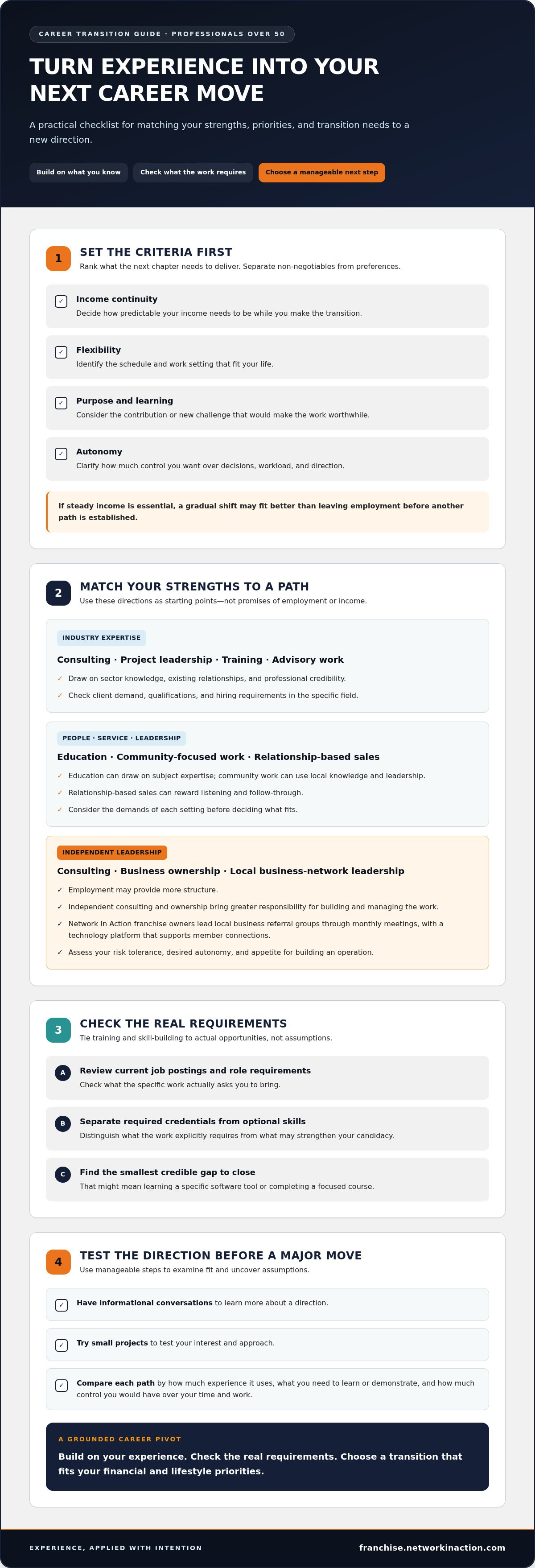
Before comparing careers, decide what the change needs to accomplish. Rank these priorities, then separate non-negotiables from preferences:
- Income continuity: How predictable does your income need to be during the transition?
- Flexibility: What schedule and work setting fit your life?
- Purpose and learning: What kind of contribution or new challenge would make the work worthwhile?
- Autonomy: How much control do you want over decisions, workload, and direction?
For example, if steady income is essential, a gradual shift may fit better than leaving employment before another path is established. If autonomy ranks highest, consulting or ownership may merit a closer look, along with their demands and uncertainties. If you’re considering a move from employment to entrepreneurship, map the income and responsibilities you’d need to manage during the transition.
Career change options for professionals over 50 that build on experience
The strongest career change options for professionals over 50 aren’t a ranked list of “best jobs.” They’re paths that match your strengths, the transition effort you can take on, and the independence you want. Your sector knowledge, professional credibility, and ability to build trust may matter as much as a new title. Treat these directions as starting points, not promises of employment or income.
Roles that use deep industry knowledge
If you know an industry from the inside, you may be able to apply that expertise in consulting, project leadership, training, or advisory roles. A seasoned operations professional, for example, might guide process improvements, lead a defined project, or train a team. These paths can make good use of existing relationships and credibility, though client demand, qualifications, and hiring requirements vary by field. Check the expectations for the specific roles you’re considering.
Paths centered on people, service, or independent leadership
Some transitions put more emphasis on connecting, teaching, or serving others. Education may draw on subject expertise; community-focused work can use local knowledge and leadership; relationship-based sales can reward listening and follow-through. Each setting has different demands. Employment may provide more structure, while independent consulting and business ownership put greater responsibility for building and managing the work on you.
Local business-network leadership is another possibility if you enjoy bringing people together and building trusted connections. Network In Action franchise owners lead local business referral groups through monthly meetings and a technology platform that supports member connections. The model may appeal if you want an independent leadership role, but ownership calls for an honest assessment of your risk tolerance, desired autonomy, and appetite for building an operation. Explore the franchise opportunity as one option among several.
When a new credential or technical skill makes sense
Don’t commit to a long training program based on a job title alone. Review current job postings and role requirements first. Separate credentials explicitly required for the work from optional skills that could strengthen your candidacy. Then identify the smallest credible gap to close, such as learning a specific software tool or completing a focused course. This keeps your retraining decision tied to actual opportunities rather than assumptions.
To narrow the field, compare each path on three dimensions: how much of your experience it uses, what you’d need to learn or demonstrate, and how much control you’d have over your time and work. That turns a broad list of possibilities into a shortlist grounded in your real constraints.
How to compare career paths without letting age concerns decide for you
Compare the work itself, not assumptions about who gets hired or what someone your age “should” do. Career change options for professionals over 50 can use decades of experience in a new setting; a pivot doesn’t automatically mean discarding your expertise. Start with the conditions you need, then judge each path against the same criteria.
Which decision criteria matter most?
Score each option against your priorities rather than searching for an abstract “best career.” Include financial runway, schedule, location, social interaction, and comfort with uncertainty. Trade-offs depend on your occupation, circumstances, and local market. Use the comparison as a first filter, then research actual roles and conditions before making a decision.
| Path | Skill fit | Training needs | Income predictability | Autonomy and time demands |
|---|---|---|---|---|
| Employed role | Often draws on relevant experience | Depends on role requirements | Review compensation and terms for each opportunity | Set by role and employer |
| Consulting | Can apply specialized knowledge directly | May require updating skills or demonstrating expertise | Depends on client demand and work secured | More control over engagements, with responsibility for finding work |
| Business ownership | Can use leadership and relationship skills | Varies by business model | Depends on business performance, not guaranteed | Greater decision-making control, alongside responsibility for building and managing the business |
How can transferable skills reduce the reset?
Translate experience into evidence. A team leader can explain how they coached staff through a complex change; a client-facing professional can describe handling a difficult negotiation; an operations manager can show how they improved a process. These examples demonstrate judgment and outcomes, not just years served. Name gaps honestly, then distinguish skills you can demonstrate from credentials or experience a target role specifically requires.
What does business ownership change?
Ownership may give you more control over decisions and how you organize your work, but it also makes you responsible for building and managing the business. Network In Action franchisees receive training and ongoing support to build and manage local business referral groups. That structure doesn’t guarantee results. When assessing franchise ownership, include the initial license fee, ongoing royalty fees, technology and platform access fees, and other operating costs in your financial planning. For a deeper comparison, explore a business networking franchise as one ownership path.
Age-related hiring concerns can influence how you approach a search, but they shouldn’t replace evidence about the role. Don’t assume every employer or field evaluates candidates the same way. Check current job requirements and credential expectations, and rely on current, carefully sourced information for claims about labor-market trends or discrimination. Base your next move on fit, proof of capability, and the trade-offs you’re willing to make.
A practical transition plan for testing your next career direction
A career pivot gets more manageable when you replace guesswork with small tests. Before committing to a new role, training program, or business, gather evidence about the work and how it fits your priorities. This process helps you assess career change options for professionals over 50 without turning an early idea into an all-or-nothing decision.
- Step 1: Clarify your priorities. Write down your essential income needs, schedule boundaries, location preferences, and reasons for making a change. Separate must-haves from benefits you’d like but could live without.
- Step 2: Shortlist realistic paths. Choose a few directions that use your experience and fit your priorities. For each, note the skills you already bring and the requirements you may need to meet.
- Step 3: Test your assumptions. Review current job descriptions, required credentials, and day-to-day responsibilities. Speak with people doing the work and ask focused questions about typical tasks, entry requirements, and challenges. Where practical, try a bounded project, volunteer responsibility, or relevant course.
- Step 4: Decide with evidence. Compare what you learned with your household needs, transition readiness, and appetite for uncertainty. Then decide whether to move forward, gather more information, or adjust your shortlist.
Translate experience into a credible story
Update your résumé or professional profile to show outcomes and transferable capabilities, not just a timeline of positions. Use concise examples that demonstrate leadership, adaptability, client service, and relationship-building. If you’re changing industries or roles, explain the reason directly and show how you’ve prepared. Be clear about the expertise you offer and honest about the gaps you’re working to close.
Keep the transition financially considered
List household commitments and distinguish essential income from optional upside. Consider how timing could affect your finances and responsibilities. If the choice involves retraining, review current program requirements and costs; if it involves business ownership, assess the commitments using current, reliable information. A financial or other appropriate adviser can help you evaluate how a transition fits your circumstances.
Don’t resign or make a major commitment based only on motivational advice. Look for evidence from conversations, real work samples, and verified requirements. If local business leadership is on your shortlist, explore the Network In Action franchise opportunity as one possible direction, then weigh its fit against your priorities and readiness for ownership.
Could a networking franchise be a career change that fits your experience?
A networking franchise is one possible path alongside employment, consulting, and other forms of business ownership. It may suit you if your strengths include building professional relationships, earning trust, and bringing people together around shared business goals. Those strengths create a foundation, not a guarantee: an established network alone doesn’t ensure members, revenue, or success. The work also calls for consistent leadership and operational follow-through.
Who may find relationship-led business ownership compelling?
Consider whether you enjoy convening professionals, creating a useful community, and helping local business relationships develop over time. Credibility can help you start conversations, while listening and follow-through help build trust. The role involves more than meeting people. You’ll need to lead consistently and manage the ongoing work of building a local group. If you prefer a defined role with less operational responsibility, employment or consulting may be a better fit.
What makes the Network In Action model distinct?
Network In Action franchisees lead local business referral groups through monthly meetings and a proprietary technology platform that supports member connections. The model emphasizes curated, high-quality membership and relationship-building without forced referrals. Franchisees also receive training and ongoing support to build and manage local groups. These features create a structured approach to professional connection, but they don’t guarantee business results.
As you compare options, look beyond autonomy. Ownership gives you responsibility for leading and developing the business, while employment and independent consulting bring different demands, risks, and degrees of control. Consider your appetite for that responsibility, how much time you want to devote to community leadership, and whether the meeting rhythm aligns with your lifestyle priorities.
What are sensible next steps for exploring ownership?
Start with fit, not pressure. Compare the responsibilities of franchise ownership with those of an employed role or independent consulting. Review the support and operating structure, and consider how you would build credibility and meaningful connections in your local business community. If location is a factor, explore available franchise territories.
If the relationship-led approach matches your experience and priorities, take a measured next step: explore the franchise information kit and use it to assess whether the opportunity aligns with your goals. Ownership is one option to weigh carefully, not a default answer.
Make your next move with purpose
The strongest career change options for professionals over 50 build on what you already bring while matching the priorities you have now. Compare paths by skill fit, income predictability, autonomy, and time demands. Then test your leading ideas through focused research and conversations before making a major commitment.
For some experienced professionals, business ownership offers a way to put relationship-building and community leadership at the center of the next chapter. Network In Action’s franchise model combines monthly meetings, a proprietary technology platform, and franchisee training and ongoing support. It’s one option to evaluate, not a guaranteed outcome or the right fit for everyone.
If leading local business referral groups aligns with your strengths and appetite for ownership, explore the Network In Action franchise opportunity. Review the model alongside your financial and lifestyle priorities, then decide whether it merits further consideration. Your experience is an asset. Put it to work in a direction you’ve chosen with care.
Frequently Asked Questions
Is it realistic to change careers after 50?
Yes, changing careers after 50 can be realistic when the path fits your skills, finances, health, and transition runway. A change doesn’t have to mean starting from scratch. You might shift industries, move into consulting, or take on a role that uses your leadership experience. Start by checking the requirements of potential roles, then assess what preparation and income adjustments a transition could involve.
What are good career change options for professionals over 50?
Good career change options for professionals over 50 depend on what you want your next chapter to deliver. Consulting, project leadership, training, education, community-focused work, relationship-based sales, and business ownership can each draw on different strengths. Compare paths by how much experience they use, what new skills or credentials they require, and the autonomy, time demands, and income predictability they offer. Treat examples as possibilities, not guarantees.
Can you start a new career after 50 without going back to school?
Yes, a new career may be possible without returning to school, particularly if your existing experience meets the role’s requirements. Start with current job postings and identify which credentials are mandatory and which skills are preferred. You may be able to address a gap through a focused course, a small project, or practical experience. Requirements vary by field, so verify them before investing in lengthy training.
How do you choose a career change that uses your experience?
Identify the capabilities behind your past job titles, such as leading teams, negotiating, mentoring, serving clients, or improving operations. Then look for roles where those capabilities solve relevant problems. Prepare specific examples that show your judgment and results, and be candid about experience gaps. Compare each option against your priorities for income continuity, flexibility, purpose, learning, and autonomy instead of relying on a generic ranking.
Is it harder to find a job after 50?
Hiring experiences differ by employer, occupation, and local market, so age alone doesn’t determine whether a search will be difficult. Age-related bias may be a concern, but it’s not accurate to assume every employer evaluates experienced candidates the same way. Focus on current role requirements and present clear evidence of your capabilities. Tailor your résumé to relevant outcomes, recent skills, and the needs of each position.
Can a franchise be a career change for an experienced professional?
Yes, franchise ownership can be one career path for an experienced professional, especially if relationship-building and local leadership are strengths. Network In Action franchisees lead local business referral groups through monthly meetings supported by a proprietary technology platform, with training and ongoing support. Ownership also involves building and managing a business, and a defined model doesn’t guarantee results. Compare its responsibilities with employment and consulting before deciding whether it fits.
How can you test a new career before leaving your current role?
Research the day-to-day work and requirements, then speak with people already doing the job. Ask specific questions about typical responsibilities, necessary qualifications, and common challenges. Where practical, test your interest through a bounded project, volunteer responsibility, or relevant course. Review what you learn against your household needs and transition plans. Small, low-commitment experiments can reveal whether a path deserves further exploration before you make a major change.