A polished franchise presentation can explain the opportunity. It can’t show you what an ordinary operating week feels like. Learning how to interview existing franchisees turns those conversations into due diligence rather than informal reassurance. You can test the business against the realities of ownership before making a decision.
Look beyond a few glowing testimonials. Ask clear, open-ended questions and compare answers from franchisees with different levels of experience. Repeated themes can reveal what owners commonly encounter, while differences may reflect individual priorities or circumstances. That gives you a more balanced view than relying on one unusually positive or difficult account.
This guide offers a practical conversation plan. You’ll learn how to ask about daily routines, franchisor support, challenges, and the gap between expectations and experience without leading the conversation. For a relationship-driven franchise, explore how monthly meetings fit into an operator’s schedule and how technology supports connections between meetings. Use what you learn to assess the opportunity against your financial goals, preferred work style, and vision for community leadership. Better questions produce clearer evidence, helping you make a more confident decision.
Key Takeaways
- Start with your ownership priorities and unanswered questions, then organize topics so each conversation has a clear purpose.
- Use how to interview existing franchisees as a structured due-diligence process, not a search for simple reassurance.
- Compare recurring themes across franchisees with different levels of experience, and distinguish broader patterns from individual preferences.
- Ask how owners assess progress, handle challenges, and experience franchise support. Interviews offer perspective, not guarantees about future results.
- Turn what you learn into a decision framework based on your goals, preferred flexibility, leadership strengths, and comfort with risk.
Why interview existing franchisees before choosing a franchise?
Franchisee validation means gathering firsthand context from people already operating the business before you commit. It answers a different question from a conversation with the franchisor. The franchisor can explain the model, training, and intended support. Franchisees can describe how those elements play out in their working routines. Both perspectives matter, but they aren’t interchangeable.
The Franchise Disclosure Document (FDD) is a starting point for reviewing the opportunity and identifying franchisees to contact. Interviews add practical detail that promotional materials can’t capture: what fills an owner’s day, how relationships are built, and which parts of the operating model need the most attention. If you’re evaluating a relationship-driven franchise, ask how monthly meetings fit into the schedule and how the technology platform helps members stay connected between meetings.
Keep expectations grounded. One owner’s experience is evidence, not a forecast or guarantee of your results. Their location, strengths, priorities, and circumstances may differ from yours. The goal is to test fit: does the actual work align with your business priorities, preferred working style, and ownership ambitions?
What can an existing franchisee tell you?
An operator can put daily responsibilities into concrete terms, from preparing for meetings to building professional relationships and leading a local business community. Ask for recent examples: “What did a typical week involve?” or “How do you stay connected with members between meetings?” Specific examples help you distinguish firsthand experience from broad impressions.
You can also ask how training, ongoing support, and technology show up in practice. Which support helped while the owner was building or managing a group? Which routines depend on the platform? Listen for details, and note when an answer reflects personal preference rather than a pattern you can compare with other franchisees.
How to approach the conversation professionally
Respect the franchisee’s time. Request a suitable time, agree on a focused conversation length, and explain that you’re evaluating the opportunity rather than seeking validation for a decision already made. A neutral, professional approach sets up a more candid and useful exchange.
Prepare a short set of questions, then leave room for follow-ups. When learning how to interview existing franchisees, the aim isn’t to ask everything at once. It’s to create a focused conversation that surfaces useful operating detail without steering the owner toward a preferred answer.
How to prepare questions for an existing franchisee interview
A focused interview starts before the call. Write down what you want ownership to deliver, what you assume the business requires, and which questions remain unanswered. This keeps the conversation centered on your decision instead of drifting into a general discussion of the franchise.
Use the same core questions with each owner so their answers are easier to compare. Then tailor follow-ups to their experience, such as how long they’ve operated or what stage they’re at in building a local group. Ask open-ended questions that invite examples rather than yes-or-no endorsements. “How did that work in practice?” often reveals more than “Is the support good?”
Organize your question bank by topic:
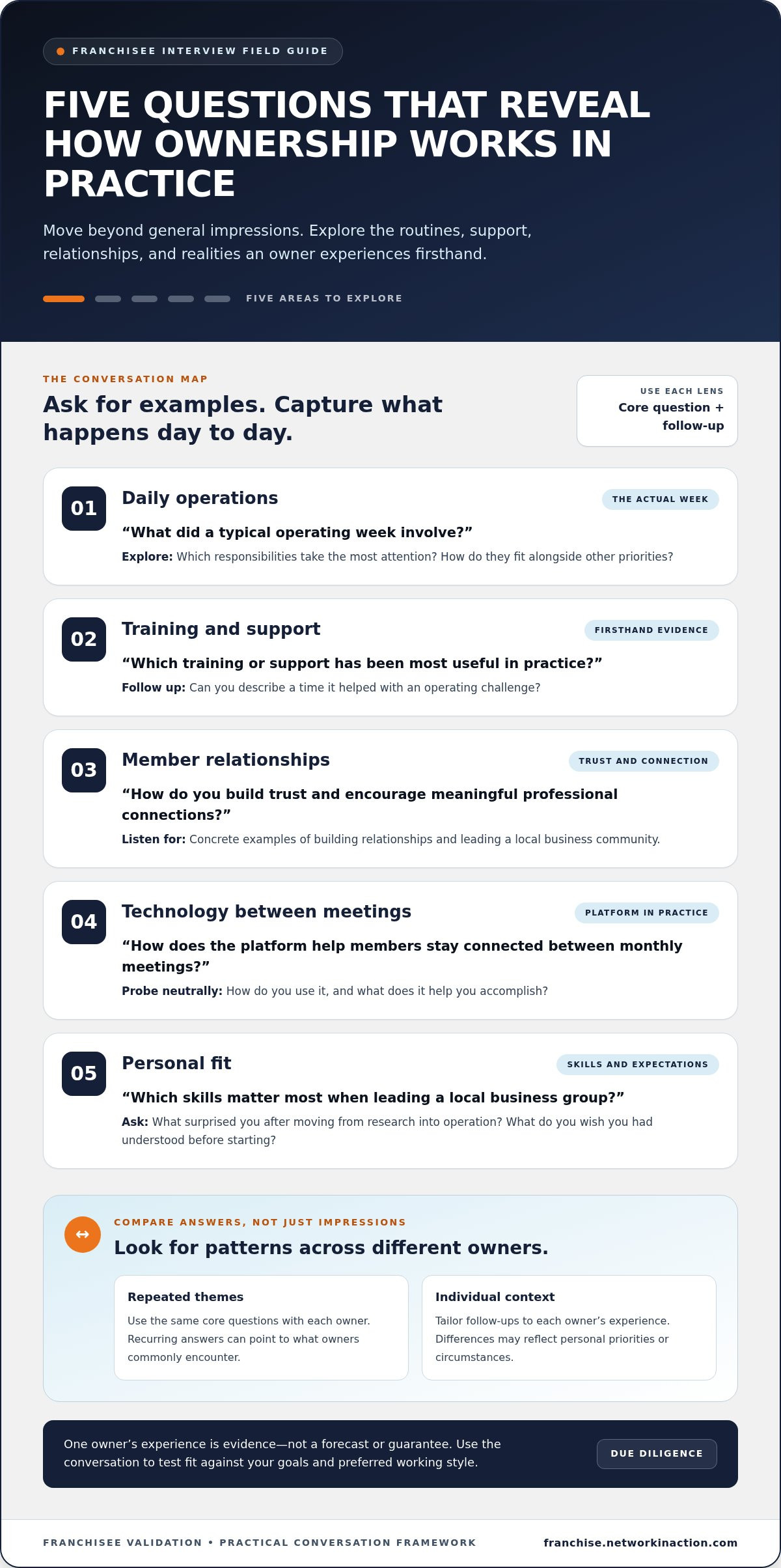
- Operations: What does a typical operating week involve? Which responsibilities take the most attention?
- Support: Which training or support has been most useful in practice? Can you describe a time it helped with an operating challenge?
- Member relationships: How do you build trust and encourage meaningful professional connections within your group?
- Technology: How does the platform help members stay connected between monthly meetings?
- Personal fit: Which skills matter most when leading a local business group? What surprised you after moving from research into operation?
Questions about daily operations and owner fit
Go beyond asking whether the schedule feels flexible. Ask the owner to walk through a recent operating week and identify the activities that demanded the most attention. Explore how responsibilities fit alongside other priorities, and which leadership skills help them build professional credibility and encourage relationship-driven growth. Ask what they wish they had understood before starting.
Questions about training, support, and the platform
Separate the franchisor’s description of its systems from the owner’s firsthand experience. Ask which parts of franchisee training proved useful during launch and ongoing operations, then request a specific example of support that addressed a real challenge. Explore how the technology platform supports member connection between monthly meetings and which routines it helps the owner manage.
Keep questions neutral. Instead of asking, “Did the platform make everything easier?” ask, “How do you use the platform between meetings, and what does it help you accomplish?” That wording makes room for nuance and produces evidence you can compare, rather than a simple endorsement.
As you refine your questions, review the franchise information kit for context on the opportunity. Use franchisee conversations to examine how the model works in practice.
How to compare franchisee answers without relying on one opinion
Several interviews help only if you can compare what you hear. A simple grid turns separate conversations into organized evidence. Use the same core topics each time, then record context that may explain differences. This makes recurring themes easier to spot without treating one owner’s experience as the whole story.
Build a practical franchisee interview comparison grid
Create a row for each topic and a column for each franchisee. Keep the structure consistent, but record examples in the owner’s own terms instead of reducing every answer to a rating. A useful grid can include:
- Theme: Operations, training and support, member relationships, technology, or personal fit.
- Specific example: What the owner described doing or experiencing.
- Context: Relevant details such as operating experience or the stage of building a local group.
- Open question: What remains unclear or needs another perspective.
- Follow-up action: What information or conversation could clarify the point.
Distinguish concrete examples from general impressions. “The platform helped members stay connected between meetings” is a broad assessment. An account of how the owner used it to keep a conversation moving between monthly meetings gives you more detail to compare. Record what supports your evaluation, and avoid unnecessary personal or confidential information.
Make sense of different operating experiences
Look for patterns across owners before drawing conclusions. If several franchisees describe similar demands around community leadership or similar benefits from training, that repetition deserves attention. One person’s preference for a particular routine may matter, but it shouldn’t carry the same weight as a theme raised independently by multiple owners.
Different answers aren’t automatically contradictions. An owner’s experience may reflect their stage of business development, territory, prior business experience, or operating style. If one franchisee finds the monthly meeting cadence manageable and another finds scheduling challenging, ask what their routines involve. Record the context before deciding that one answer is more credible.
Handle financial comments carefully. Treat them as context to investigate, not as a forecast or promise of what you’ll achieve. Ask what operating factors shaped the owner’s experience, and compare those details with the information available through the franchisor and your own due diligence.
Knowing how to interview existing franchisees means weighing evidence, not counting opinions. Use your grid to identify what appears consistent, what varies, and which differences matter to your goals, schedule, and ownership plans. That gives you a clearer basis for follow-up and a more balanced view of the opportunity.
What to ask about challenges, performance, and franchise support
A friendly conversation can reveal useful operating detail, but it can’t guarantee your future performance. The value lies in learning how an owner evaluates progress, what influences their experience, and how they respond when plans meet real-world challenges. Ask respectfully and invite specifics. You’re gathering perspective, not asking an owner to certify the opportunity.
How to discuss financial performance responsibly
Keep questions focused on decision-making. Don’t treat one franchisee’s results as a target. For example, ask:
- “Which measures do you track to understand how the business is progressing?”
- “How do those measures influence the decisions you make as an owner?”
- “What operating factors have had the greatest effect on your experience?”
Listen for the context behind the answer. An owner may describe how relationship-building, group development, or their own operating approach shaped progress. Those details can help you identify questions for further due diligence, but they don’t predict what another owner will earn or achieve. Assess financial information alongside the franchise’s official disclosures and independent professional advice.
How to ask about challenges and support
Don’t stop at “Are you satisfied with the support?” Broad ratings are difficult to interpret. Ask the owner to describe a challenge, what steps they took, and whether franchisor support helped. For example: “Can you share a time you faced an operating obstacle and explain what support or resources were useful?”
Follow up to understand the experience without pressing for confidential details:
- “What did you learn from that situation?”
- “Which kind of support made a practical difference?”
- “What would you handle differently if a similar challenge arose?”
Notice how clearly the franchisee describes the situation, the actions taken, and the result. A candid account may include limits or unresolved issues. That doesn’t define the entire franchise system, just as one positive story doesn’t settle every concern. Compare the response with other owners’ experiences, and consider whether operating stage or individual circumstances explain differences.
That’s the discipline behind how to interview existing franchisees: ask direct questions, respect boundaries, and treat each answer as one piece of evidence. For broader context as you assess the opportunity, review the franchise opportunity information.
Turn franchisee interviews into a confident next step
Use the conversations to make a decision, not to collect reassurance. After each interview, record what the owner’s experience confirmed, what challenged your assumptions, and what remains unresolved. Compare those points with your goals, preferred flexibility, leadership strengths, and comfort with risk.
Create a decision summary after each conversation
Keep your notes focused on evidence and fit. A useful summary separates specific examples from impressions and identifies what needs follow-up. For each insight, consider whether it signals a genuine mismatch or simply needs more context. A schedule that doesn’t suit one owner, for example, may reflect their circumstances rather than a broader pattern. Your priorities are the benchmark, not a generic ideal-owner profile.
- Confirmed: Which parts of the operating model align with your expectations?
- Challenged: What did you learn that changes how you view the opportunity?
- Unresolved: Which questions need clarification through more conversations or document review?
- Fit: How do the findings compare with your goals, desired flexibility, strengths, and risk tolerance?
Follow up when answers vary or leave important questions open. Ask franchisees for context, not a verdict. They can explain their own experience, but deciding whether the opportunity fits your ambitions remains your responsibility.
Explore whether Network In Action aligns with your goals
Consider whether leading a local business referral group fits how you want to build relationships and contribute to a professional community. Network In Action brings together monthly meetings and a proprietary technology platform that helps members stay connected between meetings. Ask franchisees how that cadence and platform shape their routines, then weigh what you learn against your plans for flexibility, community leadership, and relationship-driven growth.
For another perspective as you evaluate the ownership model, explore this business networking franchise guide. A structured approach to how to interview existing franchisees can bring the opportunity into sharper focus. Clarify what fits, what needs more investigation, and whether the model aligns with the business and lifestyle you want to build.
Make your next move with clear evidence
Franchisee interviews are most valuable when you treat them as structured due diligence. Ask open-ended questions, compare specific examples across owners, and separate recurring patterns from individual circumstances. Then weigh what you learned against your goals, preferred working style, leadership strengths, and comfort with risk.
Understanding how to interview existing franchisees helps you move beyond promotional claims without mistaking one person’s experience for a promise of your own results. Use follow-up conversations to clarify unanswered questions, then consider whether the day-to-day operating model fits the business and lifestyle you want to build.
For Network In Action, that evaluation includes exploring a model built around monthly meetings, a proprietary technology platform that keeps members connected between meetings, and training and support for franchisees building and managing local groups. If leading a local business community aligns with your ambitions, explore whether the opportunity fits your plans.
Explore the Network In Action franchise opportunity. Thoughtful questions create a stronger foundation for a confident decision.
Frequently Asked Questions
What questions should you ask existing franchisees before buying a franchise?
Ask about the work behind the opportunity, not just whether the owner likes it. Explore a typical operating week, the responsibilities that take the most attention, how training and support work in practice, and what surprised the owner after launch. For a relationship-driven franchise, ask how meetings fit the routine and how the technology platform supports member connections. A practical approach to how to interview existing franchisees uses open-ended questions that invite examples.
How many existing franchisees should you interview?
There’s no single interview count that fits every decision. Speak with enough franchisees to compare perspectives and identify recurring themes, including owners at different stages of experience when possible. The goal isn’t to reach a quota. It’s to understand whether an answer reflects a broader operating pattern or one person’s circumstances. If important questions remain unresolved or answers conflict, consider more conversations before drawing conclusions.
Can existing franchisees tell you how much money you will make?
No. Franchisees can describe how they track business progress and which operating factors have influenced their own experience, but their results aren’t a forecast or promise of your future income. Outcomes can vary with circumstances and operating approach. Treat financial comments as context to investigate, then assess them alongside the franchise’s official disclosures and independent professional advice. Avoid using one owner’s results as a benchmark for your decision.
How do you find current franchisees to interview?
Start with the Franchise Disclosure Document (FDD), especially Item 20, which provides contact information for current franchisees and franchisees who have left the system within the last fiscal year. Use that information to build a range of perspectives rather than relying only on contacts suggested during a sales conversation. Keep outreach professional: explain that you’re evaluating the opportunity, request a suitable time, and respect each owner’s boundaries.
What should you do if franchisees give conflicting answers?
Don’t assume one owner is right and another is wrong. Note the specific difference, then ask neutral follow-up questions to understand the context. Experience level, territory, operating style, and stage of business development may help explain varied accounts. Compare the explanations with other interviews and your own priorities. A repeated pattern deserves closer attention than an isolated preference, while unresolved differences should remain on your follow-up list.
Is it appropriate to ask a franchisee about challenges and regrets?
Yes, if you ask respectfully and give the owner room to set limits. Invite specific examples with questions such as, “What challenge took the most adjustment, and what did you learn from it?” or “Knowing what you know now, what would you investigate earlier?” Avoid pressing for confidential details. Candid examples can reveal how owners respond to setbacks and what support proved useful, without making one person’s experience a verdict on the entire system.
What should you do after interviewing existing franchisees?
Write a short decision summary while the conversation is fresh. Record what the interview confirmed, challenged, and left unanswered, then compare those points with your goals, desired flexibility, leadership strengths, and risk tolerance. Follow up on patterns that need clarification, and review relevant official disclosures. Franchisees can inform your evaluation, but the decision remains yours. Move forward when you have enough evidence to assess both the opportunity and your personal fit.