
What if the territory on your franchise map doesn’t give you the protection you expect? Understanding what happens when your franchise territory is not exclusive starts with a practical question: who else may operate or pursue opportunities in the area you’re counting on? The answer is in the franchise documents, not just on the map.
Overlapping territories could divide local opportunities or affect your growth, but a non-exclusive territory doesn’t automatically tell you how much competition you’ll face. You need to understand what the franchisor and other franchisees are permitted to do, and how those rights fit the business model.
This article explains what non-exclusive territory rights can mean, which terms and scenarios to clarify before signing, and how to assess territory fit against your goals. For a professional networking franchise such as Network In Action, consider how territory boundaries relate to building local groups and relationships, and to using the platform and support provided. Confirm the rights for any specific opportunity in its franchise documents.
Key Takeaways
- To understand what happens when your franchise territory is not exclusive, check which activities and competitors the agreement allows in your area.
- Assess how possible overlap could affect local prospecting, customer relationships, marketing, and referrals in the specific franchise model.
- Compare territory labels with the agreement’s definitions, restrictions, and exceptions before drawing conclusions.
- Use a clear review process: identify the territory terms, map realistic scenarios, ask the franchisor direct questions, and seek qualified advice where needed.
- For a Network In Action opportunity, consider how territory boundaries relate to local group-building and confirm the applicable rights in the current franchise documents.
What Does It Mean When a Franchise Territory Is Not Exclusive?
Territory language can shape where you build the business, whom you can serve, and whether other operators may pursue opportunities in the same area. Don’t rely on a map or a verbal description alone. The written agreement defines the rights that come with the territory.
A non-exclusive franchise territory is an area where you may be authorized to operate, but the agreement does not promise that the franchisor will prevent all other franchisees or the franchisor itself from pursuing business there. The specific rights depend on the contract. For a broad introduction to the distinction, see how franchise can be exclusive or non-exclusive.
A geographic operating area and a guarantee against overlap are not the same thing. A territory may identify where you’re expected or permitted to develop the business without giving you control over every customer, account, sales channel, or activity within its boundaries. So what happens when your franchise territory is not exclusive? Another operator or the franchisor could have overlapping rights, but only the applicable documents can clarify what’s allowed.
What rights can a non-exclusive territory leave open?
Potential overlap varies by franchise system. Depending on the agreement, the franchisor might retain the right to place another franchisee nearby, serve certain accounts directly, or reach customers through another sales channel. Other agreements may set limits or specific exceptions. These are examples to investigate, not assumptions about every franchise.
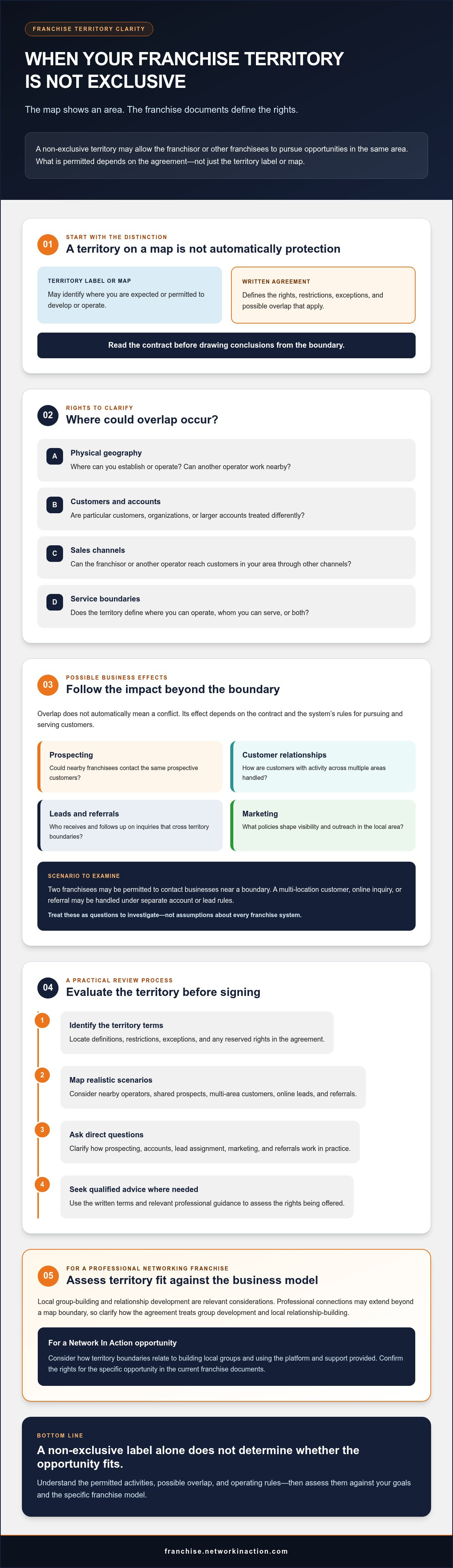
Review the terms by asking separate questions:
- Physical geography: Where can you establish or operate the business? Can another operator work nearby?
- Customers and accounts: Are particular customers, organizations, or larger accounts handled differently?
- Sales channels: Can the franchisor or another operator reach customers in your area through other channels?
- Service boundaries: Does the territory define where you can operate, whom you can serve, or both?
Does non-exclusive automatically mean a bad franchise opportunity?
No. A non-exclusive territory alone doesn’t establish whether an opportunity is viable. Assess the arrangement against the business model, the rights you’re granted, and the kind of growth you’re expected to build. Focus on where overlap could affect your ability to develop the business.
For a professional networking franchise, local groups and relationships are central to the model, while professional connections may extend beyond a map boundary. Clarify how the agreement treats group development and local relationship-building. For a Network In Action opportunity, confirm the applicable territory terms in the current franchise documents. A sales conversation, map, or territory label isn’t a substitute for the written rights.
How Franchise Territory Overlap Can Affect Customers and Growth
Territory overlap can affect the day-to-day work of finding prospects, building customer relationships, and making your local presence visible. The impact depends on what the franchise documents allow and how the system handles leads, accounts, marketing, and referrals.
Overlap consequences depend on the agreement’s territory definitions, reserved rights, account rules, lead-assignment process, marketing policies, and referral procedures. A map boundary may not determine who can pursue every customer or where an online inquiry goes. Clarify the operating rules behind the boundary before estimating how much opportunity is available to you.
Where can franchise business overlap occur?
Imagine two franchisees whose areas meet near a commercial district. If both are permitted to contact businesses there, they could approach the same prospect. If a customer operates across several locations, the agreement may treat that account differently from a local customer. An online inquiry or referral might also be routed under rules that don’t follow geographic lines.
These are possibilities to investigate, not proof of a conflict. Ask how the franchise system handles:
- Prospecting: Can nearby franchisees contact the same prospective customers?
- Customer ownership: What happens if a customer operates or seeks service across multiple areas?
- Online leads and referrals: Who receives and follows up on inquiries that cross territory boundaries?
- Local marketing: Are there guidelines for reaching audiences in neighboring areas?
- Regional accounts: Are larger or multi-location relationships handled differently?
Potential overlap becomes a practical concern when the written terms or operating rules allow competing approaches to the same opportunity. Look for the actual process, rather than relying on a possible conflict suggested by a map.
What does overlap mean for a relationship-driven business?
For a professional networking business, geography is only part of the picture. Local credibility, consistent relationship-building, and the quality of professional connections may matter alongside where a person works or lives. A contact could introduce you to someone outside your immediate area; the franchise documents and operating rules determine how that activity is treated.
Network In Action’s model centers on leading local professional referral groups, with monthly meetings and a technology platform. That context makes it useful to ask how group development, referrals, and relationships that cross local boundaries are handled. For more perspective on building business through relationships, explore the article on referral marketing strategy.
To assess what happens when your franchise territory is not exclusive, turn each possible overlap into a direct question about rights and process. If you’re evaluating a Network In Action opportunity, you can also review available franchise territories and confirm the terms that apply to your opportunity.
Exclusive vs. Non-Exclusive Franchise Territories: What Should You Compare?
The words “exclusive” and “non-exclusive” are a starting point, not a complete description of your rights. An exclusive label may not answer every question about accounts or sales channels, and a non-exclusive label doesn’t explain exactly where overlap may occur. The agreement’s definitions, restrictions, and exceptions matter more than the headline.
Use a side-by-side review to see how each structure fits your target customers, operating reach, and growth plans. Treat the table as a checklist, then confirm the answers in the documents for the specific opportunity.
| What to compare | Exclusive territory | Non-exclusive territory | Question to resolve |
|---|---|---|---|
| Who may operate | Check whether the agreement limits other operators within defined boundaries. | Check whether other franchisees or the franchisor may operate in the same area. | Who can establish or operate there, and what exceptions apply? |
| Marketing and prospecting | Confirm what restrictions apply to local outreach by the franchisor or other franchisees. | Determine whether multiple operators can approach the same prospects. | Are marketing rights tied to geography, customers, or another rule? |
| Customers and accounts | Look for exceptions involving existing, regional, or multi-location accounts. | Check whether customer relationships can cross boundaries or be served by another operator. | How are accounts assigned and handled if territories overlap? |
| Online activity and other channels | Check whether the agreement reserves activity outside the local operation. | Clarify how online inquiries or other channels may reach customers in your area. | Who receives leads, and what rules govern follow-up? |
Which territory details deserve a side-by-side review?
Compare the actual rights to operate, market, and serve customers, not just the territory names. Mark each exception involving existing accounts, online activity, referrals, or broader channels. If a term doesn’t explain who handles an opportunity or where a boundary applies, record it as an open question and request clarification in writing.
When might a non-exclusive structure still fit?
A non-exclusive arrangement may suit a model built around local community leadership or a customer base that isn’t confined to one geographic line. For a relationship-driven business, the ability to build credibility and develop professional connections may matter alongside the map. Defined systems, technology, training, and support can help you understand how the model operates, but they don’t replace clear contractual rights.
Ask whether the territory structure matches how you expect to reach customers, build relationships, and grow. What happens when your franchise territory is not exclusive depends on the written boundaries and operating rules, not on a universal ranking of territory types. Neither structure guarantees revenue protection or is automatically the better choice. Choose based on the opportunity’s terms and your goals.
How to Evaluate a Non-Exclusive Franchise Territory Before Signing
Before you commit, turn the territory description into a practical review. Read the current disclosure document and franchise agreement for the specific opportunity, then compare their terms with how you expect to build the business. A map is useful, but the written rights and exceptions tell you more.
Check written territory terms against realistic operating scenarios before deciding whether the opportunity fits your business plan.
Questions to ask the franchisor about territory rights
Ask direct questions to clarify boundaries and identify gaps. Have the franchisor point to the relevant language in the current documents, and request written clarification if a sales discussion seems inconsistent with that language.
- How does the agreement define the territory, and what exceptions or reserved rights apply?
- Can another franchisee or the franchisor pursue prospects or serve customers in the area?
- How are overlapping referrals, online inquiries, existing accounts, or regional relationships handled?
- Who decides how a disputed or unclear overlap is addressed, and where is that process documented?
Keep a record of the answers and note which points appear in the documents and which remain unclear. For an interpretation of contractual rights, consider consulting an independent franchise attorney. That can help you understand the language without relying solely on a sales explanation.
How to test the territory against your business plan
Make the review specific to your goals. Map the audience you intend to reach, the local relationships you plan to build, and any practical service area relevant to the model. Then test plausible scenarios: a prospect works near a boundary, a referral comes from another area, or an account has connections across multiple locations. In each case, ask who may pursue the opportunity and how that decision is made.
Compare the written provisions with the time, flexibility, and growth potential you want from the business. For a relationship-driven model, consider how local leadership and professional connections fit alongside geographic limits. Clear processes and support may matter to your evaluation, but they don’t replace defined rights.
Understanding what happens when your franchise territory is not exclusive means examining the applicable documents, testing realistic scenarios, and resolving unanswered questions before signing. If you’re exploring a Network In Action franchise opportunity, review the available franchise territories and confirm the specific terms that apply to your opportunity.
What a Non-Exclusive Territory Could Mean for a Network In Action Franchise
A professional networking franchise differs from a retail or real estate model. Network In Action offers franchise opportunities to lead local professional referral groups. The model includes monthly meetings, a proprietary technology platform, and training and support. These details describe how the business operates, but they don’t establish who may build groups or relationships in a specific area.
The available information does not confirm whether Network In Action territories are exclusive or non-exclusive, or define territory rights for a particular opportunity. Don’t infer exclusivity from a map, a conversation, or the company’s operating model. Confirm the applicable boundaries, exceptions, and reserved rights in the current franchise documents for the opportunity you’re evaluating.
How territory questions connect to the NIA business model
Consider how you would lead a local professional community and build relationship-driven growth in the proposed area. Ask how group boundaries are defined, whether another franchisee could develop relationships nearby, and how overlapping prospects or referrals would be handled. These questions connect territory terms to the practical work of leading groups and building local professional credibility.
The technology platform, monthly meeting structure, training, and support are part of the described model. They may help you understand how operations are organized, but they aren’t territory protections. Keep the distinction clear: operating support and contractual rights answer different questions.
Explore the opportunity with the territory terms in view
Use the franchise materials to prepare focused questions about territory rights and the support available to franchisees. Review any territory information provided for your opportunity, then compare it with the written agreement and applicable disclosure documents. Verify availability and exclusivity directly rather than assuming either.
- Ask which boundaries apply to your specific opportunity.
- Clarify how local group development and potential overlap are treated.
- Compare the written rights with your goals for community leadership, flexibility, and growth.
Understanding what happens when your franchise territory is not exclusive starts with the exact terms that apply, not assumptions about the brand or business category. If the model aligns with your goals, you can request the Network In Action franchise kit and use it to guide further questions. Take time to assess fit and verify opportunity details before deciding.
Make Your Next Franchise Decision With Clarity
Territory labels alone don’t tell you who can approach prospects, serve customers, or build relationships in a given area. To understand what happens when your franchise territory is not exclusive, compare the written terms with realistic operating scenarios, clarify exceptions, and get qualified advice on contractual language before you commit.
For a Network In Action opportunity, confirm the specific territory rights in the current franchise documents. Network In Action has more than 150 locations across the United States and several other countries. Its franchise model includes monthly meetings, a proprietary technology platform, and training and support. These details describe the model, not a promise of exclusive territory rights.
Your decision should align with how you want to lead a local professional community, build relationships, and grow the business. Explore the opportunity, bring your territory questions, and assess the fit on your terms. Explore the Network In Action franchise opportunity.
Frequently Asked Questions
What happens if a franchise territory is not exclusive?
What happens when your franchise territory is not exclusive depends on the rights and exceptions in your franchise documents. The franchisor may retain rights to operate, appoint another franchisee, or serve certain customers in the area. Review how the documents define territory, accounts, marketing, and exceptions. Ask for unclear terms in writing, then consider having qualified franchise counsel interpret the documents before you commit.
Can a franchisor sell another franchise in my territory?
That depends on the rights and exceptions stated in your franchise documents. A non-exclusive label may indicate limited geographic protection, but it doesn’t answer every question about who can operate or serve customers. Ask the franchisor to explain realistic overlap scenarios for your opportunity, including whether another franchisee could operate nearby. Compare those explanations with the written agreement and request written clarification if anything remains unclear.
Is a non-exclusive franchise territory a deal breaker?
Not necessarily. A non-exclusive territory may still fit if its terms, your customer base, and your business plan work together. First establish what protections are included, how potential overlap is handled, and whether the opportunity makes sense under those conditions. Don’t decide based on the territory label alone. Review the specific agreement and consider independent advice to assess the rights and risks for your situation.
How do I know whether my franchise territory is exclusive?
Check the territory definitions and exceptions in the current franchise documents, not just a map or verbal description. Look for language explaining who may operate, market, or serve customers within the area, and whether any accounts or sales channels are treated differently. Ask the franchisor to clarify ambiguous wording in writing. A qualified franchise attorney can help interpret how the provisions apply to your circumstances.
What should I ask before signing a franchise agreement with a non-exclusive territory?
Ask how the territory is defined, whether the franchisor or other franchisees may serve customers there, and how referrals, accounts, and online inquiries are handled. Clarify how potential overlap is addressed and who makes those decisions. Request written explanations, then compare them with the agreement and disclosure documents. Consider asking an independent franchise attorney to review unclear terms before you make a commitment.
Can franchise territories overlap?
Yes, territories can overlap, depending on how the franchisor defines and structures the rights. Overlap may involve geographic boundaries, customer accounts, marketing, referrals, or sales channels, so a map may not show the full picture. Ask which activities are permitted, how shared prospects are handled, and whether exceptions apply. Treat each scenario as a question to verify in the franchise documents, not a universal rule.