What if a franchise with impressive revenue still leaves you with too little profit, too little time, or both? That’s why how to evaluate franchise profitability starts with more than sales claims. You need to understand what remains after fees and operating costs, how much working capital the business may require, and how much owner involvement the model demands.
Looking beyond headline numbers is essential. Gross revenue isn’t owner income, and projections are useful only when their assumptions match the market, costs, and day-to-day operation you can realistically expect. Before committing, check claims against current disclosure materials and build scenarios that account for both expected performance and potential shortfalls.
This practical 2026 guide explains which financial measures matter, how to pressure-test revenue and expense assumptions, and what to verify before choosing a franchise. It also shows how owner workload affects the opportunity’s fit with your goals. For a relationship-driven model such as Network In Action, monthly meetings, a technology platform, and local demand are part of the operating picture, not proof of a particular return. The objective is to make a decision grounded in verified economics, realistic expectations, and the kind of business you want to lead.
Key Takeaways
- Learn how to evaluate franchise profitability by separating sales, operating profit, cash flow, and money available to you as the owner.
- Build a complete cost picture by identifying one-time and recurring expenses, then checking each amount against current disclosure materials.
- Compare conservative, base, and stronger operating scenarios to see how changing assumptions affect cash needs and owner hours.
- Use a structured diligence process: review records and performance claims, speak with operators, and stress-test assumptions with qualified advisers.
- Assess whether Network In Action’s monthly meetings, technology platform, training, and support fit your local market, operating preferences, and lifestyle goals.
How to Evaluate Franchise Profitability Beyond Headline Revenue
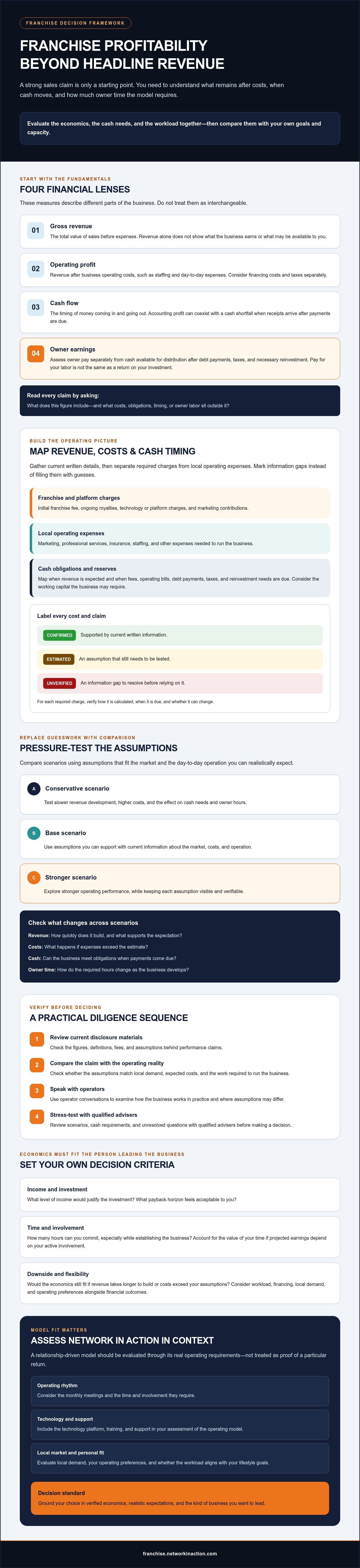
Strong sales can make a franchise look attractive, but they don’t show what the business earns, whether it generates enough cash to meet its obligations, or how much you can take home. To understand how to evaluate franchise profitability, separate four measures: revenue, operating profit, cash flow, and owner earnings.
Revenue is what the business brings in before expenses. Owner earnings are what may remain after the business meets its costs and obligations. This distinction changes how you read sales claims. A franchise can generate substantial revenue and still leave limited cash for the owner after operating expenses, financing, taxes, and reinvestment.
Revenue, profit, cash flow, and owner earnings are different
Gross revenue is the total value of sales before expenses. Operating profit subtracts business operating costs, such as staffing and other day-to-day expenses, but should be considered separately from financing costs and taxes. Cash flow tracks when money actually arrives and leaves. A business can show accounting profit while facing a cash shortfall if receipts arrive after payments are due.
Owner earnings require another distinction. If you work in the business, compensation for your labor isn’t the same as a return on your investment. Assess owner pay separately from any cash available for distribution after debt payments, taxes, and necessary reinvestment. Before treating a financial claim as money you can personally use, check exactly what it includes.
For background on the disclosure document franchise candidates review, see the Franchise Disclosure Document (FDD). Use current official disclosure materials to verify the specific figures and definitions behind any performance claim.
Start with your definition of a worthwhile return
Set your decision criteria before comparing opportunities. What level of income would justify the investment? What payback horizon feels acceptable to you? How many hours each week can you commit, especially while establishing the business? These are personal thresholds, not universal benchmarks.
Separate compensation for work from the return on invested capital. If projected earnings depend on your active involvement, account for the value of your time instead of treating every dollar as investment return. Test whether the economics still fit if revenue takes longer to build or costs exceed your assumptions. A sound evaluation weighs financial outcomes alongside workload, financing, local demand, and the operating model. Headline revenue is a starting point, not a verdict.
Which Franchise Financial Metrics Reveal the Real Economics?
A useful profitability model starts with a complete map of expected revenue sources and one-time and recurring costs. Then add the timing of cash coming in and going out. Positive revenue doesn’t guarantee positive cash flow: receipts may arrive after royalty, technology, payroll, insurance, marketing, debt, and other bills are due.
When considering how to evaluate franchise profitability, focus on the numbers that shape the operating reality, not just the sales projection. Verify amounts in current written materials, and label estimates clearly so assumptions aren’t mistaken for confirmed costs.
Build a complete revenue and expense picture
Request current written details for the initial franchise fee, ongoing royalties, technology or platform charges, and any marketing contributions. The FTC's Consumer's Guide to Buying a Franchise can help you understand what to review in franchise disclosures. Confirm which costs are required, how they’re calculated, when they’re due, and whether they can change.
Make a separate list of local operating costs, such as marketing, professional services, insurance, staffing, and any other expenses needed to run the business. Label each item confirmed, estimated, or unverified. This makes information gaps visible before they distort your forecast.
Measure break-even, cash flow, and owner workload
Estimate break-even only after documenting fixed and variable costs and choosing realistic revenue assumptions. Then map cash timing: when revenue is expected, when fees and operating bills are payable, and how much working capital may be needed before operations stabilize. A break-even estimate based on incomplete costs can create false confidence.
Model owner compensation separately from profit retained in the business or distributed to you. Track the hours needed to recruit, serve, and retain members alongside the financial measures. For a model involving monthly meetings and a proprietary technology platform, consider how recurring operations affect your schedule and costs, then verify the details in current franchise materials.
Apply the same disciplined review to every opportunity. You can explore Network In Action franchise information as one input, then compare the documented economics with your local assumptions, cash needs, and preferred level of owner involvement.
How to Compare Franchise Profitability Scenarios Without Guessing
A forecast is only as useful as the assumptions behind it. Build conservative, base, and stronger scenarios to see how changes in local demand, customer or member acquisition, retention, operating costs, and available owner hours could affect revenue, cash needs, and the time needed to reach stable operations. These are planning cases, not promises or predictions.
Start with documented records and current written disclosures. The FTC's guide to buying a franchise explains how to assess franchise information and earnings claims. Keep evidence separate from estimates, and don’t treat a brand name or polished sales presentation as proof of a profitable outcome.
Test the assumptions that drive financial results
For each scenario, note what supports the assumption and how confident you are in it. Check local demand, the pace of acquiring and retaining customers or members, and the operating capacity available to you. Then test what happens if revenue builds more slowly, expenses run higher, or operations take longer to stabilize. Don’t assign probabilities unless reliable evidence supports them.
| Scenario | Assumptions to test | Evidence and confidence | Potential effect |
|---|---|---|---|
| Conservative | Slower acquisition or retention; higher costs; delayed stability | Identify records or label each item an estimate; rate confidence low, medium, or high | Assess added cash needs, reduced available cash, and owner hours |
| Base | Expected local demand, acquisition pace, retention, and operating costs | Separate documented facts from unverified assumptions | Estimate operating needs and time commitment under your central case |
| Stronger | Faster acquisition or retention, within realistic capacity | Require evidence for each improvement; don’t assume best-case results | Assess whether added revenue also requires more time or expense |
Compare opportunities on an equivalent basis
Apply the same method to every franchise under consideration. Compare total investment needs, recurring costs, owner workload, cash requirements, and time to operating stability. Keep territory characteristics and local market conditions visible, because a revenue figure from a different market may not translate to yours.
Use the same time period and cost categories for each comparison. Flag missing or unverified performance data rather than filling gaps with guesses. That’s how to evaluate franchise profitability with discipline: compare evidence, expose uncertainty, and decide whether the downside remains manageable for your goals.
What Due Diligence Can Confirm a Franchise’s Profitability Potential?
Due diligence turns an attractive opportunity into a set of claims you can test. Follow a clear sequence: collect current records, verify financial claims, interview current and former franchisees, then stress-test your assumptions. Each step should clarify what’s documented, what’s based on firsthand experience, and what remains uncertain.
Verify financial representations and disclosure materials
Request the current Franchise Disclosure Document (FDD), franchise agreement, and any written financial performance representation. Reconcile sales or earnings claims with the disclosures, noting which period, locations, and costs the figures cover. A revenue figure alone doesn’t establish owner income or show whether results reflect a market like yours.
Investigate inconsistencies. If a fee, expense, or performance statement is missing or unclear, ask for written clarification. Have qualified legal and financial advisers review the materials and identify issues that need resolution before you rely on the numbers.
Ask franchisees questions that test the operating model
Speak with current and former franchisees, and compare their accounts rather than treating one person’s experience as typical. Ask how long launch and customer or member development took, how many hours the work requires in a typical week, which recurring expenses surprised them, and where retention or local demand created challenges. Ask what support they used and how it helped them operate.
Listen for specifics. Ask what period an answer covers, whether it reflects the operator’s own territory, and what records or direct experience support it. Differences may reflect local conditions, experience, or operating choices, so record the context instead of averaging accounts into a promise.
Use this four-step checklist to keep the review disciplined:
- Collect: Gather current disclosures, agreements, financial representations, and written fee details.
- Verify: Match each claim to its source and clarify gaps with the franchisor and qualified advisers.
- Interview: Compare operator accounts on workload, expenses, launch experience, retention, and support.
- Stress-test: Revisit your scenarios using verified facts, local conditions, and the time you can realistically commit.
For sector-specific context, compare your findings with the practical realities of owning a business networking franchise, including community leadership and recurring group operations. If you’re assessing Network In Action, review the franchise opportunity materials as part of your document-based evaluation. Use verified details, not assumptions, to decide whether the operating model fits your financial goals and preferred workload.
Does Network In Action Fit Your Profitability and Lifestyle Criteria?
Apply the same financial discipline to Network In Action that you’d use for any franchise. The opportunity centers on leading local professional referral groups through a model that combines monthly meetings, a proprietary technology platform, training, and ongoing support. These features shape the operating model, but they don’t establish a particular margin or guarantee income. Your task is to assess how they fit your market, capabilities, financial requirements, and preferred schedule.
Evaluate the Network In Action model against your criteria
Start with fit. Do you enjoy building professional credibility, cultivating business relationships, and leading a local community? Consider whether leading a group focused on business referrals aligns with your strengths and approach to relationship-building. Assess how meeting preparation, the member experience, and the technology platform may affect routine operations and owner hours. Ask how the model supports group operations, then check the time and effort required to attract and retain members in your territory.
Next, verify the economics. Review current official materials for all fees, technology charges, support details, territory terms, and any financial performance information. Check which revenue assumptions are supported by disclosure and which depend on local demand or your own operating effort. Treat potential revenue as an assumption to validate, not a promised result.
Choose a clear next step before making a commitment
Turn your evaluation into a short list of unanswered questions. You may need to confirm how the monthly meeting structure affects workload, what training and ongoing support cover, or how territory characteristics shape local demand. Compare the answers with your cash-flow scenarios and your target balance between owner compensation, time commitment, and lifestyle flexibility.
- Does community leadership and relationship-building align with your strengths and preferred working style?
- Can your local market support the group development and member experience the model requires?
- Do verified fees, operating costs, and workload fit your financial and lifestyle goals?
That’s how to evaluate franchise profitability without confusing an appealing concept with a proven personal outcome. Gather current details, validate your assumptions, and decide whether the opportunity fits your criteria. You can review the Network In Action franchise kit as a starting point for exploring the opportunity and identifying what to verify before making a decision.
Make Your Next Franchise Decision With Confidence
Franchise profitability isn’t proven by a sales claim. Assess it by separating revenue from owner earnings, verifying costs and disclosures, and testing how changes in local demand, cash needs, and owner hours affect the business. That’s how to evaluate franchise profitability clearly and decide whether the economics fit your goals.
Network In Action offers a franchise opportunity centered on leading local professional referral groups. Its model combines monthly meetings, a proprietary technology platform, training, and ongoing support. Treat these as operating factors to investigate, not evidence of a guaranteed return. Review current official materials, validate financial details, and consider whether community leadership and the time commitment align with the lifestyle and impact you want to build.
If the model merits a closer look, take a measured next step: explore the Network In Action franchise opportunity and gather verified details for your evaluation. A disciplined decision can create a stronger foundation for the business you choose to lead.
Frequently Asked Questions
How do you evaluate the profitability of a franchise?
To evaluate franchise profitability, compare realistic revenue assumptions with all operating costs, financing obligations, cash-flow needs, and owner hours. Review current disclosures and written performance claims, then test conservative, base, and stronger scenarios against local demand. Speak with current and former franchisees to understand the work behind the numbers. Decide whether the resulting owner income, investment return, workload, and risk fit your goals.
What is the difference between franchise revenue and franchise owner profit?
Franchise revenue is the money the business brings in before expenses. Owner profit is not the same as revenue: royalties, technology charges, marketing, staffing, insurance, financing, taxes, and reinvestment can all reduce what remains. Also distinguish payment for the owner’s labor from return on invested capital. A sales figure alone can’t tell you how much cash the owner may actually receive.
Can a franchise be profitable if it has high startup costs?
Yes, a franchise with substantial startup costs could still be profitable, but the upfront investment alone doesn’t determine the outcome. Assess total capital required, ongoing expenses, financing costs, working capital, and the time needed to reach stable operations. Then estimate how long it may take to recover your investment under realistic scenarios. The opportunity only fits if its potential return and downside risk align with your financial capacity and goals.
What financial information should you request before buying a franchise?
Request the current Franchise Disclosure Document, franchise agreement, itemized startup investment, and written details of recurring royalties, technology charges, marketing contributions, and other required costs. Ask whether the franchisor provides a financial performance representation and what it measures. Clarify working capital assumptions and expenses that vary by territory. Separate documented figures from estimates, and have qualified legal and financial advisers review unclear or inconsistent information before you rely on it.
How do you calculate franchise break-even?
For a basic operating estimate, divide fixed costs by the contribution margin per sale to estimate the number of sales needed to cover those costs. Contribution margin is revenue per sale minus variable costs per sale. Include applicable franchise charges and other operating expenses in the appropriate cost categories. For a cash break-even view, also account for payment timing, financing obligations, and working capital. Use realistic sales assumptions and check the calculation with a qualified financial adviser, since omitted costs can distort the result.
What should you ask current franchise owners about profitability?
Ask how long it took to launch and build customer or member demand, what recurring costs they face, how many hours they spend operating, and which factors affect retention. Ask what support they use and what evidence informs their answers. Speak with multiple current and former owners where possible. Compare responses, while accounting for differences in territory, experience, and operating choices instead of assuming one owner’s results represent everyone’s.
Does a Franchise Disclosure Document show how much a franchise owner will earn?
Not necessarily. An FDD may include a financial performance representation if the franchisor provides one, but it shouldn’t be treated as a promise of what you’ll earn. Check exactly what the information measures, which businesses it covers, the time period, and which costs may be excluded. Actual results can vary with territory, local demand, operating expenses, financing, and owner involvement. Verify the disclosures and discuss them with qualified advisers.