Wanting to leave your job isn’t the same as being ready to leave it. The signs you're ready to leave the corporate world show up in your choices and habits, not just in a difficult week or a frustrating manager. They include testing ideas, building relationships beyond your current role, and getting specific about the work and responsibilities you’d take on next.
You’re right to take the decision seriously. A predictable salary, professional identity, and familiar routine are real considerations, while entrepreneurship brings responsibilities that can look very different from the freedom you imagine. Readiness means examining both sides clearly, not treating burnout as a business plan.
This article will help you separate lasting motivation from temporary frustration, assess your readiness through observable behaviors, and identify the financial and practical questions to resolve before resigning. You’ll also compare structured ownership with starting entirely from scratch. For professionals drawn to relationship-building and community leadership, Network In Action’s franchise opportunity is one route to investigate. The goal is a considered next step, not a rushed exit.
Key Takeaways
- Assess the signs you're ready to leave the corporate world by looking for repeatable ownership behaviors, not just frustration with your current role.
- Consider whether you’re prepared to take responsibility for outcomes, make independent decisions, and work through measured uncertainty.
- Build evidence before resigning by testing your assumptions and clarifying practical questions that could affect your transition.
- Compare staying employed while preparing, starting independently, and exploring franchise ownership against your needs for autonomy, structure, relationships, and support.
- Evaluate the obligations, economics, and fit of any ownership path before making a commitment.
Signs You’re Ready to Leave the Corporate World: Start With the Right Question
You can value what you’ve achieved in your career and still want more control over how you work. That tension deserves attention, but it doesn’t automatically mean you’re ready to resign. The signs you're ready to leave the corporate world have less to do with how intensely you dislike your current role and more to do with whether you consistently act like someone prepared to build and lead something of their own.
Start with the right question: Do you want to escape this job, or are you drawn to the work of ownership? Leaving may change your title and environment, but it also puts more responsibility for decisions, results, and momentum on you. Exploring understanding career changes can offer broader context. Your own decision calls for a closer look at your patterns, motivations, and preferred responsibilities.
Is dissatisfaction a signal or a temporary reaction?
Look for persistence. Does the desire for change return across different projects, teams, or seasons, or does it spike after a difficult deadline or tense conversation? A workload problem, poor leadership, or unhealthy culture may call for a new role or employer, not necessarily ownership. Track what drains your energy, what feels meaningful, and which responsibilities you’d choose if you had more say.
Use these prompts as a starting point, not a pass-or-fail test:
- Does the desire for greater autonomy continue when work is going well?
- Are you energized by creating an opportunity, not only by leaving a frustrating situation?
- Do you take initiative when the outcome isn’t guaranteed or someone else hasn’t assigned the task?
- Can you name the responsibilities you want more of, as well as the ones you’d have to accept?
What does readiness look like in practice?
Readiness shows up in behavior. You initiate projects, bring people together around an idea, solve problems without waiting for perfect instructions, and take responsibility for results. You also stay curious about how ownership works: how value is created, how relationships can support growth, and what it takes to lead consistently. Disliking a role says what you want less of. Curiosity about building something reveals what you may want more of.
Readiness is sustained evidence that you’re willing to own the decisions, relationships, and outcomes required to build something beyond your current role. That evidence doesn’t need to be flawless. It should be repeatable and grounded in real actions, not just a burst of motivation after a bad week.
Five Signs You’re Ready to Leave Corporate Life and Own Your Next Move
Readiness isn’t a personality type. It’s a pattern of choices you make when there’s no guaranteed outcome and no manager defining the next step. These five signs can help you assess that pattern. No single one proves you should leave. Look for consistency across your work, relationships, and decisions.
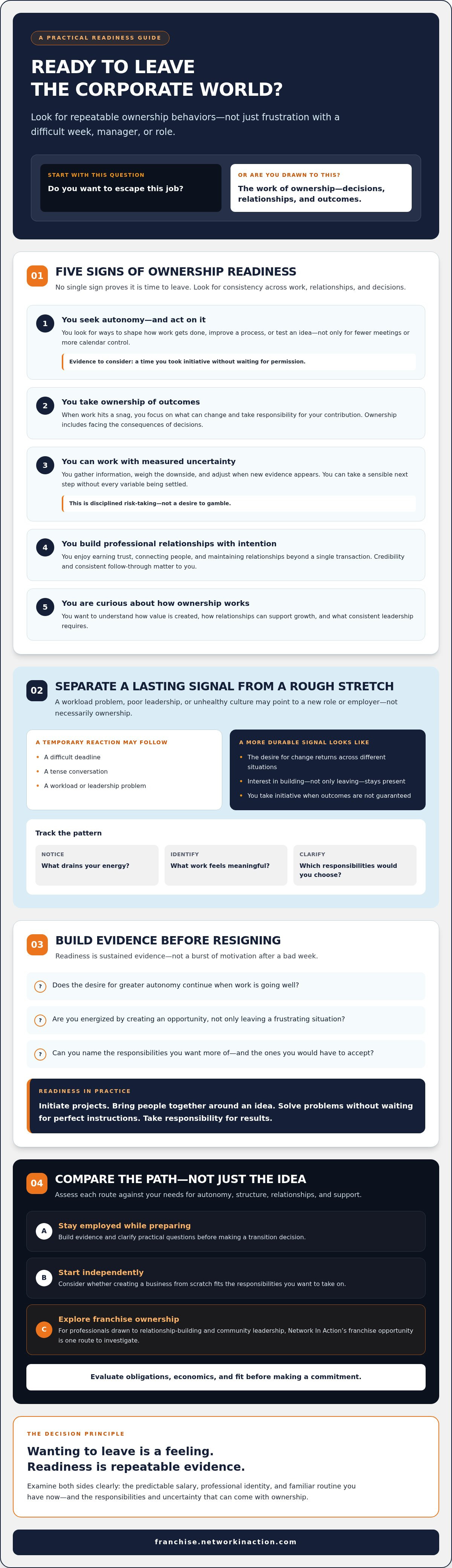
- You seek autonomy and act on it. You don’t just want fewer meetings or more control over your calendar. You look for ways to shape how work gets done, improve a process, or test an idea. Recall a time you took initiative without waiting for permission. Did having room to decide energize you, and were you willing to manage the result?
- You take ownership of outcomes. You care about whether the work succeeds, not only whether your part is complete. When a project hits a snag, you focus on what can change and take responsibility for your contribution. That differs from seeking a higher title while avoiding accountability. Ownership brings more control, but it also means facing the consequences of your decisions.
- You can work with measured uncertainty. You don’t need every variable settled before taking a sensible next step. You gather information, weigh the downside, and adjust when new evidence appears. This isn’t a desire to gamble. It’s a willingness to act without corporate certainty while staying disciplined about risk.
- You build professional relationships with intention. You enjoy earning trust, connecting people, and maintaining relationships beyond a single transaction. That can suit referral-based work, where credibility and consistent follow-through matter. Community leadership also takes service and structure: set clear goals, keep commitments, and focus on useful relationships rather than collecting contacts.
- You create your own operating rhythm. You plan priorities, protect time for important work, and follow through without relying on corporate processes to keep you moving. Relationship-driven work still needs clear goals and regular attention. Freedom without structure can become drift. Self-direction means building routines that turn intentions into results.
Look for evidence, not just enthusiasm. Have you repeatedly initiated work, accepted responsibility, built trust, and followed through when motivation dipped? If so, those behaviors offer a stronger signal than a single burst of frustration. For another perspective on the decision, explore expert advice on quitting, then compare what you learn with your own circumstances.
If relationship-building and community leadership are central to your pattern, a structured ownership path may be worth evaluating. Network In Action offers franchise opportunities built around leading local business referral groups. Review the franchise opportunity information to assess the model as one option, not as a commitment.
Ready to Leave the Corporate World? Test the Case Before You Quit
You don’t need certainty to consider a career change. You do need evidence that the work of ownership fits your strengths, responsibilities, and circumstances. Before acting on the signs you're ready to leave the corporate world, test the assumptions behind your decision while you still have room to evaluate them carefully.
Run low-risk tests of ownership responsibilities
Use your current schedule to practice habits a business may demand: plan your week, follow up with professional contacts, make decisions without waiting for approval, and track whether you complete what you commit to. Speak with business owners about their recurring tasks, customer expectations, and less visible responsibilities, such as keeping operations organized. Notice which activities give you energy and where you’d need to build skills or seek support.
Assess the practical transition, not just the appeal
A compelling business idea still has to work with your household obligations, available resources, and tolerance for uncertainty. Review your personal financial picture and discuss complex questions with qualified advisers where appropriate. If you’re evaluating franchise ownership, verify the current terms directly. Ask about fees, royalties, technology costs, ongoing support, and the responsibilities that remain yours.
Use this validation sequence to turn interest into a decision you can defend:
- Define the case. Write down what you want to change and what you want your next working life to include.
- Test the work. Practice self-direction, relationship-building, and consistent follow-through alongside your current responsibilities.
- Ask better questions. Interview owners about routine demands, customer needs, and the parts of the work that are easy to overlook.
- Check the economics. Map relevant costs, obligations, and possible revenue assumptions. For franchise opportunities, use a careful calculating franchise ROI framework and verify every input rather than treating projections as promises.
- Set decision criteria. Decide what evidence, resources, and answers you need before changing employment, then check whether you have them.
There’s no universal resignation timeline. Set criteria that reflect your real obligations, and don’t confuse a clear preference with a validated plan. If key questions remain unanswered, identify what to learn next and reassess. A deliberate transition is not hesitation. It’s disciplined ownership of the decision.
Corporate-to-Ownership Transition: Choose a Path That Fits Your Strengths
Recognizing the signs you're ready to leave the corporate world is only part of the decision. Next, match your strengths and support needs to a transition path. You can stay employed while preparing, build a business independently, or explore franchise ownership. None is universally safer, easier, or more profitable. Each comes with different trade-offs in autonomy, structure, relationships, and responsibility.
Which transition path matches your working style?
Staying employed while preparing lets you gather information and test assumptions before changing your income source. Starting independently gives you more control over the concept and operating approach, but you’ll need to create the processes and systems yourself. A franchise gives you an established model to evaluate, along with defined terms and obligations to understand before deciding. Consider whether you prefer designing the playbook or executing and adapting an existing one.
- Prioritize autonomy? Compare how much control each path gives you over your work and decisions.
- Want operating structure? Investigate which processes, training, and support are included.
- Prefer relationship-led work? Assess how central trust-building, community leadership, and business development are to the model.
- Need support? Identify where you want guidance and which responsibilities will remain yours.
Ownership isn’t an escape from accountability. You’re still responsible for consistent work, business development, and results. For a broader view of options, explore executive business opportunities and compare each path against your working style, not its most appealing promise.
When can a relationship-led franchise fit?
A relationship-led franchise may suit you if you enjoy convening professionals, strengthening connections, and supporting a local business community. Network In Action franchisees lead local business referral groups focused on high-quality referrals. Monthly meetings, rather than weekly meetings, and a proprietary technology platform help keep members connected. Consider whether this approach to community leadership fits your strengths, and review the business networking franchise guide to learn more about the franchise opportunity.
Use the comparison to identify your next questions, not force a decision. If territory availability is relevant to your evaluation, you can review available franchise territories as one part of your research.
Your Next Step After the Signs You’re Ready to Leave Corporate Work
Recognizing the signs you're ready to leave the corporate world can clarify what you want. A written action plan can help you identify what to verify before changing your employment. Separate evidence you already have from unanswered questions, then set a review point to assess what you’ve learned. That keeps the decision grounded in your circumstances rather than a temporary surge of motivation.
Build a deliberate transition checklist
Use a short checklist to distinguish what you know from what still needs investigation:
- Readiness evidence: Note examples of taking initiative, following through, building professional relationships, and accepting responsibility for outcomes.
- Unresolved risks: Record household obligations, available resources, and concerns that could affect a transition.
- Independent verification: List assumptions about franchise economics, obligations, territory availability, and the scope of support that need current, direct answers.
- Review point: Choose a date to revisit the evidence after conversations and research, rather than setting a universal deadline for resigning.
Discuss the plan with people who can bring different perspectives: family, qualified advisers, franchise representatives, and current owners. Ask owners about day-to-day work as well as benefits. If you’re considering a franchise, compare its current terms, fees, ongoing obligations, support, and economic assumptions. You can also review available franchise territories as one part of assessing fit.
Explore a structured networking franchise
Network In Action is one option to investigate, not the automatic answer for every professional considering ownership. Franchisees lead local business referral groups and receive comprehensive training and ongoing support. The model combines monthly meetings with a proprietary technology platform to keep members connected. Franchise ownership may give you a framework for leading and growing a business, but the responsibilities and outcomes depend on the opportunity and how it is operated. Verify the details and assess whether the work fits the lifestyle you want.
Before deciding, ask how the model operates, what obligations you would carry, what support is included, and how the economics align with your due diligence. Review the franchise kit to explore the opportunity and consider whether its structure and relationship-centered work fit your goals. Exploration doesn’t require commitment. It gives you better questions and a more informed basis for deciding what comes next.
Make Your Next Career Move With Clear Evidence
The signs you're ready to leave the corporate world aren’t proof that you should resign tomorrow. They’re a prompt to examine whether your interest in ownership persists, whether you’ve tested the responsibilities, and whether the path fits your strengths and obligations.
Use evidence, not urgency. Compare the autonomy and operating structure you want, verify the economics and obligations of any opportunity, and discuss the decision with people who can challenge your assumptions. A franchise may offer a defined framework, but it still requires leadership, consistent effort, and business development.
Network In Action is one option to explore if you’re interested in leading local business referral groups. Its franchise offering includes training and ongoing support, with monthly meetings and a proprietary technology platform to keep members connected. These are details to assess, not promises of results or a guarantee of fit.
Take a measured next step: review the Network In Action franchise kit, compare the opportunity with your criteria, and decide whether further exploration makes sense. Start by requesting the franchise kit and use what you learn to decide whether this path merits a closer look.
Frequently Asked Questions
How do you know when you’re ready to leave the corporate world?
You’re more likely to be ready when your interest in ownership persists beyond a difficult week and shows up in repeatable actions. The signs you're ready to leave the corporate world may include taking initiative, accepting responsibility for results, building professional relationships, and researching the practical demands of business ownership. Look for evidence across different situations, then identify unanswered questions about finances, responsibilities, and the type of work you want next.
Should you quit your job before starting a business?
Not necessarily. If your circumstances allow, you can research business models, speak with owners, and test relevant habits while still employed. Before deciding when to leave, consider your household obligations, available resources, risk tolerance, and the time demands of the opportunity. Set personal criteria for making the transition, such as verifying key costs and responsibilities, rather than relying on a universal timeline or resigning during a moment of frustration.
Can you be ready to leave corporate work if you are still nervous?
Yes. Nervousness can be part of making a consequential decision, and it doesn’t automatically mean you’re unprepared. Focus on what the concern is telling you. If it points to unanswered questions about finances, operating responsibilities, or customer needs, investigate those areas. If you’ve tested your assumptions, understand the trade-offs, and still feel drawn to ownership, you can move forward thoughtfully without waiting for every doubt to disappear.
What skills help professionals succeed after leaving corporate life?
Self-direction, sound judgment, financial planning, consistent follow-through, and clear communication all help you manage the shift. Relationship-building matters too, especially in work that depends on trust, referrals, or community leadership. You’ll need to set priorities without relying on a corporate structure, track progress, and respond to customer needs. Identify which skills you already use and where you may need practice, training, or support before choosing a path.
Is franchise ownership a good way to leave the corporate world?
It can be a fit if you want to own a business while working within an established model, but it isn’t right for everyone. Compare the autonomy, operating structure, obligations, economics, and support with your needs and goals. Network In Action offers franchise opportunities to lead local business referral groups, with franchisee training and ongoing support. Its model includes monthly meetings and a proprietary technology platform, but those features don’t guarantee business results.
How can you tell whether burnout is driving your decision to leave?
Look at whether the desire to leave changes when workload, management, or team conditions improve. If dissatisfaction is closely tied to a specific project or difficult period, burnout or a workplace issue may be influencing the decision. If the interest in ownership persists across different roles and circumstances, explore it separately. Track your energy, values, and preferred responsibilities over time, and consider discussing persistent exhaustion with a qualified health professional.
What should you research before leaving a corporate job for a franchise?
Review the franchise’s current fees, ongoing obligations, territory availability, operating expectations, and the specific training and support included. Ask how the business works day to day, what technology is used, and which responsibilities remain yours. Speak with franchise representatives and current owners, and assess the economics in light of your circumstances. Verify important details directly and consult qualified advisers where appropriate. Don’t rely on projected results as guaranteed outcomes.