
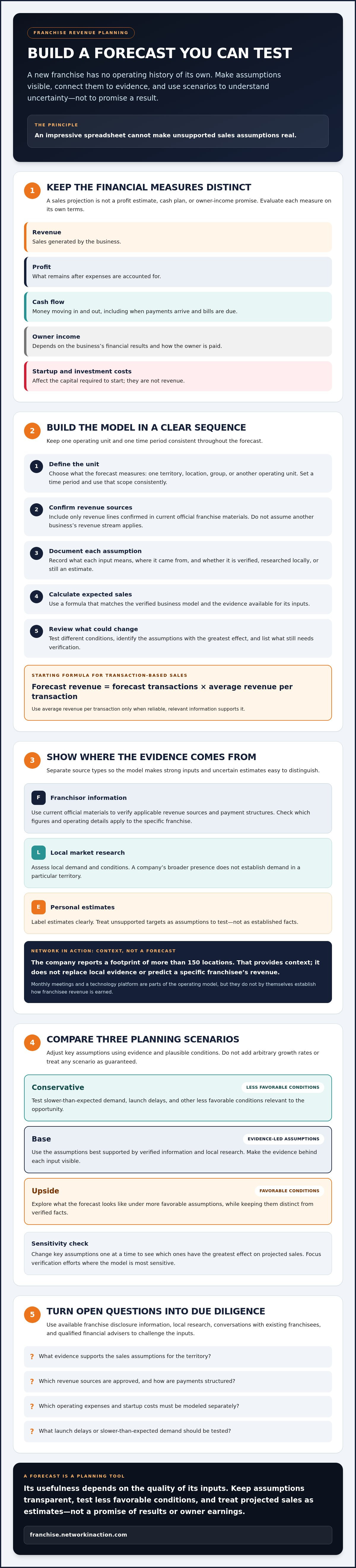
An impressive spreadsheet can’t make unsupported sales assumptions real. If you’re asking how to forecast revenue for a new franchise with little or no operating history, don’t borrow an optimistic target and treat it as fact. Build a model from assumptions you can test.
Before committing, it’s reasonable to want a clear view of earning potential. Revenue, profit, cash flow, and owner income can tell very different stories. A useful forecast makes those distinctions visible without promising a result.
This guide shows you how to set transparent revenue assumptions, build conservative, base, and upside scenarios, and identify what still needs verification. You’ll also learn how to use available franchise disclosure information and conversations with existing franchisees to challenge your inputs. For a local networking-group opportunity such as Network In Action, the company’s reported footprint of more than 150 locations provides context, not a substitute for local evidence. Your forecast should reflect verified revenue streams and local conditions, with each scenario treated as a planning tool, not a guarantee.
Key Takeaways
- Learn how to forecast revenue for a new franchise by defining the business unit, confirming applicable revenue sources, and documenting each assumption.
- Separate franchisor information, local market research, and personal estimates so you can see which inputs need stronger evidence.
- Build conservative, base, and upside scenarios by adjusting key assumptions, not by adding arbitrary growth rates.
- Use sensitivity checks to identify which assumptions have the greatest effect on projected sales.
- Turn gaps in your model into specific questions for the franchisor and qualified financial advisers before you make a commitment.
Why Forecast Revenue for a New Franchise Before You Commit?
Before launch, you won’t have a track record for your own location. A disciplined forecast can’t remove that uncertainty, but it can show which assumptions have support, which need checking, and how different conditions could affect your decision.
A revenue forecast estimates sales over a defined period under stated assumptions. It’s one part of a broader financial forecast, and a planning tool rather than a promise of actual results or owner earnings. Its usefulness depends on the quality of its inputs. Local demand, launch timing, and execution can all affect results.
Keep the financial measures separate. Revenue is sales generated by the business. Profit is what remains after expenses are accounted for. Cash flow tracks money moving in and out, including when payments are collected and bills are due. Owner income depends on the business’s financial results and how the owner is paid. Franchise investment costs are separate: they affect the capital required to start, but they aren’t revenue.
What a franchise revenue forecast can, and cannot, tell you
A forecast can help you compare opportunities using consistent assumptions and test whether a plan remains workable under less favorable conditions. It can’t tell you exactly what your location will earn. Treat projected sales as estimates and trace each one to its evidence. For a local networking-group franchise, the company’s presence or established operating model may provide context, but neither proves local demand or predicts a specific franchisee’s revenue.
Which financial questions should the forecast answer?
Start with the sales target: what level does the model assume, over what period, and what activity or customer demand would produce it? Use current official materials to confirm which revenue streams and payment structures apply to the specific franchise. Don’t assume a revenue source used by another franchise applies to this one.
Keep gross revenue assumptions separate from operating expenses and cash requirements. A business can record sales and still face a cash shortfall if expenses are due before expected payments arrive. Before comparing opportunities, write down unresolved questions, such as:
- What evidence supports the sales assumptions for the territory?
- Which revenue sources are approved, and how are payments structured?
- What operating expenses and startup costs must be modeled separately?
- What launch delays or slower-than-expected demand should be tested?
These questions turn uncertainty into a due diligence plan. Next, build the model in a clear sequence, using verified inputs rather than optimistic guesses.
How to Build the Revenue Model for a New Franchise
Revenue forecasting estimates expected sales by connecting defined assumptions to measurable business activity. It isn’t profit forecasting: revenue is the sales generated, while profit accounts for expenses. Keeping the two separate prevents a sales projection from being mistaken for take-home income.
To understand how to forecast revenue for a new franchise, build the model in sequence: define the unit, identify confirmed revenue sources, document assumptions, calculate expected sales, then review the result. The U.S. Small Business Administration’s guide to how to write a business plan also emphasizes planning inputs such as market research and financial projections.
Define the franchise unit and its revenue sources
First, choose what the forecast measures: one territory, location, group, or another operating unit. Set a time period, such as a month or year, and use the same scope throughout. A forecast that mixes unit sizes or time frames won’t support a useful comparison.
Next, list only revenue lines confirmed in the franchise’s current official materials. Don’t assume a revenue stream applies because another business uses it. When evaluating Network In Action, verify the franchisee revenue model and payment structures before entering figures. Monthly meetings and a technology platform are confirmed parts of the operating model, but they don’t establish how franchisee revenue is earned.
Turn assumptions into a simple forecast formula
For a business where sales arise from transactions, a starting formula is:
Forecast revenue = forecast transactions × average revenue per transaction
Identify the drivers behind each input. Depending on the verified business model, these could include the number of customers, transactions, retention, or service frequency. Use average revenue per transaction only when reliable, relevant information supports it. If that input doesn’t fit the franchise’s revenue structure, use a calculation method that matches the confirmed payment model. Don’t force a familiar formula onto the wrong business.
Keep the evidence beside the numbers. Label each assumption as franchisor-provided information, local research, or a personal estimate. Record the source, period, and uncertainty so another reviewer can trace how each figure was reached. For a local networking-group franchise, company-wide presence is context, not a substitute for local evidence.
Before relying on the model, check that its unit, revenue lines, assumptions, and calculations align. If you’re evaluating Network In Action, the franchise kit can help you review opportunity-specific information before finalizing inputs. A transparent model is easier to challenge, update, and compare.
Which Franchise Revenue Assumptions Should You Compare?
A projection is only as credible as its evidence and definitions. A sales estimate based on local research differs from one based on an untested belief, even if both appear as clean figures in a spreadsheet. For a useful comparison, show where each input came from, whether it fits the proposed territory, and how much uncertainty remains.
Use three labels throughout your model: franchisor-provided information, local research, and personal assumption. This makes it easier to see which inputs you can verify and which need more investigation. It also prevents company-wide information from being mistaken for proof of local demand.
Check demand, customer acquisition, and revenue timing
Check whether demand evidence matches the territory, target customer, and business model. Broad industry interest may provide context, but it doesn’t establish that enough prospective customers are available locally or that they’ll choose this specific offering.
Model a realistic ramp-up rather than assuming full capacity at launch. Consider how customers are expected to find the business, how long it could take to build relationships, and when activity becomes collected revenue. Keep each stage distinct: a lead is not a referral, a referral is not a signed agreement, and a signed agreement is not necessarily money collected. For a local networking-group franchise, verify what activity leads to franchisee revenue rather than assuming meeting attendance or referrals translate directly into sales.
Separate verified information from estimates
For every important input, record its source, time period, relevance, confidence level, and effect on forecast revenue. A simple assumption log could look like this:
- Local demand: Source and territory covered; confidence based on how closely the evidence matches the target market.
- Customer acquisition: Expected path from initial interest to a paying customer; mark unsupported conversion estimates as assumptions.
- Revenue timing: When a sale is earned and when payment is expected; confirm the applicable terms in official materials.
- Sales volume: Expected transactions or customers over a stated period; note how changing the input affects the result.
When reviewing franchise disclosure materials or other franchisor-provided figures, ask what period, locations, and operating conditions they represent. If financial performance information is provided, check exactly what it covers and whether it’s relevant to your model. Don’t treat a figure as comparable until its definitions and scope are clear.
These checks are central to how to forecast revenue for a new franchise without letting optimism pass as evidence. For a Network In Action opportunity, verify the franchisee revenue model and local assumptions directly. Its reported presence across multiple locations provides context, not a forecast for a particular territory. Record unanswered questions and resolve them before using the projection to compare opportunities.
How to Test a New Franchise Revenue Forecast with Scenarios
Scenario analysis tests assumptions; it doesn’t predict certainty. Conservative, base, and upside cases show how results could shift under different conditions. They’re planning tools, not promises, and the upside case shouldn’t be treated as the expected outcome.
Build each scenario from evidence about demand, launch timing, and customer retention. For example, a conservative case might model slower customer acquisition if local research or conversations with existing franchisees point to a gradual ramp-up. The base case can reflect the assumptions you consider most supportable. An upside case may test stronger demand or faster traction, but explain what evidence would make that outcome plausible. Avoid adding arbitrary growth percentages.
Build scenarios that reflect uncertainty
Keep the model’s structure consistent across all three cases. Change the assumptions, not the calculation rules. If expected transactions fall or take longer to materialize, update related revenue timing and cash needs too. For each case, track these measures separately:
- Revenue: Expected sales based on the scenario’s stated inputs.
- Expenses: Operating costs under the same activity and timing assumptions.
- Cash flow: When money is expected to come in and payments are due.
- Owner compensation: What may be available to the owner after business requirements are considered, not a synonym for revenue.
This separation helps you see whether a change affects sales alone or also creates pressure on expenses, cash, or owner pay.
Use sensitivity analysis to find the highest-impact inputs
Sensitivity analysis changes one assumption at a time to reveal which inputs move the result most. Test customer volume, launch timing, or retention individually before combining them into a scenario. If a small change in one assumption shifts projected revenue substantially, prioritize that input for verification.
Then ask what evidence could resolve the uncertainty. Can territory-level demand be better supported? Does the franchisor provide relevant information about ramp-up timing or revenue drivers? Are the assumed payment terms confirmed? These questions make the model useful for due diligence, not just presentation.
For a local networking-group franchise, use confirmed franchisee revenue information and local evidence, not company-wide presence as a proxy for territory results. To review opportunity-specific details for Network In Action, explore the franchise opportunity kit and check which assumptions it can substantiate.
How to Use Your Forecast to Evaluate a Franchise Opportunity
A forecast earns its value when it improves your decision, not when it confirms what you hope to see. Use it to compare opportunities by the quality of their evidence, the assumptions they require, and the operating demands behind projected sales. Headline projections alone can hide differences in what’s counted, when revenue is expected, and what the owner must do to reach it.
Turn every gap in your model into a direct question for the franchisor or a qualified financial adviser. Seek clear definitions before relying on supplied figures. If an answer depends on local conditions or personal execution, keep it labeled as an assumption rather than treating it as established fact.
Questions to resolve before relying on the forecast
Ask how any performance information was sourced, what period and locations it covers, and whether the operating conditions resemble the proposed territory. Clarify which revenue lines, expenses, fees, and other costs are included or excluded from supplied calculations. If the model depends on an input you can’t verify, ask what evidence could support it and how the result changes if the assumption proves wrong.
Use the same questions for every opportunity you compare. A consistent review makes it easier to distinguish a well-supported projection from one that relies on optimistic assumptions, even when the headline numbers look similar.
Explore the Network In Action opportunity with clear questions
When evaluating Network In Action, treat the confirmed monthly meeting model and proprietary technology platform as operating context, not automatic revenue drivers. Ask how, if at all, each affects approved franchisee revenue streams, operating requirements, or timing, then verify the answers against current official materials. The company’s reported location count doesn’t establish what a specific territory will sell.
Review the Network In Action franchise kit alongside your model, and compare your assumptions with official opportunity information. You can also check the published information on available franchise territories as part of assessing whether the opportunity aligns with your plans. Neither step replaces independent financial review, but both can help focus your questions before proceeding.
The goal of how to forecast revenue for a new franchise isn’t to manufacture certainty. It’s to identify what the decision depends on, verify what can be verified, and make a deliberate choice with a clear view of what remains unknown.
Make Your Next Franchise Decision With Clarity
A useful forecast isn’t a promise. It’s a transparent model built from defined revenue sources, evidence-based assumptions, and scenarios that show how results may change. Keep sales separate from profit, cash flow, and owner compensation, then use gaps in the model to guide your questions before committing.
That discipline matters when evaluating Network In Action. The company reports more than 150 locations across the United States and several other countries. Its operating model includes monthly meetings, a proprietary technology platform, and franchisee training and support. These details provide context, not a prediction of revenue for a specific territory. Verify the applicable revenue model and opportunity-specific information before relying on any projection.
Understanding how to forecast revenue for a new franchise helps you compare opportunities with greater confidence and identify what still needs validation. Explore the Network In Action franchise kit to review official opportunity information and assess whether the model aligns with your goals. Start by reviewing the kit and listing the assumptions you need to verify.
Frequently Asked Questions
How do you forecast revenue for a new franchise with no operating history?
Build a forecast from measurable assumptions and relevant evidence, even if your own location has no track record. Define the operating unit and period, confirm approved revenue sources, then estimate the activity that could generate sales. Use local market research and applicable franchisor-provided information, noting where personal assumptions fill gaps. Test slower and stronger outcomes, and update the model as verified information becomes available.
What assumptions should a new franchise revenue forecast include?
Include the assumptions that connect local demand to collected sales: customer or transaction volume, acquisition timing, retention or repeat activity where relevant, and average revenue per transaction if reliable information supports it. Confirm which revenue sources and payment structures apply to the franchise. Keep startup costs, operating expenses, cash requirements, and owner compensation separate from gross revenue, and label each input by source and confidence.
Can franchise revenue projections be trusted?
Projections can inform a decision, but they shouldn’t be treated as promises. Their credibility depends on clear definitions, relevant evidence, and assumptions that fit the proposed territory. Ask what period and locations any supplied figures cover, what conditions they reflect, and which costs or revenue lines are included. Compare those details with local research and seek clarification on unverified inputs before relying on the projection.
What is the difference between franchise revenue, profit, and cash flow?
Revenue is the sales generated by the business. Profit is what remains after expenses are accounted for, while cash flow tracks when money enters and leaves the business. These measures answer different questions: sales indicate business activity, profit reflects financial performance, and cash flow helps show whether funds are available when obligations come due. Owner compensation is also distinct and shouldn’t be inferred from revenue alone.
How do you create conservative, base, and upside franchise scenarios?
Create each case by changing evidence-based assumptions, not by applying arbitrary growth percentages. A conservative case might reflect slower launch activity or customer acquisition; a base case uses the assumptions best supported by available evidence; an upside case tests stronger conditions without treating them as expected. Track revenue, expenses, cash flow, and owner compensation separately in each scenario so you can see how the same change affects the wider business.
What information should you request before using a franchise revenue forecast?
Request the definitions and sources behind any performance figures, including the time period, locations, and operating conditions they represent. Confirm which revenue streams and payment structures apply, and which costs or fees are included or excluded. Ask how the assumptions relate to your territory and what evidence supports launch timing and demand. For a Network In Action opportunity, review official franchise materials and clarify its operating and financial details before using them in your model.