
A territory label can sound like a guarantee, but the rights behind it depend on the agreement’s exact language. Understanding territory rights in a franchise agreement means looking beyond the map to see whether your area is exclusive, protected, or non-exclusive, and what the franchisor can still do within its boundaries.
Your concern is practical: another franchisee, the franchisor, or an alternate sales channel could reach customers you assumed were yours. The written terms, not the label alone, determine how much room you have to build locally.
This article explains how common territory types differ, which carve-outs and boundary details deserve close attention, and how future changes may affect your plans. You’ll also learn what to clarify when a map leaves borders open to interpretation or the agreement reserves rights to serve customers inside your area. Before assessing any franchise opportunity, request current territory information and franchise documents, then review them with a franchise attorney. Clear answers can help you assess the operating model and make a more informed decision before signing.
Key Takeaways
- Understanding territory rights in a franchise agreement starts with the written grant, not just the territory label or a map.
- Identify how reserved accounts, online activity, and other sales channels could affect customer access within a stated area.
- Compare exclusive, protected, and non-exclusive terms by checking what the agreement says about competing locations and sales rights.
- Use a structured review to compare maps, written boundaries, exceptions, and future change terms before signing.
- When assessing Network In Action, consider its monthly meetings, technology platform, and franchisee training separately from territory terms, which must be verified in current documents.
Understanding Territory Rights in a Franchise Agreement
A franchise territory is the geographic area, customer group, channel, or other scope described in the franchise documents. It may shape where you develop relationships, pursue customers, and plan local operations. But a boundary on a map is not automatically a promise that every customer or sale within that boundary belongs to you.
A territory description identifies a defined scope; contractual rights determine what the franchisor and franchisee may do within it. That distinction is central to understanding territory rights in a franchise agreement. The Franchise Agreement is where to examine how territory fits with the other terms of the relationship, not just what a territory is called.
Exclusive, protected, and non-exclusive territories: what the labels suggest
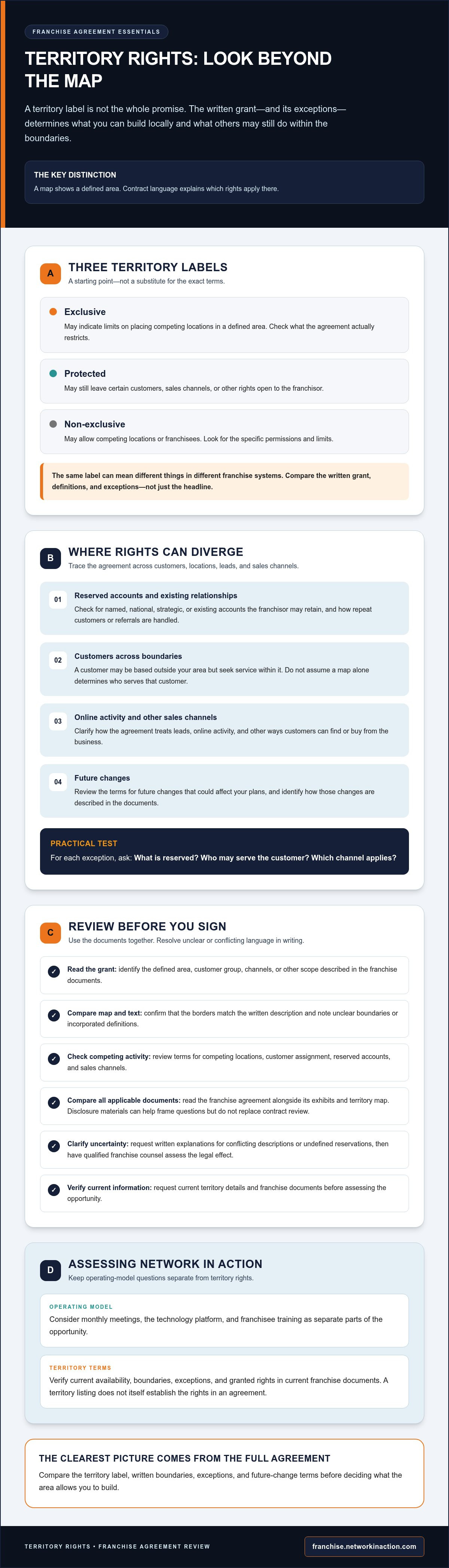
These labels offer a starting point, not a complete explanation. “Exclusive” may indicate limits on placing competing locations in a defined area. “Protected” may still leave certain sales channels or customers open to the franchisor. “Non-exclusive” may allow competing locations or franchisees. The actual scope depends on the agreement’s definitions and exceptions.
Compare the written terms, not just the headline. Check how the agreement addresses competing locations, customer assignment, reserved accounts, and sales channels. Two franchise systems can use the same label while granting different rights. Ask what the franchisor can do inside the stated area and what activity, if any, is restricted.
Where the territory grant appears in franchise documents
Read the franchise agreement alongside every applicable exhibit and territory map. Confirm that the map’s borders match the written description, and note how the documents handle unclear boundaries or incorporated definitions. A map makes an area easier to visualize, but the written terms explain what rights attach to it.
Disclosure materials can help you frame questions about the opportunity and its territory, but they don’t replace review of the contract you may sign. If the documents use conflicting descriptions or leave a key term unclear, get the franchisor’s explanation in writing and ask qualified franchise counsel to assess the legal effect, including any jurisdiction-specific issues.
For a Network In Action opportunity, verify current territory availability, boundaries, and rights against current franchise documents. The available franchise territories page can help you begin that inquiry, but it doesn’t establish the rights granted by an agreement.
How Franchise Territory Rights Work and Where Exceptions Apply
A territory grant can define where you’re expected to build local relationships, but it may not control every customer, lead, or sale connected to that area. A franchisor might reserve certain accounts, serve customers through another channel, or set rules for inquiries that cross geographic boundaries. The practical question is not only “Where is the territory?” It’s also “Which rights apply to each way customers can find and buy from the business?”
Exceptions can narrow a territory’s practical value, even when its geographic boundary looks broad. For a clearer picture, trace the agreement’s language across customers, locations, leads, and sales channels. The Federal Trade Commission’s Consumer's Guide to Buying a Franchise offers background on franchise disclosures. Use disclosure materials to form questions, then check the executed agreement and related documents for the actual terms.
Carve-outs, reserved accounts, and customers outside the boundary
Look for language covering national or strategic customers, named accounts, existing relationships, and other rights the franchisor keeps. Then ask how the agreement treats referrals, repeat customers, and people whose work or location spans more than one territory. For example, a customer may be based outside your area but seek service within it. Don’t assume the agreement assigns that customer to you based on a map alone.
Broad or undefined reservations deserve attention before signing. Ask the franchisor to explain how each carve-out works in practice, and request clear written definitions where the documents leave room for different interpretations. Your goal is to understand what is reserved, how it’s applied, and whether the same customer could be served through more than one territory.
Online sales, leads, and other channels
Geography doesn’t answer every digital question. Check how online inquiries and centrally generated leads are assigned: by the customer’s location, the referral source, or another stated method. Review terms for digital marketing, online sales, and customers who cross territory boundaries. A geographic boundary doesn’t automatically establish how those channels are handled.
Ask for a specific explanation of the process, then compare it with the written terms. If you’re evaluating Network In Action, review current franchise territory information as a starting point, and verify boundaries, rights, and exceptions in current franchise documents. These details matter when assessing how the operating model fits your local growth plans.
Comparing Franchise Territory Rights: Questions That Reveal the Difference
Labels are useful for an initial comparison, not a final decision. Two agreements may both use “protected territory” yet differ on competing locations, reserved accounts, or online sales. To understand territory rights in a franchise agreement, compare what each contract permits and restricts across the same categories.
| What to compare | Exclusive wording may suggest | Protected wording may suggest | Non-exclusive wording may suggest |
|---|---|---|---|
| Boundaries | A defined area with limits on certain competing units | A defined area, subject to stated exceptions | An area that may overlap with others |
| Competing locations | Limits on franchisor or franchisee locations, as written | Limits that may be narrower or conditional | Other locations may be permitted |
| Reserved rights | Check for exceptions; the label alone doesn’t settle them | Review expressly reserved accounts and channels | Confirm which rights remain with the franchisor |
| Customers and channels | Assignment and channel rules still need review | Customer or channel protections may be limited | Customer overlap or competing channels may be allowed |
These are general signals, not guaranteed definitions. The signed agreement controls. A legal discussion of exclusive territories and franchisor-retained rights can help frame your review of the Franchise Disclosure Document, but confirm every point against the current documents for the opportunity you’re evaluating.
Compare the written rights and exceptions, not the labels alone.
What to compare across franchise opportunities
Check that each territory map matches its written description, including included areas and boundary references. Then compare limits on new units, competing activity, and direct franchisor sales. Keep a list of open questions and ask for written answers that identify the relevant agreement language. Document-based answers make opportunities easier to assess side by side.
How territory size relates to the business opportunity
Assess whether the proposed boundary fits the intended customer base and local market, but don’t treat area size as a forecast of demand, revenue, or your results. Review any limits on growth, along with the written process, if one exists, for expanding or adjusting the territory. A larger map isn’t automatically a stronger opportunity; the rights behind it matter.
A Franchise Territory Agreement Review Checklist Before You Sign
Use a consistent review sequence before you commit. Understanding territory rights in a franchise agreement means checking how each document defines your area and what activities, customers, or channels may fall outside the grant. Don’t rely on a verbal summary or a map viewed on its own. Record unanswered questions and request written clarification tied to the proposed agreement.
- Review the map. Note the boundaries, included areas, and any labels or references that need explanation.
- Read the territory grant. Compare the map and every exhibit with the agreement’s written description. Flag any mismatch.
- Identify exceptions. Look for reserved accounts, franchisor-retained rights, existing customers, and other carve-outs.
- Check channel rules. Find out how digital leads, online activity, referrals, and customers who cross territory boundaries are handled.
- Review change terms. Look for provisions addressing relocations, boundary adjustments, amendments, or renewal.
- Resolve open questions. Keep a written list, request answers linked to the relevant clause, and confirm any agreed clarification in writing.
This process helps you evaluate what the documents actually say, not what you expect a territory label to mean. Treat each unresolved point as a decision item before signing.
Questions to ask the franchisor about boundaries and exceptions
Ask what activities the proposed territory does and doesn’t protect. How are online leads, reserved accounts, relocations, and customers who cross territory lines handled? What process applies if a boundary is unclear or disputed? Request current written territory details and compare them with the agreement. If you’re evaluating Network In Action, review available franchise territories as a starting point, then verify current boundaries and rights in the franchise documents.
When to involve a franchise attorney
Ask qualified franchise counsel to review ambiguous grant language, broad carve-outs, and amendment or renewal provisions. Counsel can also compare the agreement with applicable disclosure materials and your business expectations, and assess jurisdiction-specific issues. Educational guidance can help you prepare, but it isn’t legal advice and doesn’t replace independent counsel. Get the terms clear before you make assumptions or sign.
Assessing Network In Action Franchise Territory Rights
Territory is one part of evaluating a franchise opportunity. You also need to understand the local leadership role, operating expectations, and how the model supports relationship-driven growth. Network In Action describes a model built around monthly meetings, a proprietary technology platform that keeps members connected, and training and support for franchisees building and managing local groups. Those features describe the operating model, not the territory rights granted in a particular agreement.
When reviewing territory rights in a franchise agreement, keep the business model and the contract separate. Meetings, technology, and training don’t establish exclusivity, protect specific customers, or guarantee financial results. The current written documents determine the territory grant, its boundaries, and any exceptions. Confirm those terms directly before deciding whether the opportunity fits your plans.
Match territory terms to the way you plan to build locally
Consider whether community leadership and developing professional relationships match how you want to work. Then ask how the proposed territory relates to local group development, member connections, and the support franchisees receive. Clarify which rights apply to the location and customer base you’re evaluating, and whether any reserved accounts or channels affect that scope. Treat the answers as contract questions, not assumptions based on the model’s features.
A technology-enabled system may support how a network operates, but it doesn’t define where you may operate or how customer activity is assigned. Review the agreement and disclosure documents for those details. Assess the territory alongside your operating expectations, growth plans, and the responsibilities of leading locally.
Take the next step with clear territory questions
Before making a decision, prepare a written list and request clear answers on:
- The proposed boundaries and how they are described in the current documents
- Exceptions, reserved accounts, and any limits on competing activity
- How online activity, digital leads, and customers crossing boundaries are handled
- Whether and how territory terms can change over time
Request current franchise materials and have qualified franchise counsel review the terms before you commit. To explore the opportunity and begin reviewing its materials, visit the Network In Action franchise kit. Use that exploration to ask focused questions, then confirm territory availability, exact boundaries, and contractual rights against the current documents.
Make Your Next Franchise Decision With Clarity
Understanding territory rights in a franchise agreement means more than choosing a location. Read the grant, compare the map with the written boundaries, and clarify how exceptions, customer assignments, and sales channels may affect your plans. The label matters less than the rights the current documents actually provide.
That same discipline applies when assessing Network In Action. The company reports more than 150 locations across the United States and several other countries. Its model includes franchisee training and support for building and managing local professional referral groups, plus a proprietary technology platform that supports ongoing member connection. These features describe the business model, not a promise of territory protection or financial results. Confirm current availability, boundaries, and exceptions in writing, and review the documents with qualified counsel.
If the opportunity aligns with your goals for local leadership and relationship-driven growth, explore the details. Explore the Network In Action franchise opportunity and request current materials to support your evaluation. Start with informed questions, then assess the territory terms in the documents.
Frequently Asked Questions
What do territory rights mean in a franchise agreement?
Territory rights describe the scope the franchise agreement grants or limits, often by geography, customers, locations, or sales channels. Understanding territory rights in a franchise agreement means reading the grant alongside its definitions, maps, exhibits, and exceptions. For example, a defined area might limit certain competing locations but still leave online sales or reserved accounts outside the protection. The exact written terms determine the practical scope.
Is an exclusive franchise territory completely protected from competition?
No. “Exclusive” doesn’t automatically mean every customer, sale, or channel is protected from competition. The agreement may define which locations or activities are restricted while reserving rights for the franchisor, such as serving particular accounts or using other channels. Review the grant and carve-outs together. Ask what forms of competition remain possible within the boundaries, and get unclear points explained in writing before signing.
What is the difference between an exclusive and protected franchise territory?
The distinction depends on how each agreement defines the terms. Exclusive wording may restrict certain competing locations within a defined area, while protected wording may allow exceptions, such as sales through specified channels. Neither label guarantees a particular level of protection across all franchise systems. Compare the clauses covering competing units, franchisor-retained rights, customers, and sales channels instead of assuming the labels have standard meanings.
Can a franchisor sell to customers inside my franchise territory?
Possibly. The agreement may reserve the franchisor’s right to serve named or strategic accounts, sell through certain channels, or handle customers in ways that overlap with your territory. A geographic boundary alone doesn’t settle who may serve every customer inside it. Check the agreement for reserved rights and customer-assignment rules. Ask the franchisor for written clarification about any sales activity that the contract language leaves unclear.
Do franchise territory rights cover online leads and customers?
Not necessarily. A geographic grant may not explain how online inquiries, centrally generated leads, or customers who cross territory lines are assigned. Look for specific contract language on digital activity, lead distribution, online sales, and customer location. Ask whether assignment depends on where the customer is based, how the lead originated, or another stated method. Confirm the answer against current written documents rather than relying on assumptions.
Can a franchisor change a franchise territory after signing?
Whether a territory can change depends on the agreement’s terms and any applicable legal requirements. Review provisions on boundary adjustments, relocations, amendments, renewal, and how changes are documented. Don’t assume the territory is fixed or that it can be changed unilaterally without checking the contract. If the language is ambiguous or a proposed change affects your plans, ask a qualified franchise attorney to assess the specific documents.
Should a franchise attorney review territory rights before I sign?
Yes. A qualified franchise attorney can assess the territory grant, maps, exceptions, customer and channel provisions, and any terms that address future changes. Counsel can also compare the agreement with applicable disclosure materials and flag language that doesn’t match your business expectations. Bring a written list of unresolved questions and ask for advice based on the actual documents and relevant jurisdiction. Educational guidance isn’t a substitute for independent legal advice.