
A member rarely cancels out of nowhere. Silence often comes first: fewer conversations, less participation, and a community that feels valuable only on meeting day. For leaders building a franchise business with recurring revenue, those signals matter. Retention depends on making the value of belonging visible before a member starts considering the exit.
You already know that strong relationships and useful experiences give people a reason to stay. The challenge is delivering that value consistently, not scrambling to recover it at renewal time. This article lays out practical ways to spot disengagement earlier, keep the community relevant between scheduled meetings, and create a repeatable retention process without pressure or forced referrals.
The approach is structured, not complicated: notice changes in participation, follow up with a purpose, and make ongoing connection part of the member experience. Network In Action’s model offers a practical example, with monthly group meetings supported by a proprietary technology platform that helps members stay connected. Together, consistent touchpoints can strengthen relationships and make recurring revenue more sustainable.
Key Takeaways
- Watch for shifts in participation, then ask members directly what’s affecting their experience before deciding how to respond.
- Distinguish a fixable community issue from a change in a member’s priorities, and tailor follow-up accordingly.
- Make renewal value tangible through thoughtful onboarding, relevant participation, and relationship-building, not activity quotas or referral pressure.
- Build a retention cycle with clear ownership for check-ins, follow-up, and review so member concerns lead to action.
- For a franchise business with recurring revenue, sustainable operations depend on ongoing member value, not an assumption that revenue is guaranteed.
How member churn threatens recurring revenue in a paid community
Member churn happens when someone ends or doesn’t renew participation in a paid community. It’s a clear outcome, but often not a sudden one. A member may first become less involved, stop responding, or lose sight of what the community contributes to their goals. These changes don’t prove a cancellation is coming, but they can give operators a reason to check in.
Retention is the consistent delivery of member value that gives people a meaningful reason to continue. That principle matters to any community funded by recurring payments. Revenue depends on members choosing to stay, not simply on the existence of a renewal date. A franchise business with recurring revenue should treat retention as an operating priority, not a financial guarantee: member value can support continued participation, but it can’t promise a particular revenue result.
What member churn looks like before someone cancels
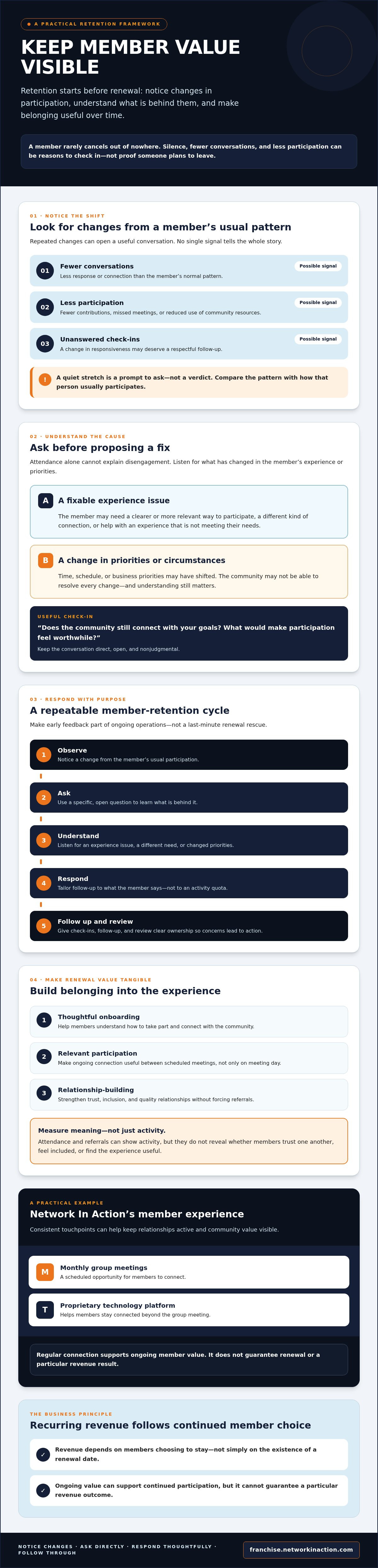
Look for changes from a member’s usual pattern, not a universal activity quota. For example, someone who regularly attends monthly meetings may begin missing them, contribute less to group conversations, or leave check-ins unanswered. Any one change could reflect a busy period or shifting priorities. It’s a possible signal, not proof of intent to leave.
Track patterns respectfully, then reach out with a specific, open question. A direct conversation can reveal whether the person needs a different kind of connection, has encountered an experience issue, or simply has less time to participate. Avoid treating silence as a verdict.
Why recurring revenue is linked to member experience
Members are more likely to consider renewing when the experience continues to feel relevant and trustworthy. Useful connections, thoughtful follow-up, and clear reasons to participate can reinforce value over time. A primer on customer churn explains the broader idea of people ending a customer relationship; in a paid community, the practical question is whether members still see a reason to remain.
Measure more than attendance or referrals. Raw counts may show activity, but they don’t reveal whether members trust one another, feel included, or find the experience useful. Quality relationships matter. They help make the community’s value tangible without turning participation into a quota or pressuring members to produce referrals. For a franchise business with recurring revenue, that distinction keeps retention grounded in the member experience rather than wishful forecasting.
How to identify the causes of member churn before renewal
Renewal conversations work better when they’re part of an ongoing process, not a last-minute attempt to reverse a decision. Use a simple sequence: observe, ask, understand, respond, and follow up. Notice a change from someone’s usual participation, ask what’s behind it, and listen before proposing a fix.
Attendance alone can’t explain why someone disengages. A member may miss meetings because of a temporary schedule change, shifting business priorities, or an experience that no longer meets their needs. Research from Harvard Business School also highlights that loyalty can be more complex than satisfaction alone. Don’t assume that extra attention or a positive past experience guarantees someone will stay.
Early feedback gives you time to understand and respond; last-minute renewal outreach gives you little room to learn. For anyone evaluating a franchise business with recurring revenue, that distinction matters: retention is supported by a responsive member experience, not guaranteed by a renewal cycle.
Which disengagement signals deserve a conversation?
Look for repeated changes, such as missed meetings, fewer contributions, reduced use of community resources, or unanswered check-ins. Compare the pattern with that member’s normal way of participating. Someone who has always preferred one-to-one conversations may not post often, while a regular contributor who suddenly goes quiet may warrant a thoughtful check-in. One missed event or quiet stretch is not proof of likely cancellation.
Ask whether the community still connects with the member’s goals. The answer may point to a fixable experience issue, such as unclear ways to participate, or a change in priorities or circumstances that the community can’t resolve.
How to ask members what would make participation worthwhile
Keep the conversation direct and nonjudgmental. Questions like these invite useful feedback without putting the member on the defensive:
- “What’s been most useful to you lately, and what’s missing?”
- “Are you making the kinds of connections you hoped to make?”
- “What would make participation fit your current goals and schedule?”
Listen without defending the community or promising a particular result. Record recurring themes consistently, while limiting notes to what’s useful and respecting personal boundaries. Then respond to what can be changed, explain what can’t, and follow up to close the loop. To explore how Network In Action structures its franchise opportunity, review the franchise opportunity kit.
Which retention practices make a paid community feel worth renewing?
A passive membership asks people to find value on their own. An intentional community makes that value easier to recognize through clear onboarding, useful participation, and relevant follow-up. The distinction isn’t about keeping members busy. It’s about helping them build relationships that serve their goals, without turning attendance or referrals into quotas.
Trust-based connections are central to referral marketing strategy: a relevant introduction can be more valuable than a long list of contacts. For broader context on ownership, see the business networking franchise model. These pages offer useful background, but a community’s retention practices should still respond to members’ actual needs.
How onboarding can establish value and belonging
Start by setting clear expectations. Explain how participation works, what resources are available, and what the community can’t promise. Then help each new member identify a relevant goal and appropriate ways to get to know others. A focused early check-in can surface confusion or unmet expectations before they turn into distance. Strong customer retention strategies begin with understanding the experience, not simply asking for another renewal.
How useful touchpoints sustain connection between meetings
Between scheduled events, prioritize purposeful contact over a stream of generic updates. Share a resource tied to a member’s stated interest, or suggest an introduction when there’s a clear reason and both people are comfortable with it. Network In Action’s model combines monthly meetings with a proprietary technology platform that helps members stay connected. The point is continuity, not constant activity.
Make the system visible with a simple member-value map. For each need, specify a useful touchpoint, the value it should deliver, and who owns the follow-up:
- Need: Meet relevant peers. Touchpoint: A consent-based introduction. Value: A focused relationship. Owner: The community leader.
- Need: Stay connected between meetings. Touchpoint: A relevant digital check-in. Value: Continued conversation. Owner: The assigned contact.
- Need: Get oriented. Touchpoint: An early onboarding conversation. Value: Clear expectations and next steps. Owner: The onboarding lead.
Review the map periodically. If a touchpoint isn’t useful, refine it. A franchise business with recurring revenue depends on continued member value, not activity counts alone, and no retention practice can guarantee a financial outcome.
How to build a repeatable member-retention process
Retention becomes more reliable when it’s built into how a community operates, rather than left to memory or renewal-season urgency. Use a simple cycle: onboard, connect, check in, learn, respond, and review. Assign a person to own each member conversation and its follow-up, so a concern doesn’t disappear when attention shifts elsewhere.
A practical process can be as simple as recording the next step after each check-in, noting who will take it, and revisiting open concerns during a regular review. Relationship-building should stay personal, even when the process is structured. For deeper guidance, the article “Referral Marketing Strategy: Unlocking Growth through Trust and Connections” explores how trust can support stronger professional relationships.
What to track without reducing relationships to a score
Choose a small set of indicators that helps you notice change without judging a member’s value. Track renewal decisions, participation patterns, recurring feedback themes, and whether promised follow-ups were completed. Pair each count or status with brief, relevant context: a shift in attendance may reflect a new priority, not dissatisfaction.
Use these indicators as prompts for supportive conversations, not as grounds for pressure. A franchise business with recurring revenue depends on members continuing to see value, but no metric can fully explain why a person stays or leaves. Review patterns to improve the experience, not to impose activity targets.
How to respond when a member is considering leaving
Start with curiosity. Ask what has changed and what, if anything, would make participation more relevant now. Listen before offering an adjustment. If the concern is within the community’s control, agree on a realistic next step and name who will follow up. Don’t imply that a change will guarantee a particular outcome.
If circumstances or priorities have shifted, respect the member’s decision. Thank them for sharing feedback and record only appropriate details that can help improve the experience. A consistent, respectful exit conversation can preserve goodwill, even when it doesn’t change the decision.
To explore how Network In Action’s franchise opportunity is structured, review the franchise opportunity kit.
How Network In Action’s franchise model applies member-retention principles
Network In Action franchisees lead local professional referral groups, with training and support from the company. The model puts community leadership and relationship-building at the center. For operators, that means member value is shaped not only by the scheduled gathering, but also by how connections continue between meetings.
A franchise business with recurring revenue depends on members choosing to continue, so consistent value matters. That is an operating principle, not a promise of retention, income, or specific franchise performance. Network In Action’s approach includes curated membership and no forced referrals, creating space for professional relationships to develop without treating referrals as an obligation.
How structured meetings and technology support ongoing connection
Monthly meetings create a regular opportunity for members to connect, share their professional perspectives, and build familiarity over time. The proprietary technology platform helps members stay connected between those gatherings. Its role is support, not substitution: technology can sustain contact, while trust and meaningful relationships still depend on people engaging with one another.
This structure offers a practical answer to the gap between scheduled meetings. A community leader can use the meeting as a consistent touchpoint, then encourage relevant connection between sessions without requiring constant activity or promising particular business results.
How to explore whether the franchise opportunity aligns with you
Consider whether you want to lead a local professional community, value relationship-driven growth, and are interested in business ownership. The model may appeal to professionals who prefer building credibility and connections over relying only on cold prospecting. Franchisees receive training and support, but the opportunity still calls for a clear-eyed assessment of your goals and fit.
For a broader ownership overview, look for the Business Networking Franchise guide. As you evaluate any franchise business with recurring revenue, distinguish the appeal of a recurring-revenue model from guaranteed financial outcomes. The right next step is informed exploration, not pressure.
Explore the Network In Action franchise opportunity to learn more and assess whether it aligns with your priorities.
Make member value part of how you lead
Strong retention doesn’t start at renewal. It starts with noticing changes in participation, asking thoughtful questions, and following through on what members share. A repeatable process helps you respond early while keeping relationships personal. Track patterns, but use them to guide conversations, not pressure people to stay.
For professionals considering a franchise business with recurring revenue, member experience is an operating priority, not a promise of financial performance. Network In Action franchisees lead local professional referral groups, with monthly meetings and a proprietary platform that helps members stay connected. Franchisees also receive training and support; confirm current program details as you evaluate the opportunity.
Consider whether community leadership and relationship-driven growth align with your strengths and goals. If they do, take a closer look at the model and decide whether it fits your vision for business ownership. Explore the Network In Action franchise opportunity at your own pace. A thoughtful next step can open the door to meaningful local impact and a business path worth exploring.
Frequently Asked Questions
How do you prevent member churn in a paid community?
You can reduce avoidable churn by making the community’s value clear and staying connected throughout the membership. Set expectations during onboarding, offer relevant ways to participate, and ask members what is working or missing. Notice changes in engagement and follow up respectfully rather than waiting for renewal. Use feedback to improve what’s within your control, while recognizing that no tactic can guarantee members will stay.
What are the most common reasons members leave a paid community?
Members may leave when the community no longer feels relevant, participation is difficult, expectations are unclear, or useful connections don’t develop. Personal and business circumstances can change, too. Don’t assume every departure means the community failed. Ask departing members for candid feedback, then look for repeated themes. Use those patterns to address fixable experience issues while respecting reasons that are outside the community’s control.
How can you tell if a member is about to cancel?
No single sign proves a member plans to cancel. Repeated absences, fewer interactions, or declining use of community resources may be changes worth discussing, especially if they differ from the person’s usual participation. Reach out with an open, nonjudgmental question instead of confronting or pressuring them. Listen to the answer, consider their circumstances, and suggest a next step only if it genuinely fits their needs.
How often should you check in with paid community members?
Check in when there’s a useful reason, not simply to increase contact. An early conversation after onboarding can clarify expectations, while later opportunities to share feedback can fit naturally into the community’s regular activities. The right cadence depends on the format and member expectations. Make it possible to raise concerns between scheduled touchpoints, and keep check-ins focused on the member’s experience rather than turning each conversation into a renewal pitch.
Can technology help reduce member churn in a paid community?
Technology can help operators organize follow-up, share relevant updates, and maintain connection between scheduled activities. Network In Action’s model includes monthly meetings and a proprietary technology platform that helps members stay connected. Tools can support relationships, but they can’t replace useful programming or thoughtful listening. Choose technology that serves members’ actual needs, explain how to use it, and review whether each digital touchpoint adds value instead of noise.
Does improving member retention guarantee recurring revenue?
No. Better retention practices can support continuity, but they can’t guarantee renewals or a particular financial result. Member decisions, operating costs, market conditions, and business-model terms can all affect outcomes. If you’re assessing a franchise business with recurring revenue, treat retention as one part of responsible operations. Understand why members stay or leave, improve what’s within your control, and review verified business information before making financial decisions.