The most lucrative business you can launch in 2026 is not a high-overhead sales machine; it is an executive leadership platform. Real influence. Scalable equity. If you're burned out by corporate politics and rightly skeptical of asset-heavy franchise concepts that simply trade an executive cubicle for retail headaches, your instincts are spot on. Today's top professionals are bypassing inventory risks, commercial buildouts, and massive payrolls to target high-ROI B2B franchise opportunities that convert professional relationship capital into recurring enterprise value.
You already know that long-term success requires working smarter, not longer. You want predictable revenue, recognized community leadership, and genuine lifestyle autonomy without the operational friction of traditional business models. In this executive guide, you will discover how high-caliber professionals leverage modern, technology-enabled platforms to capture high-margin returns. See how forward-thinking leaders leave behind the rigid, transactional grind of legacy networking organizations to build streamlined businesses engineered for sustained executive freedom.
Key Takeaways
- Discover why corporate executives are bypassing asset-heavy businesses to target scalable B2B franchise opportunities built on predictable recurring revenue.
- Unpack the hidden operational drain of legacy networking organizations and why modern alternatives favor high-trust monthly meetings over mandatory weekly attendance.
- Learn a rigorous evaluation framework to assess digital infrastructure, operational leverage, and territory potential before making an investment.
- See how proprietary technology and curated professional ecosystems allow owners to establish community leadership without taking on inventory or heavy payroll.
Defining B2B Franchise Opportunities in the 2026 Economy
Many legacy directories still define B2B franchising through an outdated lens: commercial cleaning contracts, printing shops, or direct-mail sales. That definition is obsolete. In today's market, modern B2B franchise opportunities focus on delivering high-value referral infrastructure, peer collaboration, and strategic systems directly to local business owners. High impact. Low drag.
Within contemporary business format franchising, the advantage has decisively shifted away from low-margin operational labor toward technology-enabled leadership. Unlike consumer retail models that fluctuate with volatile consumer confidence, B2B platforms provide mission-critical growth mechanisms that companies rely on across every economic cycle. Instead of buying an exhausting full-time job with physical inventory, forward-thinking owners secure a scalable leadership platform.
Service-Based vs. Relationship-Based B2B Models
Not all commercial franchises operate under the same economics. Traditional service franchises in staffing, commercial janitorial work, or logistics demand intense field management, vehicle fleets, and constant labor turnover. High overhead. Relentless friction.
Relationship-based platforms operate on a fundamentally different thesis. By facilitating curated networking ecosystems and strategic collaboration, these models swap heavy capital expenditures for executive social capital. Former corporate leaders are pivoting toward relationship-driven growth because it monetizes their existing business acumen without chaining them to operational micro-management, hourly shift coverage, or supply chain bottlenecks.
The Strategic Advantage of Business-to-Business Revenue
Transitioning into business ownership requires analyzing the structural economics of your customer base. Selling to business owners creates fundamental operational advantages that retail businesses cannot match:
- Higher lifetime value and retention: Professional clients treat business development investments as essential growth drivers, resulting in higher client retention and lower churn compared to fickle retail consumers.
- Predictable recurring revenue: Modern B2B models utilize recurring retainer and membership fee structures, generating steady cash flow that provides operational stability and long-term financial security.
- Zero cold prospecting: Instead of cold-calling uninterested prospects, owners leverage their professional credibility to convene decision-makers and build community authority from day one.
When you align predictable enterprise revenue with an asset-light operating model, you eliminate the typical headaches of business ownership while building sustainable equity.
Why High-Level Professionals are Pivoting to B2B Ownership
Decades inside corporate hierarchies teach senior executives an uncomfortable truth: working harder for an enterprise rarely translates into personal freedom. Long hours. Corporate restructuring. Capped upsides. Because of this friction, experienced executives increasingly evaluate B2B franchise opportunities to capture true lifestyle autonomy and redirect their skills toward equity they actually own.
Rather than committing massive capital to commercial leases, inventory management, or frontline payroll, corporate veterans are choosing asset-light structures. They recognize that their most valuable asset is not a retail storefront. It is their accumulated social capital, commercial insight, and community standing.
Escaping the Corporate Ceiling
Trading a predictable corporate salary for equity in an ownable professional ecosystem transforms your economic trajectory. In the corporate world, executive talent often gets treated as a line-item expense during market shifts. Operating a business-to-business enterprise reverses that dynamic, converting you into an indispensable value creator who convenes local commerce.
Building an executive-led business allows you to control your schedule while scaling an enterprise. When researching contracts and unit economics, reviewing the FTC guide to buying a franchise helps clarify how fee structures and operational disclosures support long-term profitability. Transitioning from employee to entrepreneur is no longer about taking reckless gambles; it is about deploying proven systems to run a predictable, high-margin business.
The ROI of Professional Credibility
Your professional track record functions as your primary marketing engine. Decades of corporate experience, relationship management, and leadership eliminate the need for clumsy cold outreach. Instead of pitching cold leads, you activate an existing sphere of influence:
- Reputational leverage: Your professional reputation immediately establishes trust with area founders, positioning you as an influential peer rather than a transactional salesperson.
- Relationship-driven growth: Executing a modern referral marketing strategy lets you build a powerful business ecosystem powered entirely by warm introductions.
- Strategic authority: Facilitating high-level executive connections places you at the center of local commerce, expanding your personal influence alongside your balance sheet.
Top performers know that true wealth comes from compounding professional relationships. If you want to see how elite operators transform their regional networks into scalable, equity-building assets, explore available territories to assess geographic potential in your market.
Traditional vs. Modern B2B Franchises: Efficiency and ROI
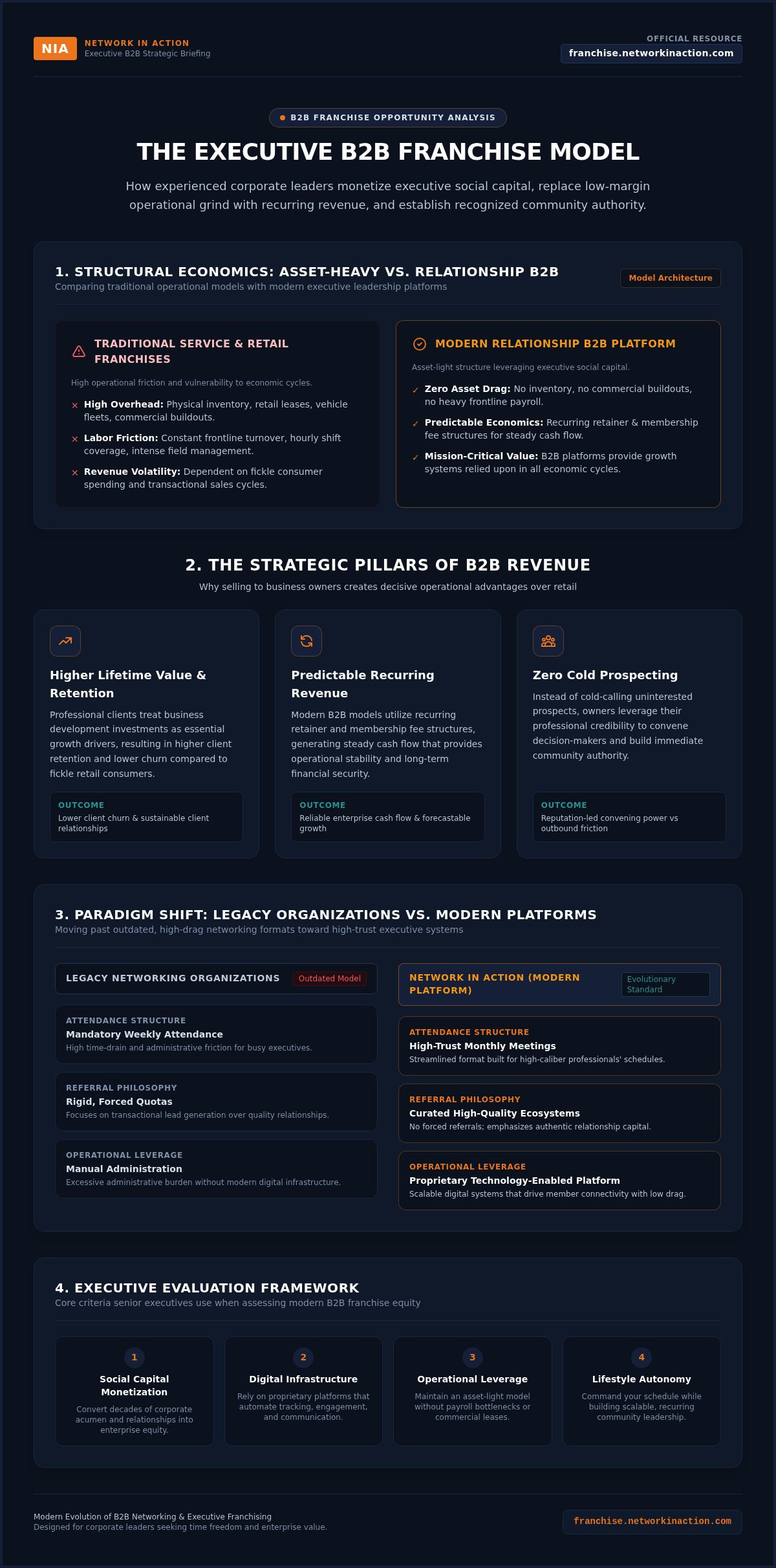
Most commercial organizations still operate on business frameworks invented decades ago. Outdated software. Endless administrative clutter. While older concepts still rely on brute force and manual labor, elite B2B franchise opportunities in 2026 leverage specialized software and modern operational structures to eliminate wasted effort.
The gap between legacy operations and modernized platforms comes down to efficiency. High-performing executives don't want to oversee chaotic daily operations or chase arbitrary activity quotas. They want automated, tech-led systems that yield measurable returns while protecting their time.
The Flaws of Legacy Networking Organizations
Traditional networking groups were created before cloud platforms, asynchronous messaging, and mobile infrastructure existed. As a result, legacy networking organizations force participants into an exhausting "time-tax" that repels serious enterprise leaders:
- The weekly attendance grind: Mandating rigid 7:00 AM weekly meetings drains business owners of over 80 hours every single year, consuming prime operational hours with low-impact formalities.
- Forced referral quotas: Demanding weekly referral minimums inevitably dilutes trust. When members are pressured to pass names just to hit an administrative quota, referral quality collapses into transactional noise.
- Manual tracking bottlenecks: Lacking dedicated software, older models still rely on paper slips or fragmented spreadsheets, leaving members unable to track true ROI or referral pipelines cleanly.
This operational friction creates high member turnover, making long-term retention an uphill battle for prospective operators.
The Modern Evolution: Informed Disruption
Modern professionals demand a superior alternative. Informed disruption replaces attendance-policed meetings with a curated, high-trust environment powered by exclusive digital architecture. The entire dynamic flips: quality replaces sheer volume.
Running a modern business networking franchise means trading rigid weekly schedules for an efficient once-per-month meeting cadence. A single, high-impact monthly session preserves executive calendars while maintaining meaningful peer relationships. In between sessions, proprietary mobile and web platforms facilitate continuous communication, allowing members to pass warm introductions, review recommendations, and quantify exact revenue outcomes around the clock.
Instead of acting as a taskmaster policing attendance slips, the franchise owner operates as an elite ecosystem curator. Advanced vetting standards ensure each room consists solely of legitimate decision-makers, boosting member lifetime value and delivering exceptional retention.
Evaluating B2B Opportunities: A Strategic Selection Framework
Vetting B2B franchise opportunities requires the same analytical rigor you would apply to an institutional acquisition. Speculative investments burn capital; systematic platforms build enterprise equity. Rigorous due diligence. Measurable advantage. When analyzing potential concepts, evaluate these five operational pillars:
- Recurring revenue architecture: Prioritize subscription or monthly retainer models over one-off transactional sales. Predictable recurring cash flow stabilizes operations and elevates valuation multiples.
- Proprietary technology stack: Verify whether the franchisor provides proprietary digital systems that automate operational tasks or simply relies on off-the-shelf commercial software.
- Protected market territory: Secure exclusive operating rights in high-growth commercial corridors by reviewing available territories with dense business populations.
- Comprehensive executive onboarding: Ensure the corporate system delivers structured initial training alongside ongoing strategic coaching to accelerate your launch curve.
- Operational capital efficiency: Focus on rapid time-to-profitability, favoring asset-light models that avoid commercial leases, heavy equipment depreciation, or large initial payrolls.
Critical Questions for the Discovery Process
During discovery calls, cut through generic marketing claims by demanding operational clarity. You aren't buying a hobby; you're acquiring an operational system. Ask these targeted questions:
- How many hours per week does operational community management actually require once groups are established?
- What exclusive digital tools separate this brand from outdated legacy competitors?
- Is the revenue model built on predictable ongoing monthly fees or unpredictable one-time transactions?
Analyzing the Franchise Disclosure Document (FDD)
The Franchise Disclosure Document reveals an organization's structural reality. Turn directly to Item 19 to analyze financial performance representations, studying average revenues and unit-level economics across mature territories. Pay close attention to how royalty structures align with franchisor support; a fair royalty should directly fund continuous software development, national brand equity, and backend administrative support.
Examine Item 12 to confirm that territorial boundaries provide sufficient room for scaling. A well-designed agreement offers clear expansion paths into adjacent submarkets. To review these systems in detail, download the franchise discovery kit and assess whether this modern model aligns with your financial and lifestyle goals.
Network In Action: The Modern Evolution of B2B Networking
Most commercial franchise guides assume business ownership requires trading a 50-hour corporate week for an 80-hour entrepreneurial grind. Network In Action (NIA) breaks that paradigm entirely. By combining an asset-light operating model with proprietary digital technology, NIA presents the informed disruption of a legacy industry, proving that premier B2B franchise opportunities can provide financial scale alongside true calendar freedom.
Instead of requiring massive storefront leases, retail equipment depreciation, or sprawling shift teams, this model focuses on relationship leverage. With over 150 locations across the US, Canada, India, and the UAE, the concept strips away the administrative bloat of traditional networking to deliver an executive-level platform built on three core differentiators:
- A lifestyle-friendly monthly cadence: Replacing mandatory weekly meetings with efficient monthly sessions protects your time and gives local business owners the freedom they actually want.
- Curated decision-maker vetting: By eliminating forced referral quotas, groups attract high-performing business owners seeking genuine collaboration rather than transactional business card exchanges.
- A performance-driven culture: Group leaders focus on high-impact connections, creating lasting commercial alliances that drive superior retention and referral quality.
The Tech-Forward Leadership Platform
Manual administrative tasks drain franchise profitability. Legacy networking organizations leave group leaders stuck with manual attendance rosters, paper slips, and fragmented text chains. NIA eliminates this operational drag through exclusive digital tools built specifically for modern referral management.
The proprietary technology platform gives owners a central digital hub to monitor group activity, manage communication, and track referral outcomes seamlessly. In turn, members access an intuitive interface to pass warm introductions, review recommendations, and quantify exact financial ROI around the clock. This technology automates the busywork, allowing you to run an efficient, high-margin business from anywhere while members stay engaged every day of the month.
Your Path to Ownership
Launching a territory does not require months of real estate negotiations or costly retail tenant buildouts. Because the model operates without physical facility overhead or frontline payroll, onboarding moves directly from license acquisition to strategic market activation.
The structured 90-day launch framework guides new franchise owners through comprehensive operational training, territory mapping, and prospective member identification. You immediately step into your local business community as a recognized convener, bringing together top-tier professionals under a modern, highly scalable platform. If you are ready to build recurring revenue while leading your regional business market, download the franchise kit to review current territory availability and determine whether this leadership model aligns with your goals.
Securing Your Strategic Advantage in 2026 and Beyond
Trading corporate burnout for true enterprise equity does not require taking on massive operational overhead, inventory risks, or 60-hour workweeks. Among premier B2B franchise opportunities, the shift toward asset-light, relationship-driven systems represents the clearest path to predictable recurring revenue and executive autonomy. Instead of draining time on outdated networking models, smart operators leverage systems that respect their calendars while elevating their regional influence.
With over 150 global locations, Network In Action demonstrates the undeniable power of informed disruption. By uniting an executive-led monthly meeting model with a proprietary networking technology platform, this turnkey system delivers continuous member value, exceptional retention, and scalable business equity. Your hard-earned professional credibility is your greatest economic asset; it is time to deploy it on your own terms. Download the NIA Franchise Kit to Explore Modern B2B Ownership and take the first step toward leading your local business community.
Frequently Asked Questions
What are the most profitable B2B franchise opportunities in 2026?
The most profitable B2B franchise opportunities in 2026 are asset-light platforms built on recurring revenue rather than physical operations. While legacy service franchises like commercial cleaning or logistics carry substantial overhead, relationship-driven models like professional networking platforms minimize expenses. Owners eliminate inventory, office leases, and large staff payrolls. This operational structure lets you retain higher gross margins while building dependable, subscription-style cash flow from regional enterprise leaders.
How do B2B franchises compare to retail or food franchises for executives?
B2B franchises operate during standard business hours without retail complexity. Food and brick-and-mortar retail concepts demand massive initial capital, commercial leases, equipment depreciation, and relentless hourly staffing turnover. In contrast, relationship-based B2B platforms leverage your executive expertise rather than manual labor. You avoid supply chain delays and weekend obligations, achieving a streamlined operation that focuses on strategic partnerships, enterprise retention, and long-term equity growth.
What is the typical investment for a professional networking franchise?
Initial investments for professional networking franchises remain significantly lower than traditional commercial concepts because they require zero physical buildout or expensive inventory. Capital requirements typically include an initial franchise license fee, territory reservation costs, and proprietary platform onboarding fees. Because owners operate remotely or from executive shared spaces, working capital requirements stay low. Prospective owners should review Item 7 of the Franchise Disclosure Document to examine complete financial schedules.
How much time does a B2B franchise owner need to spend on the business?
Time commitments depend on your growth goals, but modern platforms require far fewer hours than traditional businesses. Because modern models use a once-a-month meeting schedule instead of weekly obligations, day-to-day administrative burdens drop substantially. Proprietary digital tools manage group communication and referral logging behind the scenes. This efficiency allows owners to build a high-performing enterprise in roughly ten to fifteen hours per week once territories are established.
What makes a modern networking group different from traditional networking?
Modern networking replaces rigid quotas with high-trust peer collaboration. Traditional networking relies on weekly dawn meetings, mandatory referral quotas, and outdated paper tracking, which quickly drains busy business owners. Modern platforms introduce informed disruption: curated monthly gatherings tailored for established decision-makers, supported by proprietary mobile technology. Referral tracking happens continuously through dedicated software, ensuring professional connections generate measurable commercial ROI without wasting valuable executive time.
Can I own a B2B franchise while keeping my current executive role?
Yes, many executives launch a territory while transitioning out of their corporate positions. The monthly meeting cadence and asset-light structure allow you to control your schedule without disrupting existing executive commitments. Dedicated digital management systems automate daily operations, making it practical to lead local business communities during flexible hours. This structure provides a proven runway to build independent enterprise equity before fully stepping away from corporate life.
What kind of training is provided for new B2B franchise owners?
Comprehensive onboarding includes structured training in community management, group curation, and proprietary digital tools. New owners complete a guided launch program covering territory mapping, member vetting strategies, and leadership facilitation techniques. Corporate support continues beyond the initial launch phase with regular operational coaching, peer collaboration among franchise owners, and ongoing updates to the technology stack to ensure your groups operate efficiently and profitably.
How do I find available franchise territories in my area?
Exclusive territories are awarded based on business density, commercial market size, and regional economic activity. To explore territory rights in your market, prospective owners submit an inquiry through the official franchisor portal to cross-reference open regional zip codes. Reviewing available territories allows you to secure protected geographic zones, evaluate qualified B2B franchise opportunities, and establish a foundational footprint before adjacent markets are claimed by other leaders.