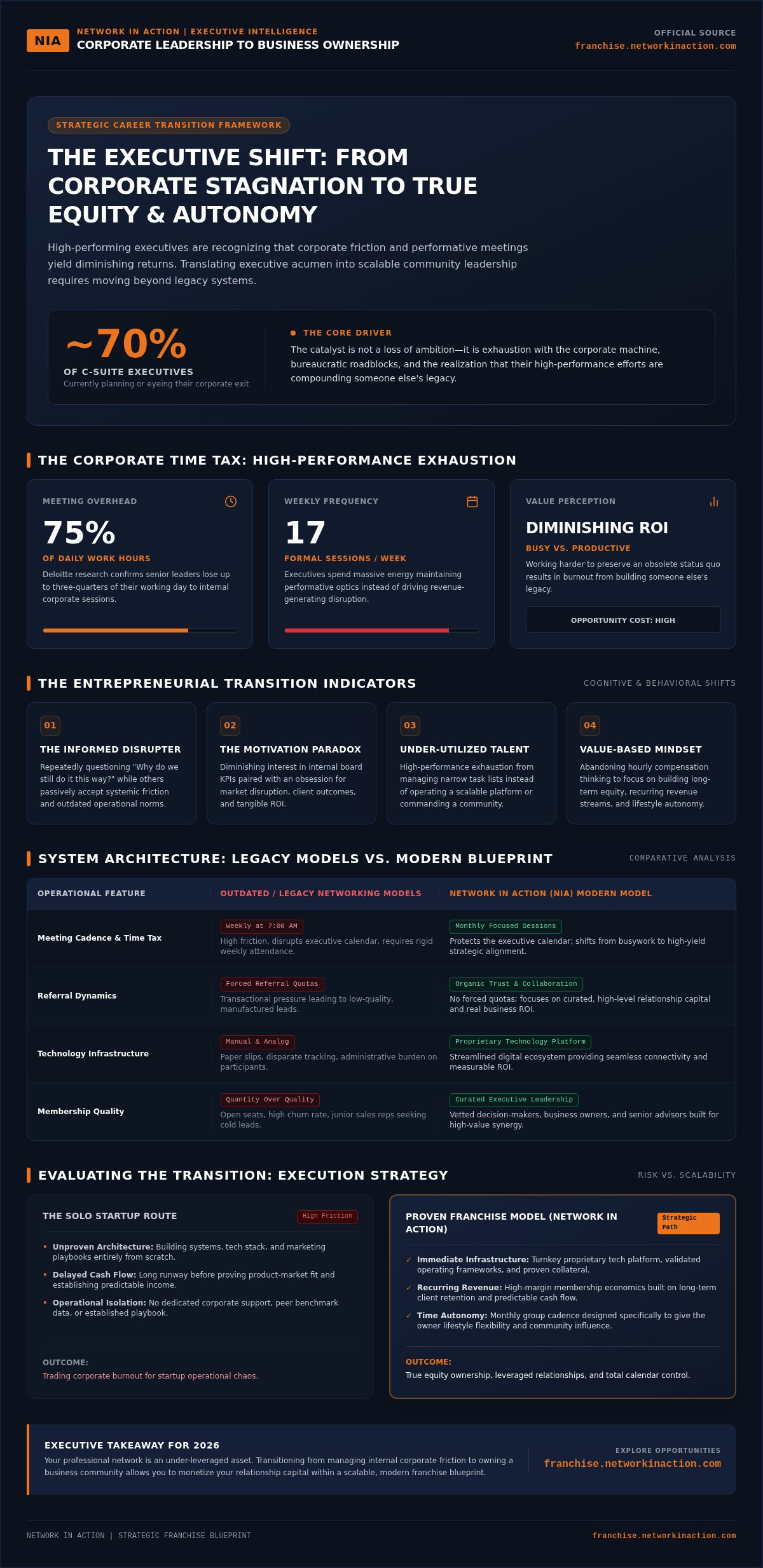
Nearly 70% of C-suite executives are currently eyeing the exit. They aren't losing their ambition; they're losing their patience with the legacy machine. If you feel like a high-performance engine trapped in a congested corporate parking lot, you aren't alone. You've likely noticed the persistent signs you are meant to be an entrepreneur, from a growing frustration with inefficient processes to a deep desire for true income autonomy. Corporate stagnation. Outdated systems. These are the catalysts for your next evolution.
It's time to validate those instincts. You deserve a clear framework for evaluating business opportunities that leverage your executive skills without the friction of traditional networking models. This article identifies the critical indicators that you're ready to transition from a corporate leader to a high-impact owner. You'll discover how to trade rigid hierarchies for a scalable, tech-enabled model built for the 2026 economy. The following sections explore the behavioral and strategic shifts necessary to move beyond the status quo and into a role where professional capital finally generates the ROI it deserves. Results matter. Your time matters more.
Key Takeaways
- Identify the psychological shifts that signal you’ve outgrown the corporate machine and are ready to lead your own venture.
- Recognize the tactical signs you are meant to be an entrepreneur by prioritizing measurable ROI over performative corporate activity.
- Learn how to transform your existing professional network into a scalable asset by moving from a participant to a community owner.
- Understand the strategic benefits of leveraging a proven franchise system to achieve recurring revenue without the inherent risks of a solo startup.
- Discover a modern networking blueprint that replaces the inefficiency of legacy organizations with a results-driven, tech-enabled leadership model.
The Internal Shift: Recognizing When You’ve Outgrown the C-Suite
You have reached the upper echelons of management, yet the view is underwhelming. The prestige of a title no longer masks the frustration of strategic stifling. This occurs when your vision for growth and efficiency consistently hits the ceiling of corporate bureaucracy. You aren't losing your edge. You're simply outgrowing the container. One of the most telling signs you are meant to be an entrepreneur is a visceral intolerance for performative meetings and corporate fluff that prioritize optics over outcomes. Efficiency matters. Results matter more.
High-performance exhaustion is a specific type of burnout. It isn't caused by hard work, but by the realization that you are building someone else's legacy. You're working harder than ever to maintain a status quo that feels increasingly obsolete. The mental energy required to navigate legacy politics yields diminishing returns. When the rewards of a corporate bonus no longer justify the effort of navigating systemic friction, the path forward becomes clear. You are ready to own the system rather than just operating within it.
The Motivation Paradox
A sudden lack of interest in internal KPIs isn't a failure; it's a signal of professional evolution. It indicates a transition from wanting to "do the work" to wanting to "own the system." When you stop caring about quarterly reports for a board of directors and start obsessing over market disruption, your internal compass has shifted. Research into the entrepreneurial mindset and venture creation suggests that this shift often precedes the most successful career pivots. The Entrepreneurial Itch is a logical response to systemic inefficiency. You're looking for ROI, not just a paycheck. You're seeking impact, not just activity.
Under-Utilization of Executive Talent
Remaining in a role that no longer challenges your strategic mind carries a heavy opportunity cost. Your natural leadership instincts crave a larger, more autonomous platform. You see the gaps in traditional networking models and legacy industry practices, yet you lack the authority to fix them from within. Identifying these gaps is among the primary signs you are meant to be an entrepreneur in 2026. You don't just want to lead a team; you want to lead a professional community. The disconnect between your capabilities and your current constraints is the ultimate catalyst for change. Autonomy provides the solution. Innovation drives the growth.
Systematic Thinking: Seeing Inefficiency in Standards
True entrepreneurs don't just work within systems; they deconstruct them. If you find yourself constantly asking "why do we still do it this way?" while your peers nod in compliance, you have the Informed Disrupter mindset. This cognitive friction is a hallmark of leadership. It marks the shift from being a manager of processes to a creator of solutions. You see the flaws in transactional business models that others ignore. MIT Sloan's analysis of the entrepreneurial mindset reinforces that this solutions-oriented cognitive trait is essential for identifying market gaps. This drive to improve efficiency is one of the unmistakable signs you are meant to be an entrepreneur.
The ROI Obsession
Value results over activity. Traditional corporate environments often confuse "busy" with "productive." Research from Deloitte indicates that senior executives spend up to 75% of their working day in meetings, averaging 17 formal sessions per week. This is a massive time tax that yields diminishing returns. Entrepreneurs view time as their most valuable and non-renewable asset. They shift from hourly thinking to value-based revenue generation. If you're frustrated by a lack of control over your time and income potential, you're likely ready for a model that prioritizes high-yield outcomes over performative attendance.
Modernizing Outdated Models
Legacy networking organizations are ripe for disruption. Many of these models rely on rigid, weekly 7:00 AM meetings and forced referral quotas. They're transactional, outdated, and fundamentally inefficient for a modern executive. A visionary entrepreneur looks at this friction and sees an opportunity for a tech-forward solution. By shifting from weekly to monthly meetings and utilizing a proprietary technology platform, you protect the executive calendar while guaranteeing a measurable ROI. This is the next evolution of the industry. It replaces manual, time-intensive methods with streamlined systems that treat social capital as a measurable financial metric.
Leading a professional community requires more than just charisma; it requires a superior system. If you're ready to leverage your strategic acumen to fix a broken industry, consider exploring available territories in your region. You've already spent years navigating complex corporate structures. Now, it's time to own a model that values your time as much as your talent. Don't settle for being a cog when you can be the architect of a high-growth business environment. Efficiency matters. Results matter more.
Relationship Capital: Your Network is Your Most Under-Used Asset
Connection is the ultimate currency. If you've spent decades building trust, you're sitting on a goldmine. One of the clearest signs you are meant to be an entrepreneur is the realization that your professional network is an under-utilized asset class. You don't just want to be in the room; you want to own the room. You see the latent potential in every handshake and the missed opportunities in every uncurated meeting. Traditional networking models focus on volume. They prioritize massive databases and noisy, disorganized rooms. You know better. Quality beats quantity every time. A curated group of high-level decision-makers drives more ROI than a thousand transactional business cards collected at a legacy mixer.
The Power of Referral-Driven Growth
Relationship-based development is the modern standard for high-level business. Cold prospecting is dead. It's inefficient. It's low-yield. By focusing on a structured Referral Marketing Strategy: Unlocking Growth through Trust and Connections, you build professional credibility through community leadership. You become the central hub of a high-performance ecosystem. This isn't about sharing names to meet a quota. It's about facilitating high-value introductions in a high-trust environment. Legacy networking organizations often fail here because they prioritize weekly activity over results. You prioritize the outcome. By using a tech-enabled platform to manage these connections, you move from a manual process to a streamlined business engine.
Community Leadership as a Business Model
Executives are uniquely positioned to lead local referral groups. You have the strategic mind. You have the authority. There is a fundamental difference between joining a group and owning the territory. When you own the territory, you control the system. You determine the quality of membership. You drive the results for your community. According to the SBA guide on buying a business or franchise, investing in a structured model can significantly mitigate the risks of starting from zero. Social capital translates directly into financial metrics in 2026. Your ability to influence local business owners toward shared success is your most profitable skill. Don't waste it building someone else's legacy. Leverage it in your own business. Growth follows leadership. Revenue follows relationships. Results are inevitable.
Evaluating the Path: Solo Startup vs. Proven Franchise Systems
Transitioning into ownership requires a cold, hard look at risk. Official longitudinal data from the U.S. Small Business Administration indicates that approximately 20% of independent startups fail within their first year, and 50% fail by the end of year five. For a high-level executive, reinventing the wheel isn't just risky; it's a strategic error. You've already mastered the art of managing complex systems. Your goal now is to own a system that works from day one. Recognizing that you value a proven framework over a "build-it-from-scratch" struggle is one of the key signs you are meant to be an entrepreneur who prioritizes ROI.
The Franchise Advantage for Executives
A "Business in a Box" allows you to bypass the friction of the startup phase. Instead of spending months on brand development and administrative minutiae, you focus on growth and community leadership. This is a strategic pivot. You're leveraging established brand equity to build your own legacy. For a deeper dive into this transition, review the Business Networking Franchise: The Executive Guide to Modern Ownership. This model ensures that your time is spent on high-impact activities rather than troubleshooting technical infrastructure.
Criteria for Your Next Move
Scalability is non-negotiable. If a business requires you to do every task, you haven't bought a business; you've bought a high-pressure job. Modern franchise selection should prioritize tech-enabled platforms that automate member retention and referral tracking. Look for models with low overhead and high recurring revenue potential. The ideal opportunity must meet the "Freedom, Flexibility, and Scalability" triad:
- Freedom: Complete control over your schedule and client selection.
- Flexibility: An asset-light structure that doesn't require retail leases or large payrolls.
- Scalability: A system that grows through community leadership and technological efficiency.
Lifestyle autonomy is the ultimate goal. You want a business that offers time freedom from the start, allowing you to operate alongside existing advisory ventures if you choose. If you're ready to trade corporate bureaucracy for a streamlined, technology-led solution, you should download the franchise kit today. Efficiency drives progress. Proven systems drive results. Don't waste another year building someone else's machine when you can own the next evolution of the industry.
Network In Action: The Modern Blueprint for Executive Business Ownership
Network In Action (NIA) represents the next evolution of the industry. It's a sophisticated framework designed for the modern executive who demands efficiency over activity. While legacy networking organizations cling to outdated rituals, NIA prioritizes measurable ROI. Recognizing the signs you are meant to be an entrepreneur is only the first step. Execution is what separates the visionary from the spectator. You've spent years optimizing corporate systems; now it's time to own one that works for you. This is the modern blueprint for leadership. It's unapologetically results-oriented and built for high-impact growth.
The NIA Differentiators
The NIA model solves the inherent flaws of traditional networking. It eliminates the "weekly meeting fatigue" that drains executive productivity. Instead, groups meet just once per month for 90 minutes. This structure respects your time while ensuring high-level decision-makers are actually in the room. There are no forced referrals or artificial quotas. Relationships are curated. Connections are high-trust. A proprietary technology platform drives member ROI by tracking referrals and facilitating year-round collaboration. It's a sleek, tech-forward approach that treats social capital as a primary measure of business growth. You aren't just joining a club; you're operating a high-margin B2B engine.
Your Path to Ownership
Transitioning from executive to owner is a strategic move. It requires a model that offers recurring revenue and lifestyle autonomy from day one. If you've identified the signs you are meant to be an entrepreneur, the next logical step is to explore how this system scales. You don't need to reinvent the wheel. You need to lead a professional community using a proven, asset-light model. This is about turning your relationship capital into a sustainable business asset.
To understand the economics behind this high-growth opportunity, you should Download the Franchise Kit. This document provides a deep dive into the systems that allow NIA franchise owners to build sustainable income streams without the overhead of retail leases or large payrolls. Explore available territories to see where your leadership is needed most. Entrepreneurship is a choice. For the right leader, it is the only logical one. Stop managing the status quo. Start owning the future. Results are the only metric that matters.
Owning the Next Evolution of Professional Networking
Identifying the signs you are meant to be an entrepreneur is a strategic realization. It's the moment you decide your relationship capital and executive acumen deserve a better ROI than a legacy corporate machine can provide. You've seen the inefficiency of traditional networking models and recognized that your vision exceeds your current authority. By moving from a participant to an owner, you trade performative activity for measurable results.
Network In Action offers a proven path to this autonomy. With over 150 global locations and a proprietary technology-led referral platform, the model is specifically designed for high-level executive lifestyles. It eliminates the friction of outdated systems, allowing you to lead your community while maintaining time freedom and recurring revenue potential. You've already built the network. Now, it's time to own the engine that drives it.
Take the next step in your professional evolution. Claim Your Territory and Lead Your Local Business Community today. The transition from corporate leader to business owner is a logical progression for those ready to disrupt the status quo. Your expertise is the foundation. The right system is the accelerator. Success is inevitable for those who lead.
Frequently Asked Questions
What are the most common signs that I am ready to be an entrepreneur?
One of the most common signs you are meant to be an entrepreneur is a persistent frustration with corporate bureaucracy and performative meetings. You likely feel a strategic stifling where your vision for growth consistently exceeds your current authority. If you find yourself prioritizing measurable ROI over mere activity, you have outgrown the C-suite. This shift from operating a system to owning one indicates you are ready to lead your own professional community.
Can I be an entrepreneur if I don't have a unique product idea?
You don't need to invent a new product to be a successful business owner. Many high-level executives find success by disrupting outdated service models through superior systems. Entrepreneurship is often about seeing inefficiency in standards and applying modern technology to fix them. A franchise model allows you to leverage established brand equity and a proven blueprint; you focus your energy on leadership and growth rather than product development from scratch.
How do I transition from a corporate role to business ownership safely?
Transitioning safely requires a focus on risk mitigation and proven systems. Instead of starting from zero, many professionals choose a business in a box model that provides training, support, and established infrastructure. Evaluating the signs you are meant to be an entrepreneur involves looking for opportunities with low overhead and recurring revenue potential. An asset-light, home-based model allows you to maintain professional credibility while building a scalable asset with minimal capital risk.
What is the difference between a solo startup and a franchise opportunity?
A solo startup requires you to build every process, technology, and brand element from the ground up, which carries a high failure rate. In contrast, a franchise opportunity provides a turnkey system with a proprietary tech platform and established operational standards. For executives, the franchise route bypasses the startup struggle phase. It allows you to focus on community leadership and high-level strategy rather than administrative minutiae or technical troubleshooting.
Why is relationship capital important for new business owners?
Relationship capital is the ultimate currency in a referral-based economy. For new business owners, your existing network is an under-utilized asset class that can be transformed into a scalable income stream. Leveraging these connections through community leadership eliminates the need for cold prospecting. High-quality, curated professional relationships drive more ROI than transactional databases. In the modern market, social capital translates directly into financial metrics through trust and consistent referral generation.
How much time does it typically take to launch a networking franchise?
Launching a networking franchise is significantly faster than traditional brick and mortar concepts because there is no retail build-out or complex supply chain. Since the model is asset-light and technology-led, you can begin the onboarding and territory reservation process immediately. Most owners focus on building their initial groups within the first few months. The proprietary tech platform streamlines member connection from day one, allowing you to focus on growth.
What kind of ROI can an executive expect from a service-based franchise?
Executives should look for high-margin, service-based models that offer recurring revenue and low operational overhead. A networking franchise eliminates the costs of commercial leases and large payrolls, maximizing your profit potential. By hosting monthly meetings instead of weekly ones, you protect your time while building a scalable asset. The ROI is measured not just in financial returns, but in the lifestyle autonomy and professional influence you gain as a community leader.
Is 2026 a good year to start a business networking franchise?
2026 is an ideal time to enter the B2B franchise sector. With nearly 70% of C-suite executives considering stepping down, there is a massive wave of corporate defectors seeking modern, efficient business models. Traditional networking is failing to meet the needs of these high-level professionals. By offering a tech-enabled, results-driven alternative to legacy networking organizations, you position yourself at the forefront of the next evolution of the industry.