Did you know that 62% of small business owners work 50 or more hours every week, often sacrificing their weekends just to keep the lights on? For high-level executives, the dream of entrepreneurship often feels like trading one set of golden handcuffs for another. You've spent years climbing the corporate ladder, yet the prospect of creating a business that offers time and financial freedom seems increasingly out of reach in a landscape dominated by high-overhead models. You deserve a transition that respects your expertise without demanding your soul.
It's time to stop settling for the inefficiency of legacy networking organizations that demand weekly volunteer hours and deliver low-quality leads. This guide reveals a strategic roadmap to owning a turnkey, technology-led professional networking asset. You'll learn how to leverage a monthly meeting model and proprietary digital tools to build a community of high-caliber professionals. This article breaks down the exact systems required to secure recurring revenue and complete autonomy over your daily schedule. The evolution of executive ownership starts with a model designed for results, not just activity.
Key Takeaways
- Master the distinction between high-pressure self-employment and owning a scalable asset that generates recurring revenue with minimal operational drag.
- Leverage proprietary technology to automate administrative tasks and member connectivity, ensuring the business thrives without your 24/7 intervention.
- Evaluate potential ventures using executive-level metrics like time-per-dollar earned to avoid the common trap of high-overhead legacy models.
- Follow a strategic five-step roadmap for creating a business that offers time and financial freedom by securing high-density territories and professionalizing local referral networks.
- Replace the rigid, time-consuming requirements of traditional networking organizations with an efficient monthly meeting structure designed for maximum ROI and lifestyle autonomy.
The Freedom Trap: Why Most Businesses Fail to Deliver Autonomy
Most high-level professionals exit the corporate world to escape bureaucracy, only to find themselves trapped in the "buying a job" cycle. You don't want another high-pressure role; you want an asset. In 2026, the difference between tactical income and strategic wealth is the degree of owner-dependency. Many franchises and startups fail to provide lifestyle autonomy because they rely on manual labor and constant owner intervention. They promise growth but deliver a 60-hour work week that leaves zero room for the life you actually wanted to lead.
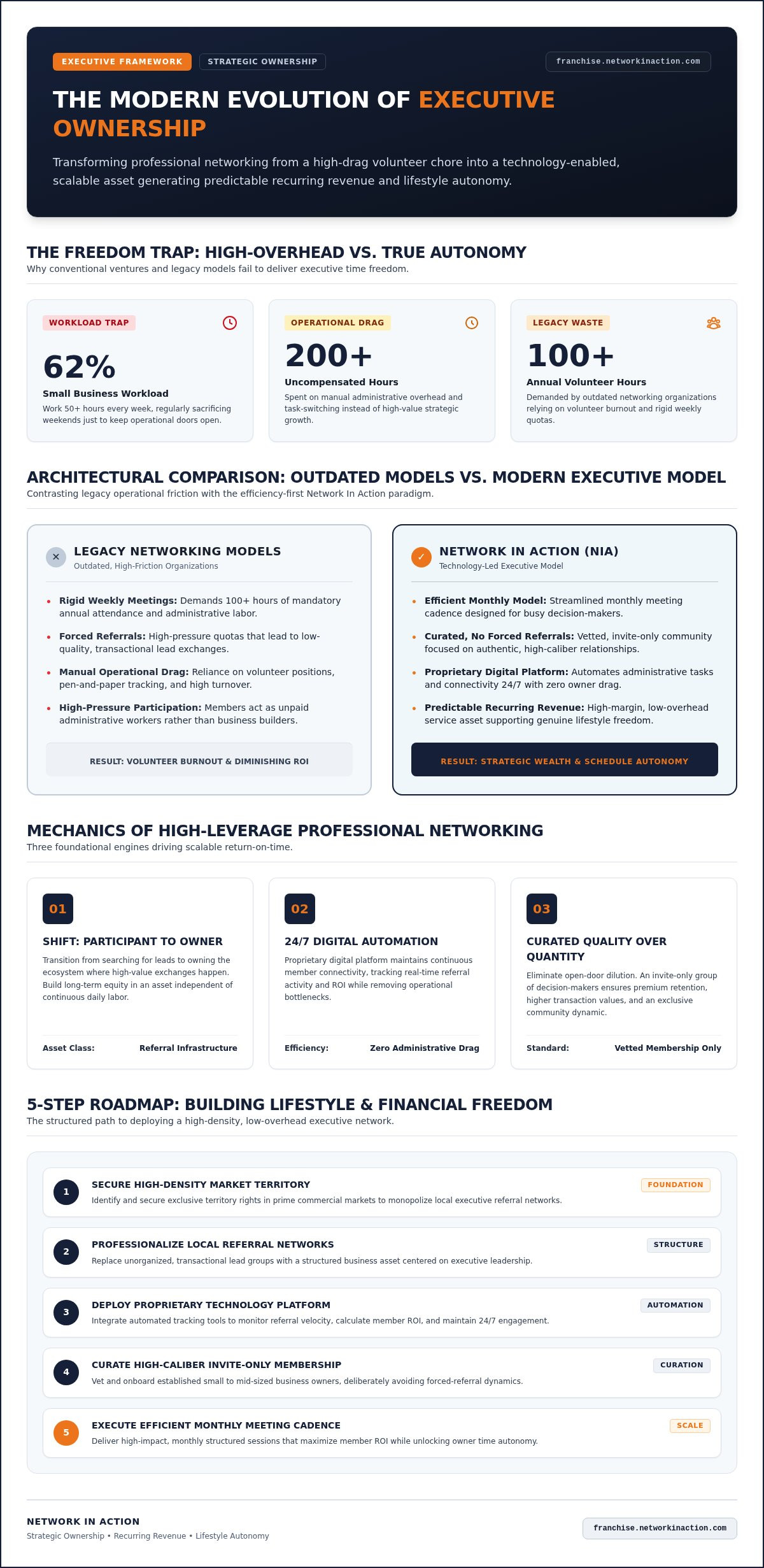
Legacy networking organizations often exemplify this freedom trap. These models demand significant time commitments, often exceeding 100 hours of annual labor, without offering a streamlined path to high-leverage returns. They're rigid, transactional, and rely on volunteer burnout. Creating a business that offers time and financial freedom requires a departure from these outdated, high-friction models in favor of streamlined, technology-led systems.
The Myth of the 60-Hour Work Week
Society obsesses over "hustle," but for an executive, hustle is often just a mask for inefficiency. Research shows that 62% of small business owners work 50 or more hours per week, with many clocking over 200 uncompensated hours on administrative drag. This is the point of diminishing returns. You shouldn't be wearing five different operational hats. Instead, you can leverage your existing social capital to reduce labor hours. Efficiency isn't about doing more; it's about ensuring every hour spent delivers a measurable, scalable result.
Evaluating Revenue Quality vs. Revenue Quantity
Not all revenue is created equal. Tactical income requires your presence, while strategic wealth flows from systems. High-margin, low-overhead service models are the cornerstone of achieving financial independence. When you focus on recurring revenue, you build a foundation that supports your lifestyle rather than consuming it. Your exit strategy should be defined on day one: a business that runs on proprietary technology and structured systems. By creating a business that offers time and financial freedom, you position yourself as a community leader rather than a full-time administrator, ensuring your income is a byproduct of your network's value, not your personal clock-punching.
The Mechanics of High-Leverage Professional Networking
Stop attending meetings. Start owning them. Moving from a participant to an owner in the professional referral economy is the ultimate power move for executives. It shifts your role from searching for leads to providing the infrastructure where high-value exchanges occur. This transition is essential for creating a business that offers time and financial freedom because it builds a scalable asset that grows independent of your daily labor. You aren't just another member; you're the architect of an elite ecosystem.
Traditional networking models rely on manual effort and rigid attendance. They're transactional. By adopting a strategic networking framework, you move beyond routine operational contacts to high-leverage strategic connections. This creates long-term business value and professional authority. Instead of trading hours for introductions, you're building a community of small to mid-sized business owners that serves as a resilient, recurring revenue stream.
The Technology-Enabled Network
Modern networking requires modern tools. Proprietary technology platforms now maintain connectivity 24/7 without owner intervention. These systems track referral activity and member engagement in real time, allowing you to manage multiple groups with minimal effort. Data-driven networking replaces guesswork. It measures ROI for every member, ensuring the group remains high-value and retention stays high. Digital tools also eliminate the friction of outdated networking models, such as forced referrals or rigid weekly rules. Efficiency wins every time. When technology handles the administrative drag, you're free to focus on leadership and growth.
Quality Over Quantity: Curating High-Value Groups
Open-door policies dilute value. A resilient asset is built on a vetted community of professionals. By curating an invited-only membership, you position yourself as the ultimate connector in your local market. This approach utilizes a sophisticated referral marketing strategy to build a self-sustaining group that values quality over volume. Monthly, curated meetings outperform weekly sessions because they respect the executive's calendar. High-performing leaders refuse to trade 100 plus hours a year for low-value exchanges. A monthly cadence allows for deeper relationship building and structured masterminds. If you're ready to lead a high-leverage community, you can explore available territories to see where your expertise can make the most impact. This is the modern evolution of professional connection.
Evaluating Business Opportunities for Time and Financial ROI
Efficiency is the executive's primary currency. When evaluating potential ventures, you must look beyond top-line revenue to the metrics that actually impact your life. Cash-on-cash return and time-per-dollar earned are the only numbers that matter for a leader seeking an exit from corporate bureaucracy. The startup grind is often a race to the bottom; Bureau of Labor Statistics data shows 45% of independent businesses fail within five years. In contrast, franchised systems offer an 85% survival rate, providing a stabilized path for creating a business that offers time and financial freedom. Service-based models consistently outperform brick-and-mortar retail by eliminating the heavy capex and employee-intensive burdens that trap owners in their own buildings.
Territory exclusivity is a non-negotiable factor in protecting your financial future. Without it, your market share is vulnerable to dilution. A high-leverage asset should provide a protected environment where your professional influence can scale without internal competition. This is where the strategic advantage of a professional networking franchise becomes clear: it converts your local expertise into a resilient, recurring revenue stream without the operational drag of traditional industries.
The Franchise Advantage for High-Level Leaders
Reinventing the wheel is a waste of your professional bandwidth. High-level leaders prioritize turnkey systems that allow for immediate operational control. A global networking organization provides established brand equity and a proven methodology, allowing you to focus on community leadership rather than administrative minutiae. By selecting from available franchise opportunities that align with your existing influence, you convert social capital into a scalable financial asset. Proven systems reduce risk. Predictable outcomes drive growth. You're investing in a shortcut to results, not a DIY project.
Assessing Ongoing Support and Training
Initial onboarding is only 10% of the success equation. True growth requires continuous innovation and technological advancement. This is the role of monthly royalty fees: they fund the proprietary tools that keep your business ahead of legacy networking organizations. Before committing, consult the FTC guide to buying a franchise to understand the depth of support and financial obligations you should expect. Avoid the 'legacy' traps found in rigid agreements that prioritize franchisor control over franchisee autonomy. A modern partnership should be demanding yet supportive, offering the digital infrastructure needed for creating a business that offers time and financial freedom while respecting your need for a lifestyle-friendly model.
5 Steps to Creating a Business That Offers Lifestyle Autonomy
Transitioning from an executive role to a business owner requires a tactical shift from managing labor to managing assets. Creating a business that offers time and financial freedom isn't a result of luck; it's the outcome of a verified, five-step sequence. You don't need to reinvent the wheel. You need to own the wheel. By following this roadmap, you replace the high-pressure grind with a streamlined, technology-led wealth engine.
- Step 1: Identify your territory. Target regions with a high density of small to mid-sized business owners. These are your primary stakeholders.
- Step 2: Integrate technology. Leverage a proprietary platform to automate administrative tasks, referral tracking, and member connectivity. Efficiency is your edge.
- Step 3: Curate your core. Vette a group of high-level professionals who value quality relationships over transactional exchanges. High standards drive high retention.
- Step 4: Establish the rhythm. Implement a monthly meeting cadence. This respects the executive schedule and eliminates the burnout common in legacy networking organizations.
- Step 5: Scale the asset. Launch additional groups or expand into new territories once your foundation is profitable. Growth should be systematic, not chaotic.
Phase 1: Foundation and Territory Selection
Success begins with market dynamics. You must analyze local economic data to ensure a high-quality referral pool exists within your chosen region. Securing the rights to an exclusive territory is the only way to protect your long-term financial interests and prevent market dilution. This exclusivity turns your local network into a defensible asset. To begin your due diligence, you can request a franchise kit to analyze the untapped potential in your specific market. Strategic selection today ensures creating a business that offers time and financial freedom tomorrow.
Phase 2: Building Your Influence Engine
In the professional referral economy, your skill set is the product. You must use your existing executive experience to lead the community rather than sell to it. Establishing professional credibility through leadership naturally attracts high-caliber members who are tired of outdated networking models. You can use resources like this free book on modernized networking to position yourself as an authority before you even host your first meeting. This influence engine creates a self-sustaining ecosystem where members provide the value and technology handles the drag. If you're ready to transition from a corporate role to a community leader, explore how this franchise model works to see if it aligns with your professional goals.
Network In Action: The Modern Evolution of Executive Ownership
Network In Action (NIA) represents the definitive shift from manual labor to professional asset management. It is the industry-leading solution for leaders focused on creating a business that offers time and financial freedom. Unlike legacy networking organizations that rely on outdated manual tracking and rigid weekly attendance, NIA utilizes a streamlined, technology-forward approach. This model shifts the focus from mere participation to measurable ROI. It is a system built specifically for executives who understand that their time is their most valuable currency. Efficiency is not just a feature; it is the foundation.
In the current market, discerning professionals are seeking top executive business opportunities in 2026 that offer more than just a paycheck. They want a platform where their influence generates recurring revenue without requiring the 60-hour work weeks typical of retail or food franchises. NIA provides this. With over 150 successful locations globally, the model is proven, scalable, and designed for high-margin efficiency. It allows you to lead a community of professionals while technology handles the administrative drag.
Efficiency as a Competitive Advantage
NIA saves approximately 75% of the time required by traditional networking models. By moving from weekly to monthly meetings, the brand respects the executive schedule while maintaining high-impact engagement. The proprietary CRM and networking platform serve as the digital backbone of this efficiency. This technology keeps members connected 24/7 without owner intervention. It automates referral tracking and member engagement, ensuring the group remains active even when you are offline. Professionals are flocking to this model because it offers a sophisticated experience that matches their own corporate standards. Results matter. Activity for the sake of activity is dead.
Your Path to Financial and Time Freedom
Owning an NIA franchise is a lifestyle-first decision. It is the strategic path for creating a business that offers time and financial freedom through recurring revenue and low operational drag. You are no longer trading your life for a salary. Instead, you are building an asset that leverages your professional credibility and local network. The transition from the corporate grind to community leadership is a move toward complete autonomy. It is time to lead. It is time to own. You can explore available territories and start your journey toward a business that finally works as hard as you do.
Secure Your Executive Future Beyond the C-Suite
The corporate ladder was never designed to provide true autonomy. Real independence requires owning the infrastructure of professional connection. By shifting from the daily grind to a high-leverage networking asset, you secure a future defined by recurring revenue rather than billable hours. Creating a business that offers time and financial freedom is no longer a theoretical goal; it's a proven reality for those who leverage modern, technology-led systems.
Network In Action has established over 150 successful locations globally by solving the inherent flaws of legacy networking organizations. With a proprietary platform that automates administrative drag and a monthly meeting structure designed specifically for high-level executive schedules, the path to ownership is clear. You have the experience. You have the network. Now, you just need the system to scale it.
Take the first step toward time freedom: Download the NIA Franchise Kit and discover how your professional influence can build a legacy of lasting impact.
Frequently Asked Questions
How much time does it actually take to run a networking franchise?
Running a modernized networking franchise requires significantly less time than traditional models due to the efficient monthly meeting cadence. While legacy networking organizations demand over 100 hours of annual labor, this model is designed for executive efficiency. You focus on leading one 90-minute structured session per month. The proprietary technology handles administrative drag between meetings. This streamlined approach is a core component of creating a business that offers time and financial freedom for busy professionals.
Is a networking business profitable compared to traditional retail franchises?
Networking franchises often offer superior profitability due to an asset-light, service-based structure. Unlike retail franchises that require high capital expenditure, physical leases, and large staff payrolls, this model operates with minimal recurring overhead. Your primary investment is your professional influence and the initial franchise fee. This results in higher margins and a faster path to ROI; it’s a strategic choice for those prioritizing financial growth without the operational headaches of brick-and-mortar businesses.
How does proprietary technology reduce the workload for a franchise owner?
Proprietary technology acts as the digital backbone of your business, automating member engagement and referral tracking. The platform maintains connectivity within your groups 24/7 without requiring your direct intervention. It handles administrative tasks that typically consume hours in manual networking models, such as tracking attendance or reporting ROI. By leveraging these digital tools, you can manage multiple groups with high efficiency, ensuring the business scales without demanding a proportional increase in your personal labor.
What is the difference between NIA and traditional networking organizations?
The primary differentiator is a shift from quantity to quality. Traditional networking often relies on rigid weekly meetings and forced referral quotas that lead to member burnout. NIA replaces this with a monthly meeting model and a technology-enabled platform that focuses on high-value relationships. There are no forced referrals; instead, the system facilitates organic, high-trust connections. This modernized approach ensures a more sophisticated experience for small to mid-sized business owners who value their time.
Can I run this business while maintaining other professional commitments?
Yes, the executive-managed model is specifically designed to accommodate individuals with existing professional commitments. Because the meeting rhythm is monthly rather than weekly, you can integrate group leadership into your current schedule without disruption. The proprietary technology manages the day-to-day connectivity, allowing you to focus on high-level strategy and community growth. This flexibility makes it an ideal vehicle for creating a business that offers time and financial freedom while transitioning away from a corporate role.
What kind of training is provided for new NIA franchise owners?
New franchise owners receive comprehensive training that covers group facilitation, member recruitment, and platform management. This initial onboarding ensures you understand the proprietary systems and the ROI-driven philosophy of the brand. Beyond the start-up phase, you have access to ongoing corporate resources and a global network of over 150 successful locations. This support structure is designed to convert your existing executive skills into a scalable business asset with predictable results and minimal trial-and-error.
How does a monthly meeting model ensure member retention?
Member retention is driven by high ROI and respect for the professional's calendar. High-performing business leaders often find weekly commitments in outdated networking models to be cumbersome and low-value. By meeting once per month, NIA provides a curated, mastermind-style environment that focuses on strategic growth rather than transactional exchanges. This efficiency, combined with proprietary tracking tools that prove financial returns, ensures that members remain engaged and committed to the community long-term.
What are the initial costs associated with starting a networking franchise in 2026?
Starting a networking franchise requires a lower capital investment compared to high-overhead industries like food or retail. The initial costs include a one-time franchise license fee for territory rights and the costs of initial onboarding. Because there is no need for physical real estate leases or a large team of employees, your startup capital is focused directly on market development and brand equity. This asset-light model allows you to launch a professional service business with minimal financial risk.