Isolation isn't a badge of honor. It's a structural failure that drains your professional ROI and clouds your strategic vision. Most high-level executives accept decision fatigue as an inevitable cost of doing business, but solo leadership is often your biggest bottleneck. Learning how to avoid the loneliness of entrepreneurship isn't about joining a social club; it's about engineering a high-performance ecosystem that replaces "fluffy" networking with measurable results. Proven systems. Elite connections.
You've likely felt the weight of making high-stakes decisions without a peer group that truly understands the pressure. Traditional networking models often fail here, offering rigid, weekly structures that waste your most valuable asset: time. This 2026 guide promises to show you how to transform isolation into a curated professional network built on modern leadership and exclusive connections. You'll discover a streamlined approach to community that provides high-quality referrals and executive support through a tech-enabled, monthly meeting model. It's time to move past legacy organizations and embrace the next evolution of professional connectivity.
Key Takeaways
- Reframe entrepreneurial isolation as a structural flaw that requires a tech-led, leader-driven ecosystem to solve.
- Discover how to avoid the loneliness of entrepreneurship by building a curated inner circle of peers who understand high-stakes decision-making.
- Replace outdated networking models with high-efficiency monthly meetings designed for executive-level schedules.
- Use proprietary digital tools to maintain professional connections and referral ROI without the noise of public social platforms.
- Shift from isolated owner to community leader to secure both professional support and recurring revenue growth.
The Silent Performance Killer: Defining Entrepreneurial Isolation
Isolation is a structural flaw in the solo-owner model. It’s not just about physical solitude; it’s the psychological weight of being the only person responsible for the bottom line. True entrepreneurial loneliness stems from a lack of peers who share your level of risk and responsibility. When every high-stakes decision rests entirely on your shoulders, the pressure creates a strategic vacuum. Understanding how to avoid the loneliness of entrepreneurship begins with recognizing that your isolation is a performance bottleneck, not a personal badge of honor.
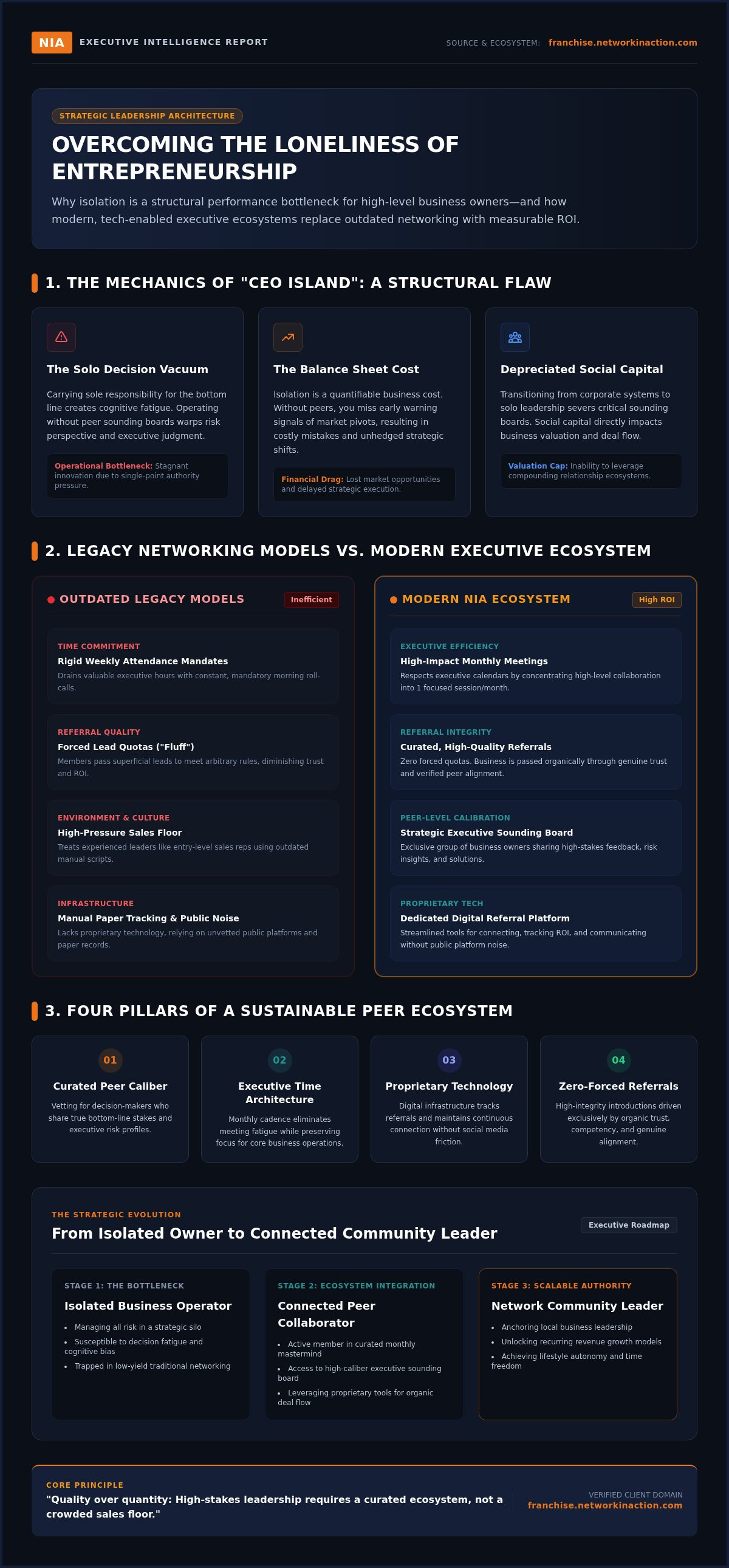
This phenomenon is often called the "CEO Island." On this island, you’re disconnected from both your team and the market. You can’t be fully transparent with employees about financial anxieties, and you can’t always trust the motives of outside vendors or competitors. The result is a strategic haze that clouds your vision. Research into loneliness and its psychological effects shows that prolonged isolation impairs cognitive function and executive decision-making. For a business owner, this means your mental state directly dictates your company’s long-term sustainability. If you’re isolated, your growth is capped.
Why Executives Feel the Sting of Loneliness
The transition from corporate leadership to entrepreneurship often severs the collaborative ties that fuel innovation. You lose the corporate "water cooler" and the high-level brainstorming sessions that once validated your instincts. Now, you’re the final authority on every financial and operational pivot. This burden is heavy. Finding peers who can offer objective, high-stakes feedback is difficult when you’re operating in a silo. Without a sounding board of equals, your instincts can become skewed by your own biases, leading to a dangerous lack of perspective.
The Financial Cost of Isolation
Isolation isn't just an emotional state; it’s a line item on your balance sheet. Narrowed perspectives lead to missed market opportunities and stagnant service offerings. When you lack a diverse peer group, you miss the "early warning signals" of industry shifts that others are already navigating. Mental fatigue from solo decision-making often results in poor investment choices and high-cost operational errors. Social capital is the measurable value of your professional network and is a primary driver of modern business valuation. If you want to know how to avoid the loneliness of entrepreneurship, you must first audit the quality of your current professional ecosystem. By failing to invest in high-quality connections, you’re effectively devaluing your company and your future. Growth requires leverage, and you can't leverage a network you don't have.
Why Legacy Networking Organizations Often Increase Loneliness
Traditional networking often fails the very people it claims to help. Legacy organizations rely on rigid, transactional models that prioritize attendance over impact. For the modern executive, these environments don't cure isolation; they compound it. You trade your most valuable asset, time, for shallow interactions and forced referrals. This "check-the-box" mentality creates a hollow experience where quantity is valued over strategic alignment. It's a performance killer.
Transactional environments fail because they lack the depth required to build genuine trust. When you're forced to pass leads every week, the quality of those leads inevitably drops. You end up managing a stream of "fluff" rather than building a high-ROI ecosystem. The weight of these inefficient systems adds to your decision fatigue. Understanding how to avoid the loneliness of entrepreneurship requires moving away from these manual, outdated practices. The health risks of loneliness and social isolation are significant, and a room full of transactional strangers won't mitigate those risks. You need a peer group, not a sales floor.
The Flaws of Traditional Networking
Outdated networking models treat high-level executives like entry-level sales reps. They demand rigid adherence to scripts and manual tracking methods that belong in the last century. These structures are designed for mass participation, not elite performance. In these groups, relationships remain surface-level because the environment is built on obligation rather than shared executive stakes. You don't find peer support; you find another set of rules to follow. This friction drives leaders further into their silos, making the search for real connection even more exhausting.
The Time-Value Conflict
Your time is your primary currency. A modern business networking franchise must respect the owner’s schedule to be effective. Weekly "check-the-box" sessions are a drain on productivity and mental energy. High-impact leaders require monthly meetings that focus on quality and strategic depth. This shift allows for meaningful connection without sacrificing your time freedom. Evaluating the ROI of your time is essential. If a professional organization doesn't leverage technology to streamline connectivity, it's wasting your resources. Real growth happens when systems work for you, not when you work for the system. If you're ready for a more sophisticated approach, consider exploring available territories to lead a group that actually respects your schedule.
How to Build a Strategic Support System
Building a strategic support system is an engineering task. It isn't about collecting business cards or attending generic local mixers. You need a curated inner circle of 5 to 10 people who share your risk profile and executive stakes. These individuals are your strategic partners. They provide the objective feedback required to scale. To understand how to avoid the loneliness of entrepreneurship, you must first audit your current network for diverse expertise and shared values. If your circle doesn't challenge your logic, it's an echo chamber. High-level growth requires friction. It requires peers who can see your blind spots and call them out without hesitation.
A professional audit involves more than just checking LinkedIn connections. You must evaluate your network based on its ability to provide social capital and high-ROI referrals. By implementing a strategic system, you learn how to avoid the loneliness of entrepreneurship while simultaneously increasing your business's social capital. Consider these audit criteria for your inner circle:
- Revenue parity: Are your peers operating at a similar financial scale?
- Risk alignment: Do they understand the weight of high-stakes decision-making?
- Expertise diversity: Does the group cover blind spots in finance, technology, and operations?
Prioritize groups where membership is vetted for professional parity. This ensures every minute spent in connection is an investment in your business’s future, not a distraction from it. Engineering excellence. Strategic alignment.
Vetting Your Peer Group
High-quality peer groups require strict vetting. Revenue level. Industry experience. Growth mindset. These metrics ensure professional parity and high-level dialogue. You shouldn't be in a room where you're the only one with significant skin in the game. A sophisticated referral marketing strategy is built on mutual respect and shared success, not the forced participation found in legacy organizations. By prioritizing groups with vetted membership, you ensure every conversation has the potential for high ROI. Seek diverse industry perspectives to avoid the groupthink that limits your market potential. Diversity in industry, but parity in experience. That's the formula for a resilient support system.
Creating a Rhythm of Connection
Consistency drives results. Establish a non-negotiable monthly "think tank" session with your peers. These aren't social hours; they're strategic assets. Use structured agendas to ensure every meeting delivers actionable value. Focus on problem-solving. Focus on growth. While the primary goal is business intelligence, social events play a critical role in cementing professional trust. Building deep rapport allows for the transparency needed to address real executive challenges. This balanced rhythm ensures you stay connected without sacrificing deep work time. You don't need more meetings; you need better ones. High impact. Low friction. This is the modern evolution of professional community.
Leveraging Technology to Bridge the Connection Gap
Public social media is a distraction. It offers the illusion of connection while actually increasing isolation through shallow engagement and endless noise. For high-level leaders, the signal-to-noise ratio on these platforms is far too low to be useful. Proprietary, tech-enabled platforms solve this by creating a closed-loop ecosystem designed for executive performance. These tools ensure your network is "always-on" without the requirement of constant, time-consuming meetings. By leveraging technology, you can access on-demand peer support for urgent business hurdles whenever they arise. This is a critical component of how to avoid the loneliness of entrepreneurship in a digital-first economy. You need a system that works at the speed of your business.
Modern platforms do more than just facilitate chat; they track referral ROI and member engagement with surgical precision. This transparency eliminates the guesswork inherent in legacy organizations. You can see exactly which connections are driving value and which require more cultivation. It's about moving from manual, "check-the-box" networking to a sophisticated, tech-led strategy. When your network is backed by data, you spend less time wondering who to call and more time closing deals. Technology isn't just a bridge; it's a force multiplier for your social capital.
The "Always-On" Professional Network
The isolation of the home office is a performance killer. Real-time communication tools bridge this gap by providing an immediate sounding board for strategic decisions, effectively ending the "CEO Island" effect. Digital directories and integrated referral tracking eliminate the friction of manual follow-ups, ensuring that no opportunity falls through the cracks. These systems ensure that you're never truly working in a vacuum. Advanced digital tools allow a professional networking business to scale globally while maintaining the intimacy and trust of a local peer group. This is the next evolution of connectivity, replacing outdated methods with streamlined efficiency.
Data-Driven Relationship Management
Social capital shouldn't be a mystery. Using specific metrics to identify which relationships drive the most business value allows you to focus your energy where it yields the highest return. Integrated software solutions automate the "busy work" of tracking referrals and meeting schedules, which is often the most draining part of traditional models. This automation frees you to focus on high-level human connection and strategic growth. The future of networking isn't found in a paper binder; it's rooted in integrated software that measures engagement and ROI. If you're ready to lead a tech-forward community that values time as much as you do, download the franchise kit to see how modern systems redefine professional support.
From Isolated Owner to Community Leader: The Ultimate Solution
Isolation is often the result of being a passive participant in your own professional life. Joining a group might provide temporary relief, but leading one provides a permanent strategic advantage. Shifting from a member to an architect is the most effective way to understand how to avoid the loneliness of entrepreneurship. By taking the lead, you move from the "CEO Island" to the center of a high-value ecosystem. You're no longer seeking a seat at the table; you're the one who built the room. This position of authority naturally attracts the high-level peers you've been missing, effectively curing isolation through active influence.
Modern executive business opportunities allow you to leverage your existing social capital into a recurring revenue stream. This isn't about "volunteering" your time for legacy organizations that prioritize their own growth over yours. It's about owning a professional asset that scales. Leading a community establishes immediate professional credibility and ensures you're surrounded by the best minds in your market. You gain the dual benefits of a built-in support system and a profitable business model, proving that how to avoid the loneliness of entrepreneurship is ultimately a question of leadership, not just attendance.
The Power of Curating Your Own Environment
As a leader, you have the exclusive right to hand-pick the business owners you collaborate with every month. You aren't forced to interact with low-level transactional players found in traditional networking. Instead, you curate a room of equals who share your risk profile and ambition. This creates a psychological shift from "seeking support" to "providing a platform." You become the essential super-connector in your territory. This role doesn't just solve your own loneliness; it positions you as the primary driver of growth for every other leader in the group. You control the culture, the quality, and the ROI.
Building an Empire Through Connection
True professional freedom comes from scalability and autonomy. When you choose to franchise a business opportunity that focuses on high-level connection, you're investing in a model that values your time as much as your network. NIA's technology-enabled platform manages the operational "busy work," allowing you to focus on high-impact relationship building and strategic growth. This is the next evolution of the industry. It's a path that leads away from isolation and toward a lifestyle-friendly business that generates consistent income while cementing your influence. Don't just join another group. Lead the community you need. If you're ready to move from isolated owner to visionary leader, explore available territories today and start building your own elite ecosystem.
Mastering the Next Evolution of Professional Connectivity
Entrepreneurial isolation is a choice, not a requirement. By shifting from a passive participant to a community architect, you replace the "CEO Island" with a high-ROI ecosystem. You've learned that how to avoid the loneliness of entrepreneurship requires more than just networking; it requires a tech-led strategy and a commitment to professional parity. Legacy organizations offer rigid schedules and forced referrals. The modern leader demands efficiency and measurable results. High-stakes leadership requires high-stakes support.
Network In Action has solved these industry flaws across 150+ global locations. Recognized as a top franchise opportunity for executives, the NIA proprietary tech platform streamlines connection so you can focus on strategic growth and recurring revenue. It's time to own the room and secure your professional future. Download the NIA Franchise Kit to see how you can lead your own high-level network. Build your community. Drive your growth. Lead the evolution.
Frequently Asked Questions
Why is entrepreneurship so lonely even when I have a team?
Leadership isolation occurs because team members don't share your risk profile or the psychological weight of final authority. You can't always be transparent with employees about financial anxieties or strategic pivots. This creates the "CEO Island" effect where you're surrounded by people but lack peers who understand executive-level stakes. Finding a peer group that operates at your level is the only way to bridge this specific gap. You need equals, not just reports.
How can I find a peer group that matches my executive experience?
Finding a group that matches your experience requires looking for organizations that prioritize vetting and professional parity. Outdated networking models often allow anyone to join, which dilutes the quality of the room. You should seek out environments where membership is restricted to business owners and high-level executives. This ensures that every conversation is rooted in real-world business logic and shared risk. High-quality connections require a room full of people with skin in the game.
Is joining a networking group worth the time commitment?
A networking group is only worth your time if the ROI of your connections exceeds the hours invested. Legacy networking organizations often demand weekly attendance, which drains productivity and leads to burnout. You should prioritize models that respect your schedule by meeting monthly. This approach allows for high-impact strategic sessions without the "check-the-box" fatigue of traditional models. If the system doesn't use technology to streamline connectivity between meetings, it's likely wasting your most valuable asset.
What is the difference between social networking and strategic peer support?
Social networking is built on surface-level interactions and high-volume noise, often found on public platforms. Strategic peer support is a results-oriented ecosystem designed for problem-solving and growth. It involves a vetted group of peers who provide objective feedback on high-stakes challenges. This structure is the ultimate solution for how to avoid the loneliness of entrepreneurship because it replaces isolation with targeted intelligence. It's the difference between having a contact list and having a board of advisors.
How do I avoid the transactional feel of traditional networking organizations?
Avoiding a transactional atmosphere requires moving away from forced referral systems. Legacy networking organizations often mandate lead quotas, which leads to shallow relationships and low-quality referrals. You should look for groups that prioritize relationship-driven growth and professional trust. When participation is based on mutual respect rather than obligation, the connections become more meaningful. This shift ensures that your network acts as a support system rather than a high-pressure sales floor. Quality always beats quantity.
Can technology really help solve the loneliness of working for myself?
Technology solves isolation by keeping your professional network "always-on" without requiring constant physical meetings. Proprietary platforms allow for on-demand peer support when urgent business problems arise. You don't have to wait for a scheduled session to get feedback or track a referral. Digital tools also remove the friction of manual follow-ups, making connection seamless. This tech-forward approach ensures you're never truly working in a vacuum, even when operating from a home office or solo territory.
What are the benefits of leading my own networking group instead of just joining one?
Leading your own group allows you to curate your professional environment by hand-picking the peers you want to collaborate with every month. It transforms you from a seeker of support into a local super-connector. This executive business opportunity provides dual benefits: professional credibility and a scalable model for recurring revenue. When you choose to how to avoid the loneliness of entrepreneurship by leading, you leverage your social capital while gaining the lifestyle freedom and autonomy you deserve.