The franchise industry's biggest secret isn't the cost of entry; it's the cost of staying in a system designed to extract your capital while ignoring your growth. High-level executives often enter the world of business ownership with high expectations, only to find themselves trapped by rigid, outdated operational requirements. Understanding how to protect yourself from a predatory franchisor is no longer just a legal precaution. It's a strategic necessity. Informed disruption. This is the baseline for any professional who values time freedom and financial autonomy over system volume and churn.
You likely feel a healthy skepticism toward legacy networking organizations that prioritize high membership counts over actual business results. It's frustrating to watch your investment disappear into an inefficient system that demands your presence at weekly, time-wasting meetings. This guide provides a clear framework for vetting franchisors through an executive lens. You'll learn to decode predatory contracts, identify red flags, and confidently select a results-driven business model built for the 2026 economy. Results matter. It's time to move beyond transactional networking and embrace a modern, technology-enabled path to professional leadership.
Key Takeaways
- Learn to distinguish between legitimate high-growth opportunities and predatory "churn-and-burn" schemes that prioritize system volume over your individual unit profitability.
- Master how to protect yourself from a predatory franchisor by auditing Items 19 and 20 of the Franchise Disclosure Document to uncover the true history of territory turnover.
- Identify the structural flaws in legacy networking organizations, specifically how rigid quotas and forced referrals erode professional trust and long-term ROI.
- Apply a strategic due diligence framework to validate proprietary technology and conduct owner interviews, ensuring the business model supports your lifestyle autonomy.
- Shift your focus toward modern, results-driven franchise models that leverage digital tools to replace manual, time-consuming prospecting methods.
Defining the Predatory Franchisor in the 2026 Market
A predatory franchisor isn't always easy to spot. In the 2026 market, these entities have traded aggressive sales pitches for sophisticated digital marketing and sleek interfaces. At its core, a predatory model is defined by one specific metric: it prioritizes system volume and corporate growth over individual unit profitability. When a franchisor focuses entirely on selling licenses rather than supporting the success of existing partners, you're looking at a trap. Understanding how to protect yourself from a predatory franchisor starts with recognizing that their success is decoupled from yours.
Professional networking is uniquely vulnerable to these legacy tactics. Legacy networking organizations often operate on "churn and burn" cycles, where the goal is to saturate every available territory regardless of market viability. They sell a dream of community while delivering a reality of rigid, outdated operational requirements. To succeed, you must look past the marketing gloss and evaluate the underlying business logic.
Identifying the 'Churn and Burn' Model
High-growth opportunities should feel expansive, not desperate. A major red flag is an organization that relies on constant recruitment to stay afloat. If a franchisor is constantly re-listing the same available territories or has a revolving door of owners, the system is fundamentally broken. Low entry barriers often signal a lack of professional curation. Predatory models don't care about your background; they only care about your franchise fee. Reliable growth requires a model built on retention, where the franchisor's revenue is tied to your long-term performance, not just the initial sale.
The Hidden Costs of Outdated Networking Systems
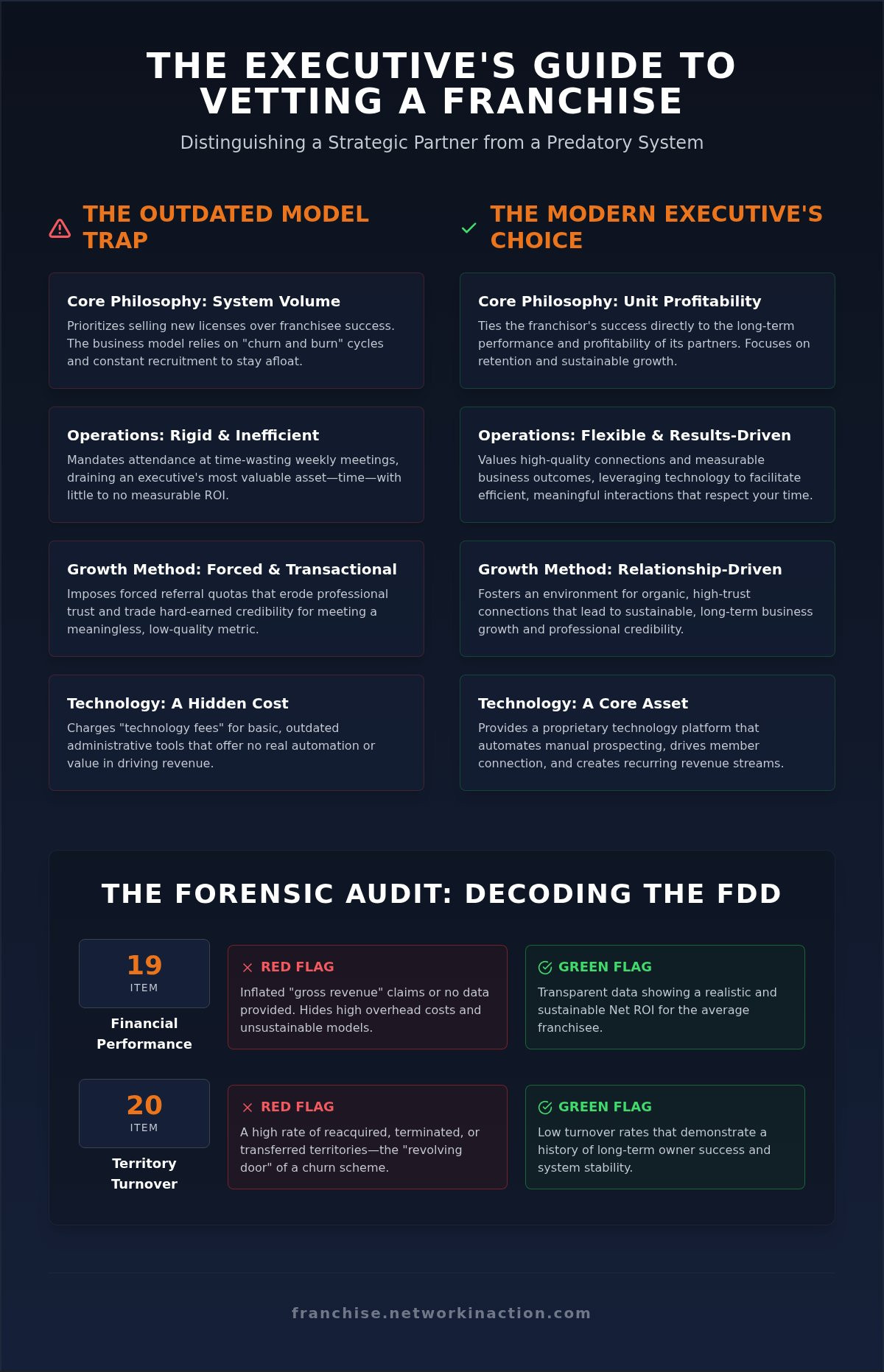
Traditional networking models are notorious for draining an executive's most valuable asset: time. These systems often mandate weekly, 90-minute meetings that prioritize attendance over actual business outcomes. The financial impact is staggering when you calculate the opportunity cost of these rigid requirements. Forced referral quotas are another hallmark of a predatory environment. When a system mandates a specific number of leads, quality collapses. Professional trust is destroyed. You end up trading your hard-earned credibility for a quota. A modern, results-driven model eliminates these manual burdens, focusing on high-quality connections facilitated by technology rather than forced, transactional activity. It's about ROI, not just staying busy.
Decoding the Franchise Disclosure Document (FDD) for Red Flags
The FDD is the executive's ultimate truth-seeking tool. Marketing teams sell a vision; legal documents reveal the operation. To understand how to protect yourself from a predatory franchisor, you must treat this document as a forensic audit rather than a casual read. Every item tells a story of either operational excellence or systemic failure. Don't skim. Investigate.
Item 19 and the Reality of Financial Performance
Item 19 is where franchisors disclose their financial performance representations. Predatory models often inflate their potential by highlighting "gross revenue" while burying the high overhead costs required to achieve those numbers. You aren't looking for a high top-line figure; you're looking for a sustainable net ROI that justifies your investment. If a franchisor refuses to provide any financial data in Item 19, it's a definitive warning that their business model cannot withstand the scrutiny of a professional investor.
Audit Item 20 with equal intensity. This section tracks territory churn. If you see a pattern of reacquired or closed territories, the "churn and burn" license scheme is likely in play. A healthy system grows through owner success, not through the constant resale of failed markets. High turnover is a loud signal of a system that extracts value rather than creating it.
Buried Fees and Unreasonable Termination Clauses
Scrutinize the fee structure for hidden escalations that erode your margins over time. Outdated networking models frequently hide "Technology Access Fees" that offer little more than basic administrative tools. A modern franchisor should provide a proprietary technology platform that actively drives member connection and recurring revenue. If you're paying for technology that doesn't automate your growth, you're just subsidizing the franchisor's overhead.
Pay close attention to the termination clause and liquidated damages. Predatory franchisors use these legal traps to ensure that even if the system fails you, they still get paid. You need an exit strategy based on performance, not a lifelong sentence in an inefficient system. Before signing, it's wise to download a franchise kit to see how a results-oriented model structures its partnership for mutual success.
Watch for these specific red flags in the contract:
- Escalating royalty percentages that penalize your growth.
- Mandatory marketing funds with zero transparency on local spend.
- Restrictive non-compete clauses that go beyond protecting trade secrets.
- Lack of a clear, equitable path to territory resale or transfer.
Legacy Traps: Why Rigid Models Breed Predatory Environments
Rigidity is the hallmark of a system that has stopped evolving. In the 2026 market, legacy networking organizations cling to manual, activity-based metrics because their revenue depends on high-volume churn. These models are inherently predatory because they demand your most finite resource, time, without providing a proportional return. To understand how to protect yourself from a predatory franchisor, you must look for activity traps that prioritize staying busy over making money. Growth should be strategic, not frantic.
The Fallacy of Forced Referrals and Quotas
Forced referral quotas are the ultimate sign of a transactional, inefficient system. When a franchisor mandates that every member must bring a specific number of leads each week, quality becomes an afterthought. This creates a quantity-over-quality environment where professional trust is sacrificed for a metric. For the franchise owner, this is a reputational disaster. You aren't building a curated community of leaders; you're managing a group of people trying to meet a quota to avoid a penalty. Modern, relationship-driven growth doesn't require force. It requires a model that incentivizes high-value connections through proprietary technology and professional curation.
High-Frequency Demands vs. Professional Efficiency
Weekly meetings are a relic of a pre-digital era. In an outdated networking model, these high-frequency demands are used to create an illusion of value. In reality, they drain the lifestyle autonomy of high-level leaders. Executives don't have time to spend 90 minutes every week in a rigid, scripted environment. The ROI just isn't there. High churn in these systems is inevitable because the time cost eventually outweighs the networking benefit for the most successful members.
The informed disruption of the industry involves moving to a monthly meeting model. This shift respects the owner's time and attracts a higher caliber of professional member who values results over ritual. By focusing on efficiency, you protect your investment and build a business that scales without requiring constant manual oversight. It's about leveraging technology to maintain connections between sessions rather than relying on face-to-face meetings as the only touchpoint. Learning how to protect yourself from a predatory franchisor means rejecting any system that values attendance more than outcomes. This is the core of the Network In Action philosophy: efficiency, structure, and professional ROI. It's the modern evolution of professional community leadership.
The Executive’s Shield: A Strategic Due Diligence Framework
Most advice focuses on legal litigation after a disaster occurs. Strategic selection is your real defense. Knowing how to protect yourself from a predatory franchisor requires a proactive, multi-step framework designed for high-level professionals. You don't just sign; you validate. Your due diligence must be as rigorous as any corporate acquisition. Results matter. Efficiency is the benchmark.
Start by reviewing the Available Territories to gauge the brand's market health. A healthy system has strategic openings based on demand, not a desperate map of vacancies from failed owners. Assess the scalability of the model beyond a single territory. With over 150 locations globally, a successful system should demonstrate that its model works across diverse markets without requiring constant manual intervention from the franchisor.
Validating Support Systems and Technology ROI
Don't take "proprietary technology" at face value. Many legacy networking organizations offer "proprietary tools" that are just rebranded, outdated message boards. Test the impact on recurring revenue. Does the platform automate member connections? Does it simplify your administrative load? High-tech tools should allow you to lead local business communities with minimal manual effort. If the tech doesn't drive efficiency, it's just a line item on your fee schedule.
Analyze the support structure. Onboarding is common; long-term strategic support is rare. Ask how the franchisor helps high-level leaders navigate complex market dynamics. If the support ends after the first week, the model is likely built for license volume, not your long-term ROI. A modern franchisor acts as a partner in your growth, providing the systems you need to maintain lifestyle autonomy.
Interviewing Current Franchisees for the Unfiltered Truth
Exhaustive interviews are non-negotiable. Go beyond the provided list of "happy" owners. Ask the critical question: "Would you invest in this territory again today?" Listen for mentions of rigid, outdated rules versus a culture that listens to feedback. If owners feel trapped by legacy requirements or forced referral quotas, you're looking at a predatory environment. Professional trust is built on quality, not forced metrics.
Use this Business Networking Franchise: The Executive Guide to benchmark these responses against modern ownership standards. A results-driven franchisor welcomes these conversations because their owners are successful partners, not just revenue sources. Validation is your shield. Use it. Download your franchise kit to see how a tech-forward model structures its partnership for mutual success.
Aligning with Results: The Modern Evolution of Franchise Ownership
Due diligence often feels like a defensive maneuver. You've audited the FDD, interviewed owners, and decoded the contracts. Now, you must pivot to an offensive strategy. The ultimate secret to how to protect yourself from a predatory franchisor is to align your capital with a system that values your time as much as your investment. Modern franchising for executives isn't about buying a job; it's about building a scalable empire. It's about freedom. It's about flexibility. It's about informed disruption of a legacy industry that has failed its participants for decades.
Traditional models rely on high-volume, low-quality membership to sustain their corporate overhead. They need your constant manual labor to keep the gears turning. A results-driven model flips this script. By focusing on curated, high-quality professional networking, you create a business that attracts top-tier talent and generates consistent, recurring revenue. This is the shift from being a system operator to becoming a community leader.
Choosing a Curated, Lifestyle-Friendly Model
Lifestyle autonomy is the primary measure of a successful franchise investment. Legacy networking organizations trap you in a cycle of weekly, 90-minute meetings that offer diminishing returns. Modern models leverage a monthly meeting structure. This respects your schedule and the schedules of your high-level members. It's a more sustainable approach that prevents burnout and maintains member retention. High retention means a more stable ROI for you.
A no-forced-referral policy is another critical differentiator. When you eliminate quotas, you restore professional trust. Members refer business because they want to, not because they have to. This builds a more credible and effective network. To understand the structural differences that protect your growth, download the NIA Franchise Kit. You'll see how a tech-forward platform replaces manual prospecting, allowing you to focus on high-level relationship building rather than administrative busywork.
Strategic Growth through Professional Community Leadership
Moving from a 9-to-5 to a business empire requires a model with built-in scalability. Professional community leadership allows you to leverage your existing network to build credibility and income simultaneously. You aren't just selling a service; you're facilitating the growth of your local economy. High-level referral groups serve as a powerful asset in an executive's long-term portfolio, providing a consistent income stream while requiring minimal time commitment compared to traditional business models.
Proprietary technology is your greatest ally in this evolution. It automates the connection process, tracks financial metrics, and ensures that your members see measurable results. This transparency protects your reputation and justifies your membership fees. Don't settle for an outdated networking model that ignores the digital tools of 2026. Align your future with a results-driven model that respects your time and empowers your leadership. Explore the possibilities and see if your vision matches a modern, technology-led path to professional freedom.
Secure Your Professional Future
Securing your professional future requires more than just a signature; it demands a fundamental shift in perspective. You now recognize that the most effective strategy for how to protect yourself from a predatory franchisor is prioritizing measurable results over outdated rituals. By auditing territory churn and rejecting the rigid, time-consuming quotas of legacy networking organizations, you position yourself for genuine financial ROI. Informed disruption. Results matter. This is the only reliable path to true lifestyle autonomy and professional impact.
Network In Action represents the next evolution of the industry. With over 150 locations worldwide and a Red Dot level technology platform, this system is built specifically for the high-level executive who values efficiency. A lifestyle-friendly monthly meeting structure ensures you lead your professional community without sacrificing your most valuable asset, time. It's time to stop settling for inefficient systems and align with a results-driven model designed for your long-term success. Explore the NIA Modern Franchise Model today to discover a smarter way to grow. Your strategic move toward freedom starts now.
Frequently Asked Questions
What are the most common signs of a predatory franchisor?
Common signs include high territory turnover in Item 20 of the FDD and a focus on recruitment volume rather than individual owner success. Predatory models often enforce rigid, outdated operational requirements that drain your time without delivering a proportional return. Understanding how to protect yourself from a predatory franchisor means looking for systems that decouple their corporate revenue from your actual unit profitability. If the franchisor prioritizes selling licenses over supporting your growth, you're looking at a churn-and-burn scheme.
Is a lack of an Item 19 in the FDD always a bad sign?
While not technically illegal, the absence of an Item 19 is a significant warning sign for high-level professionals seeking a strategic investment. It indicates that the franchisor either lacks the data to support their claims or is hiding a model with poor ROI. Executives need transparency to make informed decisions. A model that refuses to disclose financial performance representations often hides a system that is inefficient, outdated, or fundamentally incapable of producing consistent results for its partners.
How do legacy networking organizations differ from modern networking franchises?
Legacy networking organizations rely on time-consuming weekly meetings and manual prospecting methods that haven't evolved since the pre-digital era. They focus on volume over quality. In contrast, modern networking franchises like Network In Action utilize a technology-forward approach with monthly meetings and curated memberships. This shift prioritizes your lifestyle autonomy and professional credibility. By eliminating forced referrals and rigid quotas, modern models create a more sophisticated environment designed for actual business growth rather than just staying busy.
What should I look for when interviewing current franchise owners?
You must ask current owners if they would reinvest in the same territory today and if the franchisor actually listens to their feedback. Exhaustive interviews are the best way to learn how to protect yourself from a predatory franchisor before committing capital. Look for evidence of long-term strategic support rather than just initial onboarding. If current owners feel trapped by legacy requirements or report high member churn, the model likely lacks the efficiency needed for sustainable executive ownership.
Are forced referrals a sign of a predatory or outdated networking model?
Forced referrals are a definitive sign of an outdated networking model that values transactional volume over professional trust. When a system mandates quotas, the quality of leads collapses, and your local reputation suffers. Predatory environments use these metrics to create an illusion of activity. Modern systems reject this approach, focusing instead on relationship-driven growth and high-quality connections. This ensures that every referral is meaningful, protecting your credibility while driving real financial returns for your members.
How does proprietary technology protect a franchisee's return on investment?
Proprietary technology protects your investment by automating the manual, time-consuming tasks associated with traditional networking. A Red Dot level platform facilitates member connections and tracks metrics in real-time, allowing you to manage your business with surgical precision. This efficiency is a key differentiator for Network In Action. By reducing your administrative load, technology ensures that you spend your time on high-level community leadership rather than basic coordination, maximizing your hourly ROI and lifestyle freedom.
What is the typical timeframe for launching a modern networking franchise?
The typical timeframe for launching depends on your market and the completion of the comprehensive onboarding process. A modern system is built for efficiency, allowing you to move through training and territory setup without the delays common in legacy industries. By utilizing a tech-forward platform, you can begin identifying high-quality members and building your professional community shortly after your initial training is complete. This focus on speed and structure ensures your capital starts working for you immediately.
Can I run a networking franchise while maintaining other professional commitments?
Yes, the modern franchise model is specifically designed for executives who value flexibility and have other professional commitments. Because the system utilizes a monthly meeting structure instead of weekly demands, your time requirement is significantly reduced. You lead your local business groups while maintaining your lifestyle autonomy. This scalability allows you to build a recurring revenue stream without being tethered to a 9-to-5 schedule, making it an ideal addition to a sophisticated professional portfolio.