What if the biggest hurdle to your entrepreneurial freedom isn't the initial capital or the market, but the conversation happening at your own dinner table? Many high-level professionals hesitate to pivot because they fear the strain a new venture might place on their family's financial stability and precious personal time. It's understandable for a partner to feel skeptical when they've only seen traditional, high-pressure business models that demand grueling schedules and constant sacrifice.
Understanding how to get spousal support for buying a franchise is less about a high-pressure sales pitch and more about demonstrating a strategic alignment of goals. You're not just asking for permission to invest; you're presenting a blueprint for a shared future. This guide will help you master the art of aligning your business ambitions with your partner’s lifestyle goals to secure the ultimate franchise buy-in. This roadmap provides a clear plan for balancing business growth with family life. You'll learn how to replace fear with confidence by focusing on modern, tech-led systems that prioritize efficiency over the rigid, time-consuming demands of legacy networking organizations. Proven systems. Lifestyle autonomy. Results-driven growth.
Key Takeaways
- Reframe spousal buy-in as a strategic partnership milestone rather than a hurdle, ensuring your business ambitions are in lockstep with your family’s lifestyle goals.
- Discover how to get spousal support for buying a franchise by using the Franchise Disclosure Document to provide total financial transparency and mitigate perceived risks with logic.
- Contrast the efficiency of modern, monthly meeting models against the rigid, time-consuming schedules of legacy networking organizations to prove long-term sustainability.
- Leverage proprietary technology to manage professional networks efficiently, ensuring business growth and recurring revenue don't come at the expense of family time.
- Position the franchise as a community leadership opportunity that builds a lasting professional legacy and enhances your family's social capital.
The Partnership Paradigm: Why Spousal Alignment is Your First Business Milestone
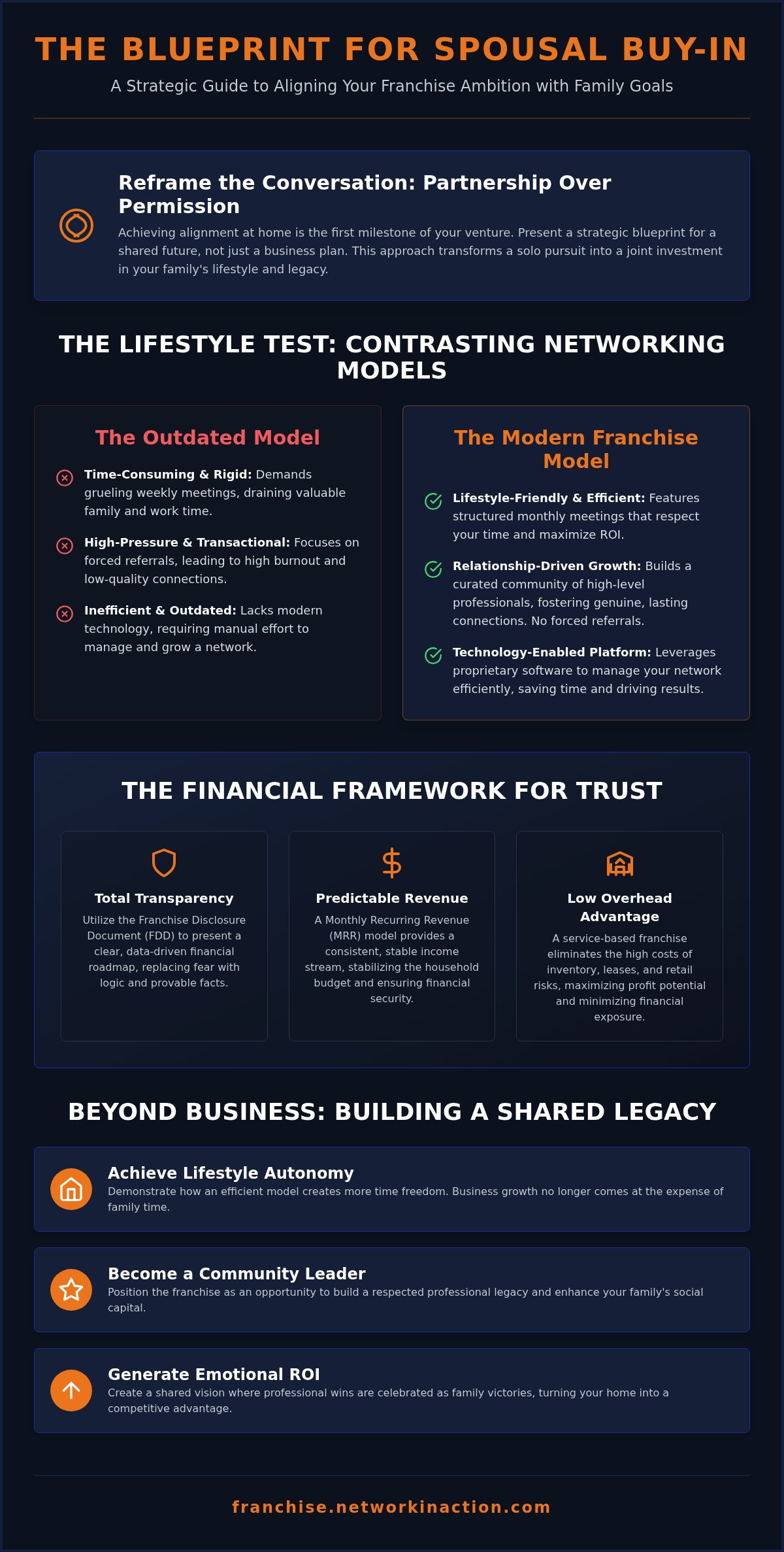
Spousal support is often discussed in legal contexts, but in the world of high-stakes entrepreneurship, it's your most vital strategic asset. It isn't a mandate; it's a partnership. When you decide to pivot from a corporate career to business ownership, your spouse becomes your primary stakeholder. Achieving alignment at home is the first real milestone of your new venture. If you want to understand how to get spousal support for buying a franchise, you must stop treating the decision as a solo pursuit and start treating it as a joint investment in your family's future.
Success requires a supportive home base. In the framework of Understanding the Franchise Model, your partner often serves as a silent partner who provides the emotional runway for your professional takeoff. Their buy-in is as critical as your initial capital. Without it, the friction of a divided household will eventually stall your growth. Most spouses don't fear the business itself; they fear the unknown. They worry about financial volatility and the potential for a high-pressure model to steal time away from the family. Identifying these fears early allows you to replace anxiety with a concrete, results-oriented plan.
The Emotional ROI of Shared Vision
Alignment isn't about permission. It's about partnership. You must connect your business goals to a long-term family legacy. When both partners see the franchise as a vehicle for lifestyle autonomy, the psychological impact is profound. A shared vision creates an environment where professional wins are celebrated as family victories. This emotional ROI sustains you through the scaling phase, turning a supportive home base into a competitive advantage. Shared goals. Shared success.
Addressing the Risk-Aversion Gap
One partner often plays the role of the skeptic. This protective instinct is a natural response to the perceived risks of business ownership. To bridge this gap, you must reframe the conversation. Move away from the gamble narrative and focus on the logic of a proven system. Explain that a modern networking franchise isn't like legacy networking organizations that demand weekly, time-consuming commitments. Use data to show how a streamlined, tech-led model reduces risk while maximizing time freedom. Results-driven logic is the best antidote to skepticism. Data builds trust. Systems drive confidence.
Funding the Dream: Navigating the Financial Realities of Franchise Investment
Financial clarity is the cornerstone of trust. When exploring how to get spousal support for buying a franchise, you must move beyond vague projections and present a hard-data reality. Your partner needs to see the total investment, including license fees, ongoing royalties, and technology access, not as a drain, but as a strategic allocation of capital. Transparency starts with the Franchise Disclosure Document (FDD). This document isn't just a legal requirement; it's a roadmap for building confidence. It provides the granular detail needed for joint financial planning that doesn't compromise family security.
Predictability is the ultimate stabilizer. By leveraging recurring revenue models, you provide a consistent income stream that traditional, transactional businesses struggle to match. This predictability is often the deciding factor for a spouse who wants to know exactly how to get spousal support for buying a franchise through measurable results rather than hopeful guessing. High-level professionals understand that a business is only as strong as its cash flow, and a model built on social capital and technology delivers that strength.
The Economics of Professional Networking
Service-based franchises offer a distinct advantage over legacy brick-and-mortar models. You aren't managing physical inventory, massive leases, or the high-overhead risks associated with retail. Instead, you're building an asset based on monthly recurring revenue (MRR). This model stabilizes the household budget by creating a predictable cash flow. Consider these core financial benefits:
- Low Overhead: Minimal fixed costs compared to traditional storefronts or legacy networking organizations.
- Predictable MRR: Consistent income streams that provide financial peace of mind.
- Scalable Growth: Leveraging tech-led systems to manage multiple groups efficiently without increasing physical costs.
When you compare initial investment requirements to potential long-term ROI, the math favors the efficient, tech-led systems that define the next evolution of this industry.
Strategic Capital Allocation
Strategic capital allocation requires a clear-eyed look at your funding options. Whether you're utilizing joint savings or exploring professional funding like SBA 7(a) loans, where variable rates currently range from 9.75% to 13.25%, the goal is to ensure the business supports the family's standard of living. Modern franchise models often require a lower total initial investment compared to the common industry range of $50,000 to $200,000. You can Download the NIA Franchise Kit for detailed financial breakdowns that simplify this process. Protecting your family's baseline while pursuing growth is the most effective way to secure a supportive partner. Explore how a low-overhead model fits your family's goals by reviewing available territories today.
The "Spouse-Approved" Model: Why Legacy Networking Fails the Lifestyle Test
Traditional business models often demand a sacrifice that many modern families are no longer willing to make: their time. Legacy networking organizations frequently rely on the "7 AM Trap," requiring weekly attendance at dawn. This rigid structure inevitably disrupts family routines, creates morning friction, and forces a choice between professional growth and being present for breakfast. When you're researching how to get spousal support for buying a franchise, the most persuasive argument you can make is that your new venture won't become a second job that steals your primary life.
The math of time freedom is simple but powerful. By shifting from a weekly requirement to a monthly meeting model, you reclaim dozens of hours every month. This isn't just about working less; it's about working smarter. A tech-enabled management system allows you to lead professional groups from a tablet rather than being tethered to a cubicle or a banquet hall. This flexibility is what makes a business truly "spouse-approved." It offers a path to community leadership and recurring revenue without the "grind" associated with outdated networking models. Efficiency is the new currency of the successful entrepreneur.
Reclaiming the Family Calendar
The hidden cost of legacy networking organizations is the pressure of "forced referrals." This transactional approach is time-consuming and often feels disingenuous. In contrast, a modern model focuses on curated, high-quality membership. By prioritizing quality over quantity, you spend less time on low-value activities and more time building meaningful professional credibility. This monthly rhythm allows for genuine lifestyle autonomy. You aren't just buying a business; you're securing a schedule that respects your family’s priorities. It’s about moving from a state of constant "hustle" to a position of strategic community leadership.
Efficiency as a Value Proposition
Modern professionals demand tools that match their pace. Leveraging proprietary technology keeps members connected 24/7 without requiring you to be physically present 24/7. This informed disruption of a traditionally manual industry reduces the need for constant cold prospecting and unnecessary travel. When your spouse sees that the business is managed through streamlined digital systems, their skepticism often turns into confidence. You can demonstrate how to get spousal support for buying a franchise by showing a clear, tech-led plan that maximizes ROI while minimizing the strain on your home life. Strategic growth doesn't have to be loud or exhausting. You can explore how this balance works in practice by reviewing available territories that fit your local lifestyle goals.
Presenting a Franchise Opportunity to Your Partner
Securing spousal buy-in isn't about persuasion; it's about professional alignment. When you're ready to discuss how to get spousal support for buying a franchise, you must approach the conversation with the same rigor you'd bring to a corporate merger. This is a four-step process designed to replace emotional hesitation with logical confidence. First, gather the evidence. Your partner needs to see the concrete math behind the ROI and the specific time commitment required. Second, address the "Worst-Case Scenario" directly. Use data to show that franchises have a significantly higher survival rate than independent startups, with roughly 65% to 85% of franchises remaining open after five years. Third, connect the business to their specific personal goals. Whether it's more frequent travel or an earlier retirement, the franchise must be the vehicle that gets you there. Finally, invite them into the discovery process early. Ownership grows when they feel part of the decision-making team rather than a spectator.
The Executive Presentation
Positioning this as an executive business opportunity requires high-level materials. You aren't just starting a hobby; you're leading a community. Focus on the "Why Now" factor. Explain why the current market demand for efficient, tech-led networking makes this the perfect time to disrupt legacy models. You can Get the Free Book on Modern Networking to help share this vision with your partner. Professional credibility is built through transparency and sophisticated systems. This isn't about selling a dream; it's about presenting a ready-to-use solution for professional growth. Results matter. Systems deliver.
Handling Common Objections
Expect skepticism and treat it as a request for more data. If the objection is "We don't have the time," counter with the monthly NIA model. Contrast it against the grueling weekly schedules of legacy networking organizations that drain morning hours. If the concern is "It's too expensive," shift the focus to the ROI of referral-based businesses and the scalability of leading multiple professional groups. For those worried that "You've never run a business," highlight NIA’s comprehensive training and proprietary technology platform. These tools are designed to bridge the experience gap and ensure consistent results from day one. Confidence is contagious when it's backed by a proven framework. You can explore how to get spousal support for buying a franchise by demonstrating a clear, tech-forward path to success. Start the conversation with clarity by reviewing available territories that match your family's future goals.
Building a Legacy Together: Why Network In Action is the Strategic Choice
Building a legacy is the ultimate form of social capital. It transforms a career into a community-wide impact that your family can be proud of. When you consider how to get spousal support for buying a franchise, you must emphasize that this isn't just about income; it's about influence. The 2026 market has no patience for the inefficient, manual processes of the past. High-level professionals are migrating toward tech-forward solutions that respect their time and deliver measurable ROI. Network In Action represents this next evolution, offering a scalable model where you can lead multiple professional referral groups without the burnout associated with traditional models. This is about creating a family brand that stands for professional excellence and community leadership.
Scalability is built into the DNA of the NIA model. Unlike legacy networking organizations that require you to be physically present for every minor interaction, the NIA proprietary technology platform handles the heavy lifting of member connection. This allows for growing a business across multiple territories while maintaining the lifestyle autonomy your partner expects. You're not just buying a job; you're investing in a system that has been refined across over 150 locations globally. When your spouse sees the potential for recurring revenue paired with a flexible schedule, the decision moves from a "maybe" to a strategic "yes."
The Modern Evolution of Business
Legacy models are fading because they failed to adapt to the digital age. They rely on rigid, transactional structures that feel like a chore rather than a strategic advantage. In contrast, NIA positions you as a visionary leader within an exclusive, curated network of executives. This is informed disruption at its finest. You aren't just running a business; you're managing a sophisticated system that serves your family's lifestyle. By leveraging digital tools, you ensure that the growth of your franchise enhances your family's autonomy rather than draining it. It's a business that fits your life, not a life that fits your business.
Next Steps for the Entrepreneurial Couple
Moving from discussion to territory reservation is the final step in securing your future. The process is designed to be collaborative, ensuring both partners are aligned on the vision and the execution. Your first priority should be to Explore Available Territories near you to see where your influence can have the greatest impact. Once a territory is identified, scheduling a joint discovery call with the NIA team allows both of you to ask the hard questions and see the systems in action. It's the most effective way to finalize the plan together.
A clear 90-day launch plan removes the guesswork from the first quarter. This roadmap sets firm expectations for growth, training, and community engagement. It provides the logical framework needed to maintain confidence as you transition from corporate life to business ownership. You've mastered how to get spousal support for buying a franchise by proving that this model is the smartest path toward time freedom and shared success. The future of networking is here, and it’s time to lead it together.
Secure Your Shared Future Through Strategic Alignment
Success in business is rarely a solo achievement. It's the result of a coordinated effort between ambitious leaders and their most trusted partners. You've learned that understanding how to get spousal support for buying a franchise requires shifting the focus from risk to lifestyle ROI. By replacing the rigid, time-consuming demands of legacy networking organizations with a modern, tech-led model, you protect your family's most valuable asset: time. Proven systems. Lifestyle autonomy. Measurable results.
Network In Action offers an executive-level revenue model backed by over 150 locations worldwide and a proprietary tech platform designed for efficiency. This isn't just a business opportunity; it's a path to community leadership that enhances your family's professional legacy. The transition from corporate executive to franchise owner is a strategic move that benefits everyone in your household. Take the next step by exploring how this modern evolution of networking fits your shared vision. Download the Complete Franchise Kit and Start Your Partnership Journey today. Your new chapter starts with alignment. Build your legacy together.
Frequently Asked Questions
How do I explain the ROI of a networking franchise to a skeptical spouse?
Explain the return on investment by highlighting the predictability of monthly recurring revenue. Traditional business models often face feast-or-famine cycles, but a networking franchise builds consistent income through curated membership. Focus on the low overhead of a service-based model compared to the high risks of brick-and-mortar ventures. This shift from transactional sales to relationship-driven growth provides the financial stability that skeptical partners value. It’s about building a scalable asset with long-term value.
Can a franchise be funded using legal spousal support or alimony payments?
You can potentially use legal spousal support or alimony payments to fund your investment. These funds represent personal capital that you can allocate toward a franchise license fee to build your own business. When discussing how to get spousal support for buying a franchise in this context, it's vital to treat the investment as a strategic move toward financial independence. Consult with a financial advisor to ensure your capital allocation aligns with your long-term security goals.
What are the time commitments for a Network In Action franchise compared to legacy models?
Network In Action requires only a few hours of face-to-face commitment monthly. This is a significant disruption to legacy networking organizations that demand rigid, weekly morning meetings. By eliminating the "7 AM Trap," you reclaim dozens of hours every month for your family and other professional pursuits. The NIA model is built for efficiency, allowing you to manage your groups without the time-consuming grind associated with outdated, transactional networking systems that prioritize quantity over quality.
How does NIA proprietary technology help maintain a work-life balance?
NIA’s proprietary technology platform keeps your members connected 24/7 without requiring your constant physical presence. You can manage referrals, track ROI, and communicate with your network from a tablet or smartphone. This digital-first approach eliminates the need for constant cold prospecting or manual administrative tasks. By automating the heavy lifting of group management, the technology ensures your business growth doesn't come at the expense of your family time or personal freedom. Efficiency drives balance.
What training does NIA provide for first-time business owners?
Franchisees receive comprehensive training designed to bridge the gap from corporate executive to community leader. NIA provides a ready-to-use solution that includes proprietary systems, marketing tools, and ongoing corporate support. You don't need prior business ownership experience to succeed. The training focuses on leveraging your existing professional credibility to build high-quality referral groups. This structured onboarding process gives you the confidence to lead your professional community effectively and achieve measurable results from day one.
How do I handle a spouse who is afraid of the initial franchise fee?
Address the initial franchise fee by comparing it to the total investment required for high-overhead industries. A service-based franchise typically falls on the lower end of the industry average, which often ranges from $50,000 to $200,000. Reframe the fee as an investment in a proven system and established brand equity. Highlight that this one-time payment secures a protected territory and provides access to proprietary tools that would cost significantly more to develop independently.
Why is a monthly meeting model better for family life than weekly meetings?
A monthly meeting model is superior for family life because it respects your morning routines and personal calendar. Weekly meetings in legacy networking organizations often create recurring friction at home. Shifting to a monthly rhythm provides lifestyle autonomy while maintaining professional impact. This model prioritizes quality over quantity, ensuring that your time spent working is high-value. It allows you to be a present parent and partner while still building a successful, recurring revenue business.
What is the best way to involve my spouse in the franchise discovery process?
The best way to involve your spouse is to invite them into the discovery process early. Include them in initial calls with the NIA team so they can hear the facts firsthand. When you're researching how to get spousal support for buying a franchise, transparency is your best tool. Let them review the Franchise Disclosure Document and explore available territories with you. Building a shared vision from the start creates a sense of ownership and partnership.