
Market sovereignty. Total protection. Your geographic boundary isn't just a line on a map; it's the literal foundation of your professional empire. Yet, many entrepreneurs sign their Franchise Disclosure Document without realizing how easily that foundation can crumble. You likely fear encroachment from neighboring franchisees or feel buried under legal jargon that feels designed to obscure the truth. This confusion is a liability. In a landscape where digital sales often ignore physical borders, having franchise territory rights explained in clear, modern terms is a prerequisite for protecting your capital.
Mastering these complexities ensures your investment stays shielded from internal competition while remaining optimized for maximum ROI. Legacy models fail to address these shifts. Modern systems thrive on them. This guide breaks down the specific territory types relevant in 2026, including data-driven mapping and exclusive zones. You'll gain a high-level checklist for auditing your FDD with surgical precision. Stop guessing about your market's scalability. Start building with the absolute confidence that your territory is secure, protected, and ready to dominate.
Key Takeaways
- Secure your market sovereignty to protect your capital from encroachment and ensure maximum long-term ROI.
- Navigate the legal nuances of 2026 with our franchise territory rights explained, distinguishing between truly exclusive zones and limited protected areas.
- Perform a surgical audit of Item 12 in the FDD to uncover potential carve-outs and secure your Right of First Refusal for adjacent markets.
- Leverage data-driven mapping over outdated radius circles to ensure your territory is optimized for actual market demand and scalability.
- Discover how modern networking models replace the inefficiency of legacy organizations with protected, tech-enabled territories designed for executive leadership.
What Are Franchise Territory Rights? Defining Your Market Sovereignty
Territory rights are the lifeblood of your franchise investment. In simple terms, these rights define the geographic area where you have the authority to conduct business under the brand's banner. To have franchise territory rights explained properly, you must view them through the lens of market sovereignty. This isn't just a legal convenience; it's your most critical asset. Sovereignty ensures that the time and capital you invest in building local relationships won't be cannibalized by another partner from your own system setting up shop across the street.
There's a vital distinction between an operating area and a protected market. An operating area merely grants you permission to work in a specific zone. A protected market, however, legally bars the franchisor from opening competing locations or selling to other partners within your boundaries. For those looking at larger scales, such as a Master franchise, these boundaries become the very product you manage and scale. Without this protection, your growth is perpetually at risk.
The Scope of Territorial Protection
Your protection dictates where you can legally market your services. Passive solicitation often allows customers from outside your zone to find you, but active solicitation, which involves deliberately hunting for leads in another's backyard, is usually prohibited. This clarity is essential for your eventual exit strategy. A clearly defined, exclusive territory significantly boosts your resale value. A future buyer is purchasing a guaranteed market share, not just a business name. Clear boundaries equal clear profits.
Traditional vs. Modern Territory Models
Outdated networking models often fail here. Legacy networking organizations frequently allow chapters to overlap or crowd into the same zip codes, creating internal friction and diluted results. It's a transactional approach that values quantity over the health of your business. Modern franchising has evolved beyond these manual limitations. Technology now allows for surgical precision in market definition.
Network In Action (NIA) utilizes technology-enabled territory management to ensure you lead a curated, high-quality community without the threat of encroachment. By moving away from the rigid, inefficient structures of traditional networking, NIA provides a lifestyle-friendly model where your market is your own. You can explore available territories to see how these exclusive zones are strategically mapped for maximum ROI. This is the next evolution of the industry: protected, tech-forward, and built for leaders.
Exclusive vs. Protected Territories: Navigating Market Control
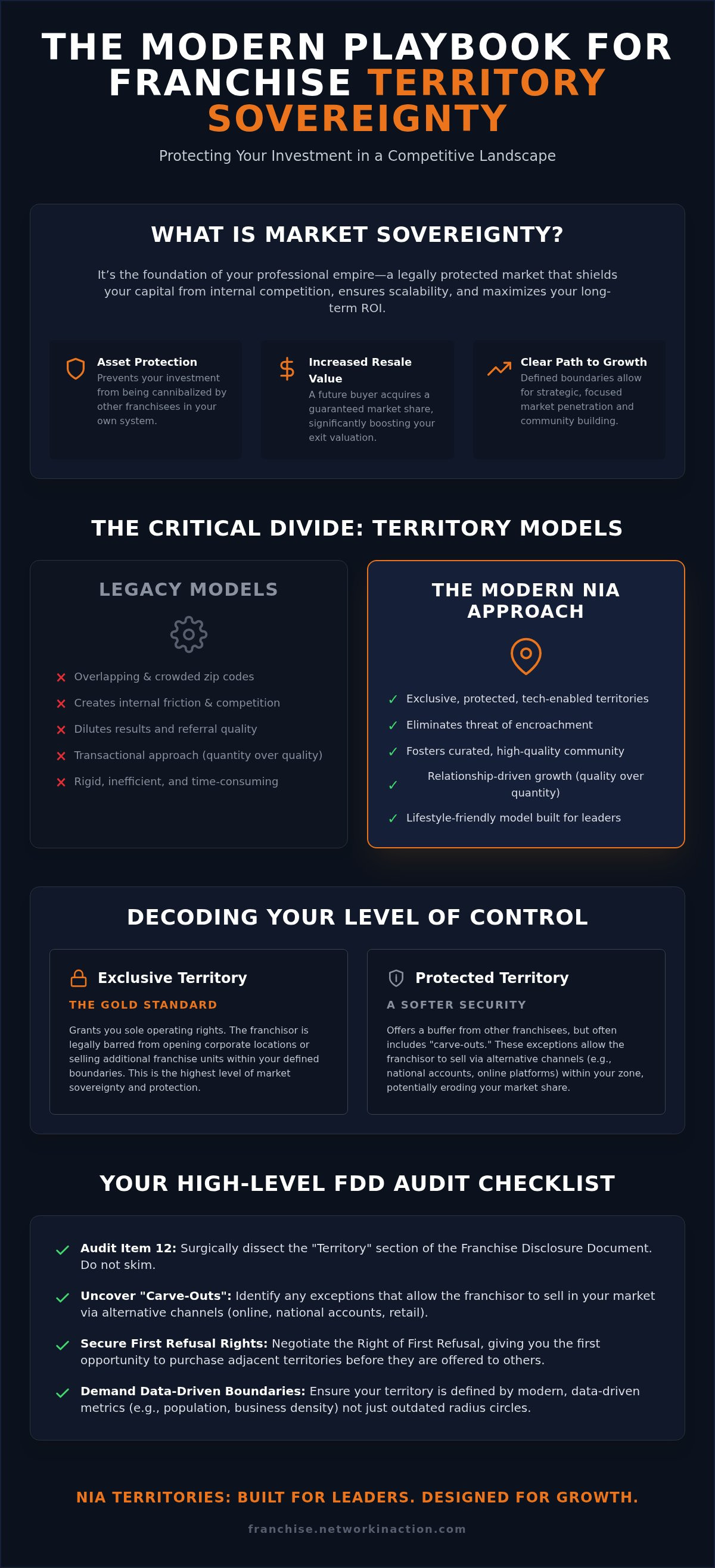
Control is absolute. In the world of business ownership, you either own your zone or you're competing for airtime on a crowded shelf. When you have franchise territory rights explained by a legal professional, the first distinction you'll encounter is between exclusive and protected territories. An exclusive territory grants you sole rights. The franchisor cannot open corporate locations or sell additional units within your boundaries. This is the gold standard for market sovereignty.
Protected territories offer a softer version of this security. While they provide a buffer, they often include "carve-outs." These are specific exceptions that allow the brand to sell products or services through alternative channels, such as national accounts or online platforms, even if the customer is in your backyard. As highlighted in A Consumer's Guide to Buying a Franchise, understanding these nuances is a non-negotiable step in your due diligence process. If your rights aren't clearly defined, your ROI is at the mercy of the franchisor's next expansion strategy.
The Mechanics of Exclusivity
Exclusivity drives quality. When you hold sole rights to a professional market, you aren't just a service provider; you're a community leader. This status allows you to curate a high-quality membership without the threat of internal competition. Legacy networking organizations often fall into the "internal competition" trap, where multiple chapters overlap in the same zip code. This creates a transactional environment that dilutes the value of every referral. Modern models eliminate this friction by ensuring that your growth doesn't come at the expense of your neighbor.
Common Carve-outs and Exceptions
In 2026, the digital frontier is where many territory disputes are won or lost. You must look for clarity on how digital leads and "ghost" territories are managed. If a franchisor can launch a virtual platform that services your area without your involvement, your physical boundary becomes irrelevant. High-level executives must negotiate for protection against future technology platforms that could bypass traditional geographic lines. Clarity today prevents litigation tomorrow.
Smart professionals look for models that prioritize their market control from day one. You can download a franchise kit to see how a tech-forward approach to territory rights can secure your professional future. Stop settling for the crowded, inefficient chapters of outdated networking models and start building on protected ground.
How Modern Franchises Define Boundaries: Radius, Population, and Data
Radius definitions are a relic of a slower era. When you have franchise territory rights explained by a legacy brand, they often point to a simple circle on a map. This approach is lazy. It ignores traffic patterns, natural barriers, and business density. A five-mile radius in a rural county might contain fifty businesses, while the same circle in a metro center holds thousands. Modern franchising demands more than geographic proximity; it requires demographic and business density metrics to ensure long-term scalability.
Precision prevents litigation. By utilizing zip code and county definitions instead of vague radii, you lock in a territory that is legally defensible and commercially viable. This data-driven approach is detailed in the Franchise Disclosure Document, specifically under Item 12. Understanding how these boundaries are constructed is the difference between owning a ghost town and a goldmine.
The Role of Business Density in Professional Networking
Density is the engine of recurring revenue. In professional networking, your territory must have a critical mass of high-quality business owners to sustain multiple groups. Outdated networking models ignore this, often saturating a market until every chapter is a carbon copy of the last. A modern model targets high-value professional sectors using data-driven design. This ensures your territory isn't just a space on a map, but a fertile ecosystem for relationship-driven growth.
Targeting high-quality business owners requires looking beyond population counts. You need to evaluate:
- Business Density: The number of registered businesses within your specific zip codes.
- Professional Demographics: The presence of high-level executives and decision-makers.
- Growth Potential: Market trends that signal long-term scalability.
Technology-Enabled Territory Management
Proprietary technology is the only way to enforce territory integrity in real-time. NIA uses a technology-enabled platform to create digital fences around your market. This system prevents lead-stealing and ensures that the members you recruit remain your members. In a service-based franchise, this integrity is your most valuable asset. Digital encroachment occurs when a neighboring owner uses online tools to solicit business within your protected geographic zone. Legacy organizations lack the tools to prevent this, relying on manual oversight that fails under pressure. NIA's platform automates this protection, allowing you to focus on leadership. You can view available territories to see how this precision-led mapping creates superior opportunities for growth.
Due Diligence: Auditing Territory Clauses in the FDD
Item 12 of the Franchise Disclosure Document (FDD) is the definitive source for your market's security. It's where the legal fine print dictates whether you own a kingdom or a temporary lease. To have franchise territory rights explained with executive-level clarity, you must look past the surface. You're searching for a Right of First Refusal on adjacent territories. This clause allows you to claim neighboring markets before they're offered to outsiders, providing a clear path to multi-unit expansion and long-term dominance.
Performance matters. Many franchisors include minimum performance requirements that, if unmet, allow them to shrink your territory or strip away your exclusivity. This is a massive red flag. You must understand exactly what metrics you're expected to hit to maintain your sovereignty. If the bar is set unrealistically high, your investment is built on sand. Don't let a poorly negotiated clause turn your hard-earned growth into a liability for the franchisor to exploit.
The Executive Audit Checklist
Don't sign until you've answered these three critical questions. Your ROI depends on the answers.
- Question 1: Does the franchisor reserve the right to sell online in your zone? If they can bypass you via a digital platform, your physical boundaries are essentially decorative.
- Question 2: Are the boundaries clearly defined by fixed markers like zip codes? Zip codes and county lines are defensible; a radius is a recipe for legal disputes.
- Question 3: What happens if the population in your zone grows or shrinks? Ensure your rights don't evaporate if a census report shows a minor population dip.
Negotiating for Market Growth
Smart professionals secure their future from day one. Negotiate for multi-unit expansion options early. This ensures that as you build professional credibility, you have the room to scale without administrative roadblocks. Outdated networking models often change their models on a whim, diluting the value of their chapters. You need a contract that protects your ROI even if the leading brand shifts its strategy. This is about more than just a single group; it's about building a scalable asset.
Building a legacy requires the right ground. You can Explore available territories for your next move to see where the most lucrative opportunities remain. Once you've audited the FDD and confirmed your protections, you can move forward with the confidence of a visionary leader. If you're ready to lead a high-growth community, start by aligning with a model that respects your market sovereignty at Network In Action.
The Strategic Advantage of NIA Territories: Built for Leaders
Market sovereignty is more than a legal boundary. It's a strategic weapon. While other franchises leave you to fight for scraps in overlapping zones, Network In Action (NIA) builds your business on a foundation of absolute exclusivity. Having franchise territory rights explained through the lens of NIA reveals a model designed for high-level professionals who value time as much as capital. You don't just own a zip code; you lead a curated ecosystem of the most influential business owners in your market. When you have franchise territory rights explained in the context of modern professional networking, the NIA model stands alone as a superior alternative to legacy systems.
Legacy networking organizations rely on manual oversight and outdated structures that often lead to chapter-hopping and lead-stealing. NIA eliminates this friction. By leveraging a proprietary technology platform, NIA enforces territory integrity in real-time. This tech-forward approach ensures that your efforts stay within your protected zone, allowing you to build a recurring revenue stream that is both scalable and defensible. This is the next evolution of the industry: a system where your market is yours to dominate.
Efficiency Over Volume
Quality beats quantity. Every time. Traditional networking models force you into a high-volume grind, requiring hundreds of members to see a significant ROI. This approach is transactional, rigid, and time-consuming. NIA disrupts this status quo by focusing on curated, high-level professional circles. You don't need 500 members to reach your financial goals. By hosting monthly meetings instead of weekly sessions, you maximize territory efficiency without sacrificing your personal freedom. This is networking for the executive schedule. It's about deep relationships, not forced referrals.
Securing Your Future with NIA
Your territory is your empire. Owning a protected NIA zone means you are the undisputed leader of your local business referral market. This lifestyle-friendly model provides the flexibility to grow at your own pace while building professional credibility that lasts. Whether you are an executive looking for a second act or an entrepreneur seeking a scalable system, NIA provides the turnkey business opportunity to make it happen. You gain the freedom of business ownership without the inefficiency of outdated networking models.
The path from community leader to a business empire starts with the right tools. You need a system that respects your time and your market sovereignty. Stop settling for the rigid, inefficient models of the past. Download the NIA Franchise Kit to see the tech in action and discover how a modernized approach to territorial protection can shield your investment and optimize your ROI. Align your future with a brand that understands the value of your market sovereignty.
Dominate Your Market With Strategic Sovereignty
Market sovereignty is the difference between a struggling business and a scalable empire. You now have franchise territory rights explained from a tactical perspective, ensuring you can audit Item 12 of the FDD with surgical precision. By prioritizing data-driven mapping and exclusive zones, you eliminate the threat of encroachment that often plagues legacy networking organizations. This clarity is your primary defense against internal competition and the fundamental foundation of your long-term ROI. Dominate your zone. Build your legacy.
Network In Action (NIA) backs this sovereignty with an executive-led business model and a proprietary technology platform designed for measurable results. With over 150 locations globally, the system is proven, scalable, and ready for your leadership. It's time to stop settling for the inefficiency of outdated networking models that demand your time without protecting your territory. Secure your professional future by aligning with a brand that values your expertise and your market. Explore available territories and secure your market sovereignty to begin your journey as a community leader. Your professional evolution starts with a single, strategic move toward a more efficient and profitable future.
Frequently Asked Questions
What is an exclusive franchise territory?
An exclusive territory ensures the franchisor cannot open corporate locations or grant rights to another franchisee within your defined area. This is the gold standard for market sovereignty. It protects your investment from internal competition. In the context of having franchise territory rights explained, exclusivity means you have the sole right to lead the brand's presence in that specific zone, ensuring your growth efforts remain entirely your own.
Can a franchisor change my territory after I sign the agreement?
Generally, the boundaries defined in your signed agreement are legally binding and cannot be changed without your consent. However, some contracts include performance-based clauses that allow a franchisor to reduce your territory size if you fail to meet specific growth metrics. You must audit your FDD carefully to identify any "right to modify" language that could jeopardize your market sovereignty or ROI in the future. Don't sign until these terms are clear.
How are territories defined in a networking franchise?
Modern networking franchises like Network In Action use zip codes or county lines to create defensible, data-driven boundaries. This method is superior to the outdated radius approach, which often leads to disputes. By using fixed markers, you ensure your territory has the necessary business density and demographic profile to support multiple high-quality referral groups. This precision is what allows you to maximize your recurring revenue potential without fear of encroachment.
What is franchise encroachment and how do I avoid it?
Encroachment occurs when a franchisor or another franchisee operates within your protected market, diluting your leads and profits. You avoid this by securing an exclusive territory and ensuring your agreement has clear language regarding digital sales and alternative distribution channels. NIA uses a proprietary technology platform to enforce these boundaries in real-time, preventing the lead-stealing common in legacy networking organizations. Technology is the only reliable way to maintain your market's integrity.
Do I need a large geographic territory to be successful?
Success depends on business density rather than raw acreage. A compact metro territory with thousands of high-level professionals is often more valuable than a sprawling rural zone with limited prospects. Your goal is to achieve critical mass for your referral groups. Modern models prioritize quality over quantity, allowing you to reach a high ROI with fewer, more influential members in a well-defined zone. Focus on market depth rather than geographic width.
How does online competition affect my territory rights?
Digital encroachment is a modern reality where online solicitation bypasses physical boundaries. You must ensure your agreement specifically addresses how digital leads and virtual meetings are handled. If your franchisor can sell services online into your zone without compensating you, your physical territory rights are compromised. NIA’s tech-forward model integrates these digital tools to support, rather than compete with, your local market leadership. This ensures your professional credibility remains intact across all channels.
What should I look for in Item 12 of the FDD?
Item 12 is the most critical section for understanding your geographic protections. You should look for a clear definition of your territory, any carve-outs for alternative sales channels, and your Right of First Refusal for adjacent areas. This section tells you if your rights are truly exclusive or merely protected, which can mean you face limited competition from the franchisor itself. High-level professionals never overlook the fine print in this section.
Why do legacy networking organizations have overlapping territories?
Outdated networking models often prioritize short-term volume and transaction fees over long-term franchisee success. This leads to crowded, inefficient markets where multiple chapters compete for the same professionals in the same zip codes. These legacy systems lack the proprietary technology and strategic vision required to enforce exclusivity. NIA disrupts this by providing protected ground, ensuring you are never fighting your own brand for local market share. It's a more sophisticated way to lead.