Traditional networking is broken. Most legacy networking organizations still rely on rigid, weekly rituals that force high-level executives to trade their most valuable asset, time, for low-quality outcomes. Outdated systems. Wasted hours. You likely recognize that these legacy models lack the modern technology and curated membership required for a high-ROI business environment. If you're tired of high-pressure sales and inefficient meetings, identifying the best networking franchises in 2026 requires a fundamental shift in perspective. It's about moving away from manual, transactional models toward sophisticated systems that prioritize executive-level efficiency and predictable, recurring revenue.
You deserve a business that reflects your professional standing while offering genuine lifestyle autonomy. This guide explores how to identify profitable opportunities that leverage proprietary technology and monthly meeting structures to build elite communities. It details how the next evolution of the industry replaces forced referrals with curated, high-value relationships. The following analysis examines the financial metrics, the operational flexibility of modern home-based models, and the specific frameworks that allow for leading a community of successful business owners without being chained to a desk.
Key Takeaways
- Ditch the weekly trap. Understand why monthly meeting structures deliver superior efficiency and better results for high-level leaders compared to traditional networking.
- High-margin assets. Evaluate the best networking franchises based on their ability to generate predictable, recurring revenue with minimal overhead and no inventory.
- Curated circles over quotas. Learn to build exclusive business communities that focus on relationship-driven growth rather than rigid, forced-referral systems.
- Tech-led engagement. Leverage proprietary digital platforms to maintain member connection and drive social capital around the clock, even between physical meetings.
- Strategic autonomy. Master the factors for territory selection and founding group creation that allow you to lead a prestigious community while maintaining lifestyle freedom.
Why Networking Franchises Outperform Traditional Service Models
Traditional service models are exhausting. They demand massive payrolls, physical inventory, and constant fire-fighting. In 2026, the most sophisticated investors are pivoting toward relationship-based assets. This is why the best networking franchises consistently outperform legacy service businesses. You aren't managing a fleet of trucks or a warehouse of goods. You're curating a high-value community. High margins. Zero inventory. These are the hallmarks of a modern business asset.
Low overhead and recession resistance aren't just buzzwords; they are the structural advantages of owning a referral ecosystem. When the economy tightens, businesses don't stop needing clients. They stop spending on unproven digital ads and lean into trusted relationships. By owning the platform where these connections happen, you secure a recurring revenue stream that remains stable regardless of market volatility. It’s a leadership advantage that replaces the grind of employee management with the prestige of community influence. Recurring revenue provides the foundation for long-term stability. Unlike one-off service contracts, a networking franchise builds a predictable income stream through consistent membership, allowing you to focus on strategic growth rather than daily survival.
The Evolution of Business Referral Ecosystems
Modern Business networking has moved beyond the transactional handshake. In a market saturated with AI-generated noise, face-to-face trust is the ultimate premium. Professionals are fleeing from cold prospecting. They want warm, vetted introductions. The best networking franchises facilitate this by acting as local economic engines. You provide the infrastructure for growth, turning social capital into a tangible business utility. This shift represents the informed disruption of outdated networking models that prioritize quantity over quality. Legacy networking organizations often fail because they rely on rigid, manual processes. Modern systems replace this friction with streamlined technology, ensuring members spend less time on administration and more time on high-value interactions.
Social Capital as a Financial Metric
Social capital is no longer a soft skill; it's a measurable financial metric. For executives, trading a corporate title for network ownership is a strategic power move. It’s the difference between being a cog in a machine and owning the machine itself. This model scales without the typical headaches of managing a massive employee base. You lead successful business owners, not entry-level staff. The scalability is inherent because the members provide the value while you provide the system. Ownership of a network means you control the room. This positioning grants you immediate credibility within your local market. You aren't just another business owner; you're the architect of the local business community. This status allows for a lifestyle-friendly model where your income is decoupled from your hourly labor.
Evaluating the Top Networking Franchise Systems: Traditional vs. Modern
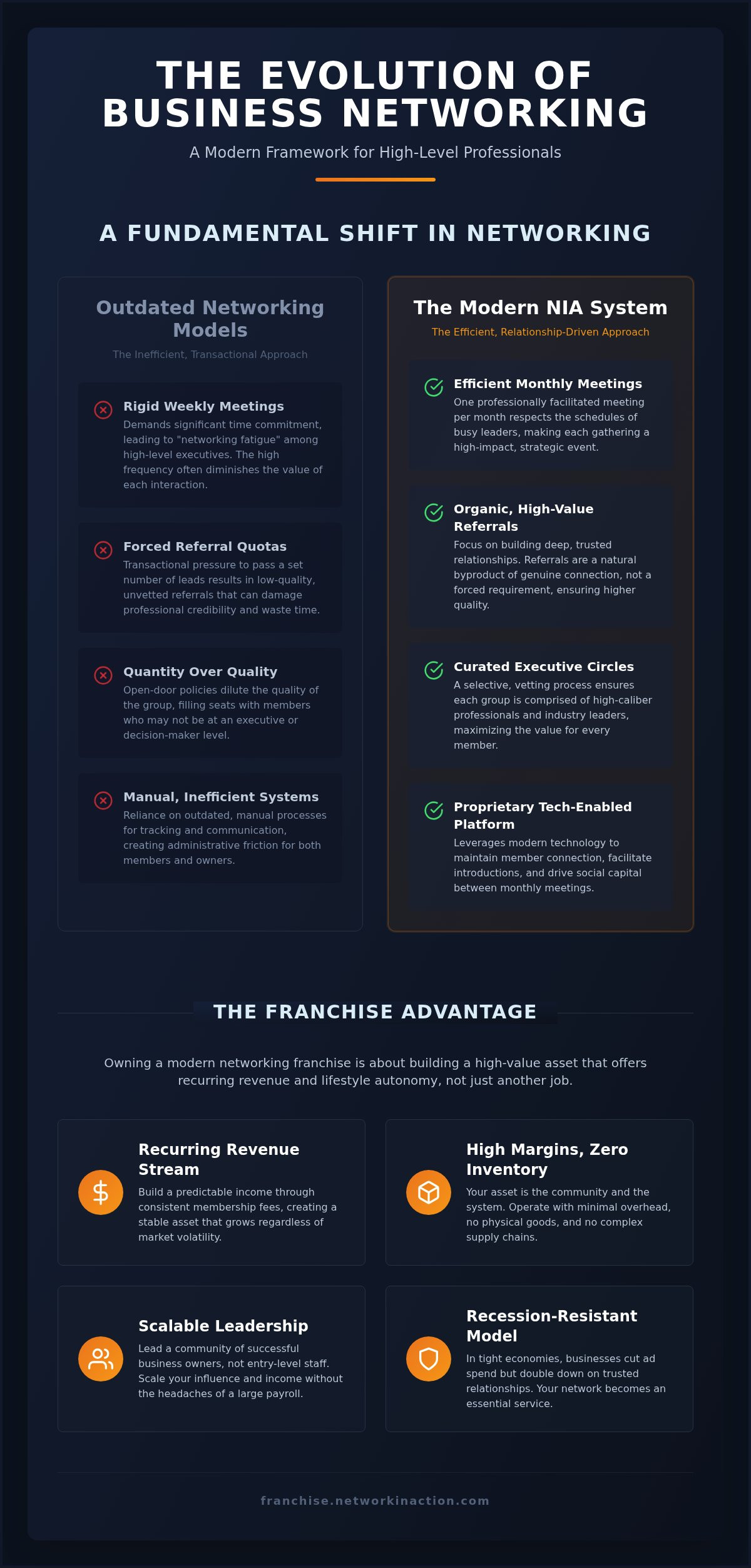
Selecting a business asset requires a ruthless evaluation of the "time-cost" involved. The best networking franchises distinguish themselves by how they value your schedule. Legacy networking organizations often trap owners in a relentless cycle of weekly meetings. This high-frequency model creates "networking fatigue" among the very executives you want to attract. It's a rigid, manual approach that feels out of place in a tech-driven economy. Modern systems replace this friction with monthly efficiency, allowing you to lead a high-prestige community without sacrificing your calendar.
Quantity rarely equals quality. Many outdated networking models rely on the "forced referral" fallacy, demanding a specific number of leads per week. This transactional pressure leads to low-value referrals that waste everyone's time. While Networking for referrals remains a foundational principle in the industry, the execution has evolved. Modern groups prioritize curated executive circles where referrals are organic and high-value. Technology integration further separates the leaders from the laggards. While legacy brands rely on manual tracking and paper slips, elite systems use automated platforms to facilitate 24/7 connection. You can check available territories to see where this modern, tech-enabled model is currently expanding.
The Limitations of Legacy Networking Organizations
Legacy networking organizations are built on rigid, decades-old frameworks. They prioritize high-volume, low-value referral quotas that alienate mid-sized business owners. These professionals don't have time for a "breakfast club" atmosphere. They need efficiency. Rigid rules and mandatory weekly attendance create a high-pressure sales environment that feels transactional rather than relationship-driven. This failure to adapt to modern executive needs leaves a significant gap in the market for more sophisticated alternatives.
The Modern Alternative: Results-Driven Professional Groups
Informed disruption has arrived. Results-driven professional groups utilize a monthly meeting cadence that respects the schedules of high-level leaders. This frequency maintains momentum without the burnout associated with weekly grinds. Curated memberships ensure that every referral has a higher average value, focusing on quality over sheer volume. By positioning yourself as the leader of an elite circle, you build a prestigious asset that attracts the top tier of your local market. The best networking franchises in 2026 are those that leverage technology to drive engagement between these monthly sessions, ensuring that social capital continues to grow even when the group isn't physically in the room.
Calculating the ROI: Recurring Revenue and Lifestyle Autonomy
Return on investment is often viewed through a narrow lens of initial capital versus annual profit. For the modern executive, the true measure of a high-ROI business is the ratio of income to time spent. The best networking franchises excel here by utilizing a recurring revenue model that decouples your earning potential from your hourly labor. You build a community once and benefit from consistent monthly dues. This royalty-based structure ensures that as your membership grows, your profit margins expand without a linear increase in operational complexity.
Scalability is the engine of long-term wealth. In a networking franchise, adding a second or third territory doesn't require doubling your staff or renting more office space. You're leveraging a proven system and high-quality social capital. When you're ready to move on, a mature networking group functions as a sellable asset. Unlike a solo consulting practice that disappears when you stop working, a franchise territory has a clear resale value based on its predictable cash flow and established member base.
The Economics of Membership-Based Businesses
Predictable cash flow is the holy grail of entrepreneurship. The monthly subscription model provides a financial floor that traditional service businesses lack. To maximize your returns, you must understand how to spot franchise trends that prioritize member retention. High retention is driven by referral ROI. When members see a clear financial gain from their participation, they remain committed. You can Calculate Your ROI: NIA Franchise Economics to see how these membership dynamics translate into a sustainable business model.
Autonomy and Time Freedom for Franchise Owners
Time freedom is the ultimate luxury. Many former C-suite executives and consultants are drawn to this model because it allows them to maintain an executive income on part-time hours. It's entirely possible to manage your groups in approximately 20 hours a month. This isn't a 9-to-5 grind. It's a leadership role. Tech-enabled tools allow you to lead from anywhere, whether you're at home or traveling. This flexibility is a direct response to the rigid requirements of legacy networking organizations. You aren't just buying a job. You're investing in a lifestyle that values results over activity.
Strategic Factors for Launching a Successful Referral-Based Territory
Success in this industry requires a combination of geographic precision and social authority. While traditional networking models often leave owners to fend for themselves with outdated manuals, the best networking franchises provide a data-driven roadmap. You must identify high-density business corridors where mid-sized firms are concentrated. These are the engines of local economies. By focusing on professional diversity rather than just volume, you create a more robust referral ecosystem. Credibility is your primary currency. Building a "Founding Group" isn't about filling seats; it's about curating a circle of influence. Your first 20 members set the tone for the entire territory. If you recruit high-level leaders, others will follow. This relationship-driven growth is far more effective than traditional advertising. It creates a self-sustaining cycle of prestige and profit. You should examine the modern launch blueprint to understand how to dominate your local market from day one.
Assessing Local Market Potential
Identifying the right territory involves more than just a map. You need to look for "referral gaps" where local professionals are underserved by legacy networking organizations. These gaps exist where busy executives are tired of weekly grinds and low-value meetings. Analyzing business density and professional diversity allows you to pinpoint where a more sophisticated model will thrive. You can Explore Available NIA Territories to find regions with the highest density of professional service providers and small-to-mid-sized business owners ready for a superior alternative.
The 90-Day Launch Framework
A world-class franchisor provides a structured 90-day framework to establish your authority. This period focuses on recruiting your initial high-level members through strategic introductions rather than cold prospecting. You aren't just a franchise owner; you're the architect of a new business community. Training and support should focus on leveraging proprietary technology to maintain 24/7 connectivity. This ensures that your group remains engaged even between physical meetings. This tech-forward approach separates modern systems from manual predecessors. By the end of this launch phase, you will have established yourself as the local authority in networking, positioning your franchise for long-term scalability and recurring revenue.
Network In Action: Leading the Shift to Tech-Enabled Business Communities
Traditional networking is a relic. Legacy networking organizations rely on manual processes that fail the modern executive. Network In Action (NIA) represents the informed disruption of an industry that remained stagnant for decades. By integrating proprietary technology with a results-driven philosophy, NIA has scaled to 150+ locations globally. You aren't just buying into a brand; you're joining a tech-enabled movement that prioritizes measurable social capital. This is why NIA is consistently recognized among the best networking franchises for those who value efficiency and professional prestige.
The monthly meeting model is a deliberate choice. High-level leaders don't have time for weekly rituals. Less is more. By meeting once a month, NIA maintains a premium atmosphere where every interaction is high-stakes and high-value. This structure allows you to build a prestigious community while maintaining total lifestyle autonomy. You lead the group. The system does the heavy lifting. For professionals vetting the best networking franchises, the focus must be on systems that solve the time-poverty of the executive class. Comprehensive training ensures that from corporate onboarding to territory reservation, you have the tools to succeed. The support is relentless. The results are predictable.
The NIA Differentiator: Technology Meets Tradition
Social capital requires constant cultivation. The NIA platform automates referral tracking and reporting, keeping members connected 24/7. This tech-forward approach is a massive differentiator. It attracts younger, modern entrepreneurs who expect efficiency. Manual tracking is for the past. Automated systems are for the future. You can Download the NIA Franchise Kit to see the specific digital tools that drive member engagement and retention. This technology bridges the gap between monthly meetings, ensuring the referral engine never stops turning. It’s a sophisticated solution for a traditionally manual industry.
Leadership and Community Impact
You aren't just a business owner. You're a strategic partner to every small business owner in your territory. Owning the modern evolution of networking grants you immediate professional prestige. You become the gatekeeper of high-quality connections. This role offers more than just recurring revenue; it provides a platform for meaningful community impact. You lead. You connect. You grow. If you're ready to trade the corporate grind for strategic leadership, taking the next step is simple. Schedule a discovery call with NIA to explore how this model aligns with your goals for 2026. The shift has already begun. It's time to secure your territory.
Lead the Evolution of Professional Networking
The shift toward relationship-driven assets is undeniable. You've seen how modern, tech-enabled systems solve the inherent flaws of legacy networking organizations. Choosing the right path means prioritizing your time and social capital. The best networking franchises in 2026 are those that replace the weekly grind with executive-level efficiency and predictable, recurring revenue. High margins. Low overhead. Elite influence. With over 150 successful locations worldwide and a proprietary technology platform, the infrastructure for your success is ready.
You can now trade the corporate treadmill for a model that values lifestyle autonomy. The monthly meeting model ensures you lead a community of high-level professionals without sacrificing your schedule. It's time to move beyond the rigid, transactional methods of the past. Align yourself with a system that views networking as a sophisticated business asset rather than a manual chore. Your influence is your most valuable asset. Invest it where the returns are measurable and the impact is lasting.
Secure Your Territory and Lead Your Local Business Community
Frequently Asked Questions
What makes a networking franchise better than a traditional business?
A networking franchise excels because it operates as a high-margin, relationship-based asset with minimal overhead. Unlike traditional service businesses that require massive payrolls and physical inventory, this model focuses on social capital. You lead a community of professionals rather than managing entry-level staff. This structure makes it one of the best networking franchises for investors seeking a recession-resistant income stream that remains stable during market volatility.
How much time does it realistically take to manage a networking franchise?
Managing a territory typically requires approximately 20 hours of focused effort per month. This efficiency is achieved through a monthly meeting cadence rather than the exhausting weekly grind found in legacy networking organizations. You spend your time on high-value leadership and strategic growth instead of administrative minutiae. This streamlined approach allows you to maintain professional prestige while achieving significant time freedom and lifestyle autonomy.
Do I need a background in sales to be a successful franchise owner?
Success depends more on professional credibility and community leadership than a traditional sales background. You aren't cold prospecting; you're building a vetted circle of influence. High-level executives and consultants often thrive because they already understand the value of social capital. The system provides the framework for relationship-driven growth, allowing you to leverage your existing network to recruit high-quality members who value results over high-pressure sales tactics.
What is the difference between NIA and traditional networking organizations?
The primary differentiator lies in the meeting frequency and the quality of the membership. Traditional networking models often rely on rigid, weekly rituals and forced referral quotas that lead to low-value outcomes. NIA utilizes a monthly meeting structure and proprietary technology to facilitate 24/7 connection. There are no forced referrals. Instead, the focus is on curated executive circles where high-quality introductions happen organically within a tech-forward environment.
How does the technology platform help franchise owners?
The proprietary technology platform automates the administrative heavy lifting of referral tracking and reporting. It serves as a digital bridge between monthly meetings, ensuring that your members remain engaged and connected around the clock. By moving away from the manual processes used by legacy networking organizations, you provide a modern experience that appeals to tech-savvy entrepreneurs. This automation allows you to scale your business without a linear increase in workload.
Can I own a networking franchise while maintaining another job?
Many owners successfully manage their territories while maintaining other professional commitments or consulting practices. The monthly meeting model is specifically designed for busy leaders who cannot commit to the weekly demands of outdated networking models. Because the business is home-based and technology-led, you have the flexibility to lead from anywhere. This makes it an ideal lifestyle franchise for those seeking to diversify their income without a 9-to-5 desk requirement.
What kind of training and support do networking franchisors provide?
Franchisees receive comprehensive training that covers everything from initial corporate onboarding to territory reservation strategies. A structured 90-day launch framework helps you establish yourself as a local authority and recruit your founding members. Ongoing support includes access to corporate resources, brand equity, and a global network of over 150 successful locations. You are provided with a ready-to-use solution that includes all the digital tools necessary to manage your professional community effectively.
What is the typical ROI for a networking franchise territory?
ROI is measured through predictable, recurring revenue and the lifestyle ROI of a low-hours business model. Monthly royalty structures and subscription-based memberships provide a stable financial floor that traditional businesses lack. As you build your groups, your profit margins expand because there is no added overhead for new members. This scalability, combined with the potential resale value of a mature networking territory, offers a strategic path to long-term wealth and time freedom.